• Following Us

  • Categories

  • Check out the Archives


  • Awards & Nominations

Mike W. Barr and Gordon Purcell’s Run on Star Trek: Deep Space Nine (Malibu Comics) (Review/Retrospective)

The September and October, we’re taking a look at the jam-packed 1994 to 1995 season of Star Trek, including Star Trek: Deep Space Nine and Star Trek: Voyager. Check back daily for the latest review.

The nineties comic book market was an interesting place. It enjoyed a huge boost due to the rise of speculation and collectors. The industry was massively successful in the early years of the decade, fuelled by high-profile artists, hype, and events. The industry imploded in on itself in the middle and towards the end of the decade, but it looked surprisingly profitable in the early years. Against that backdrop, Malibu Comics emerged.

Malibu had become the publisher of record for Image Comics in 1992. Image had been founded by a number of popular artists who had departed Marvel to set up their own shop and found their own company. Malibu distributed their comics for about a year, which gave Malibu access to a larger distribution platform. Although Image soon grew strong enough to publish its own comics, there was a point where Malibu had surpassed industry veteran DC Comics in the market place.
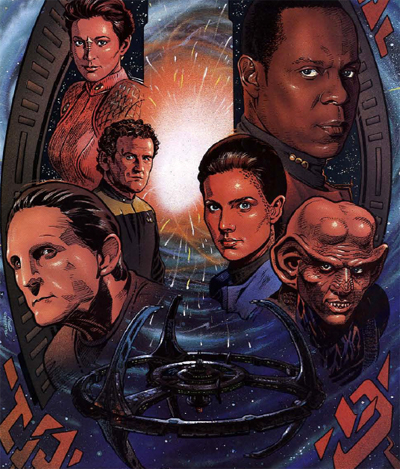
"Think of it—five months ago no one had ever heard of Bajor or Deep Space Nine. Now all our hopes rest here."

“Think of it—five months ago no one had ever heard of Bajor or Deep Space Nine. Now all our hopes rest here.”

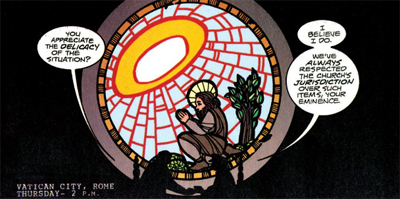
Against this backdrop, Malibu secured the rights to publish comic books based on Star Trek: Deep Space Nine. Up until this point, DC comics had been publishing comics based on the original Star Trek and Star Trek: The Next Generation. Paramount’s decision to award the Deep Space Nine license to Malibu effectively split the comic book license up. DC Comics continued to publish comics based around the first two Star Trek shows, while Malibu had exclusive rights to the characters and world of Deep Space Nine.

As such, the decision to recruit writer Mike W. Barr and artist Gordon Purcell to write the first six issues of the comic was a pretty big deal. Barr and Purcell were incredibly associated with Star Trek comic books. The duo had done popular work on the movie-era comics, and had demonstrated an obvious and abiding affection for the franchise. Assigning these two creators to work on Deep Space Nine was a very clear message. Malibu were taking this license very seriously, indeed.

Triptych...

Triptych…

Continue reading

The X-Files (Topps) – Trick of the Light (Review)

This August (and a little of September), we’re taking a trip back in time to review the second season of The X-Files. In November, we’ll be looking at the third season. And maybe more.

The X-Files tie-in comic book was a massive success for Topps. It’s interesting to note the amount of cross-promotion that went into the comic. Factoring in short stories and tie-ins and annuals and other obligations, the output from writer Stefan Petrucha and Charles Adlard was nothing short of astounding. Topps worked very hard to promote the book, an approach that paid off – the comic would frequently appear in Diamond’s top 100 and was the publisher’s most successful monthly book.

Trick of the Light was a short twelve-page comic that was published as part of the The X-Files/Hero Illustrated Special, featuring an interview with Petrucha and packaged with Hero Illustrated #22 in March 1995. It was something of a glorified advertising gimmick, but one that demonstrates the popularity of the comic in question.

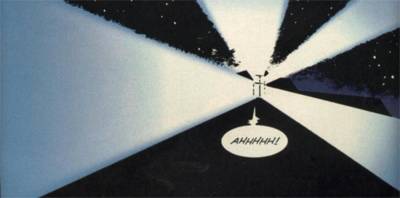
Don't go into the light!

Don’t go into the light!

Continue reading

The X-Files (Topps) #2 – A Dismembrance of Things Past (Review)

This August (and a little of September), we’re taking a trip back in time to review the second season of The X-Files. In November, we’ll be looking at the third season. And maybe more.

A Dismembrance of Things Past is an absolute delight, and a nice demonstration of how well writer Stefan Petrucha and Charles Adlard could tell stories set within The X-Files universe.

There are many interesting things about A Dismembrance of Things Past. It’s a fine piece of work, deftly balancing the demands on a new comic book set within the world of The X-Files with an urge to tell a story that fits very clearly and very comfortably within the show’s basic structure. It is easy to imagine A Dismembrance of Things Past receiving a live-action adaptation. Indeed, Petrucha’s script feels like something of a tribute to writer Darin Morgan before Darin Morgan had even written for the show, half-way between Blood and Jose Chung’s “From Outer Space.”

Something to remember them by...

Something to remember them by…

A Dismembrance of Things Past confronts the difficulties of writing a tie-in comic book to The X-Files, while using those constraints to tell an interesting story in its own right. After all, the comic book would have to tell an alien or U.F.O. story eventually. The words “The X-Files” are written on the cover, and that comes with the territory. At the same time, Petrucha and Adlard have to acknowledge the fact that the tie-in comic book cannot advance the on-screen mythology arc. Indeed, it seems unlikely Carter had shared too much of that arc with Petrucha or Adlard.

It takes a lot of skill to balance these competing demands of a tie-in comic book – to remain connected to the source material, but never pulling too far away or ahead, while remaining interesting. A Dismembrance of Things Past manages to satisfy all of its obligations and then some.

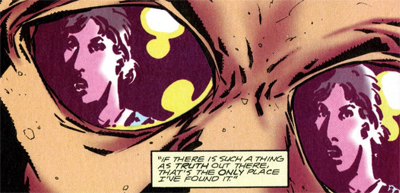
Through alien eyes...

Through alien eyes…

Continue reading

The X-Files (Topps) #1 – Not To Be Opened Until X-Mas (Review)

This August (and a little of September), we’re taking a trip back in time to review the second season of The X-Files. In November, we’ll be looking at the third season. And maybe more.

If you needed proof that The X-Files had made it, then the forty-issue Topps comic book series from the mid-nineties seems a place to start. Of course, this has less to do with the stories published in the comics themselves – though some are very interesting – and more to do with the comic book market in the nineties and the business model employed by Topps. The comic book industry was perhaps at its peak in the nineties – at least when it came to exposure and public profile.

Chris Claremont and Jim Lee’s X-Men #1 became the biggest-selling comic book of all time in 1991, selling over eight million copies. A year later, DC Comics published The Death of Superman, a sprawling highly-publicised comic book event that killed off (and then revived) the Man of Steel. The year after that, Batman got in on the action with the Knightfall trilogy, a suitably spectacular event that featured the crippling of Bruce Wayne, his replacement as Batman, and the eventual return of the Caped Crusader.

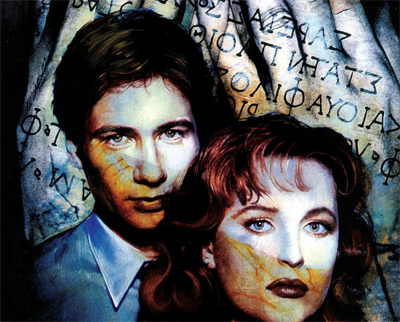
The truth is in here?

The truth is in here?

It is important to put those figures in perspective. While this was a financial peak for the comic book industry, it was still something of a fringe economy. In the mid-nineties, a television show attracting only eight million viewers would find itself on the bubble line when it came to renewal. However, that figure was the largest readership of any comic book ever. (Audience diversification means that both television audiences and comic book readers have dwindled in the years since, but the latter much more than the former.)

However, the business model for comic books in the nineties made them highly profitable, despite their smaller audience. Price gouging was not uncommon, with some retailers charging as much as $30 for Superman #75 in 1992. Poly bags, gimmick covers, variant artwork, celebrity authors – comics were largely driven by gimmicks in the nineties. More than that, the emphasis on comic books as an investment in the mainstream media helped to suggest the industry was more for collectors than for readers.

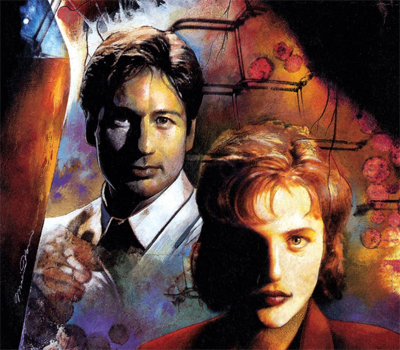
Holy conspiracy, Mulder!

Holy conspiracy, Mulder!

It is telling that the company to land the license for The X-Files was Topps, a company famous for producing sports memorabilia. The company had branched into comics in 1993, as the industry was growing and growing, hoping to license various characters and properties. The implication was that The X-Files comic had been designed more as an accessory than as a story. The cover to Not To Be Opened Until X-Mas ever features a handy “first collectors item issue” tag below the “1” at the top left-hand corner.

Licensed comic books have something of a chequered history. In the context of the mid-nineties, it would be easy to write off the forty-one issues (and change) of The X-Files as a cynical cash-in. However, the series has moments of brilliance and insight that mark it as a worth extension of the brand name.

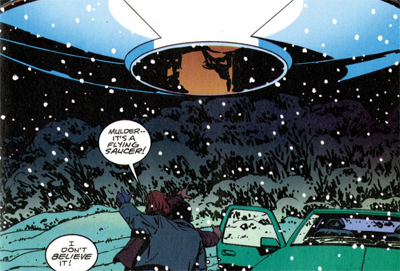
Up in the sky!

Up in the sky!

Continue reading

Batman – Arkham Asylum: Living Hell (Review/Retrospective)

23rd July is Batman Day, celebrating the character’s 75th anniversary. To celebrate, this July we’re taking a look at some new and classic Batman (and Batman related) stories. Check back daily for the latest review.

There is something absolutely compelling about witnessing the surreal and the impossible through the eyes of ordinary people. In the middle of the first decade of the twentieth century, DC seemed to take a novel approach to the larger Batman mythos. Acknowledging the absurdity of the world inhabited by the Caped Crusader, comic book fans were asked to look at that strange world from the perspective of the ordinary people inhabiting it.

Greg Rucka, Ed Brubaker and Michael Lark all collaborated on Gotham Central, the wonderful police procedural that offered a new way of examining the streets of Gotham. As observed by the members of the Gotham Police Department’s Major Crimes Unit, Gotham’s population of heroes and villains seemed particularly unsettling and ethereal. It is one thing to imagine the weird and wonderful world inhabited by the Batman and the Joker and the Mad Hatter. It is another to imagine sharing that world.

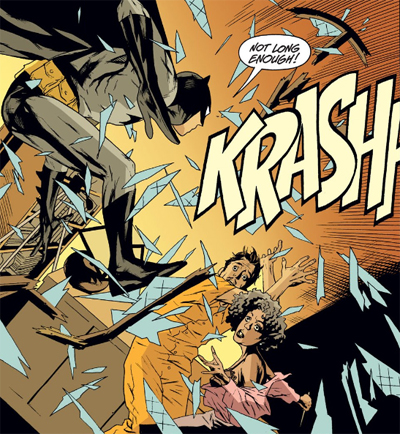
He knows how to make an entrance...

He knows how to make an entrance…

Launched a few months after the first issue of Gotham Central, Dan Slott and Ryan Sook’s wonderful Arkham Asylum: Living Hell is a six-issue miniseries that invites the reader inside the eponymous institution. As glimpsed through the eyes of white-collar criminal Warren White, Arkham Asylum is a place that defies explanation – a macabre and horrific environment that is home to all sorts of depravity and brutality.

Batman himself barely appears in Arkham Asylum: Living Hell, existing at the fringes of the book as he does with Gotham Central. However, despite these limited appearances, it remains clear that Warren White has found his way to the other side of the looking glass.

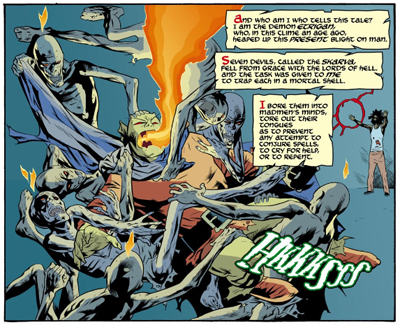
We all face our demons...

We all face our demons…

Continue reading

Mike W. Barr and Alan Davis’ Run on Detective Comics (Review/Retrospective)

23rd July is Batman Day, celebrating the character’s 75th anniversary. To celebrate, this July we’re taking a look at some new and classic Batman (and Batman related) stories. Check back daily for the latest review.

When DC comics published Crisis on Infinite Earths, it was a brave new world. Everything was new again. Nothing could be taken for granted. The company had the opportunity to start again with its characters and properties, offering a new beginning to iconic heroes that would hopefully welcome new readers while learning from prior successes and past failures. It was an exciting time in the industry, one bristling with potential.

In many respects, the defining Batman story in the immediate aftermath of Crisis on Infinite Earths was Batman: Year One. Even today, Year One remains a foundational text for Batman, one of the best (and most influential) stories ever told using the character. It defined Batman for the eighties and nineties, and beyond. Frank Miller offered readers a new and updated origin for the Caped Crusader that teased a new way of looking at Gotham City and its inhabitants.

"It's a trap!"

“It’s a trap!”

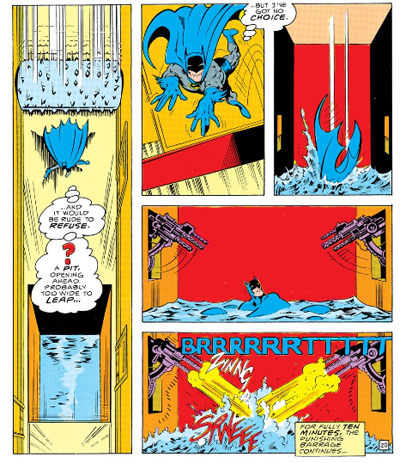
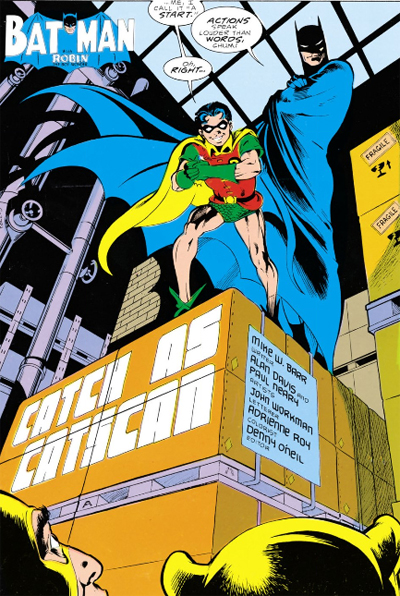
Meanwhile, a more quiet revolution was in progress over on Detective Comics. Writer Mike W. Barr and Alan Davis began their run on Detective Comics in the immediate aftermath of the now-all-but-forgotten Legends crossover. Although the duo were lucky enough to work on the book over the fiftieth anniversary of Detective Comics, their work was somewhat overshadowed by the publication of Year One in their sister publication – to the point that their run culminates in Year Two, a sequel to Year One.

Still, while it never got the attention that it deserved, Barr and Davis did a lot to offer an alternative to Miller’s gritty and grounded reimagining. Featuring death traps and puns and brainwashing and dodgy jokes, Barr and Davis seem almost subversive. It is as if the duo are working hard to import all the stuff that might otherwise be washed away by Crisis on Infinite Earths, reminding readers that with world of Batman has always been absurd, and that is not necessarily a bad thing.

Talk about making an entrance...

Talk about making an entrance…

Continue reading

Mark Waid’s Run on Justice League of America – Tower of Babel (Review/Retrospective)

23rd July is Batman Day, celebrating the character’s 75th anniversary. To celebrate, this July we’re taking a look at some new and classic Batman (and Batman related) stories. Check back daily for the latest review.

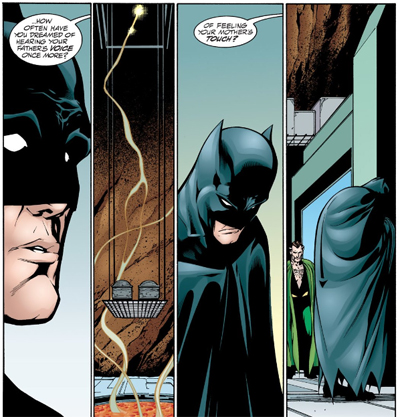
Although actually published in 2000, Tower of Babel is the third definitive Batman story of the nineties. Running only four issues instead of a massive sprawling crossover across an entire line of comic books, Tower of Babel is certainly more condensed than either Knightfall or No Man’s Land, hitting on many of the same themes and concepts. It is very much constructed as a cautionary tale – a warning about taking a particularly cynical approach to Batman to its logical extreme.

Due to his stand-off-ish nature, the nineties iteration of Batman is sometimes affectionately (or not so affectionately) referred to a “Batjerk.” This version of the character has a wonderful knack of pushing his friends and allies away, making enemies, and escalating problems due to arrogance and ego. In many respects, Tower of Babel is a quintessential “Batjerk” story, where Batman’s anti-social tendencies lead to the humiliation and defeat of the entire Justice League using his own plans.

The last temptation of Batman...

The last temptation of Batman…

Continue reading

Star Trek V: The Final Frontier (DC Comics, 1989) (Review)

This June, we’re taking a look at some classic Star Trek movie tie-ins and other interesting objects. Check back daily for the latest reviews and retrospectives.

In many respects, the late eighties represented a changing of the guard when it came to Star Trek. The feature films had been relatively serialised. The events of Star Trek II: The Wrath of Khan led into the events of Star Trek III: The Search for Spock, which itself led directly into the events of Star Trek IV: The Voyage Home. At the same time, the expanded universe was generally left free to its own devices. Novelists and writers were given the freedom to do whatever they wanted.

In the late eighties, things changed. Directed by William Shatner, Star Trek V: The Final Frontier stood quite clearly apart from the events of the last three Star Trek films. At the same time, the franchise had found its way back to weekly television in the form of Star Trek: The Next Generation. Whereas comic books and novels had served to fill a gap when there was a scarcity of “official” Star Trek material, they were now very clearly of secondary importance to the “real” (or simply “live action”) versions of Star Trek.

Oh your God...

Oh your God…

There was a rather seismic shift in the nature and tone of tie-ins and adaptations. Rather notably, the creators who had adapted the last couple of films into prose and comic book form did not return to translate The Final Frontier across different media. Vonda McIntyre had written the novelisations of the last three Star Trek films, but was replaced by J.M. Dillard. Mike W. Barr and Tom Sutton had produced the comic book adaptations of the last two Star Trek films, but were replaced by Peter David and James W. Fry. Both Dillard and David would find themselves tasked with adaptation of Star Trek VI: The Undiscovered Country.

Peter David and James W. Fry’s adaptation of The Final Frontier is clearly intended as a launchpad for their new on-going Star Trek series that would debut only a few months later. Indeed, the final page of The Final Frontier includes an advertisement for that new series. In many respects, this adaptation of The Final Frontier seems to serve as a pilot for a new comic book series, a starting point for a bold new beginning to DC’s Star Trek line. Opening with the The Final Frontier, you might be forgiven for assuming it was doomed from the outset.

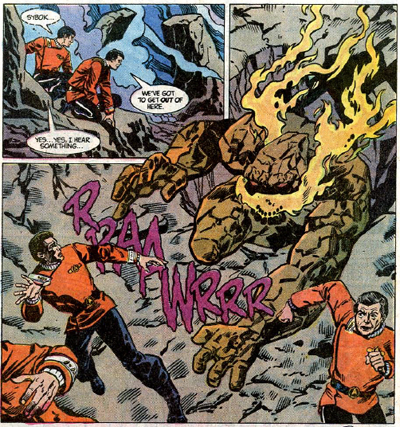
Here there be rock monsters...

Here there be rock monsters…

Continue reading

Star Trek: Khan – Ruling in Hell (Review)

This June, we’re taking a look at some classic Star Trek movie tie-ins and other interesting objects. Check back daily for the latest reviews and retrospectives.

Khan is a massively important figure in the grand mythology of Star Trek.

One need only look to Star Trek Into Darkness as proof of that assertion – a film that trades on how iconic the name “Khan” is, even to the most casual of fans. However, despite the fact that Khan has only appeared in a single episode and two feature films, each spaced apart by more than a decade, the character continues to exert a strong pull over the rest of the franchise. He is arguably more iconic and well-known than any lead character from a show produced after Star Trek: The Next Generation.

War of the supermen...

War of the supermen…

After all, Khan’s influence can be felt on just about every iteration of the franchise. On Star Trek: Deep Space Nine, he haunted the character of Julian Bashir. When the fourth season of Star Trek: Enterprise began its high-profile journey into the franchise’s continuity, Khan became something of a touchstone. The season’s first three-part episode (Borderland, Cold Station 12 and The Augments) was devoted to exploring the legacy of Khan Noonien Singh. Indeed, the show even tied Khan into the origin of the flat-foreheaded Klingons in Affliction and Divergence.

And yet, despite all this, there really is only so much material the character can support. Khan Noonien Singh is an iconic bad guy, but there’s a point where he ends up over-saturated.

The sands of time...

The sands of time…

Continue reading

Star Trek II: The Wrath of Khan (IDW, 2009) #1-3 (Review)

This June, we’re taking a look at some classic Star Trek movie tie-ins and other interesting objects. Check back daily for the latest reviews and retrospectives.

Due to bad timing, the Star Trek comic book license was between publishers when Star Trek II: The Wrath of Khan was released into cinemas in 1982. As the license transitioned between Marvel and DC, the movie adaptation got lost in the shuffle. As a result, the film was the only classic Star Trek film without a contemporary comic book adaptation. It remained that way for over a quarter of a century.

However, on the release of JJ Abrams’ rebooted Star Trek, current license holder IDW decided to release an omnibus of the classic movie adaptations as a tie-in. In doing so, they discovered a Wrath-of-Khan-sized hole in the collection, and so set about filling it with a three-issue miniseries that could be included in the omnibus for completeness’ sake.

Stationary orbit...

Stationary orbit…

Continue reading