• Following Us

  • Categories

  • Check out the Archives


  • Awards & Nominations

Mark Waid, Ian Churchill and Ken Lashley’s Deadpool – Sins of the Past (Review/Retrospective)

This May, to celebrate the release of X-Men: Days of Future Past, we’re taking a look at some classic and modern X-Men (and X-Men-related) comics. Check back daily for the latest review.

It’s interesting to try to chart the meteoric rise of Deadpool. Over the past decade, Deadpool has emerged as one of Marvel’s most popular comic book characters. He features in various miniseries and variant covers, populated quite a few books from month-to-month. While his exposure hasn’t quite reached the same level as that of Spider-Man or Wolverine, Deadpool is easily one of the most frequently-appearing characters in Marvel Comics.

It is strange to think that he is a relatively young character, originating in Rob Liefeld’s New Mutants shortly before it became X-Force. First appearing in February 1991, Rob Liefeld created Deadpool as a decidedly nineties character – “the merc with the mouth”,  he felt like a conscious composite of Spider-Man with more outrageous villains (or anti-heroes) like Deathstroke. Indeed, the similarity is something of a cheesy joke. Where might one practise their Deathstroke? In the Deadpool, of course.
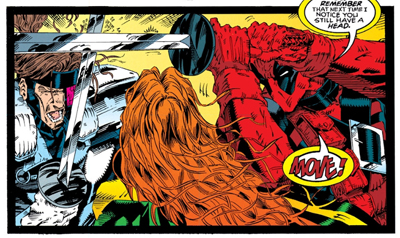
Crossing swords...

Crossing swords…

Liefeld created a cheesy and hyperactive foe for his mutant characters, allowing the character all manner of cheesy and awkward one-liners. However, that version of Deadpool is almost unrecognisable when compared to the character as he exists today. The modern version of Deadpool is a character aware of his own fictional nature, with dialogue balloons painted yellow to distinguish him from the less self-aware characters around him.

Today’s Deadpool is more of a comedy force of nature than a serious anti-hero, a character basking in the absurd rather than trying to appear badass. It’s interesting to wonder how that character transformed so radically (and so thoroughly). Certainly, his first solo miniseries seems to occupy the strange space between Rob Liefeld’s half-serious mercenary psychopath and Joe Kelly’s comic book comic. While still a little too steeped in nineties aesthetic for its own good, Mark Waid’s Deadpool is a small step in that direction.
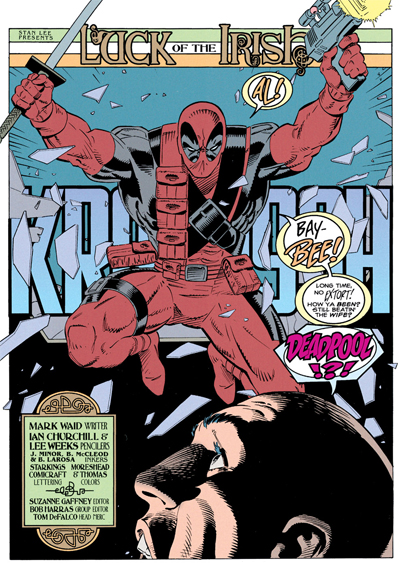
Well, at least he knows how to make an entrance...

Well, at least he knows how to make an entrance…

Continue reading

X-Men – Battle of the Atom (Review)

This May, to celebrate the release of X-Men: Days of Future Past, we’re taking a look at some classic and modern X-Men (and X-Men-related) comics. Check back daily for the latest review.

Battle of the Atom is a gigantic mess – but it’s a very fun gigantic mess.

Battle of the Atom seems to exist to fill two separate niches. On the one hand, its publication syncs up rather nicely with the fiftieth anniversary of Marvel’s merry mutants – something that the comic acknowledges by focusing on Stan Lee and Jack Kirby’s original creations and by setting the climax at a recognisable setting from that first issue all those years ago. There’s a palpable sense of nostalgia about the whole thing – focusing on the past, present and future of the superhero team.

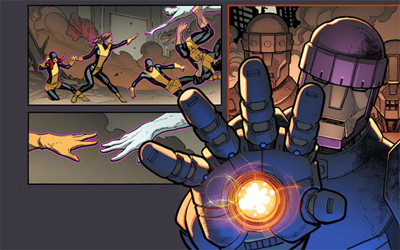
Stop or my Sentinel will shoot...

Stop or my Sentinel will shoot…

At the same time, it’s the big X-Men crossover event published half-a-year before the release of a multi-million dollar Bryan Singer motion picture. As such, Battle of the Atom feels heavily influenced by X-Men: Days of Future Past. Not only does it play with a variety of the tropes and conventions cemented by that classic Chris Claremont and John Byrne story, it includes numerous shout-outs and even the same basic structure.

Writers Brian Michael Bendis, Brian Wood and Jason Aaron are all having a great deal of fun writing Battle of the Atom, even if the comic does occasionally feel a little bit too light or too familiar. Then again, what’s the point in a fiftieth birthday party if you can’t be a little indulgent?

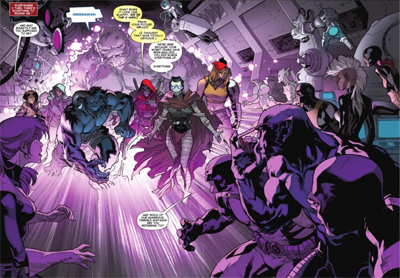
Dazed by X-Men past...

Dazed by X-Men past…

Continue reading

Todd McFarlane’s Run on Spider-Man (Review/Retrospective)

This April, to celebrate the release of The Amazing Spider-Man 2, we are taking a look at some classic and modern comics featuring Spider-Man (and friends). Check back daily for the latest review.

Todd McFarlane is undoubtedly one of the best artists ever to work on Spider-Man. His take on the character is iconic and influential. He really captures the sense of Spider-Man as a character who should be unnerving or disturbing – a character who is part insect, whose limbs are able to bend and contort in ways that would seem unnatural to a casual observer. His run on The Amazing Spider-Man with writer David Michelinie is one of the most underrated Spider-Man comics ever produced.

McFarlane was working at Marvel around the time that the company was investing more power in its artists. More and more, artists were becoming more essential to the creative process – whether credited as “plotters” or “writers.” Jim Lee was wresting control of the X-Men franchise from veteran writer Chris Claremont. Rob Liefeld was writing and drawing on his popular X-Force, launched from New Mutants.

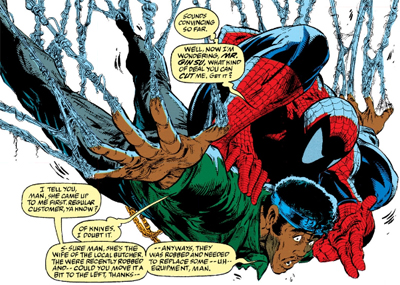
Holding it together...

Holding it together…

In this context, it made sense to allow Todd McFarlane to branch out and write his own Spider-Man title. Launched to run alongside The Amazing Spider-Man, McFarlane’s adjectiveless Spider-Man remains one of the comic book success stories of the nineties, selling 2.5 million copied on initial release. It remains one of the best selling comic books of all time, with the original artwork recently selling for over $675,000.

As with many of its contemporary artist-drive series, McFarlane’s Spider-Man is a compelling read. It’s a glimpse inside the mindset of the comic book industry, a snapshot of trends that were still developing. McFarlane’s writing might be a little over-cooked, his plotting a little weak and he may not have the strongest sense of theme or structure. However, McFarlane’s artwork is absolutely spectacular, and there’s something very fascinating about McFarlane’s attempt to write Spider-Man as a horror comic starring the iconic web-slinger.

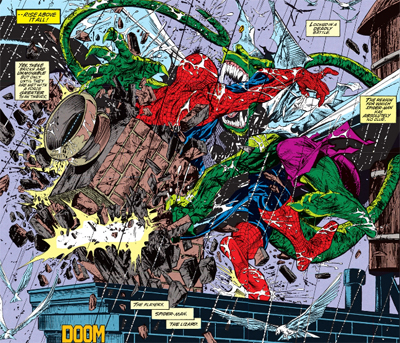
A sting in the tale...

A sting in the tale…

Continue reading

Red Skull: Incarnate (Review/Retrospective)

This March, to celebrate the release of Captain America: The Winter Soldier, we’ll be taking a look at some classic and not-so-classic Avengers comic books. Check back daily for the latest updates!

Incarnate is something of a companion piece to Greg Pak’s Testament. Testament was a miniseries following the life of a young boy named Erik during the Holocaust. Of course, Erik would grow up to become the supervillain known as Magneto, but Pak was more fascinated in the history surrounding the character – his origins as a Holocaust survivor. The series was beautifully written and well received, prompting Marvel to hire Pak to produce a companion piece.

Incarnate is effectively the origin story of the Red Skull, Captain America’s arch-enemy and a character Pak himself describes in the afterword as “the Marvel Universe’s most evil villain.” Setting the story in late twenties and thirties Germany, Pak sets the character’s origins against the rise of Nazism and the decline of the Weimer Republic.

A slice of life...

A slice of life…

Continue reading

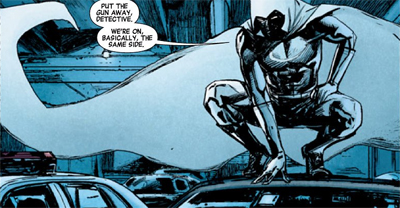
Brian Michael Bendis and Alex Maleev’s Moon Knight (Review/Retrospective)

This March, to celebrate the release of Captain America: The Winter Soldier, we’ll be taking a look at some classic and not-so-classic Avengers comic books. Check back daily for the latest updates!

One of the more endearing aspects of comic book publishing is the way that the “little guys” occasionally get a shot. There are mountains of titles published each month featuring iconic characters like Batman or Wolverine, but the major companies are occasionally willing to check chances on more quirky and unknown characters using top-tier talent. One of the big surprises of DC’s “new 52” relaunch was the decision to put superstar writer Geoff Johns on pop culture joke Aquaman.

Despite the fact that he has never quite set the world on fire, Marvel seems willing to invest in repeated attempts to launch the character of Moon Knight. Most recently, writer Warren Ellis has launched a new volume of the comic with artist Declan Shalvey. However, before the latest relaunch, Marvel tried another high-profile take on Moon Knight written by Brian Michael Bendis and illustrated by Alex Maleev, the duo responsible for one of the best-loved runs ever published on Daredevil.

The series made it to twelve issues, before Marvel cancelled it due to disappointing sales. Bendis has insisted that it was always the plan to end the series after twelve issues, but it seems strange that the series was not announced as a miniseries. Still, it’s easy to understand why Moon Knight struggled to find an audience. It’s great to have Bendis and Maleev crafting an on-going street-level comic book, but the series seems almost at war with itself, struggling with the difficulties of fitting this character in this particular role.

Oh what a knight...

Oh what a knight…

Continue reading

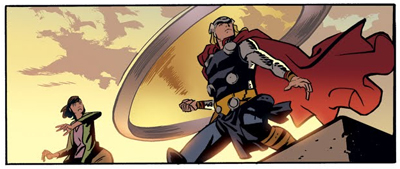
Roger Langridge & Chris Samnee’s Thor: The Mighty Avenger (Review)

This March, to celebrate the release of Captain America: The Winter Soldier, we’ll be taking a look at some classic and not-so-classic Avengers comic books. Check back daily for the latest updates!

There really aren’t enough all-ages friendly comic books, and there certainly aren’t enough comic books that you can pop into a curious stranger’s hands and say “hey! read this!” In this era of blockbuster movies and hit television shows based off comic book properties, you’d imagine that companies would be working hard to attract new fans, trying to make comics accessible and enjoyable to those with little experience of picking up a comic book or graphic novel.

Thor: The Mighty Avenger is a wonderfully accessible piece of work that provides a brilliant introduction to Marvel’s take on the classic Norse God of Thunder. However, it remains a tragedy that this is one of very few efforts to provide such a comic, and also that Thor: The Mighty Avenger came to such an unceremonious end, cancelled after only eight issues.

Taking Thor for a spin...

Taking Thor for a spin…

Continue reading

Star Trek: The Next Generation (DC Comics, 1989) #19 – The Lesson (Review)

This January and February, we’ll be finishing up our look at the second season of Star Trek: The Next Generation and moving on to the third year of the show, both recently and lovingly remastered for high definition. Check back daily for the latest review.

We’ll be supplementing our coverage of the episodes with some additional materials – mainly novels and comics and films. This is one such entry.

One of the biggest problems that the writing staff had on Star Trek: The Next Generation was the insistence that the show was episodic. Themes and characters were rarely carried from week to week. Occasionally, a plot point or character might recur, but the bulk of the show was intentionally designed to be readily accessible in just about any order imaginable. In the era of HBO and “televisual novels”, this approach seems quite quaint, but it was very much the reality of late eighties and early nineties television.

However, there were no such restrictions on comic book story telling. Far from downplaying continuity and long-term plotting, mainstream American comics pride themselves on their serialised nature. It’s quite common for characters to suddenly reappear after absences of considerable time, and for writers to make callbacks to events that occurred decades ago. Publishing twelve issues a year, typically from the same author, The Next Generation comic book did afford the opportunity for a slightly different type of storytelling.

All set...

All set…

And, to be fair, that was one of the strengths of Michael Jan Friedman’s approach to The Next Generation comic book. He was fond of focusing on supporting characters, or giving page space to characterisation, or even basking in the show’s continuity in a way that wasn’t possible on television. Sure, Friedman could occasionally get a little obsessive in his continuity references, and could occasionally have difficulty tying everything into a cohesive story, but this was one way the author capitalised on the shift in the medium.

The Lesson is a single-issue story that is all the more intriguing for essentially existing as a series of character moments, with little in the way of an over-arching plot. The writing is a little clumsy and on-the-nose, with the comic earnestly offering its readers a rather ham-fisted message of the week, but it’s notable for the way that Friedman seems to bask in the freedom afforded to him by virtue of the fact that he’s writing a comic book (rather than an episode) of The Next Generation.

They've really bonded...

They’ve really bonded…

Continue reading

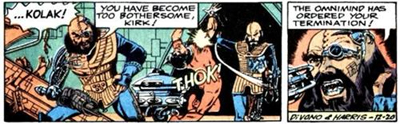
Star Trek: The Newspaper Strips – Beware the Omnimind! (aka Restructuring is Futile) (Review)

This January and February, we’ll be finishing up our look at the second season of Star Trek: The Next Generation and moving on to the third year of the show, both recently and lovingly remastered for high definition. Check back daily for the latest review.

We’ll be supplementing our coverage of the episodes with some additional materials – mainly novels and comics and films. This is one such entry.

As brilliant as the Borg were when they were introduced in Q Who?, they were hardly the most original of constructs. The cybernetic aliens went on to become one of the most iconic and recognisable pieces of Star Trek lore, featuring in the most popular Star Trek: The Next Generation feature film and all the subsequent spin-offs, but it’s tempting to give the Borg a bit more credit than they’re due.

After all, cybernetic organisms were hardly cutting edge in 1989. In fact, this wasn’t even the first time that Star Trek had told this kind of story. In late 1981, the Star Trek news paper strip that had begun as a companion piece to Star Trek: The Motion Picture, featured a similar adversary for Kirk’s Enterprise.

Resistance is futile!

Resistance is futile!

Continue reading

Star Trek: The Next Generation/Doctor Who – Assimilation² (Review)

This January and February, we’ll be finishing up our look at the second season of Star Trek: The Next Generation and moving on to the third year of the show, both recently and lovingly remastered for high definition. Check back daily for the latest review.

We’ll be supplementing our coverage of the episodes with some additional materials – mainly novels and comics and films. This is one such entry.

It’s amazing that Assimilation² represents the first official crossover between Star Trek and Doctor Who. After all, the nineties saw a trilogy of comics and novels in which Star Trek crossed over with Marvel’s X-Men. At the same time, though, the miniseries’ combination does seem a little odd. Pairing the Cybermen and the Borg is a bit of a no-brainer, but the Eleventh Doctor feels like a bit of a strange fit on board Picard’s Enterprise.

The Ninth or Tenth would arguably offer more of a contrast with Picard’s restrained and dignified command style. The Tenth Doctor and Donna arriving on the luxury Enterprise practically writes itself. (“Now that’s what I call a spaceship. You’ve got a box, they’ve got a Stella Liner.”) Picard and the Eleventh Doctor feels like a particularly bland pairing, if only because there’s no way they’d try each other’s patience. The Eleventh Doctor would probably work better in the context of Sisko’s Deep Space Nine or either Kirk’s Enterprise.

Still, although Assimilation² never quite takes full advantage of its central hook, it’s a diverting enough mish-mash of two science-fiction staples.

Cue Who?

Cue Who?

Continue reading

American Vampire, Vol. 1 (Review)

This October, to get us in the mood for Halloween, we’re taking a look at some awesome monster comics. Check back in every Monday this month for a review of Scott Snyder’s American Vampire Saga.

In the end, though, it’s all about giving back the teeth that the current “sweetie-vamp” craze has, by and large, stolen from the blood suckers.

– Stephen King’s introduction to the collection

Stephen King, who wrote the origin half of this collection based off Scott Snyder’s notes, remarks in his wonderful foreword, “Here’s what vampires shouldn’t be: pallid detectives who drink Bloody Marys and only work at night; lovelorn southern gentlement; anorexic teenage girls; boy-toys with big dewy eyes.” American Vampire seems to be a strong rebuttal to all those modern and soft depictions of the blood-sucking monsters we’ve been swamped with over the last decade or so.

If that isn’t enough to at least interest you, then I don’t know what will.

Ch-ch-ch-changes…

Continue reading