• Following Us

  • Categories

  • Check out the Archives


  • Awards & Nominations

The X-Files – Triangle (Review)

This July, we’re taking a trip back in time to review the sixth season of The X-Files and the third (and final) season of Millennium.

There are a lot of reasons to celebrate Triangle.

The episode gets a lot of attention for its wonderful use of long tracking shots. According to Chris Carter’s commentary, there are only twenty-four individual shots stitched together to produce the forty-five-minute episode. Considering the amount of split-screen action at the climax, that is not a lot. Triangle is an artistic tour de force for writer and director Chris Carter. The success that both Birdman and True Detective enjoyed in 2014 due to their extended takes suggests that Carter was significantly ahead of the curve.

Dragging up the past...

Dragging up the past…

There are other aspects to note. Triangle also ushers in a new mood and tone for the sixth season of The X-Files. The show had moved to Los Angeles, and would struggle with how to retain its identity in the new (and bright) surroundings of California. The Beginning and Drive had both answered the question in their own way, but Triangle ushers in a whole new approach to storytelling. Triangle is the first of a series of light and breezy episodes in the early stretch of the sixth season where The X-Files almost turns into a paranormal sitcom.

However, there is one other reason to celebrate Triangle. It is an extended forty-five minute pun on the word “ship.”

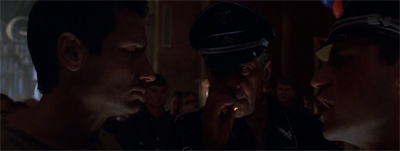
Cigarette-Smoking Nazi...

Cigarette-Smoking Nazi…

Continue reading

Millennium – TEOTWAWKI (Review)

This July, we’re taking a trip back in time to review the sixth season of The X-Files and the third (and final) season of Millennium.

The best thing that can be said about TEOTWAWKI is that it knocks quite a few items off Chris Carter’s “millennial anxieties” checklist – touching on issues of school shootings, gun control, Y2K, anarchy, survivalism, and a few more.

There are some good and interesting ideas in TEOTWAWKI. It is written by Chris Carter and Frank Spotnitz, the first script credited to either writer since the first season of the show. It seems like both writers were clearly thinking about Millennium while working on the fifth season of The X-Files, storing up ideas for late use. TEOTWAWKI is not a script suffering from a lack of ideas. In fact, it has too many ideas packed too tightly. The script isn’t particular graceful; none of the threads dovetail as neatly into one another as they really need to.

Blood money...

Blood money…

This is a recurring theme across the third season of Millennium. There are shows with interesting and compelling ideas, but they are mixed together in a way that doesn’t work – often mingling with some of the more unfortunate creative decisions driving the show. Episodes in the third season frequently feel like curate’s eggs – scrambled messes with good bits and bad bits that are ultimately impossible to separate. TEOTWAWKI might be an interesting mess, but it is still a mess.

TEOTWAWKI makes it clear that The Innocents and Exegesis were not a rough spell as Millennium tried to find its sea legs. This is the way that things will be going forward, at least for a while.

"Doomsday Defense" was a better read...

“Doomsday Defense” was a better read…

Continue reading

Millennium – The Innocents (Review)

This July, we’re taking a trip back in time to review the sixth season of The X-Files and the third (and final) season of Millennium.

So, how do you write your way out of the end of the world?

To be fair, it is not an easy assignment. The Fourth Horseman and The Time is Now are two spectacular pieces of television, but they arguably work better as a series finalé than a season finalé. Once Fox decided to renew Millennium for a third season, the biggest problem facing the staff was the challenge of writing around the apocalypse that had arrived at the end of the second season. It is a problem that hobbled the third season of Millennium coming out of the gate. However, it was not the only such problem.

Guess who's Black?

Guess who’s Black?

Millennium is a show that feels particularly disjointed from year-to-year. It has been argued – quite convincingly – that Millennium was really three different shows, and that no two seasons of Millennium convincingly resemble one another. The third season of Millennium would be a different beast than the second. The Innocents and Exegesis demonstrate that clearly and quite articulately. The two-part season premiere made it quite obvious that Millennium was no longer a show particularly interested in ideas of apocalypse – whether global or personal.

Unfortunately, it seemed like the show had no real idea of what it wanted to be.

"Yep, this is what Chris Carter found when he took the show back."

“Yep, this is what Chris Carter found when he took the show back.”

Continue reading

Non-Review Review: The X-Files – Fight the Future

The X-Files: Fight the Future is often described as the mythology episode that somehow got released into theatres. In her review, Joyce Millman teased that Fight the Future was little more than “a two-hour episode of the show, except with better production values and a nicer wardrobe for Scully.” It is a fair point. It is not too hard to imagine a slightly cheaper version of Fight the Future split into two parts and replacing The End and The Beginning as the two-parter bridging the fifth and sixth seasons of the show.

Certainly, Fight the Future retains the late-stage mythology’s reluctance to provide any real sense of closure to the long-running plot about alien invasion and colonisation. Writers Chris Carter and Frank Spotnitz increase the stakes by using some of that sweet blockbuster money to pay for a gestating alien fetus, but what do Mulder and Scully actually accomplish? What would a viewer jumping from The End to The Beginning miss, except for the fact that the Well-Manicured Man has left the mortal plane to visit that great Somerset estate in the sky?

What you've all been waiting for, admit it...

What you’ve all been waiting for, admit it…

The answer is nothing, but that is not the point. As much as Fight the Future enjoys playing with the trappings of the mythology (black oil! bees! tanker trucks! space ships! Oklahoma City!), the film is only interested in the idea of alien colonisation as a vehicle to explore the show’s central relationship. Carter and Spotnitz have shrewdly realised that Fight the Future will have the largest possible audience for the show, and has decided to give the general public what they want.

As a two-hour mythology episode, Fight the Future leaves a lot to be desired. As a two-hour Mulder and Scully ship tease, it is right on the money.

Buried secrets...

Buried secrets…

Continue reading

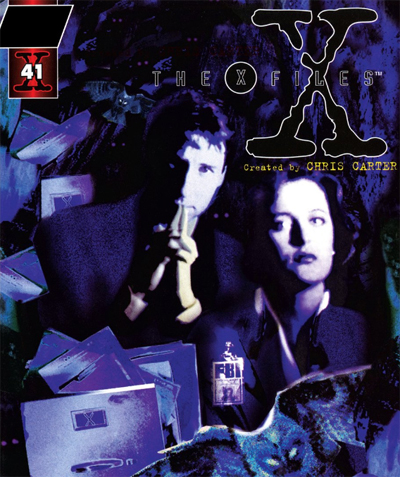
The X-Files (Topps) #41 – Severed (Review)

This May and June, we’re taking a trip back in time to review the fifth season of The X-Files and the second season of Millennium.

This is the end.

Severed is the last X-Files comic book to be published by Topps. It was released in September 1998, after the release of The X-Files: Fight the Future and before the broadcast of The Beginning. The company had actually solicited a number of X-Files comics that were never actually published – including Season One adaptations of The Jersey Devil and Ghost in the Machine. It seems quite likely that Severed was the last comic book to be published by the comic book division of Topps, who had decided to retreat from the industry following market trends.

Filed away...

Filed away…

Topps wrapped up the bulk of its publishing operations over the summer of 1998, releasing the last few tie-in comics for Xena: Warrior Princess and Hercules: The Legendary Journeys. Severed was actually delayed significantly. Devil’s Advocate had been published in June, leaving a three-month gap between the two issues. It is interesting to wonder what the delays behind publication might have been; certainly writer John Rozum and Alex Saviuk had proven themselves quite capable of managing a monthly schedule.

Whatever was happening behind the scenes, Severed is very much damp squib of an ending. It’s a bland and forgettable story, but one that is sadly par for the course in the stage of the book’s life cycle.

The transformed man...

The transformed man…

Continue reading

The X-Files – Season 5 (Review)

This May and June, we’re taking a trip back in time to review the fifth season of The X-Files and the second season of Millennium.

The fifth season of The X-Files represents the height of the show’s popularity.

Bookended by the production and release of the motion picture, the fifth season also earned the highest overall Neilsen ratings of any of the show’s nine seasons. The X-Files was a cultural force to be reckoned with, and had come a long way from its origins as little-seen cult television show. In the late nineties, it seemed like it wasn’t just aliens conspiring to colonise the planet; Chris Carter and his team were doing a pretty good job of it themselves. The fifth season has all the swagger and confidence of a show enjoying the view as it stands on top of the world.
xfiles-postmodernprometheus33

The fifth season might not be able to match the third season for consistency from episode to episode. The fifth season might also struggle to match the breathless ambition of the fourth season’s best (and wildest) episodes. However, it is a highly enjoyable season of television on its own terms. The season feels a little more relaxed and organised than the fourth season, and more confident in itself than the third. The fifth season even makes better use of its own internal themes and motifs than any of the previous seasons, with most of the staff seemingly on the same page.

Oddly enough, this thematic consistency does not translate into clear or fully-formed arcs. Unlike the second season of Millennium, it seems like the fifth season of The X-Files has no real idea of where it is going or how it wants to get there. This is slight problem when the fifth season needs to build to a feature film that was shot in the gap between the fourth and fifth seasons. The X-Files gets a lot of credit for popularising serialised storytelling on prime-time television, but the fifth season demonstrates just how sloppy the show could sometimes be in that regard.

xfiles-badblood10

Still, this is a minor problem. With only twenty episodes, the fifth season is the shortest season of The X-Files produced at this point in the show’s history. The ninth season would run the same length, but there is an argument to be made that it is technically the shorter season; The Truth was written and broadcast as a single feature-length episode rather than two individual episodes. However, production necessities required a lot of innovation and experimentation in the fifth season, leading to a very playful and very off-format season of television.

While it is probably very difficult to argue that the fifth season of The X-Files was the show’s best run of episodes, it is a highly enjoyable collection of shows that brings together a lot of what was so much fun about The X-Files. The last season to be filmed in Vancouver, and the season that moves us closer to the end of the series than the beginning. Although certain segments of fandom would argue that it is the last truly great season of The X-Files, that feels unduly harsh to both the sixth and eighth seasons. Nevertheless, it is thrilling to watch a show so thoroughly enjoying its moment in the sun.

xfiles-theend32

Continue reading

Millennium – Season 2 (Review)

This May and June, we’re taking a trip back in time to review the fifth season of The X-Files and the second season of Millennium.

The second season of Millennium is understandably polarising.

It is returned from its summer hiatus as what was, on the surface, a radically different television show. The Millennium Group was no longer simply a forensic consultancy firm, but had transformed into a secret society dating back millennia; it had become, as Frank would concede in The Fourth Horseman, “a cult.” More than that, the show had changed around the Millennium Group. Serial killers had been the show’s bread and butter in its first season, prompting some critics to describe it as a “serial killer of the week” procedural; now they were a rare occurrence.

millennium-thebeginningandtheend2

More than that, Frank Black had also changed. In interviews around the first season, Lance Henriksen had been very proud to play a hero who solved problems with his mind rather than with a gun. In contrast, the second season opened with Frank Black brutally murdering the man who kidnapped his wife. The yellow house had been a symbol of everything pure and good in the world of Frank Black, of the family he worked hard to protect. The second season had exiled Frank Black from this family and had him move deeper and deeper into the Millennium Group itself.

However, there were other changes that were less profound, but just as striking. Frank Black was suddenly a fan of the music of Bobby Darin. He suddenly had a sense of humour that led him to crack more than two jokes in a season. at the same time, he was also more short-tempered and grouchy. The first season had presented Frank Black as a rock in the middle of otherwise chaotic seas; in the second season, it was clear that Frank himself was feeling the strain and the stress. In short, Frank Black felt a lot more human.

millennium-aroomwithnoview9

The entire mood of the show changed around Frank. Millennium was suddenly a lot weirder. Though the first season had largely moved away from the classic “Frank hunts a serial killer” formula by the end of the year, the second season abandoned any sense of formula altogether. Watching the second season of Millennium on a week-to-week basis, it was almost impossible to predict what the next show would be like. Although there was a very strong thematic continuity between episodes, there was less of a rigid structure to their construction.

The second season of Millennium was a radical departure from what had come before. It was also the best season of television ever produced by Ten Thirteen.

millennium-luminary28

Continue reading

The X-Files – The X-Files Game (Review)

This May and June, we’re taking a trip back in time to review the fifth season of The X-Files and the second season of Millennium.

At the end of its fifth season, with the release of The X-Files: Fight the Future looming large, it was the perfect time to cash in the popularity of The X-Files. The show had already branded comic books and music albums, so an honest-to-goodness video game was the next logical step. The X-Files Game was released at the end of May 1998, right between the broadcast of The End and the theatrical release of Fight the Future. Fans who could not wait three weeks to see the big budget feature film would have the game to keep them occupied.

To be fair, The X-Files Game was not the first digital project to cash in on the success of The X-Files. Unrestricted Access had been released over a year earlier – a database of information relating to the show that could be read in Internet Explorer 4. Spanning seven discs, The X-Files Game was a much more ambitious project, a series of live-action sequences stitched together to form an interactive video game narrative. However, the game suffers from a somewhat repetitive design and the fact that, while it tries to emulate the look and feel of the show, it simply can’t.

xfiles-game4

Continue reading

The X-Files – The End (Review)

This May and June, we’re taking a trip back in time to review the fifth season of The X-Files and the second season of Millennium.

The End is a watershed moment for the show.

There is a reasonable argument to be made that The End accomplishes very little in terms of narrative. It doesn’t really do a great job bridging to The X-Files: Fight the Future. It certainly doesn’t do a great job wrapping up any of the show’s long-running concerns. Indeed, it adds two characters who will go on to become major (if controversial) players in the show’s overarching mythology. Even the big dramatic twist at the end of the episode feels familiar, with The End closing on a more memorable visualisation of the cliffhanger to The Erlenmeyer Flask.

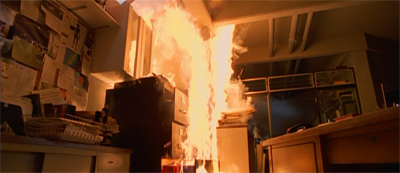
Burn, baby, burn...

Burn, baby, burn…

Nevertheless, The End does feel like an end of sorts. It closes out five seasons of The X-Files. Carter had suggested in interviews that he only wanted to do five seasons of the show before transitioning into feature films, and so The End marks the conclusion of the run that Carter had originally planned for the show. After all, The X-Files had crossed the hundred episode mark earlier in the year. It was ripe for syndication. It was at the stage where Fox and Ten Thirteen did not need to keep the show on the air to keep printing money.

At the same time, The End marks another more definitive sort of end. It would be the last piece of The X-Files to be filmed in Vancouver until The X-Files: I Want to Believe a decade later. Vancouver was a part of the show’s DNA. It had been the show’s production hub since The Pilot. More than two decades later, The X-Files would return to Vancouver for its six-episode wrap-up miniseries. Discussing the revival, Carter argued that Vancouver was “a natural place to make a show like The X-Files.” Certainly, the mood and atmosphere lent itself to the series.

"My video collection!"

“My video collection!”

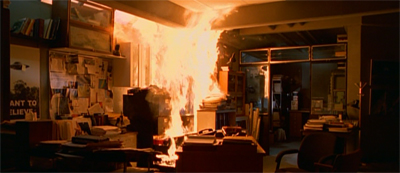
So The End marks a fond farewell from the production team to a city and region that had served them well.  In that respect, it feels like a more definitive sort of ending. The End opens with a scene that is confident enough to let Canada be Canada. As with the opening scene of Herrenvolk, it is almost comical how hard The End flags its “and starring Canada as Canada” cred, to the point where a mountie rushes to the aid of an assassination victim. The closing scene of The End burns down the show’s most iconic and memorable sets.

While The End is not necessarily a satisfying mythology episode or season finalé in its own right, it does feel like a suitably big moment in the evolution of the show.

Smoking gun...

Smoking gun…

Continue reading

Millennium – The Time is Now (Review)

This May and June, we’re taking a trip back in time to review the fifth season of The X-Files and the second season of Millennium.

The second season of Millennium holds together very well as a season of television.

It is arguably more cohesive in terms of plotting and theme than any individual season of The X-Files, with the possible exception of the eighth season. Ideas, characters and themes are all set up early in the season so that they might pay-off at the climax. Watching The Fourth Horseman and The Time is Now, it is very hard to believe that the season could have ended any other way. That is a tremendous accomplishment on the part of Glen Morgan and James Wong, who steered the second season as Chris Carter brought his focus back to The X-Files.

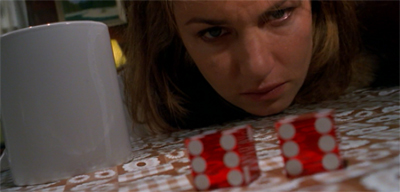
Dicey proposition...

Dicey proposition…

The attention to detail is staggering. There are lots of little touches, from the way that the use of chickens in The Fourth Horseman calls back to the story that bookends Monster to the reference to the fate of Brian Roedecker to the quick shot of Frank placing the statue of the angel on his father’s grave. Glen Morgan has repeatedly stated that the character of Lara Means was introduced in Monster knowing her fate in The Time is Now, and that seems to be true of most of the character and plot arcs over the stretch of the second season.

However, what is truly touching about the second season of Millennium is the way that the show manages to remain deeply personal and emotional, despite the scale of what is unfolding.

Shattered mirror...

Shattered mirror…

Continue reading