• Following Us

  • Categories

  • Check out the Archives


  • Awards & Nominations

Star Trek: Deep Space Nine – The Never-Ending Sacrifice by Una McCormack (Review)

Star Trek: Deep Space Nine is twenty years old this year. To celebrate, I’m taking a look at the first season. Check back daily for the latest review or retrospective.

We’ll be supplementing our coverage of the episodes with some additional materials – mainly novels and comics and films. This is one such entry.

More than any of the other Star Trek spin-offs, Star Trek: Deep Space Nine lends itself to narratives running in parallel to the main plot. Part of this is due to the conscious world-building the show engaged in, creating an expansive supporting cast populated by citizens of countless different worlds that were developed into more than just “planets of the week.”

There’s also the rather epic scale of events depicted in the show, with only The Best of Both Worlds offering a glimpse of events on a scale similar to those of Deep Space Nine. The show’s setting helps as well; even with the Defiant and occasional trips to other worlds, most of the show was focused on life on the station, suggesting a maelstrom of activity in the wider universe.

The Never-Ending Sacrifice takes advantage of these factors to offer a compelling narrative running in parallel to the events of Deep Space Nine, spanning from Cardassians through to the Pocket Books relaunch. It’s a rich and expansive tale which feels like a genuine epic, taking the opportunity to glimpse events of the season through a set of alien eyes.

cvr9781439109618_9781439109618_hr

Continue reading

Star Trek: Deep Space Nine – Cardassians (Review)

Star Trek: Deep Space Nine is twenty years old this year. To celebrate, I’m taking a look at the first and second seasons. Check back daily for the latest review or retrospective.

Cardassians suffers a bit from the same problems that haunt Invasive Procedures. Here’s another solidly constructed piece of world-building featuring a wonderful guest cast and an intriguing high concept. However, in the midst of all this, it seems like the human (er, Cardassian) element gets a bit lost. It’s great to have Garak and Dukat back on the show, and it’s great to deal with more fallout from the Occupation, but Cardassians never makes the emotional connection that a story about war orphans probably should.

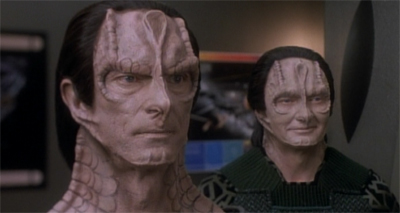
Keeping up with the Cardassians...

Keeping up with the Cardassians…

Continue reading

Star Trek: Deep Space Nine – The Circle (Review)

Star Trek: Deep Space Nine is twenty years old this year. To celebrate, I’m taking a look at the first and second seasons. Check back daily for the latest review or retrospective.

Drama naturally lends itself to a neat three-act structure. At the most basic level, it’s as simple as beginning, middle and end. However, it’s also a format taught in just about every screenwriting course, and it’s even used as the conventional model for those with more innovative approaches. With that in mind, it’s interest that Star Trek has done relatively few three-part stories. The Circle sits in the middle of the first such attempt, in the second season of the second spin-off. The format would not see use again for over a decade, when it would become a feature of the final season of Star Trek to air on television.

Given the franchise is relatively fond of two-parters, it seems strange that there haven’t been more attempts to extend that out an episode. Perhaps the reason is obvious. Of the three acts, the beginning and the end are the most essential. Both come with a certain in-built amount of energy. The first part introduces the problem, while the conclusion deals with it. However, it’s the middle which proves problematic. It’s the point in the story after you’ve set up the conflict, but before you resolve it. Given how much difficulty Star Trek: The Next Generation had with conclusions, imagine how difficult the second part of a three-parter would be.

Even when Star Trek: Enterprise adopted the three-parter format it ran into basic structural difficulties, with a couple feeling like a two-part episode with an additional prologue or epilogue added on. The Circle isn’t a terribly flawed piece of television, but it suffers from the fact that Star Trek has never really tried storytelling in this mode before.

The writing's on the wall...

The writing’s on the wall…

Continue reading

Star Trek: Deep Space Nine – The Homecoming (Review)

Star Trek: Deep Space Nine is twenty years old this year. To celebrate, I’m taking a look at the first and second seasons. Check back daily for the latest review or retrospective.

The Homecoming is notable for a number of reasons. It kicks off the franchise’s first three parter. Sure, Family provided a nice epilogue to The Best of the Both Worlds, but The Homecoming, The Circle and The Siege represents the first explicit three-part story in the history of the franchise. Star Trek: Enterprise would develop a fondness for the format in its final season and one of those three-parters (The Forge, The Awakening and Kir’Shara) would owe a conscious debt to this opening trilogy.

It also pretty much sets the tone of season premieres on Star Trek: Deep Space Nine. Star Trek: The Next Generation and Star Trek: Voyager would both display a fondness for bridging their seasons with two-part adventures. The opening episode would air as a season finalé, with the resolution airing as the opening episode of the following season. Deep Space Nine was not so literal minded. While each season premiere was informed by the themes and events of the last season’s closing episode, Deep Space Nine tended to favour opening with multi-part episodes rather than conclusions to narrative hooks.

Rather than wrapping up the threads hinted at in In the Hands of the Prophets, The Homecoming only builds on them. It suggests that the problems and the difficulties facing Bajor won’t magically disappear because ninety minutes of screen time have elapsed.

Dynamic Kira action pose!

Dynamic Kira action pose!

Continue reading

Star Trek: Deep Space Nine – Duet (Review)

Star Trek: Deep Space Nine is twenty years old this year. To celebrate, I’m taking a look at the first season. Check back daily for the latest review or retrospective.

And here we hit the first truly classic episode of Star Trek: Deep Space Nine. Positioned almost at the very end of what has been a fairly uneven season of television, Duet firmly demonstrates that this spin-off can hold its head tall among the other franchise installments. Duet isn’t just a quintessential Deep Space Nine episode. It isn’t just a classic Star Trek episode. It is an absolutely beautiful piece of allegory, a stunning character study and a probing exploration of collective guilt and responsibility.

J'accuse...

J’accuse…

Continue reading

Star Trek: Deep Space Nine – Progress (Review)

Star Trek: Deep Space Nine is twenty years old this year. To celebrate, I’m taking a look at the first season. Check back daily for the latest review or retrospective.

Progress is the best episode of Star Trek: Deep Space Nine‘s first season to date. Of course, there are better episodes ahead – two of them clustered at the end of the show’s truncated first year – but Progress still represents a considerable improvement over anything that has come before. It isn’t quite perfect, but it does have a nice character focus and takes advantage of the show’s unique perspective and position. It’s evidence that the writing staff were at least engaging with the show’s status quo and trying to work with it to tell interesting stories, with Progress offering an early pure example of what Deep Space Nine story should probably look like.

While the first season has been quite bumpy (although notably less bumpy than any of the opening seasons of the other three Star Trek spin-offs), Progress offers a demonstration that we are getting somewhere. The title might apply as much to the status of the show itself as to the themes of the episode.

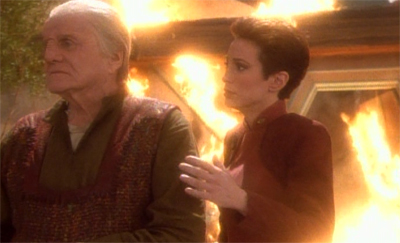
Burning down the house...

Burning down the house…

Continue reading

Star Trek: Terok Nor – Night of the Wolves by S.D. Perry & Britta Dennison (Review)

Star Trek: Deep Space Nine is twenty years old this year. To celebrate, I’m taking a look at the first season. Check back daily for the latest review or retrospective.

We’ll be supplementing our coverage of the episodes with some additional materials – mainly novels and comics and films. This is one such entry.

Prequels are a tricky business. Not just because we already know the ending – after all, we love adapting old familiar stories in new ways, and knowing the outcome can easily lend a project an air of grand tragedy or irony. However, the temptation with prequels is to make it all make sense, to tie absolutely everything up in a neat little bow, resolving all the plot threads and removing any hint of ambiguity or mystery from the original work – less of a story in its own right and more of a “fill in the blanks” approach.

James Swallow’s Day of the Vipers occasionally fell into this trap as it offered an account of the Cardassian plot to take control of Bajor, but it managed to offer its own insights and character development – giving us a suitably complex and self-justifying version of Gul Dukat. Night of the Wolves is somewhat less successful at avoiding the same problems, with a plot that appears to have been fashioned by linking off-hand references and back story from various early episodes together.

We get Odo and Kira meeting for the first time; an account of the liberation of Gallitep; a back story for a young Damar; the roots of Natima Lang’s dissatisfaction with the Central Command. None of these threads seem to build to anything insightful or clever, instead playing out predictably – pretty much exactly as we might have imagined them.

Continue reading

Star Trek: Deep Space Nine – Battle Lines (Review)

Star Trek: Deep Space Nine is twenty years old this year. To celebrate, I’m taking a look at the first season. Check back daily for the latest review or retrospective.

Battle Lines is, quite frankly, not a very good piece of television. Like a few of the episodes scattered throughout the first season of Star Trek: Deep Space Nine, it feels like it was pulled from a list of rejected scripts for Star Trek: The Next Generation. Ironically, it feels more like a reheated left-over than the next episode, The Storyteller, which was actually a recycled script from the first season of The Next Generation. Were it not for the involvement of Kai Opaka and a few hints about Bajoran spirituality, Battle Lines would feel almost as generic as The Passenger.

The concept is fascinating, and it represents another long-term shift in Deep Space Nine, but the script from Hilary J. Bader feels too functional and broad to do the episode justice. Instead, it feels fairly bland, which is a bit disappointing for an episode where Sisko accidentally gets the pope caught up in the universe’s most deadly game of laser tag.

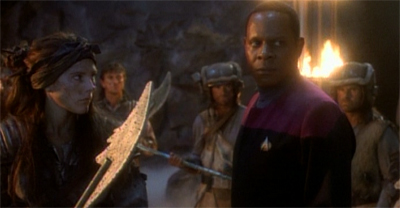
Taking a stab at bringing peace...

Taking a stab at bringing peace…

Continue reading

Star Trek: Deep Space Nine – A Man Alone (Review)

Star Trek: Deep Space Nine is twenty years old this year. To celebrate, I’m taking a look at the first season. Check back daily for the latest review or retrospective.

To be fair to Star Trek: Deep Space Nine, it’s clear that the show’s heart is in the right place. After all, a Star Trek television show isn’t quite the gambit that it was in 1987. The producers expect that the series will be going for quite some time. After all, the regulars signed six-year contracts, one of the reasons that the show managed to make it to its penultimate season without losing a primary cast member.

As such, a lot of the early episodes of Deep Space Nine seem prudent – they effectively amount to good housekeeping. While Star Trek: The Next Generation got its cast together and couldn’t wait to start telling bold Star Trek stories, you can see that Deep Space Nine is laying a lot of groundwork. The ensemble doesn’t gel instantly. Episodes are devoted to little more than set-up for something that will pay off over the coming year. A vast supporting cast is systematically established.

This is world-building, and it’s world-building to a purpose, even if Deep Space Nine doesn’t seem to really know what that purpose is yet. So it’s quite hard to fault these early episodes, even if they feel more like set-up for delayed pay-off.

The writing's on the wall for Odo...

The writing’s on the wall for Odo…

Continue reading

Star Trek: Deep Space Nine – Emissary (Review)

Star Trek: Deep Space Nine is twenty years old this year. To celebrate, I’m taking a look at the first season. Check back daily for the latest review or retrospective.

Star Trek: Deep Space Nine is a phenomenal piece of television. It’s often a bit overlooked because of its unique setting. After all, the words Star Trek evoke space ships and new worlds – “new life forms and new civilisations.” As such, a Star Trek series about a space station feels counter-intuitive. “To boldly sit” is the hardly the most dynamic premise. And yet, despite that, there’s a very serious argument to be made that Deep Space Nine is the crowning accomplishment of television Star Trek. It’s certainly the last great attempt to boldly push the franchise forward, with Star Trek: Voyager and Star Trek: Enterprise feeling just a tad regressive and conservative in comparison.

Indeed, Deep Space Nine represents a massive narrative leap forward from the success of Star Trek: The Next Generation, which remains one of the greatest science-fiction shows ever produced. For better or worse, Emissary makes it quite clear that Deep Space Nine is not an attempt to copy its direct predecessor, even if some of the other episodes in the first season might back-pedal a bit. In fact, it’s surprising just how well the pilot for this strangest of Star Trek shows holds up, suggesting a firmer grasp of its own identity than a few of the subsequent episodes could claim.

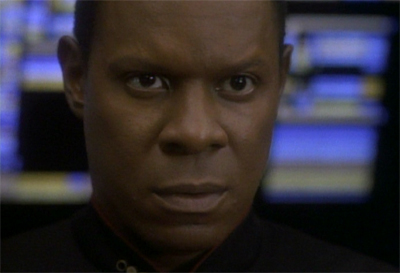
A Commanding presence...

A Commanding presence…

Continue reading