• Following Us

  • Categories

  • Check out the Archives


  • Awards & Nominations

Tintin: The Castafiore Emerald (Review)

In the lead-up to the release of The Adventures of Tintin: The Secret of the Unicorn, I’m going to be taking a look at Hergé’s celebrated comic book character, from his humble beginnings through to the incomplete post-modern finale. I hope you enjoy the ride.

The Castafiore Emerald is famous as an example of Hergé playing with the reader’s expectations of a Tintin book. It’s essentially an exercise in creating suspense out of nothing, with the mystery of the eponymous jewel ultimately turning out to be a rather mundane affair, and instead allowing for all sorts of hilariously mundane hijinks to befall Hergé’s cast with relatively little point to it all. Then, after all, this is fiction, as Tintin seems coyly aware of on the cover, staring our at us with his finger on his lips, smiling like he knows something none of his castmates do. If you can embrace the central pointlessness of it all, and enjoy it as a collection of wryly observed scenes, The Castafiore Emerald is another rewarding addition to a series growing gradually more experimental.
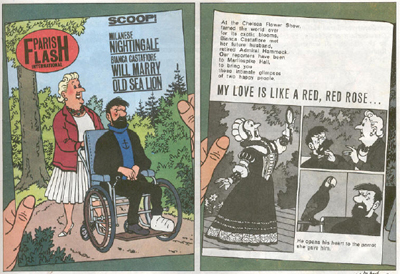
That engagement's news to Haddock!

Continue reading

Tintin in Tibet (Review)

In the lead-up to the release of The Adventures of Tintin: The Secret of the Unicorn, I’m going to be taking a look at Hergé’s celebrated comic book character, from his humble beginnings through to the incomplete post-modern finale. I hope you enjoy the ride.

Tintin in Tibet is a highly regarded book. In fact, it’s arguably the most highly regarded book in the entire Adventures of Tintin collection, and it’s easy to see why. While I could recall the events of some of the stories I’d read as a child almost word-for-word, and while I harbour a deep affection for particular adventures in the series, I don’t think I was looking forward to revisiting any of the classic Tintin stories nearly as much as I was anticipating flicking through Tintin in Tibet. I remember the book filling me with a tremendous sense of optimism and hope as a child, a story of faith and hope against impossible odds, deeply moving because of its relative intimacy.

I was not disappointed.

Whiteout...

Continue reading

Tintin: The Red Sea Sharks (Review)

In the lead-up to the release of The Adventures of Tintin: The Secret of the Unicorn, I’m going to be taking a look at Hergé’s celebrated comic book character, from his humble beginnings through to the incomplete post-modern finale. I hope you enjoy the ride.

The Red Sea Sharks is, I suppose, a fine adventure tale, even if it’s not an entry in Hergé’s canon that I’m particularly fond of. The nineteenth instalment in the series, the author uses the opportunity to tie a whole slew of open story threads together and anchor the long-term continuity of the series, but he also decides to deal with the issue of modern slavery – a controversial and topical issue, to be sure. However, while I have no doubt the author’s intentions were true, the story reads more than a little awkwardly in dealing with the topic.

Calculus gets his skates on...

Continue reading

Tintin: The Calculus Affair (Review)

In the lead-up to the release of The Adventures of Tintin: The Secret of the Unicorn, I’m going to be taking a look at Hergé’s celebrated comic book character, from his humble beginnings through to the incomplete post-modern finale. I hope you enjoy the ride.

The Calculus Affair is an interesting little story that is one part suspense thriller, and another part mystery. In short, it’s almost the perfect cocktail to brew up a Cold War espionage thriller, which was exactly what Hergé was going for. It wouldn’t be too difficult to rework the adventure as a James Bond movie (in fact, it even features a sequence with our lead piloting a tank), but Hergé does a lot of work to ensure that the story never gets too heavily bogged down. Much like King Ottokar’s Sceptre, the story stands quite well as an examination of the time when it was written.

Another fine mess!

Continue reading

“You Shiver In Such An-tici-pation”: Upcoming Releases and the Waiting Game…

It’s a bit of a defunct popular witticism that the actual purpose of the internet is not to increase global communication or facilitate and encourage the development and spread of ideas, but exists solely for pornography. I don’t think that’s necessarily true (in fact, it only accounts for 1% of the internet). Instead, I’d argue that the internet exists primarily to provide spoilers, casting calls, plot summaries, set pictures and gossip around all the upcoming releases. In an era where even fictitious characters have facebook and twitter accounts, it sometimes feels like information overload, with constant updates about the status of a given project and director and cast.

All at sea?

Continue reading

Tintin: Explorers on the Moon (Review)

In the lead-up to the release of The Adventures of Tintin: The Secret of the Unicorn, I’m going to be taking a look at Hergé’s celebrated comic book character, from his humble beginnings through to the incomplete post-modern finale. I hope you enjoy the ride.

The one thing I really admire about Explorers on the Moon is the fact that – for an adventure that takes the iconic boy reporter off te surface of the planet and launches him into outer space – it’s a remarkably low key affair. In fact, most of the book is devoted to nice character moments for the ensemble, and to explore some of the wonderful research Hergé did to put his story together. There’s no great mystery on the moon, none of the aliens that would later appear in Flight 714. Instead, Hergé seems to accept that launching his cast out of the planet’s atmosphere was enough of a radical deviation from the norm as it was. So what we get is a strange situation where Explorers on the Moon feels like one of the more grounded adventures in the series.

"Can you hear me, Major Tom?"

Continue reading

Tintin: Destination Moon (Review)

In the lead-up to the release of The Adventures of Tintin: The Secret of the Unicorn, I’m going to be taking a look at Hergé’s celebrated comic book character, from his humble beginnings through to the incomplete post-modern finale. I hope you enjoy the ride.

Destination Moon is an interesting entry in the Tintin canon, in that it really feels like Hergé’s relaxing just a bit. Since around about The Broken Ear (or even Tintin in America), most of Hergé’s stories have been relatively plot-driven, with a central mystery and a story built around solving that mystery. Destination Moon, on the other hand, is an adventure that feels far more episodic in nature, with Hergé taking a central plot (the race to land a man on a moon) and then building a variety of small adventures around it, from attempts to hijack a test rocket through to Professor Calculus’ amnesia and beyond. The story is somewhat leisurely plotted, but that’s not necessarily a bad thing. The author is clearly enjoying having a little bit more narrative freedom than he’s used to, and also having a great deal of fun taking a fantastical core concept and demonstrating how much research he’s put in.

It's out of this world...

Continue reading

Tintin: Land of Black Gold (Review)

In the lead-up to the release of The Adventures of Tintin: The Secret of the Unicorn, I’m going to be taking a look at Hergé’s celebrated comic book character, from his humble beginnings through to the incomplete post-modern finale. I hope you enjoy the ride.

Land of Black Gold is certainly an interesting Tintin story. It was begun during the Second World War, but suspended while Hergé’s paper, Le Soir, was investigated under suspicion of collaboration. Following the war, the author returned to complete the work, updating the adventure to remove some of the more obvious political elements, and to retroactively insert some of the more modern characters into the tale (Captain Haddock has a small role, and Cuthbert Calculus appears only via letter). However, despite all this interesting shuffling around, and the fact the story was begun in one political climate and finished in another, it’s surprising how relevent Hergé’s exploration of Middle Eastern politics remains.

Thompson and Thomson get their just deserts, eh?

Continue reading

Tintin: Prisoners of the Sun (Review)

In the lead-up to the release of The Adventures of Tintin: The Secret of the Unicorn, I’m going to be taking a look at Hergé’s celebrated comic book character, from his humble beginnings through to the incomplete post-modern finale. I hope you enjoy the ride.

I have to admit to really liking the two-part Seven Crystal Balls and Prisoners of the Sun adventure, to the extent that I’m actually eagerly anticipating Peter Jackson’s adaptation that may never materialise. The two-parter really just takes the best aspects of Hergé’s Tintin mythos, brewing up a pop culture stew that can be served as a mystery story or an adventure into a mystical and unknown world. The idea of discovering a long-lost tribe of ancient Inca is certainly an appealing one, and would make for a gripping turn-of-the-century adventure. Using that premise as a starting point, Hergé leads us and Tintin in the heart of Amazon, filled with excitement and danger and mystery.

Tintin, why don't you come Inca?

Continue reading

Tintin: The Seven Crystal Balls (Review)

In the lead-up to the release of The Adventures of Tintin: The Secret of the Unicorn, I’m going to be taking a look at Hergé’s celebrated comic book character, from his humble beginnings through to the incomplete post-modern finale. I hope you enjoy the ride.

Apparently, if Steven Spielberg’s The Adventures of Tintin: The Secret of the Unicorn is a success, Peter Jackson will be directing a sequel that will be based on the two-part story directly following The Secret of the Unicorn and Red Rackham’s Treasure. I’m already anticipating that, seen as The Seven Crystal Balls and Prisoners of the Sun are probably among my favourite Tintin stories, and I can actually see the rather wonderful conflict between mysticism and rationality playing out really well on the big-screen. It’s pure unadulterated pulp fiction, and it’s pulp fiction done exceptionally well.

Mummy!

Continue reading