• Following Us

  • Categories

  • Check out the Archives


  • Awards & Nominations

Doctor Who: Time and the Rani (Review)

To celebrate the fiftieth anniversary of the longest-running science-fiction show in the world, I’ll be taking weekly looks at some of my own personal favourite stories and arcs, from the old and new series, with a view to encapsulating the sublime, the clever and the fiendishly odd of the BBC’s Doctor Who.

Time and the Rani originally aired in 1987.

Right, that all seems quite clear. Just three small points. Where am I? Who am I? And who are you?

– the Doctor

A Doctor’s first story is always difficult. Even if it’s not as explicit as it was in Power of the Daleks, the new actor his constantly fighting against the weight of expectation, trying to cast off the spectre of their predecessor and make the show their own. There’s also a sense that the production team is trying to reinvent the show around their new lead. It’s transitional, and it’s not too difficult to see how the task could be daunting.

If that’s a typical first story, imagine how frustrating Time and the Rani must have been at the time. Hastily cobbled together in a rush, coming out of a season that had been a spectacular failure and with the shadow of cancellation looming heavy, there’s a lot of pressure on Time and the Rani. It is a story that is routinely trashed and mocked, and perhaps deservedly so. However, I must concede, it’s not as bad as it could have been and I’d be very reluctant to rank it among the worst Doctor Who serials of all time.
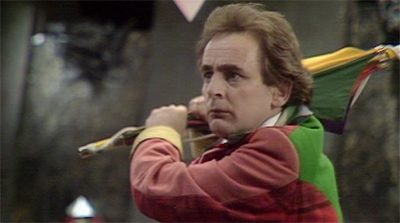
He's got an umbrella and he's not afraid to use it!

He’s got an umbrella and he’s not afraid to use it!

Continue reading

Doctor Who: The Trial of a Time Lord – The Ultimate Foe (Review)

To celebrate the fiftieth anniversary of the longest-running science-fiction show in the world, I’ll be taking weekly looks at some of my own personal favourite stories and arcs, from the old and new series, with a view to encapsulating the sublime, the clever and the fiendishly odd of the BBC’s Doctor Who.

The Trial of a Time Lord originally aired in 1986.

In all my travellings throughout the universe I have battled against evil, against power-mad conspirators. I should have stayed here. The oldest civilisation, decadent, degenerate and rotten to the core. Ha! Power-mad conspirators, Daleks, Sontarans, Cybermen, they’re still in the nursery compared to us. Ten million years of absolute power, that’s what it takes to be really corrupt.

– the Doctor

There really are no excuses for the mess that The Trial of a Time Lord became. I mean, seriously. The producers had eighteen months to plan everything out. The task shouldn’t be that difficult. If you are going to fictionalise the persecution of Doctor Who by the BBC in the form of a trial, you really should have some idea what you plan to do or say at the end of it. If your fourteen episode season-long story arc is about defending a show that is coming close to cancellation, then perhaps it might be a good idea to be able to tell us why it shouldn’t be cancelled. The Trial of a Time Lord is a gigantic mess, and something that makes a stronger case in favour of Michael Grade’s attempts to cancel that show than it does against them.

The Ultimate Foe isn’t as soul-destroyingly horrible as Terror of the Vervoids, but that may be because Pip and Jane Baker only wrote half of it.

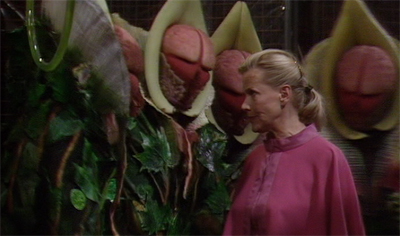
Only himself for company...

Only himself for company…

Continue reading

Doctor Who: The Trial of a Time Lord – Terror of the Vervoids (Review)

To celebrate the fiftieth anniversary of the longest-running science-fiction show in the world, I’ll be taking weekly looks at some of my own personal favourite stories and arcs, from the old and new series, with a view to encapsulating the sublime, the clever and the fiendishly odd of the BBC’s Doctor Who.

The Trial of a Time Lord originally aired in 1986.

Mmm. This is a situation that requires tact and finesse. Fortunately, I am blessed with both.

– the Sixth Doctor

Okay, so the “past” and “present” sections of The Trial of a Time Lord haven’t been blow-outs. The Mysterious Planet demonstrated that maybe, once upon a time, Doctor Who had been decidedly average, constructed of a checklist of familiar and inoffensive tropes. Mindwarp demonstrated that Colin Baker’s Doctor was the kind of character who you could probably imagine chaining his companion to a rock on the beach, before leaving her to die… or marry Brian Blessed… or something. But, hey, there was some social commentary! If The Trial of a Time Lord is constructed as a defence by the show to avoid being sentenced to the bleak nether-realms of cancellation, I have to confess that I’m not convinced. And I like the show to begin with.

Still, it’s not a total failure. I mean, whatever the show was or is, it can always be something better, right? And so, this final story, Terror of the Vervoids, could easily prove that the show has a very clear idea of where it’s going next? The future will be better tomorrow, and all that?

Cue incredibly lame "Pussy Galore" joke...

Cue incredibly lame “Pussy Galore” joke…

Continue reading

Doctor Who: The Trial of a Time Lord – The Mysterious Planet (Review)

To celebrate the fiftieth anniversary of the longest-running science-fiction show in the world, I’ll be taking weekly looks at some of my own personal favourite stories and arcs, from the old and new series, with a view to encapsulating the sublime, the clever and the fiendishly odd of the BBC’s Doctor Who.

The Trial of a Time Lord originally aired in 1986.

Well, this is a charade.

– the Doctor gets the idea quickly enough

The Doctor had been off screens for eighteen months following Revelation of the Daleks. Michael Grade was desperately trying to cancel the show, and it only limped back to screen with a significantly reduced budget and much shorter run of episodes. The show length was also reverted back to its default value. This season would only run for fourteen half-hour episodes – what would become the set length for Doctor Who in the years to come. (Indeed, counting the Christmas Special, the revived series also runs to that length, albeit in forty-five minute episodes.)

By all accounts, the production on the infamous Trial of a Time Lord was a disaster for reasons natural and otherwise. Veteran writer Robert Holmes was to provide the opening and closing scripts, but passed away before his work on the finalé could be finished. Script editor Eric Saward and producer John Nathan-Turner clashed over the climax of the trial, prompting Saward to resign and Nathan-Turner to temporarily become script editor himself. Colin Baker couldn’t make sense of Mindwarp. The last episode of the season was written by two writers wrapping up from Holmes’ first part, but unable to examine his notes on how he planned to conclude it.

Believe me when I state that every last ounce of this behind-the-scenes friction was visible on-screen by the end of the year. Luckily enough, the show does a decent enough job concealing these approaching problems in the first story of the arc. That’s not to say that The Mysterious Planet is an unsung classic, merely to point out that it is at least unburdened by the seemingly real time collapse of Doctor Who.

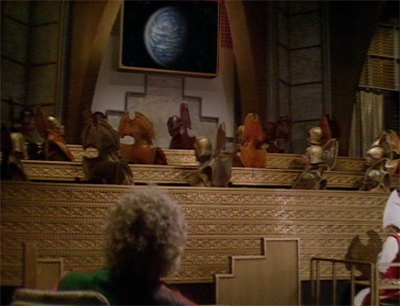
Ah, it's a fourteen-week adventure about watching Doctor Who!

Ah, it’s a fourteen-week adventure about watching Doctor Who!

Continue reading

Doctor Who – The Shakespeare Code (Review)

To celebrate the fiftieth anniversary of the longest-running science-fiction show in the world, I’ll be taking weekly looks at some of my own personal favourite stories and arcs, from the old and new series, with a view to encapsulating the sublime, the clever and the fiendishly odd of the BBC’s Doctor Who.

The Shakespeare Code originally aired in 2007.

Goodnight, Doctor.

Nighty night, Shakespeare.

– talk about your British icons

The Shakespeare Code is the third season’s opening trip into British nostalgia, a celebrity historical where the Doctor journeys back in time to meet a famous character and to deal with alien menaces masquerading as something altogether more sinister. This time, the Doctor and Martha travel back to meet William Shakespeare. It’s a little on the nose, but perhaps that’s not a bad thing. After all, teaming the Doctor up with Queen Victoria in Tooth and Claw did seem a little cynical when the show opened with a gag at the expense of Margaret Thatcher.

The rather safe and occasionally quite “postcard-y” portrayal of British history aside, The Shakespeare Code is more interesting as a rather novel form of arc-building for the show. “Saxon” was the arc word for the show’s third season, but restricted to those episodes set in the present. However, The Shakespeare Code winds up offering major thematic foreshadowing of the season ahead.

Where there's a Will...

Where there’s a Will…

Continue reading

Doctor Who: The Reign of Terror (Review)

To celebrate the fiftieth anniversary of the longest-running science-fiction show in the world, I’ll be taking weekly looks at some of my own personal favourite stories and arcs, from the old and new series, with a view to encapsulating the sublime, the clever and the fiendishly odd of the BBC’s Doctor Who.

The Reign of Terror originally aired in 1964.

Hush, child. Say your goodbyes and remember, we shall be leaving almost immediately

– the Doctor, about two minutes into the first part of a six parter

The Reign of Terror represents a fairly disappointing conclusion to a reasonably solid first season of Doctor Who. I won’t argue that the show’s first year can be ranked among the finest in the fifty-year history of the show, but I do think that the stories generally did quite a decent job of introducing the characters and concepts and setting them up so that they could support a lot more. It’s interesting to compare the title character introduced in An Unearthly Child to the version presented in The Sensorites.

While The Sensorites is still a story far too long and far too generic for its own good, it still feels like it solidifies a version of the character who – broadly speaking – resembles the Doctor we know and love. While I’d argue the Doctor was only absolutely solidified as a hero in The Dalek Invasion of Earth, there’s a very clear through-line from An Unearthly Child to The Sensorites which charts the evolution of the character. The Sensorites would make a decent (if unspectacular) place to end the first season.

Unfortunately, the first season continues on for one more episode. The Reign of Terror is just as over-long and just as padded out as The Sensorites, but it suffers because it feels like a massive step backwards in a season that has been very clearly moving forwards.

An animated sort...

An animated sort…

Continue reading

Doctor Who: Vincent and the Doctor (Review)

To celebrate the fiftieth anniversary of the longest-running science-fiction show in the world, I’ll be taking weekly looks at some of my own personal favourite stories and arcs, from the old and new series, with a view to encapsulating the sublime, the clever and the fiendishly odd of the BBC’s Doctor Who.

Vincent and the Doctor originally aired in 2010.

But you’re not armed.

I am.

What with?

Overconfidence, this, and a small screwdriver. I’m absolutely sorted.

– Vincent and the Doctor

One of the strengths of the revived series has been a willingness to engage with a variety of writers. While Andrew Cartmel may have tried in vain to convince Alan Moore to write for the final years of the classic show, Russell T. Davies and Steven Moffat have managed to draw a wealth of diverse talent to write for the revived series. Sometimes this didn’t always work out (Life on Mars creator Matthew Graham wrote Fear Her), but it did mean that the series could boasts scripts from figures as diverse as Neil Gaiman and Richard Curtis.

There’s something to be said for the diversity the format of the show allows. Vincent and the Doctor is really unlike any other story the show has ever tried to tell, but it still manages to feel like Doctor Who. Which is something pretty spectacular, and worth celebrating. Doctor Who works best as a vehicle for any and all kinds of stories, where the audience isn’t always exactly sure what it is going to get.

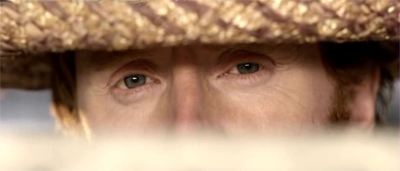
An artist's eyes...

An artist’s eyes…

Continue reading

Doctor Who: Timelash (Review)

To celebrate the fiftieth anniversary of the longest-running science-fiction show in the world, I’ll be taking weekly looks at some of my own personal favourite (and not-so-favourite) stories and arcs, from the old and new series, with a view to encapsulating the sublime, the clever and the fiendishly odd of the BBC’s Doctor Who.

Timelash originally aired in 1985.

I don’t trust you. You’re being too reasonable.

– Peri’s on to him

Timelash is on the short list of serials broadly agreed to be “the worst Doctor Who stories ever.” Given how prone science-fiction fans are to bickering about absolutely everything, and how impossible it is to find consensus, that’s really saying something. More than that, it ranks with quite a few Colin Baker stories among that list. I can’t help but wonder if part of the problem with Baker’s tenure isn’t a lack of classic episodes (Revelation of the Daleks and Vengeance on Varos surely count), but the batting average skewed by so many truly terrible stories.

Any season containing Timelash would be ridiculed, but it’s hard to imagine that any year of television containing Attack of the Cybermen, Timelash and The Mark of the Rani couldn’t help but raise questions about the show’s future at the BBC.

The face of evil...

The face of evil…

Continue reading

Doctor Who: The Gunfighters (Review)

To celebrate the fiftieth anniversary of the longest-running science-fiction show in the world, I’ll be taking weekly looks at some of my own personal favourite stories and arcs, from the old and new series, with a view to encapsulating the sublime, the clever and the fiendishly odd of the BBC’s Doctor Who.

The Gunfighters originally aired in 1966.

Everything excepting that rattlesnake friend of yours Holliday blew in this mornin’. Who’re your friends, Wyatt?

Well I, er–

Oh, quite, quite so. Allow me, sir, to introduce Miss Dodo Dupont, wizard of the ivory keys, and er Steven Regret, tenor. And lastly sir, your humble servant Doctor Caligari.

Doctor who?

Yes, quite right.

– Masterson, Wyatt Earp and the Doctor

I am hesitant to turn my trip into the history of Doctor Who into a series of articles about fan opinion or consensus. If I like a story, or dislike a story, I have my reasons that I will often try to explain away. However, sometimes it’s nice to have a bit of context. It is handy, for example, to know that I like The Talons of Weng-Chiang just a little bit less than most fans seem to. The Gunfighters is an oft-maligned serial. It is part of the show’s troubled third season, building – as it did – off the show’s generally quite solid second year. However, I actually enjoy The Gunfighters for what it is, which is a knack I seem to have for a lot of the stories from William Hartnell’s era.

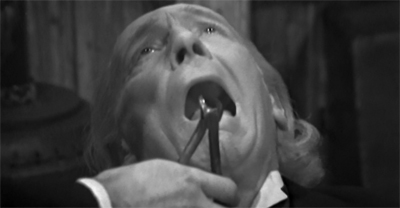
People would try to convince you that it's like pulling teeth...

People would try to convince you that it’s like pulling teeth…

Continue reading

Doctor Who – School Reunion (Review)

To celebrate the fiftieth anniversary of the longest-running science-fiction show in the world, I’ll be taking weekly looks at some of my own personal favourite stories and arcs, from the old and new series, with a view to encapsulating the sublime, the clever and the fiendishly odd of the BBC’s Doctor Who.

School Reunion originally aired in 2006.

You can tell you’re getting older. Your assistants are getting younger.

– Sarah Jane to the Doctor

Coming at the start of the revived show’s second season, School Reunion changed the way that the show related to its long and complex history, explicitly confirming what had been implied at least as early as Dalek and Aliens of London, that this was indeed the same Doctor who had had all of those adventures for all those years on British television. Bringing back the iconic pepper pots was one thing, as was name-dropping the paramilitary outfit from early in the original show’s run.

However, bringing back the most fondly remembered companion of the classic television show and affirming that she had travelled with this man for several years provides a firm anchor to the past. Looking back now, it’s hard to appreciate how dramatic a shift this was, and just what it represented. However, it’s hard to imagine that Doctor Who could get to the point where the Doctor could recruit a Silurian detective and her Sontaran butler in Victorian England without School Reunion.

It changed the game.

(Anthony Stewart) Head master...

(Anthony Stewart) Head master…

Continue reading