• Following Us

  • Categories

  • Check out the Archives


  • Awards & Nominations

Doctor Who: The Green Death (Review)

To celebrate the fiftieth anniversary of the longest-running science-fiction show in the world, I’ll be taking weekly looks at some of my own personal favourite stories and arcs, from the old and new series, with a view to encapsulating the sublime, the clever and the fiendishly odd of the BBC’s Doctor Who.

The Green Death originally aired in 1973.

Where are you off to?

To pack a suitcase.

Oh, good. Give me a couple of minutes and we’ll be off.

Off? Off where?

Well, Metebelis III, of course.

I’m not going to Metebelis III.

Why? Where are you thinking of going to?

Well, South Wales, of course. Llanfairfach.

– the Doctor and Jo discuss travel plans… why would you want to go to Metebels III when you can visit South Wales?

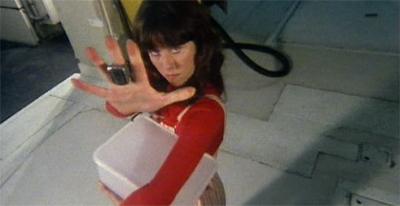
The Green Death is a great example of the Jon Pertwee era. It offers a pretty solid showcase of the best of the era, along with the glaring structural and thematic weaknesses that the show never really tackled head-on. It’s a great yarn, an affectionate run-around. There is a reason, after all, that the overgrown maggots have managed to wedge themselves in British popular consciousness. There’s a conscious sense that The Green Death is a season finalé, in the biggest and boldest terms possible.

In an era where television wasn’t really structured in that way, you can trace a pretty clear line between The Green Death and the big epic series finalés of the Russell T. Davies era of Doctor Who.

And the Beatz go on...

And the Beatz go on…

Continue reading

Doctor Who: Army of Ghosts (Review)

To celebrate the fiftieth anniversary of the longest-running science-fiction show in the world, I’ll be taking weekly looks at some of my own personal favourite stories and arcs, from the old and new series, with a view to encapsulating the sublime, the clever and the fiendishly odd of the BBC’s Doctor Who.

Army of Ghosts originally aired in 2006.

How long are you going to stay with me?

Forever.

– the Doctor and Rose tempt fate

It’s only logical that anybody diving head-first into a fifty-year-old television show is going to have an opinion that radically diverges from the fandom consensus on a couple of stories. So, for example, I’ll concede that I like The Talons of Weng-Chiang, but less than most. However, the biggest divide – and the point on which I feel furthest from consensus – comes with Army of Ghosts and Doomsday, Russell T. Davies’ massive farewell to Rose Tyler, the companion he introduced all the way back in Rose. It’s generally acknowledged as one of the high points of Davies’ tenure and one of the truly great Tenth Doctor stories.

I am far from convinced.

The cracks are starting to show...

The cracks are starting to show…

Continue reading

Doctor Who: The Hand of Fear (Review)

To celebrate the fiftieth anniversary of the longest-running science-fiction show in the world, I’ll be taking weekly looks at some of my own personal favourite stories and arcs, from the old and new series, with a view to encapsulating the sublime, the clever and the fiendishly odd of the BBC’s Doctor Who.

The Hand of Fear originally aired in 1976.

Come on, where are we?

We’re in a quarry.

Yes, I know we’re in a quarry, but where?

Well, how do I know? I don’t know all the quarries that–

– the Doctor and Sarah Jane get a bit meta

The Hand of Fear is odd, because it’s the end of an era – but it’s not the end of the era for the rather obvious reason that it bids farewell to one of the franchise’s best-loved companion character. The Hand of Fear is best known as the final story to feature Sarah Jane Smith. Indeed, the DVD comes with a helpful sticker informing any potential purchasers of the story’s significance.

However, watching The Hand of Fear with the benefit of hindsight, it isn’t Sarah Jane’s departure that is the most striking part of the show.

Keep it handy...

Keep it handy…

Continue reading

Doctor Who: Warriors of the Deep (Review)

To celebrate the fiftieth anniversary of the longest-running science-fiction show in the world, I’ll be taking weekly looks at some of my own personal favourite stories and arcs, from the old and new series, with a view to encapsulating the sublime, the clever and the fiendishly odd of the BBC’s Doctor Who.

Warriors of the Deep originally aired in 1984.

“Release the Myrka.”

– three words to create dread in even the toughest Doctor Who fan

I’ve always been somewhat less fond of Johnny Byrne’s Doctor Who than most fans. I can never, for example, understand the high esteem generally reserved for The Keeper of Traken (although it is a better story than Logopolis), and I really disliked Arc of Infinity. So I suspect some of the problems with Warriors of the Deepwere quite fundamental. However, there’s also a sense that those flaws were only exaggerated by a combination of other factors, including a low budget, a tight schedule and a script editor who believed an adventure’s pathos could be measured by its bodycount.

Everybody's dead, Davison...

Continue reading

Doctor Who: The Sea Devils (Review)

To celebrate the fiftieth anniversary of the longest-running science-fiction show in the world, I’ll be taking weekly looks at some of my own personal favourite stories and arcs, from the old and new series, with a view to encapsulating the sublime, the clever and the fiendishly odd of the BBC’s Doctor Who.

The Sea Devils originally aired in 1973.

If Horatio Nelson had been in charge of this operation, I hardly think that he would have waited for official instructions.

Yes, a pretty impulsive fellow, if one can believe the history books.

History books? Captain Hart, Horatio Nelson was a personal friend of mine. Come on, Jo.

– Namedropping? The Doctor? Never!

When it comes to Doctor Who, “sequel” stories get a bit of a hard time from fandom. It seems to be easy to dismiss Snakedance in favour of Kinda, and to praise Spearhead from Space at the expense of Terrors of the Autons and even elevate The Daleks above The Dalek Invasion of Earth. It seems that time, and conventional wisdom, tend to favour the original serials. Of course, there are undoubtedly examples where follow-up scripts have disappointed (the ridiculously padded The Monster of Peladon following The Curse of Peladon). Still, for my money, The Sea Devils represents a tighter, complimentary and ambitious sequel to Doctor Who and the Silurians, easily one of the most highly regarded adventures of the seventies. It’s a fairly impressive accomplishment, but The Sea Devils is more than up to it.

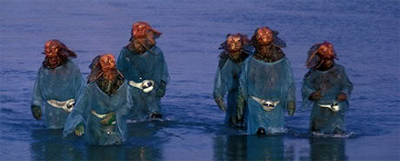
Everybody out of the water!

Continue reading

Doctor Who: Cold Blood (Review)

To celebrate the fiftieth anniversary of the longest-running science-fiction show in the world, I’ll be taking weekly looks at some of my own personal favourite stories and arcs, from the old and new series, with a view to encapsulating the sublime, the clever and the fiendishly odd of the BBC’s Doctor Who.

Cold Blood originally aired in 2010.

It is the story of our past and must never be forgotten.

– Eldane attempts to justify the “traditional monster” two-parters the revived show is so fond of

The Hungry Earth wasn’t too bad. It wasn’t great. There was nothing too exciting or novel about it, but it wasn’t a complete failure. It was an interesting and affectionate throwback to an older style of Doctor Who. It wasn’t exceptional, but it was -broadly speaking – functional. Chris Chibnell’s script had some rough edges, mostly around characterisation, but there was nothing too unworkable about the premise, which basically consisted of a selection of classic Doctor Who tropes thrown in a blender and served up to the audience.

However, Cold Blood is much less satisfying. Part of that is because it’s part of a story that can’t be sustained by nostalgia or affectionate references to tales long past. There’s also the fact that it hinges on an emotional climax that asks us to invest in an especially two-dimensional supporting cast. And that’s saying nothing about how the last few minutes of the episode aren’t even devoted to tying up its own threads so much as playing into the much more interesting season-long arc.

Cold Blood leaves me… well, cold.

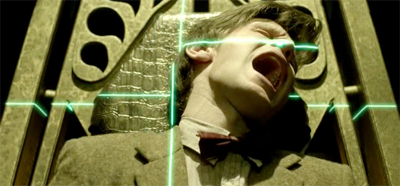
Doesn't scan...

Doesn’t scan…

Continue reading

Doctor Who: The Hungry Earth (Review)

To celebrate the fiftieth anniversary of the longest-running science-fiction show in the world, I’ll be taking weekly looks at some of my own personal favourite stories and arcs, from the old and new series, with a view to encapsulating the sublime, the clever and the fiendishly odd of the BBC’s Doctor Who.

The Hungry Earth originally aired in 2010.

Oh look! Big mining thing! Oh, I love a big mining thing. See, way better than Rio. Rio doesn’t have a big mining thing.

– the Doctor looks on the bright side of arriving in not!Rio

The Hungry Earth represents the biggest structural shift of Steven Moffat’s first season of Doctor Who. The writer would indulge in a number of radical structural changes over his time running the show, but his first season as showrunner conforms to the pattern of Russell T. Davies’ four full seasons. There’s the introductory present/past/future trilogy, the two mid-season two-parters and the gigantic two-part season finalé. The content of Moffat’s season might have been markedly different (actual romantic snog! a season building an arc that isn’t just references and easter eggs!), but the format was carried over faithfully.

Moffat’s following two seasons would get more experimental. For one thing, both seasons would be split in half. This allowed Moffat to offer the first genuine cliffhanger in the revival’s history to last more than a week, with a gap of several months between A Good Man Goes to War and Let’s Kill Hitler. His second season would feature the first two-part season opener (and first one-part season finalé) of the revived television show. His third season would feature no two-part episodes, spread across two calendar years.

However, sitting at the tail end of his first season, The Hungry Earth feels like the strangest structural element of Moffat’s first year in charge of Doctor Who. It’s what would traditionally be the first two-parter of the season, pushed back towards the end of the year.

Balancing the scales...

Balancing the scales…

Continue reading

Doctor Who: Dragonfire (Review)

To celebrate the fiftieth anniversary of the longest-running science-fiction show in the world, I’ll be taking weekly looks at some of my own personal favourite stories and arcs, from the old and new series, with a view to encapsulating the sublime, the clever and the fiendishly odd of the BBC’s Doctor Who.

Dragonfire originally aired in 1987.

You’re going to go looking for the dragon?

Absolutely.

Oh, cool. Can I come too?

– Ace introduces herself to the Doctor smoothly

Dragonfire is better than Delta and the Bannermen, which is certainly damning with faint praise. Like the rest of Sylvester McCoy’s first season, Dragonfire suffers because of a gap between concept and execution. There is a wealth of good ideas here, but Dragonfire can’t seem to develop any of them to the point where they stand out. Of this troubled first season, it’s perhaps the serial where the conflict between the show’s old-fashioned production and more modern writing are thrown into sharpest contrast. Dragonfire looks like it wants to be a classic Doctor Who episode, even though it’s written like anything but.

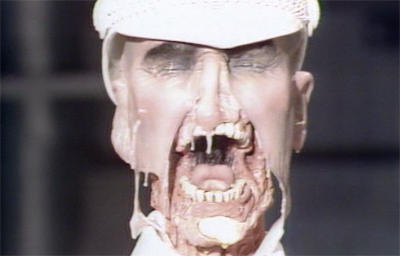
"I'm melting!"

“I’m melting!”

Continue reading

Doctor Who: Delta and the Bannermen (Review)

To celebrate the fiftieth anniversary of the longest-running science-fiction show in the world, I’ll be taking weekly looks at some of my own personal favourite stories and arcs, from the old and new series, with a view to encapsulating the sublime, the clever and the fiendishly odd of the BBC’s Doctor Who.

Delta and the Bannermen originally aired in 1987.

Hey, this doesn’t look like Disneyland.

No, well, according to my reckoning, it seems to be somewhere in, er, Wales.

– Murray and the Doctor get in touch with the “real fifties”

Delta and the Bannermen is quite terrible. That said, it’s not terrible in the same way that, say, Timelash or Attack of the Cybermen or The Twin Dilemma is terrible. It doesn’t offer a demonstration of everything intrinsically wrong with this era of the show, and the frustration isn’t compounded by the sense that nobody producing the show seems interested in watching it and maybe learning from their mistakes.

While that is certainly a promising thing from the perspective of the show, it doesn’t really do the viewer that much good when they are watching it.

Large ham, incoming!

Large ham, incoming!

Continue reading

Doctor Who: Paradise Towers (Review)

To celebrate the fiftieth anniversary of the longest-running science-fiction show in the world, I’ll be taking weekly looks at some of my own personal favourite stories and arcs, from the old and new series, with a view to encapsulating the sublime, the clever and the fiendishly odd of the BBC’s Doctor Who.

Paradise Towers originally aired in 1987.

Oh, I see. It’s some sort of robotic cleaner with automotive bicurval scraping blades. Impressive workmanship.

You don’t understand.

No, I don’t, but I intend to.

– the Doctor and the Deputy Chief Caretaker

Paradise Towers is brilliant. It’s crazy, it’s overstated, it’s an hour too long and it suffers from the fact that nobody really knows what they’re doing, but there’s a sense of genius at work here. Script editor Andrew Cartmel took over at the start of the season, with no scripts. Time and the Rani came from John Nathan Turner’s reliable Pip and Jane Baker, so Paradise Towers is the first script where Cartmel has been allowed to make his mark.

And it’s precisely what the show needed. The execution is significantly flawed, the pacing is all wrong and there’s a sense that not everybody between the script and the camera realised what was going on, but it has a distinct energy to it. Time and the Rani was essentially Doctor Who struggling to keep its head above water. Paradise Towers sees the show diving right into the eighties.

"... where the grass is green and the girls are pretty..."

“… where the grass is green and the girls are pretty…”

Continue reading