• Following Us

  • Categories

  • Check out the Archives


  • Awards & Nominations

Doctor Who: Silence in the Library (Review)

To celebrate the fiftieth anniversary of the longest-running science-fiction show in the world, I’ll be taking weekly looks at some of my own personal favourite stories and arcs, from the old and new series, with a view to encapsulating the sublime, the clever and the fiendishly odd of the BBC’s Doctor Who.

Silence in the Library originally aired in 2008.

There’s the real world, and there’s the world of nightmares. That’s right, isn’t it? You understand that?

Yes, I know, Doctor Moon.

What I want you to remember is this, and I know it’s hard. The real world is a lie, and your nightmares are real.

– Cal and Doctor Moon get to the root of what makes Moffat scripts terrifying

Ah, Silence in the Library. The Steven Moffat story that isn’t, that doesn’t. The first Steven Moffat script that isn’t the strongest story in its season by a clear margin; the first Steven Moffat adventure that didn’t claim the Hugo for Doctor Who. The biggest problem with Silence in the Library and Forest of the Dead is that they can’t quite measure to The Empty Child, The Doctor Dances, The Girl in the Fireplace or Blink. That’s hardly an unforgivable sin, and there’s no shame in not being quite as good an episode of Doctor Who as Midnight was.

I’m quite fond of the two-parter, even though I’ll concede that it has its problems. The most obvious of which is the fact that – four years into the revival – the audience has had a chance to come to appreciate “Moffat-isms”, with many viewers able to recognise the writer’s preferred genre tricks and tropes. Silence in the Library is far from the most original script of the season, but it’s well written and well executed.

It’s just a little too familiar.

Going by the book on this one...

Going by the book on this one…

Continue reading

Doctor Who: The Unicorn and the Wasp (Review)

To celebrate the fiftieth anniversary of the longest-running science-fiction show in the world, I’ll be taking weekly looks at some of my own personal favourite stories and arcs, from the old and new series, with a view to encapsulating the sublime, the clever and the fiendishly odd of the BBC’s Doctor Who.

The Unicorn and the Wasp originally aired in 2008.

Oh, it’s you… I was just doing a little research… I say, what are you doing with that lead piping? But that’s impossible. Oh, no!

– Professor Peach discovers the point of crossover between Agatha Christie and Doctor Who

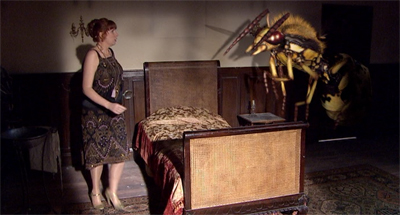
The Unicorn and the Wasp is the most fun episode of the fourth season, by a significant margin. It’s a high-concept high-energy run-around that has a great deal of fun playing with a genre mash-up, as the Doctor intrudes on an Agatha Christie mystery (starring Agatha Christie!) to create curious horror/sci-fi/mystery/class drama hybrid of an episode. It’s an episode that really benefits from the lighter tone of the fourth season. Despite some of the darkness creeping in at the edge of the frame, especially towards the final scenes, it’s an astonishingly light-hearted and playful episode.

In spite of Christie’s stern admonishings, it’s hard not to seize on the story with same glee as the Doctor does.

A sting in the tale...

A sting in the tale…

Continue reading

Doctor Who: The Doctor’s Daughter (Review)

To celebrate the fiftieth anniversary of the longest-running science-fiction show in the world, I’ll be taking weekly looks at some of my own personal favourite stories and arcs, from the old and new series, with a view to encapsulating the sublime, the clever and the fiendishly odd of the BBC’s Doctor Who.

The Doctor’s Daughter originally aired in 2008.

Not what you’d call a natural parent, are you?

They stole a tissue sample at gunpoint and processed it. It’s not what I call natural parenting.

Rubbish. My friend Nerys fathered twins with a turkey baster. Don’t bother her.

You can’t extrapolate a relationship from a biological accident.

Er, Child Support Agency can.

– Donna and the Doctor discussing parenting

The Doctor’s Daughter is the weakest script of the fourth season. It’s just a mess of high concepts and ideas and in-jokes mashed together and then cut down to fit into a forty-five minute time slot. It’s a fundamentally flawed episode that has some meritorious elements, but a whole host of other ingredients that just fall flat. It’s the speed bump in the fourth season of the show, Russell T. Davies’ final season of Doctor Who, which had started out of the gate so very strong.

I suppose the real positive of The Doctor’s Daughter is that it doesn’t cause too much damage as it stumbles.

The ball's in his court...

The ball’s in his court…

Continue reading

Doctor Who: The Web of Fear (Review)

To celebrate the fiftieth anniversary of the longest-running science-fiction show in the world, I’ll be taking weekly looks at some of my own personal favourite stories and arcs, from the old and new series, with a view to encapsulating the sublime, the clever and the fiendishly odd of the BBC’s Doctor Who.

The Web of Fear originally aired in 1968.

See, now this is interesting.

The Enemy of the World had the luxury of arriving almost unannounced, a genuine honest-to-goodness classic story that had been written off by all but a minority of fans as a generic run-around James Bond pastiche. It was recovered, it turned out to be quite brilliant, and so was a massive surprise. Indeed, even if it had been merely “good” or “fine”, it would have been a joy to watch, because the episode was being measured against a popular imagination that had never really been too bothered with it. I don’t think it was too near the top of the majority of fans’ “would love to recover…” lists.

There were no expectations, so The Enemy of the World didn’t have to worry about measuring up to anything. The fact that it was quite brilliant was icing on the cake. In contrast, The Web of Fear has a lot of expectations to live up to. It is being measured not against the weight of continuity – featuring a much loved monster and introducing a recurring character – nor the sky-high expectations of fans. It is measured against the popular imagination. While The Enemy of the World probably seemed like an after-though to most Doctor Who fans, The Web of Fear is a massive part of what Doctor Who is to the general public.

Fur and loathing...

Fur and loathing…

Continue reading

Doctor Who: The Enemy of the World (Review)

To celebrate the fiftieth anniversary of the longest-running science-fiction show in the world, I’ll be taking weekly looks at some of my own personal favourite stories and arcs, from the old and new series, with a view to encapsulating the sublime, the clever and the fiendishly odd of the BBC’s Doctor Who.

The Enemy of the World originally aired in 1967-68.

One chance, my friend. I said one chance.

– Patrick Troughton gets his David Tennant on

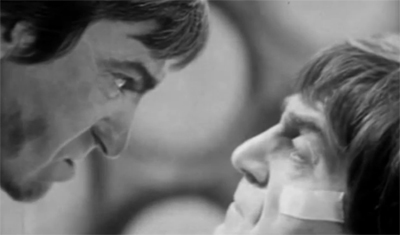
The Enemy of the World is an absolute joy from start to finish. Far too often, six-part Doctor Who serials tend to feel over-padded or over-stuffed, more a result of budget and production constraints than of any creative imperative to tell a story spread across six weeks. Instead, The Enemy of the World is a thoughtful, playful and fin six-part adventure that shows off Patrick Troughton at his best, with Dennis Whitaker’s script toying with various genre expectations and some interesting ideas about who the Doctor really is.

Face to face...

Face to face…

Continue reading

Doctor Who: The Ice Warriors (Review)

To celebrate the fiftieth anniversary of the longest-running science-fiction show in the world, I’ll be taking weekly looks at some of my own personal favourite stories and arcs, from the old and new series, with a view to encapsulating the sublime, the clever and the fiendishly odd of the BBC’s Doctor Who.

The Ice Warriors originally aired in 1967.

It’s strange that the Jon Pertwee era tends to attract so much criticism for adhering so rigidly to formula, with Barry Letts and his team rigidly working within well-defined lines and trying hard to produce television that doesn’t suck. Outside of the political criticism of the Pertwee era, there’s a train of thought that suggests the show became a little too formulaic, a little too predictable, failing to really push its own boundaries, with a few scattered exceptions.

And yet the Patrick Troughton era was arguably just as much a slave to routine and formula. The Troughton era is defined by its “base under siege” stories, so massively influential that they’ve become a Doctor Who subgenre unto themselves. Episodes like Earthshock and The Almost People arguably serve as homages to the genre that peaked during the late sixties. Indeed, allowing for some measure of flexibility, six of the seven adventures in this season could be described as “base under siege” stories.

I can’t help but wonder if the destruction of so many Troughton-era stories has led many Doctor Who fans to become blinded by nostalgia reflecting on the era. The Tomb of the Cybermen is, after all, much more exciting as the sole surviving “base under siege” story of the fifth season than it as the first of six adventures loosely adhering to the same structure and conventions.

Ice to meet you...

Ice to meet you…

Continue reading

Non-Review Review: Diana

Diana is a rare beast. You have to try very hard to make a biography film that is so perfectly and so calculatedly terrible. Diana isn’t the product of people who don’t care, it’s the product of people who care too much about the cynical market of prestige biography films. As such, with focus-group precision targeting, the film hits what might be the most bitter of sweet spots. It is both toothless and incredibly cynical; manipulative and shallow; vacuous and crammed with unnecessary and irritating detail.

Most damning of all is the way that the film seems perfectly calibrated to fit the public image of the People’s Princess, never bold enough to challenge or explore her work, her life or her legacy. Given how raw the public’s nerves are, even sixteen years after her tragic death, it might have been expecting too much to hope for a provocative or compelling exploration of one of the most iconic figures of the past three decades. However, we might have hoped it would at least be interesting.

It's a minefield...

It’s a minefield…

Continue reading

Doctor Who: Day of the Daleks – Special Edition (Review)

To celebrate the fiftieth anniversary of the longest-running science-fiction show in the world, I’ll be taking weekly looks at some of my own personal favourite stories and arcs, from the old and new series, with a view to encapsulating the sublime, the clever and the fiendishly odd of the BBC’s Doctor Who.

Day of the Daleks originally aired in 1972.

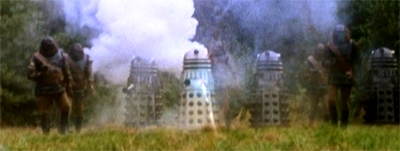
Day of the Daleks is a rather wonderful little story that’s been tucked away and forgotten about due its fairly lousy execution. After all, it’s hard to take a story particularly seriously when it suggests that the fate of the world will be decided by an assault on an old country house by three Daleks and a handful of extras. The wonderful people on the Doctor Who Restoration Team have done a wonderful job putting together a special edition of the adventure, using enhanced CGI effects and new footage to give the story the scale that it really deserves. After all, Day of the Daleksrepresents a bold attempt to do something new with the time travel at the very heart of the series.

Dawn of the Daleks...

Continue reading

Non-Review Review: Alan Partridge – Alpha Papa

Alan Partridge: Alpha Papa successfully brings the BBC icon to the big screen. He’s come a long way from a sports desk persona on a BBC4 parody radio show, and modern British comedy owes a lot to Coogan’s creation. Partridge has been around for over twenty years at this point, in many ways becoming more recognisable than Steve Coogan himself. It’s surprising that it’s taken this long to shepherd Partridge to the big screen.

Partridge is the king of what might be termed “cringe comedy”, and is a clear forbearer of Ricky Gervais’ David Brent. As such, it’s possible to feel that Partridge is a little dated. Certainly, there are times when Alpha Papa plays out like it could be an extended holiday special featuring North Norfolk’s most famous radio DJ. To be fair, that’s not a bad thing. Coogan is on fine form here, the comedy is broad and the wit is quick enough that there’s never a dull moment.

It’s a giant-sized helping of the comedy character, one which stays true to his roots even if it does occasionally feel like it over-simplifies him a bit.

On the air, and on the line...

On the air, and on the line…

Continue reading

Doctor Who: Doomsday (Review)

To celebrate the fiftieth anniversary of the longest-running science-fiction show in the world, I’ll be taking weekly looks at some of my own personal favourite stories and arcs, from the old and new series, with a view to encapsulating the sublime, the clever and the fiendishly odd of the BBC’s Doctor Who.

Doomsday originally aired in 2006.

Daleks, be warned. You have declared war upon the Cybermen.

This is not war. This is pest control.

We have five million Cybermen. How many are you?

Four.

You would destroy the Cybermen with four Daleks?

We would destroy the Cybermen with one Dalek. You are superior in only one respect.

What is that?

You are better at dying.

– the Cyberleader and Dalek Sec compete for the title of “bitchiest Doctor Who villain”

Part of my frustration with Doomsday is the same problem that I have with the rest of the second season’s weaker episodes. Like Fear Her or Rise of the Cybermen, the second season finalé lacks ambition. It feels complacent, it feels comfortable. It feels like putting the Daleks and the Cybermen together in one episode is enough to merit attention, without anything more than exchanging pithy one-liners. It feels like the separation of the Doctor and his companion is the biggest and most important thing in the universe, without really convincing us that this isn’t the best possible outcome. It feels like the easiest way to make these threats palpable is to set them in modern London, without any real sense of consequence or scale.

The tears of a Time Lord...

The tears of a Time Lord…

Continue reading