• Following Us

  • Categories

  • Check out the Archives


  • Awards & Nominations

Doctor Who: The Eleventh Hour (Review)

To celebrate the fiftieth anniversary of the longest-running science-fiction show in the world, I’ll be taking weekly looks at some of my own personal favourite stories and arcs, from the old and new series, with a view to encapsulating the sublime, the clever and the fiendishly odd of the BBC’s Doctor Who.

The Eleventh Hour originally aired in 2010.

So, coming?

No.

You wanted to come fourteen years ago.

I grew up.

Don’t worry. I’ll soon fix that.

– the Doctor and Amy

The arrival of a new producer on Doctor Who always represents a shift in some way shape or form. The change from Barry Letts to Philip Hinchcliffe must have seemed radical, even at the time. Graham Williams following Hinchcliffe represented a similarly strange departure. The departure of Russell T. Davies, the producer who had brought Doctor Who back to television after over a decade, was always going be a pretty significant change for those watching. Steven Moffat’s first episode as producer might not seem like it’s a shocking departure from what came before, but it also quite efficiently and effectively distinguishes Moffat’s tenure from that of his direct predecessor.

While by no means as radical a shift as Spearhead from Space, there is a very clear feeling that The Eleventh Hour brings with it significant tonal and thematic changes to the tale of the Doctor.
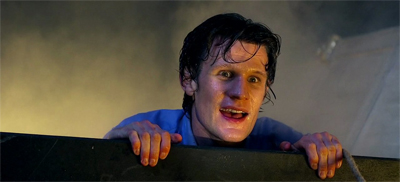
A mad man with a box...

A mad man with a box…

Continue reading

Doctor Who: Spearhead From Space (Review)

To celebrate the fiftieth anniversary of the longest-running science-fiction show in the world, I’ll be taking weekly looks at some of my own personal favourite stories and arcs, from the old and new series, with a view to encapsulating the sublime, the clever and the fiendishly odd of the BBC’s Doctor Who.

Spearhead from Space originally aired in 1970.

Oh well, at least he won’t get very far.

You mean, before your men shoot him again?

I don’t find that funny.

– The Brigadier and Liz discuss the Doctor’s (second) escape

Looking back now, it’s hard to believe that Spearhead from Space had so much riding on it, if only because of the deft combination of Robert Holmes’ sharp script and Derek Martinus’ confident direction. Indeed, the serial served as something of a second pilot for the show, demonstrating that the survival of the series during the transition between William Hatnell and Patrick Troughton had not been a fluke, broadcasting in colour for the first time, and setting up an entirely new status quo set primarily on present-day Earth. It’s a miracle that it all works so well, let alone that fact that it remains one of the most accessible adventures featuring the character.

We need a Doctor in the TARDIS!

Continue reading

Doctor Who: The Aztecs (Review)

To celebrate the fiftieth anniversary of the longest-running science-fiction show in the world, I’ll be taking weekly looks at some of my own personal favourite stories and arcs, from the old and new series, with a view to encapsulating the sublime, the clever and the fiendishly odd of the BBC’s Doctor Who.

The Aztecs originally aired in 1964.

Don’t you see? If I could start the destruction of everything that’s evil here, then everything that is good would survive when Cortes lands.

But you can’t rewrite history! Not one line!

– Barbara and the Doctor discuss time travel

The Aztecs is generally considered one of the show’s very best historicals, so I think it’s absolutely wonderful that the adventure has managed to survive the purges that wiped out a significant portion of the Hartnell era and a huge chunk of Patrick Troughton’s work.

A low-tec culture?

Continue reading

Doctor Who: The Keys of Marinus (Review)

To celebrate the fiftieth anniversary of the longest-running science-fiction show in the world, I’ll be taking weekly looks at some of my own personal favourite stories and arcs, from the old and new series, with a view to encapsulating the sublime, the clever and the fiendishly odd of the BBC’s Doctor Who.

The Keys of Marinus originally aired in 1964.

While the initial thirteen-episode block helped established Doctor Who, it was the follow-up stories that built on those initial blue-prints. Marco Polo was a historical adventure in the style of An Unearthly Child, paying homage to the original educational aim of the series, designed to teach kids about history and science. However, the real breakout of the initial run had been The Daleks, with those adorable psychotic pepper pots. Keen to capitalise on the success of the futuristic adventure, another adventure serial was commissioned to take place on an alien world, with Terry Nation’s The Keys of Marinus helping to establish science fantasy as a concrete part of the show’s identity.

All a-Voord!

Continue reading

Doctor Who: The Edge of Destruction (Review)

To celebrate the fiftieth anniversary of the longest-running science-fiction show in the world, I’ll be taking weekly looks at some of my own personal favourite stories and arcs, from the old and new series, with a view to encapsulating the sublime, the clever and the fiendishly odd of the BBC’s Doctor Who.

The Edge of Destruction originally aired in 1964.

The Edge of Destruction is an interesting little two-parter. Basically created to fill out a two-episode gap in the end of the initial run of episodes following the four-part An Unearthly Child and the seven-part The Daleks. It wasn’t possible to bring Marco Polo forward into this production block, as it was too long, and there wasn’t any budget provided for a guest cast or for new sets. So, as seemed to happen quite a lot on the show, the production team’s ingenuity forced their creativity. The Edge of Destruction (or Inside the Spaceship) ended up being a two-part “bottle” episode, featuring only the four members of the lead cast.

After seven episodes of The Daleks, I can’t blame the Doctor for wanting a nap…

Continue reading

Doctor Who: The Daleks (Review)

To celebrate the fiftieth anniversary of the longest-running science-fiction show in the world, I’ll be taking weekly looks at some of my own personal favourite stories and arcs, from the old and new series, with a view to encapsulating the sublime, the clever and the fiendishly odd of the BBC’s Doctor Who.

The Daleks originally aired in 1963-4.

Make! no! attempt! to! capture! them! they! are! to! be! exterminated! you! understand! exterminated!

– four episodes in, the Daleks have a catchphrase

Because of the somewhat confusing naming conventions for the Hartnell era, where each individual episode had its own title, this one goes by a variety of names: The Mutants, The Dead Planet, or The Daleks. Still, if you’re reading this, you probably know the serial I’m talking about. It’s the one that introduced everyone’s favourite psychotic little pepper pots.

Taking the plunger…

Continue reading

Doctor Who: An Unearthly Child (Review)

To celebrate the fiftieth anniversary of the longest-running science-fiction show in the world, I’ll be taking weekly looks at some of my own personal favourite stories and arcs, from the old and new series, with a view to encapsulating the sublime, the clever and the fiendishly odd of the BBC’s Doctor Who.

An Unearthly Child originally aired in 1963.

“Just open the doors, Doctor Foreman.”

“Eh? Doctor who? What’s he talking about?”

– Ian and the Doctor drop the title

And so, it begins…

There from the beginning…

Continue reading

Watch! The Full 1985 Version of The Hobbit! In Russian!

Okay, since there’s no subtitles this is sort of a bit of a niche thing, but I found it and thought I’d pass it on.

Below is the full 1985 version of The Hobbit produced for Russian television. It is… a little less impressive than Peter Jackson’s adaptation, and not just because it’s in less than 48 frames per second and two dimensions. Still, I kinda admire the ambition of it, even if the results are less than spectacular. Check out how they take down Smaug, for an example, or the way that the action cuts back to the “narrator” before any expensive shots are required.

The whole thing calls to mind the sort of stuff the BBC were doing with Doctor Who at the time, and I can’t quite hate it. After all, the matte paintings are great and at least it seems committed to an idea that would have been technically quite difficult for a big-budget movie of the time, let alone state television.

Check it out below and let me know what you think!

Doctor Who: The Snowmen (Review)

Snowmen are rubbish in July. You’ll have to be better than that.

– the Doctor points out that the Great Intelligent doesn’t seem especially… intelligent

The Snowmen is a return to the sort of plot-driven Christmas Special that we occasionally saw during the Davies era. Much like The Christmas Invasion was concerned with introducing David Tennant and The End of Time, Part I was focused on wrapping up the Davies era, The Snowmen feels like it’s more concerned with setting up the fiftieth anniversary half-season ahead than it is with being a Christmas Special in its own right.

Sure, The Snowmen has all the festive trappings you might expect. There are killer snowmen, as the title implies. There’s a rich lonely old miser, as we’ve come to expect in these sorts of tales. There’s a nice Victorian setting for all the action as well. However, The Snowmen devotes a considerable amount of time to developing the mystery surrounding the Doctor’s new companion, and setting up a recurring foe for this fiftieth anniversary half-season.

The result is somewhat unsatisfying, as if The Snowmen is working harder to check the requisite boxes than it is to provide seasonal Doctor Who viewing.

What white teeth they have...

What white teeth they have…

Continue reading

Doctor Who: A Town Called Mercy (Review)

I see ‘Keep Out’ signs as suggestions more than orders.

– the Doctor

To be fair, it’s very clear that these two annual trips to North America have been an attempt for Doctor Who to “break” into the market place over there – to provide viewers with something recognisable as a gateway to a uniquely British television show. While the American backdrop of The Impossible Astronaut and Day of the Moon added some wonderful stylistic touches, and a nice juicy role for President Nixon, A Town Called Mercy feels like a more overt attempt to tell a distinctly “American” story within the framework of the show. Borrowing more than just its aesthetic from the setting, A Town Called Mercy is also decidedly American in theme and tone.

A gunslinger built…

Continue reading