• Following Us

  • Categories

  • Check out the Archives


  • Awards & Nominations

Star Trek: Deep Space Nine – Duet (Review)

Star Trek: Deep Space Nine is twenty years old this year. To celebrate, I’m taking a look at the first season. Check back daily for the latest review or retrospective.

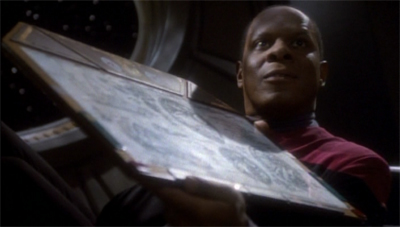
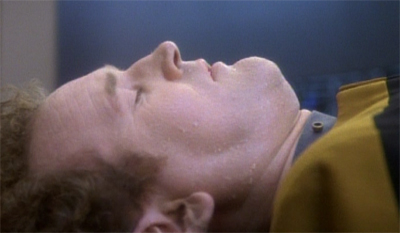
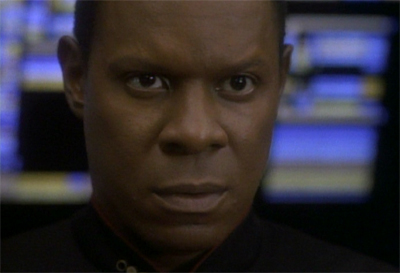
And here we hit the first truly classic episode of Star Trek: Deep Space Nine. Positioned almost at the very end of what has been a fairly uneven season of television, Duet firmly demonstrates that this spin-off can hold its head tall among the other franchise installments. Duet isn’t just a quintessential Deep Space Nine episode. It isn’t just a classic Star Trek episode. It is an absolutely beautiful piece of allegory, a stunning character study and a probing exploration of collective guilt and responsibility.

J'accuse...

J’accuse…

Continue reading

Star Trek: Deep Space Nine – Dramatis Personae (Review)

Star Trek: Deep Space Nine is twenty years old this year. To celebrate, I’m taking a look at the first season. Check back daily for the latest review or retrospective.

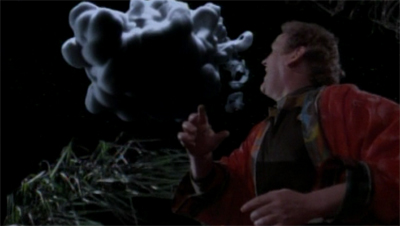
Dramatis Personae tends to get lost in the shuffle at the end of Star Trek: Deep Space Nine‘s first season. Sitting between two of the season’s most generic Star Trek stories (If Wishes Were Horses… and The Forsaken) and two distinctly Deep Space Nine classics (Duet and In the Hands of the Prophets), it’s easy to see why Joe Menosky’s tale of repeated history tends to get overlooked. It manages to sit quite neatly in both camps, as a generic Star Trek tale and as something more specific to Deep Space Nine.

After all, possession stories are scattered throughout the Star Trek mythos. Star Trek: The Next Generation was quite fond of have various members of the crew impersonated or doubled or controlled by a variety of alien influences. Dramatis Personae also feels like a very Joe Menosky script, linked by various thematic connections to the writer’s work on both The Next Generation and later on Star Trek: Voyager.

And yet, despite all those links, Dramatis Personae feels quite anchored to Deep Space Nine. It’s hard to imagine the dynamic working with any other Star Trek cast, even Voyager‘s Maquis and Starfleet ensemble. There’s also the sense that the episode’s pattern of repeated history feels more in keeping with Deep Space Nine‘s perception of history than any other Star Trek show’s.

The man with the plan...

The man with the plan…

Continue reading

Star Trek: Deep Space Nine – Progress (Review)

Star Trek: Deep Space Nine is twenty years old this year. To celebrate, I’m taking a look at the first season. Check back daily for the latest review or retrospective.

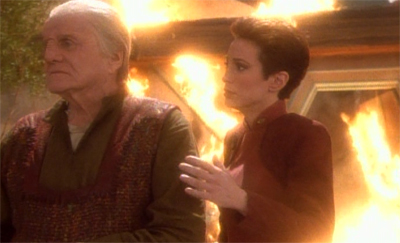
Progress is the best episode of Star Trek: Deep Space Nine‘s first season to date. Of course, there are better episodes ahead – two of them clustered at the end of the show’s truncated first year – but Progress still represents a considerable improvement over anything that has come before. It isn’t quite perfect, but it does have a nice character focus and takes advantage of the show’s unique perspective and position. It’s evidence that the writing staff were at least engaging with the show’s status quo and trying to work with it to tell interesting stories, with Progress offering an early pure example of what Deep Space Nine story should probably look like.

While the first season has been quite bumpy (although notably less bumpy than any of the opening seasons of the other three Star Trek spin-offs), Progress offers a demonstration that we are getting somewhere. The title might apply as much to the status of the show itself as to the themes of the episode.

Burning down the house...

Burning down the house…

Continue reading

Star Trek: Terok Nor – Night of the Wolves by S.D. Perry & Britta Dennison (Review)

Star Trek: Deep Space Nine is twenty years old this year. To celebrate, I’m taking a look at the first season. Check back daily for the latest review or retrospective.

We’ll be supplementing our coverage of the episodes with some additional materials – mainly novels and comics and films. This is one such entry.

Prequels are a tricky business. Not just because we already know the ending – after all, we love adapting old familiar stories in new ways, and knowing the outcome can easily lend a project an air of grand tragedy or irony. However, the temptation with prequels is to make it all make sense, to tie absolutely everything up in a neat little bow, resolving all the plot threads and removing any hint of ambiguity or mystery from the original work – less of a story in its own right and more of a “fill in the blanks” approach.

James Swallow’s Day of the Vipers occasionally fell into this trap as it offered an account of the Cardassian plot to take control of Bajor, but it managed to offer its own insights and character development – giving us a suitably complex and self-justifying version of Gul Dukat. Night of the Wolves is somewhat less successful at avoiding the same problems, with a plot that appears to have been fashioned by linking off-hand references and back story from various early episodes together.

We get Odo and Kira meeting for the first time; an account of the liberation of Gallitep; a back story for a young Damar; the roots of Natima Lang’s dissatisfaction with the Central Command. None of these threads seem to build to anything insightful or clever, instead playing out predictably – pretty much exactly as we might have imagined them.

Continue reading

Star Trek: Deep Space Nine – The Storyteller (Review)

Star Trek: Deep Space Nine is twenty years old this year. To celebrate, I’m taking a look at the first season. Check back daily for the latest review or retrospective.

The Storyteller should not work half as well as it does. While some episodes this season (notably The Passenger and Battle Lines) feel like they were simply lifted directly from the “reject” pile within the writers’ room on Star Trek: The Next Generation, The Storyteller is actually a rejected pitch from that show’s first season. Written by Kurt Michael Bensmiller, the writer responsible for Time Squared, one of the stronger installments of the show’s first two years, it was also written late in 1992, about a month before Star Trek: Deep Space Nine would actually air.

And yet, despite that, The Storyteller really feels like a show that wouldn’t work on any of the other Star Trek spin-offs. A lot of that seems to be down to the work by Ira Steven Behr to polish up Bensmillers’ draft and to add a lot of character work and development to what is a decidedly high concept. As producer Michael Piller confessed in Captains’ Logs Supplemental – The Unauthorized Guide to the New Trek Voyages, “Ira did a lot of work on that script.”

O'Brien's mind is a bit clouded right now...

O’Brien’s mind is a bit clouded right now…

Continue reading

Star Trek: Deep Space Nine – Battle Lines (Review)

Star Trek: Deep Space Nine is twenty years old this year. To celebrate, I’m taking a look at the first season. Check back daily for the latest review or retrospective.

Battle Lines is, quite frankly, not a very good piece of television. Like a few of the episodes scattered throughout the first season of Star Trek: Deep Space Nine, it feels like it was pulled from a list of rejected scripts for Star Trek: The Next Generation. Ironically, it feels more like a reheated left-over than the next episode, The Storyteller, which was actually a recycled script from the first season of The Next Generation. Were it not for the involvement of Kai Opaka and a few hints about Bajoran spirituality, Battle Lines would feel almost as generic as The Passenger.

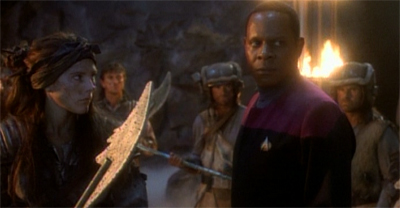
The concept is fascinating, and it represents another long-term shift in Deep Space Nine, but the script from Hilary J. Bader feels too functional and broad to do the episode justice. Instead, it feels fairly bland, which is a bit disappointing for an episode where Sisko accidentally gets the pope caught up in the universe’s most deadly game of laser tag.

Taking a stab at bringing peace...

Taking a stab at bringing peace…

Continue reading

Star Trek: Deep Space Nine – Babel (Review)

Star Trek: Deep Space Nine is twenty years old this year. To celebrate, I’m taking a look at the first season. Check back daily for the latest review or retrospective.

With Babel, we hit the most significant flaw in the first season of Star Trek: Deep Space Nine. Put frankly, Babel is the first story that could easily have worked as an episode of the original Star Trek or of Star Trek: The Next Generation. Indeed, Michael Piller concedes in Captains’ Logs Supplemental – The Unauthorized Guide to the New Trek Voyages that Babel had a history longer than that of Deep Space Nine itself:

We had this premise for over five years at Next Generation. It was written by the same person who wrote “Hollow Pursuits” for us, and we had always been attracted to the idea that you could suddenly lose the ability to use language and communicate, and how people are able to communicate with each other.

This isn’t necessarily a bad thing, but it’s worth noting that the first season of Deep Space Nine was airing concurrently with the sixth season of The Next Generation. If people wanted to see stories that could work on The Next Generation, it made more sense to see them executed on that show by a production team with experience in these sorts of plots.

While Babel isn’t a bad episode by any means, there’s a sense that it has been cobbled together from leftovers at another table, and the result isn’t nearly as satisfying as it should be.

Chief concerns...

Chief concerns…

Continue reading

Star Trek: Deep Space Nine – Prophecy & Change: Ha’Mara by Kevin G. Summers (Review)

Star Trek: Deep Space Nine is twenty years old this year. To celebrate, I’m taking a look at the first season. Check back daily for the latest review or retrospective.

We’ll be supplementing our coverage of the episodes with some additional materials – mainly novels and comics and films. This is one such entry.

Comparing and contrasting the anniversary short story anthologies for Star Trek: The Next Generation and Star Trek: Deep Space Nine can be highly informative. The Sky’s the Limit, released to celebrate the twentieth anniversary of The Next Generation, features fourteen stories. Most of these stories serve as prologues or epilogues to existing Next Generation episodes. Suicide Note provides closure to The Defector; Turncoats follows a character from Face of the Enemy after the camera stops rolling; Four Lights is an epilogue to Chain of Command.

In contrast, Prophecy and Change, released to celebrate the tenth anniversary of Deep Space Nine, tends to focus on short stories that fit gracefully between episodes – fleshing out connective tissue and explaining how one plot development or character decision led to another. That says quite a lot about the two shows and the way that their stories were told, with much of Prophecy and Change feeling ling deleted scenes or inserts loosely inserted between what was seen in television.

Ha’Mara is the first short story of the collection, following the introduction and the mysterious Revisited – a book-ending wrap-around written by an author who has yet to be publicly identified. Written by Kevin G. Summers, who provided Isolation Ward 4 to Strange New Worlds IV, the short story is set in the immediate aftermath of Emissary, attempting to smooth over the rough edges transitioning from the pilot to the rest of the show.

ds9-prophecyandchange

Continue reading

Star Trek: Deep Space Nine – Past Prologue (Review)

Star Trek: Deep Space Nine is twenty years old this year. To celebrate, I’m taking a look at the first season. Check back daily for the latest review or retrospective.

Past Prologue is a pretty decent second episode of Star Trek: Deep Space Nine. It does what it needs to do, serving primarily to build the world of Deep Space Nine just a little bit. After all, a story like this was inevitable with a character like Kira in the main cast, so it’s probably for the best that the show deals with it so early. It’s not a classic episode by any means, feeling as if the show was obligated to tell this particular story. Then again, I suppose that’s what the first season of any television show is for. Set up and development.

Past Prologue continues to hint at the strengths of Deep Space Nine, investing considerable effort in crafting a tangible setting for the series. However, there’s also a hint of the weaknesses of the first season to be found here. Like just about any of the Star Trek spin-offs, Deep Space Nine is going to spend its first year searching for its identity. While Past Prologue indicates the series is looking the right direction, it hasn’t quite found its footing.

Los cannon...

Los cannon…

Continue reading

Star Trek: Deep Space Nine – Emissary (Review)

Star Trek: Deep Space Nine is twenty years old this year. To celebrate, I’m taking a look at the first season. Check back daily for the latest review or retrospective.

Star Trek: Deep Space Nine is a phenomenal piece of television. It’s often a bit overlooked because of its unique setting. After all, the words Star Trek evoke space ships and new worlds – “new life forms and new civilisations.” As such, a Star Trek series about a space station feels counter-intuitive. “To boldly sit” is the hardly the most dynamic premise. And yet, despite that, there’s a very serious argument to be made that Deep Space Nine is the crowning accomplishment of television Star Trek. It’s certainly the last great attempt to boldly push the franchise forward, with Star Trek: Voyager and Star Trek: Enterprise feeling just a tad regressive and conservative in comparison.

Indeed, Deep Space Nine represents a massive narrative leap forward from the success of Star Trek: The Next Generation, which remains one of the greatest science-fiction shows ever produced. For better or worse, Emissary makes it quite clear that Deep Space Nine is not an attempt to copy its direct predecessor, even if some of the other episodes in the first season might back-pedal a bit. In fact, it’s surprising just how well the pilot for this strangest of Star Trek shows holds up, suggesting a firmer grasp of its own identity than a few of the subsequent episodes could claim.

A Commanding presence...

A Commanding presence…

Continue reading