• Following Us

  • Categories

  • Check out the Archives


  • Awards & Nominations

Star Trek: Enterprise – Impulse (Review)

Next year, Star Trek is fifty years old. We have some special stuff planned for that, but – in the meantime – we’re reviewing all of Star Trek: Enterprise this year as something of a prequel to that anniversary. This August, we’re doing the third season. Check back daily for the latest review.

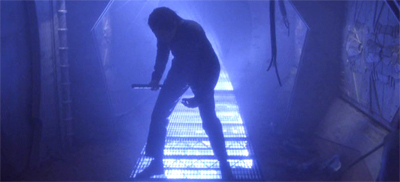
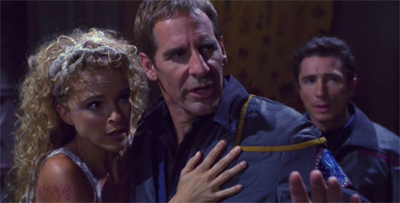
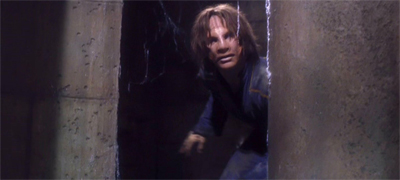
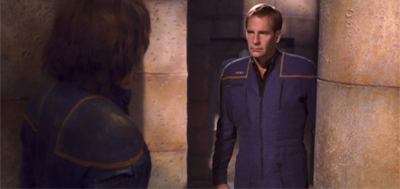
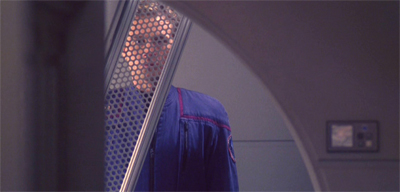
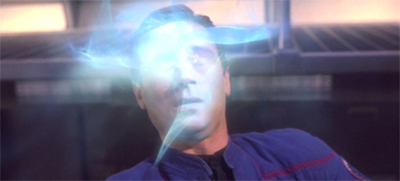
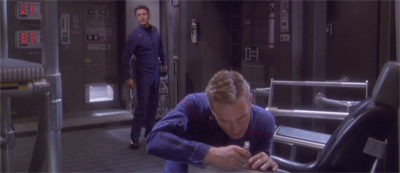
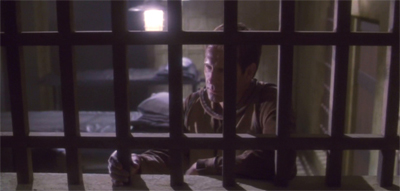
Impulse is a Star Trek zombie story.

It might sound absurd, but it works very well. After all, the Star Trek franchise rooted in pulp space horror, with extended stretches of the original show portraying space as haunted. In some ways, Impulse could be seen as a logical extension of Regeneration from late in the second season. Both episodes are very much modelled on the classic zombie horror movie formula, both deal with how traditional Star Trek morality applies to that formula, and both are even directed by veteran Star Trek producer David Livingston, who brings a nice kinetic feel to the adventures.

Dead space...

Dead space…

Impulse works a lot better than it really should. There are some plotting issues created by the secondary storyline grafted into the episode, and the show doesn’t quite develop its Vulcan themes as well as it might. However, it compensates for these issues with an incredible sense of energy and momentum. The third season of Star Trek: Enterprise might be the first season of Star Trek to be seriously facing cancellation in decades, but it had an entirely new lease on life.

Impulse is a bold and exciting piece of television, one that feel vital and urgent. It recaptures some of the appeal of the new status quo that had been somewhat squandered by Extinction and Rajiin.

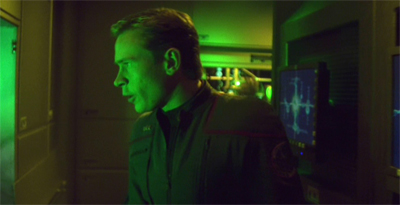
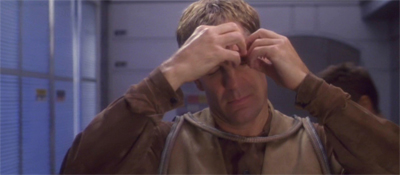
Reed shirt...

Reed shirt…

Continue reading

Star Trek: Enterprise – Rajiin (Review)

Next year, Star Trek is fifty years old. We have some special stuff planned for that, but – in the meantime – we’re reviewing all of Star Trek: Enterprise this year as something of a prequel to that anniversary. This August, we’re doing the third season. Check back daily for the latest review.

Rajiin is not as bad as Extinction. So there’s that.

Rajiin continues the pulpy theme that runs through the third season of Star Trek: Enterprise and into the fourth. There is a sense that the writing staff are cutting loose with a collection of decidedly retro science-fiction tropes that they found in the old storage cupboard. The third and fourth seasons have a gonzo energy to them, with elements like the reptile!Xindi and the evil!alien!space!Nazis feeling like ideas that escaped from the types of magazines where Benny Russell used to work.

"Captain, my scans report that she does have Bette Davis eyes."

“Captain, my scans report that she does have Bette Davis eyes.”

At its best, this new storytelling freedom allows the show to cut loose with ideas that would have made Star Trek: The Next Generation or Star Trek: Voyager blush. The show would never have attempted episodes like Impulse and North Star in its first or second season. Even if the episodes are not flawless, they have an energy and vitality that was sorely lacking in the first two years of the show. It feels like the writing staff are really having fun with the concept, playing with the sort of goofy ideas that they never would have attempted a year or so earlier.

Of course, there is a flip side to that coin. The biggest misfires of the third season are generally rooted in that pulpy storytelling style. Extinction was effectively a “lost race” story that felt like a throwback to colonial narratives about explorers in exotic parts of the world. Rajiin is the story of an alien seductress who our hero rescues from slavery, only to use her womanly wiles to seduce the crew for a sinister purpose.

"Hey, Kirk got to do this all the time!"

“Hey, Kirk got to do this all the time!”

Continue reading

Star Trek: Enterprise – Extinction (Review)

Next year, Star Trek is fifty years old. We have some special stuff planned for that, but – in the meantime – we’re reviewing all of Star Trek: Enterprise this year as something of a prequel to that anniversary. This August, we’re doing the third season. Check back daily for the latest review.

In many respects, The Xindi and Anomaly opened the third season as if it were the first season of a new show. In particular, Anomaly built consciously and cleverly off of Fight or Flight and Strange New World in providing a solid foundation for the year ahead. The comparison works quite well. By that logic, Extinction and Rajiin serve as Unexpected and Terra Nova. They are two of the weakest episodes of the season, harmed by their close proximity to the start of the year. Anybody wanting to reach Twilight or Damage has to get through Extinction and Rajiin.

In many respects, this early lag in the third season demonstrates just how inexperienced the creative team were at long-form serialised storytelling. The only arc comparable to the Xindi arc in the entire Star Trek franchise is the Dominion War arc on Star Trek: Deep Space Nine. There, the writers were clever enough to launch the new status quo with an unheralded six-episode interconnected story. The Dominion War had its share of duds, but the opening salvo was magnificently confident.

Archer's not feeling himself lately...

Archer’s not feeling himself lately…

In contrast, the third season of Star Trek: Enterprise suffers out of the gate. The Xindi and Anomaly do good work setting up plot points and character beats that will be of use later in the season, but there is no real sense that the writing staff has any idea what that use might be at this point of the season. Two episodes into the third season, the show is already back to fairly formulaic adventures that stand quite cleanly alone. It is not too difficult to imagine Extinction or Rajiin as episodes in any other season – albeit with some slight tinkering.

However, this is only part of the problem. Long-form storytelling need not become a burden. There is a great deal of value to be had in drifting away from a serialised story arc to tell a quality standalone tale. Unfortunately, Extinction is not a quality standalone tale. In fact, it is one of the worst episodes of Enterprise ever produced. Airing it as the third episode of a bold new season feels like a poor choice.

"C'mon, wouldn't you like to go back to being a torturing and almost genocidal human?"

“C’mon, wouldn’t you like to go back to being a torturing and almost genocidal human?”

Continue reading

Star Trek: Enterprise – Anomaly (Review)

Next year, Star Trek is fifty years old. We have some special stuff planned for that, but – in the meantime – we’re reviewing all of Star Trek: Enterprise this year as something of a prequel to that anniversary. This August, we’re doing the third season. Check back daily for the latest review.

Anomaly continues the sense that the third season of Star Trek: Enterprise is essentially a new first season of the show.

That is most obvious in the way that the script works hard to establish the ground rules of the Expanse. There is a sense that the episode is very clearly establishing rules and plot points that will come into play later in the run. Anomaly not only explains why mining for trellium-D is such a profitable enterprise; explaining that ships without it are susceptible to all sorts of strange distortions to the laws of physics. Anomaly also introduces the spheres, strange structures that will become a key part of the third season’s mythology.

A good man goes to war...

A good man goes to war…

The show is also marking out ground for later exploration. Anomaly becomes a lot more potent in hindsight, with various decisions here reversed in later episodes. In Anomaly, Archer is a victim of piracy; in Damage, he is forced to commit piracy. In Anomaly, Archer tortures a prisoner in order to procure information that he needs; in Countdown, Hoshi is tortured by Dolim in order to procure information that he needs. It is not entirely clear whether these plot beats were figured out ahead of time, but – like the destroyed Xindi home world in The Xindi – they lend the third season a nice sense of moral symmetry.

Most interestingly – and, perhaps, most pointedly – Anomaly represents a clear return to two very early episodes of the first season. The script of Anomaly touches quite overtly on plot points from Fight or Flight and Strange New World. In some ways, it could be seen as a belated do-over.

Sparks fly...

Sparks fly…

Continue reading

Star Trek: Enterprise – First Flight (Review)

Next year, Star Trek is fifty years old. We have some special stuff planned for that, but – in the meantime – we’re reviewing all of Star Trek: Enterprise this year as something of a prequel to that anniversary. This April, we’re doing the second season. Check back daily for the latest review.

First Flight is a prequel to a prequel.

First Flight unfolds before the events of Broken Bow, providing something of a belated origin story for Captain Jonathan Archer. The tail end of the second season feels like an odd place for such a story. The decision to air First Flight and Bounty as a double feature meant that First Flight premiered only a week before The Expanse, an episode that changed everything that fans thought they knew about Star Trek: Enterprise. Then again, perhaps this is the perfect place for an episode like this.

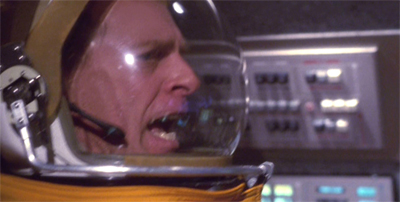
Ground Control to Commander Robinson... Ground Control to Commander Robinson...

Ground Control to Commander Robinson… Ground Control to Commander Robinson…

Much of the final stretch of the second season of Enterprise is introspective and reflective. The show seems aware that a big change is coming, and takes the opportunity of these last few episodes to look back on a classic model of Star Trek. Judgment puts Archer on trial; Cogenitor wonders whether old-fashioned Star Trek morality plays can still work in the twenty-first century; Regeneration finds the Borg lying among the (literal) wreckage of Star Trek: The Next Generation. First Flight opens with the death of Captain A.G. Robinson, a character we never met before.

More to the point, First Flight opens with the death of the man who was almost the captain of the Enterprise. On the cusp of a creative change in direction that effectively kills the show as it existed in the first two seasons, First Flight is pretty heavy on the symbolism.

... Take your protein pill and put your helmet on...

… Take your protein pill and put your helmet on…

Continue reading

Star Trek: Enterprise – Regeneration (Review)

Next year, Star Trek is fifty years old. We have some special stuff planned for that, but – in the meantime – we’re reviewing all of Star Trek: Enterprise this year as something of a prequel to that anniversary. This April, we’re doing the second season. Check back daily for the latest review.

It seems like a bit of an understatement to describe Regeneration as highly controversial.

The blu ray release of the second season of Star Trek: Enterprise includes two commentaries for the episode, a sure sign that there is a lot to talk about. On a track recorded in 2005, writers Mike Sussman and Phyllis Strong describe the episode as “infamous.” On a track recorded in 2013, John Billingsley describes how certain segments of fandom considered it a “jumping the shark” moment for the show. That last statement illustrates one of the perverse qualities of Star Trek fandom; one would assume that the viewers turned off by Regeneration would have already tuned out with Acquisition.

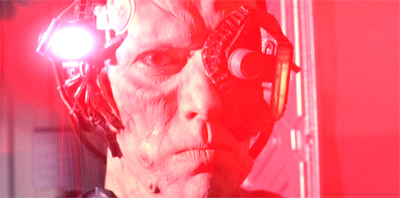
We are Borg.

We are Borg.

After all, the decision to bring back the Ferengi in Acquisition is hard to explain. Nobody was clamouring for more Ferengi episodes after Star Trek: Deep Space Nine had gone off the air. Outside of Deep Space Nine, the most enduring impression of the Ferengi was that they had begun their life as “villains that didn’t quite work” and bad quickly been transformed into “comic relief that didn’t quite work.” As such, it is hard to account for the decision to bend continuity in order to introduce the Ferengi into the first season of a prequel show designed to escape the baggage of the larger Star Trek franchise.

On the other hand, it made a great deal of sense to bring back the Borg. After all, the Borg were one of the few Star Trek aliens created after 1969 to make a genuine impression on popular culture. The Borg will never be as iconic as Klingons or Vulcans, but they will always be more iconic than Cardassians or Bajorans. They were also stars of the best-loved Star Trek movie starring the cast of Star Trek: The Next Generation. The Borg are a big deal; there is a reason that Star Trek: Voyager ran them into the ground.

"Assimilate this!"

“Assimilate this!”

It is no wonder that the Borg are frequently cited in discussions around the future of JJ Abrams’ Star Trek reboot. Asked if the creative team would consider bringing the Borg to the rebooted twenty-third century, Roberto Orci answered, “I think we would think about it.” Damon Lindelof was even blunter in his assessment, “You can’t talk about Trek and not talk about the Borg.” While they have undoubtedly been over-exposed and over-used since they first appeared in Q Who?, the Borg are the most distinctive and most successful addition to the Star Trek mythos outside the classic show.

While common sense and experience seemed to weigh against bringing back the Ferengi in Acquisition, it seems that continuity is the only thing holding the Borg back from making an appearance on Enterprise. That said, Sussman and Strong find a clever way around that issue, by remembering the suggestion in Broken Bow that Enterprise is as much a sequel to Star Trek: First Contact as a prequel to the rest of the Star Trek universe.

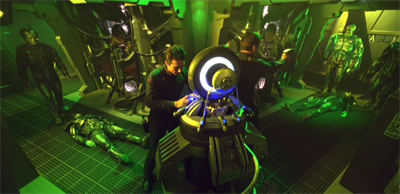
"Oh no, Cap'n, they've discovered the mood lightin' settin'."

“Oh no, Cap’n, they’ve discovered the mood lightin’ settin’.”

Continue reading

Star Trek: Enterprise – The Crossing (Review)

Next year, Star Trek is fifty years old. We have some special stuff planned for that, but – in the meantime – we’re reviewing all of Star Trek: Enterprise this year as something of a prequel to that anniversary. This April, we’re doing the second season. Check back daily for the latest review.

The Crossing represents a troubling return to form for the second season of Star Trek: Enterprise in a number of ways.

In terms of basic storytelling, the show is back at the point where it is simply throwing Star Trek plots into a blender and serving up a rather unappetising smoothy. The Crossing is packed with familiar Star Trek tropes – it is Return to Tomorrow by the way of Power Play through Cathexis. The idea of non-corporeal entities hijacking living bodies is not particularly novel, and The Crossing really has nothing new to offer in terms of that sort of story. There is no element of The Crossing as fun as Leonard Nimoy’s performance in Return to Tomorrow or the hostage crisis stakes of Power Play.

Here's Trip!

Here’s Trip!

However, even without the feeling of reheated leftovers, The Crossing is a very ugly little story. It reflects the reactionary post-9/11 politics of the show, the sense of isolationism and xenophobia that have become part of the fabric of Enterprise. The Crossing is essentially a fifties horror film repurposed as a post-9/11 cautionary tale about the dangers of trusting people who are not like you. It feels like a pretty solid indication of just how thoroughly Star Trek has lost its way. The decision to just externalise these anxieties in The Expanse is long overdue.

The fact that The Crossing is credited to the two showrunners driving Enterprise is quite worrying, particularly given that it serves to express an uncomfortable subtext running through the season.

Having a gas time...

Having a gas time…

Continue reading

Star Trek: Enterprise – The Catwalk (Review)

Next year, Star Trek is fifty years old. We have some special stuff planned for that, but – in the meantime – we’re reviewing all of Star Trek: Enterprise this year as something of a prequel to that anniversary. This April, we’re doing the second season. Check back daily for the latest review.

The Catwalk is a solid, if unexceptional, piece of Star Trek.

Given the problems that the second season of Star Trek: Enterprise has been having to date, it feels like a breath of fresh air. As with a lot of the episodes around it, The Catwalk feels a little familiar. There are refugees with a secret; an alien take-over of the ship; a clever bluff to reclaim the ship from a position of weakness. If we are looking at The Catwalk in the “… by way of …” formula that seems to apply to most of this stretch of the second season, The Catwalk is “Starship Mine by way of Basics.”

"Right, right! Goddammit, Trip, now we'll never get the high score!"

“Right, right! Goddammit, Trip, now we’ll never get the high score!”

However, The Catwalk feels a lot more functional than many of the earlier episodes in the season. A large part of that is down to the way that writers Mike Sussman and Phylis Strong play to their strengths. The inevitable alien hijacking and threat is relegated to the background; The Catwalk is almost half over by the time that anything actually happens. While the episode’s pacing is a little uneven, it does allow Sussman and Strong a bit of room to explore the characters, building up the sense that the crew is something of a family unit.

While The Catwalk isn’t innovative or particularly adventurous, it works quite well. The idea of pushing the whole crew into a confined space and having them weather the storm together feels like it captures a lot of the pioneering sense of adventure that the show has allowed to fade over the second season.

Don't forget to turn out the light...

Don’t forget to turn out the light…

Continue reading

Star Trek: Enterprise – Singularity (Review)

Next year, Star Trek is fifty years old. We have some special stuff planned for that, but – in the meantime – we’re reviewing all of Star Trek: Enterprise this year as something of a prequel to that anniversary. This April, we’re doing the second season. Check back daily for the latest review.

Star Trek: The Next Generation casts a pretty long shadow.

Singularity aired over eight years after All Good Things… and it still feels like an attempt to re-capture the mood and atmosphere of that second-generation Star Trek spin-off. Singularity feels like it might have made for a passable seventh-season instalment of The Next Generation, airing somewhere between Phantasms, Masks and Genesis. You would probably only have to tweak Singularity ever-so-slightly for that earlier cast.

"Hai!"

“Hai!”

Of course, this fixation on The Next Generation is not unique to the second season of Star Trek: Enterprise. After all, Star Trek: Voyager spent a significant portion of its run trying to re-capture the magic associated with The Next Generation. There were lots of generic aliens- and anomalies-of-the week. The second season of Enterprise is just interesting in this regard because it is really the last gasp of this sort of nostalgic storytelling on so wide a scale.

It would not be easy. It would take the box office failure of Star Trek: Nemesis, a change of management at UPN, falling ratings and the threat of cancellation. Nevertheless, Enterprise would eventually manage to exorcise the ghost of The Next Generation. In the meantime, Singularity offers a reminder of just how closely Enterprise was hewing to The Next Generation.

"Are you sitting comfortably? Then we'll begin."

“Are you sitting comfortably? Then we’ll begin.”

Continue reading

Star Trek: Enterprise – The Communicator (Review)

Next year, Star Trek is fifty years old. We have some special stuff planned for that, but – in the meantime – we’re reviewing all of Star Trek: Enterprise this year as something of a prequel to that anniversary. This April, we’re doing the second season. Check back daily for the latest review.

One of the biggest problems with positioning Star Trek: Enterprise as a prequel is that the original Star Trek was very much a product of its time. It is very difficult to line-up a television show broadcast in the early years of the twenty-first century with a series that was produced towards the end of the sixties. It is a completely different world, and so the show itself must inevitably be completely different.

This reflects itself in the production design of Enterprise. One of the more frequent fan complaints about the series concerns the design of the new ship. After all, it doesn’t look like anything Matt Jefferies would design. If anything, it looks like the missing link between a modern submarine and the Defiant from Star Trek: Deep Space Nine. All the pastels and mood lighting have been replaced with functional grey and buttresses. Kirk’s Enterprise and Archer’s Enterprise speak to two different aesthetics.

"What we've got here is failure to communicate..."

“What we’ve got here is failure to communicate…”

Of course, it is possible to land a little closer to the classic design as Scott Chambliss demonstrated with his work on JJ Abrams’ reboot. Then again, this only reinforces the point. The general mood and tone of design when Star Trek hit cinema screens in 2009 was markedly different from the mood and tone of design when Broken Bow first aired in 2001. It just so happened that one was more compatible with Jefferies’ original vision than the other. (And even then, Chambliss’ update is markedly different.)

However, while the design of the ship itself is a handy indicator of just how difficult it is to line up a show produced in the first decade of a new millennium to a show produced before man walked on the moon, there are more substantial cultural and social differences at play. The Communicator is another second season Star Trek mash-up, this time taking the ending of A Piece of the Action and offering a perfect example of how Enterprise could never be an entirely comfortable companion to classic Star Trek.

"Westmore's not gonna like this..."

“Westmore’s not gonna like this…”

Continue reading