• Following Us

  • Categories

  • Check out the Archives


  • Awards & Nominations

Non-Review Review: The X-Files – Fight the Future

The X-Files: Fight the Future is often described as the mythology episode that somehow got released into theatres. In her review, Joyce Millman teased that Fight the Future was little more than “a two-hour episode of the show, except with better production values and a nicer wardrobe for Scully.” It is a fair point. It is not too hard to imagine a slightly cheaper version of Fight the Future split into two parts and replacing The End and The Beginning as the two-parter bridging the fifth and sixth seasons of the show.

Certainly, Fight the Future retains the late-stage mythology’s reluctance to provide any real sense of closure to the long-running plot about alien invasion and colonisation. Writers Chris Carter and Frank Spotnitz increase the stakes by using some of that sweet blockbuster money to pay for a gestating alien fetus, but what do Mulder and Scully actually accomplish? What would a viewer jumping from The End to The Beginning miss, except for the fact that the Well-Manicured Man has left the mortal plane to visit that great Somerset estate in the sky?

What you've all been waiting for, admit it...

What you’ve all been waiting for, admit it…

The answer is nothing, but that is not the point. As much as Fight the Future enjoys playing with the trappings of the mythology (black oil! bees! tanker trucks! space ships! Oklahoma City!), the film is only interested in the idea of alien colonisation as a vehicle to explore the show’s central relationship. Carter and Spotnitz have shrewdly realised that Fight the Future will have the largest possible audience for the show, and has decided to give the general public what they want.

As a two-hour mythology episode, Fight the Future leaves a lot to be desired. As a two-hour Mulder and Scully ship tease, it is right on the money.
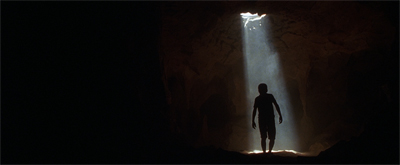
Buried secrets...

Buried secrets…

Continue reading

Star Trek: Enterprise – Silent Enemy (Review)

Next year, Star Trek is fifty years old. We have some special stuff planned for that, but – in the meantime – we’re reviewing all of Star Trek: Enterprise this year as something of a prequel to that anniversary. This January, we’re doing the first season. Check back daily for the latest review.

Silent Enemy is very much a game of two halves.

It’s an episode that suffers from the decision to incorporate two radically different plots into a single episode. In many respects, it’s a show that suffers from Star Trek: Enterprise‘s decidedly old-fashioned storytelling aesthetic: the sense that most hours of Star Trek need to have two plots running through them for pacing and structural reasons. This storytelling technique is a decidedly outdated approach to television, reflecting the narrative conservatism at play in the first season of the show.

We come in peace...

We come in peace…

Silent Enemy is built around two plots. The primary plot sees the ship coming into conflict with a bunch of strange predatory aliens who do not respond to attempts for contact, and who grow increasingly belligerent over the course of the episode. Archer and his crew find themselves facing an opponent far stronger and more aggressive than they are. It’s a pretty bleak, pretty heavy plotline. Inevitably, the show decided to pair it with something a bit more light-hearted, so we get Hoshi trying to figure out what Reed’s favourite food is that Chef can bake him a super-special birthday cake.

While the combination of plotlines isn’t the worst in the history of the franchise – the episode doesn’t feel like Frankenstein’s monster in the same way that Life Support does, for example – it’s still rather incongruous. Silent Enemy is an episode weakened by the decision to combine these two into a single story; the desire to offset the doom of the “Enterprise under siege” story with something a bit more easy-going and comedic.

Alien aliens...

Alien aliens…

Continue reading

Space: Above and Beyond – Sugar Dirt (Review)

This November (and a little of December), we’re taking a trip back in time to review the third season of The X-Files and the first (and only) season of Space: Above and Beyond.

The end is nigh.

There is a generally funereal atmosphere to the last few episodes of Space: Above and Beyond, creating the sense that the show was well aware of – and had perhaps come to terms with – its own inevitable cancellation. Stardust had assured viewers (and the show itself) that the dead can be heroes too. Sugar Dirt seems a lot angrier about the series’ situation. It is the story of our heroes surrounded and outgunned on all sides; abandoned to their fate by those in authority.

Sadly, McQueen couldn't quite save the show...

Sadly, McQueen couldn’t quite save the show…

Continue reading

The X-Files – Jose Chung’s “From Outer Space” (Review)

This November (and a little of December), we’re taking a trip back in time to review the third season of The X-Files and the first (and only) season of Space: Above and Beyond.

Then there are those who care not about extraterrestrials, searching for meaning in other human beings. Rare or lucky are those who find it. For although we may not be alone in the universe, in our own separate ways, on this planet, we are all alone.

– Darin Morgan takes his bow

It came from beyond the stars...

It came from beyond the stars…

Continue reading

Star Trek (Marvel Comics, 1980) #4-5 – The Haunting of Thallus!/The Haunting of the Enterprise! (Review)

The first Star Trek pilot, The Cage, was produced in 1964. To celebrate its fiftieth anniversary, this December we are reviewing the second season of the original Star Trek show. You can check out our first season reviews here. Check back daily for the latest review.

Marvel certainly had an unconventional approach to publishing Star Trek.

The company had licensed the comic book rights following the release of Star Trek: The Motion Picture. They had released a successful adaptation of the film as part of their Marvel Super Special line and had re-package the three-part adaptation as the first three issues of an on-going Star Trek comic book. Written by Marv Wolfman and illustrated by Dave Cockrum, it was clear that Marvel had big plans for Star Trek. However, it also quickly became clear that they had no idea where they wanted to go with the comic.

Here there be monsters...

Here there be monsters…

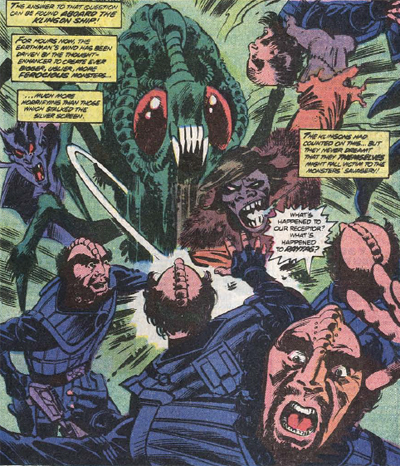
After all, they immediately followed up the big three-issue opening arc with a comic where the Enterprise discovered a haunted house floating in space. While it was certainly a catchy image, it wasn’t exactly a quintessential Star Trek premise. It seemed that Marvel had no idea what to do with the comic. Writer Marv Wolfman wrote the first of the two issues comprising the storyline, handing the second issue over to Mike W. Barr. He would only stick around for two issues before handing the comic over to Tom DeFalco. DeFalco wrote a single issue before moving on.

It is a rather disjointed comic book, one which lacks the strong narrative voices that DC would give to their late-eighties licensed Star Trek comics. Then again, it is probably easy enough to deduce all of this from the fact that the first original Star Trek storyline published by Marvel featured a haunted house floating in space.

In space, everyone can hear you scream...

In space, everyone can hear you scream…

Continue reading

X-Men: The End – Book Two: Heroes and Martyrs (Review/Retrospective)

This May, to celebrate the release of X-Men: Days of Future Past, we’re taking a look at some classic and modern X-Men (and X-Men-related) comics. Check back daily for the latest review.

To describe Chris Claremont’s three six-part miniseries that comprise X-Men: The End as “convoluted” is to miss the point. Of course they are convoluted. Claremont is essentially writing a gigantic epilogue to his work on Uncanny X-Men. He is tidying away decades of continuity and offering a sense of closure to his work on these characters and their world. Claremont is an exceptional storyteller when it comes to long-form serialised storytelling.

As a writer, Claremont tends to layer interesting twists on top of interesting twists, with every resolution opening up more avenues for future stories to explore. He has demonstrated an ability to string along plots for decades, revisiting characters and situations years after most readers had forgotten about them. These are the qualities that make his Uncanny X-Men run so deeply fascinating, but they are also the qualities that make him a bit of an awkward fit for a concept like The End, an epic miniseries built around the idea of wrapping up the entire X-Men mythos.

Some things never go into fashion...

Some things never go into fashion…

However, what is so fascinating about X-Men: The End is that all of the elements that Claremont uses are the same elements that he has been playing with since he took over Uncanny X-Men. The story beats have a familiar pattern to them, the themes are familiar, the characters speak as they did in the years that Claremont wrote them. What is fascinating about X-Men: The End is the way that it serves to really set Claremont’s take on the X-Men in stone, treating the elements associated with Claremont as a truly inexorable part of the comic’s mythology.

X-Men: The End is very much a Chris Claremont comic, through-and-through. That’s what makes it feel like such a perfect fit.

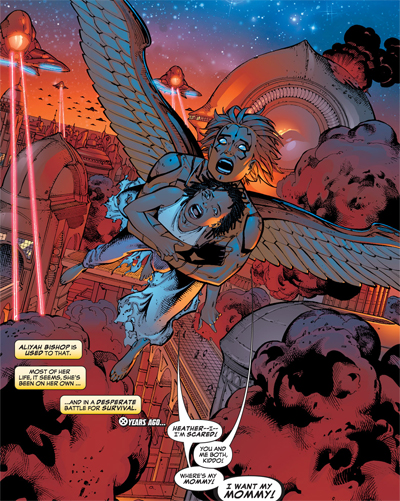
A wing and a prayer...

A wing and a prayer…

Continue reading

Non-Review Review: Predator

Predator is an absolutely brilliant piece of work. It’s elegantly constructed, beautifully directed and cleverly written. Perhaps the smartest thing about Predator is the way that it so fantastically plays on audience expectations, offering the perfect bait-and-switch, teasing a jungle adventure in the style of Schwarzenegger’s Commando before morphing into something else entirely. It’s so well handled that the film’s reputation and prestige has done little to dampen its thrills.

A predator stalks...

A predator stalks…

Continue reading

The X-Files – Gender Bender (Review)

Gender Bender is weird. As an atmospheric moody piece of television, it’s pretty phenomenal – the script manages to tap into a whole bunch of basic nineties fears and uncertainties, while director Rob Bowman layers on the sense that something is not quite right here. On the other hand, as a narrative, the episode comes up short. From the cop-out ending to the laziness of putting Scully in peril twice, the story for Gender Bender is nowhere near as tight as it needs to be.

And yet, despite that, there’s a pervading sense of dread and unease that makes it far more compelling than it should be.

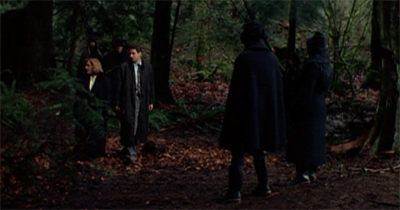
In the woods...

In the woods…

Continue reading

My 12 for ’12: Prometheus, Faith, Treachery & The Great Beyond…

I’m counting down my top twelve films of the year between now and January, starting at #12 and heading to #1. I expect the list to be a little bit predictable, a little bit surprising, a little bit of everything. All films released in the UK and Ireland in 2012 qualify. Sound off below, and let me know if I’m on the money, or if I’m completely off the radar. And let me know your own picks or recommendations.

This is #5

In the year 7510,
If God’s a-comin’, he ought to make it by then.
Maybe he’ll look around himself and say,
“Guess it’s time for the Judgement Day.” 

In the year 8510,
God’s gonna shake his mighty head.
He’ll either say “I’m pleased where man has been”,
Or tear it down and start again.

-Zager and Evans, In The Year 2525

Faith is a funny thing. If you don’t have it, it’s impossible to explain. If you do have it, it needs no explanation. Ridley Scott’s Prometheus feels a little bit ham-strung by the Alien DNA” that it carries. As a prequel to the iconic film series, it’s hardly the most successful endeavour. Indeed, the film’s references to everybody’s favourite chest-bursting extra-terrestrial feel almost forced. Like the discussion about the Scientology influence on The Master, focusing on the instantly recognisable xenomorph tends to obscure the unique strengths of Prometheus as its own film.

Interestingly, the strongest connection to Alien is thematic rather than literal. Like Ridley Scott’s first science-fiction masterpiece, Prometheus postulates a cold and uncaring universe, one that is inherently alien, incomprehensible and hostile. The human condition causes us to question, but Prometheus suggests that there can be no answers – no satisfactory answers at least.

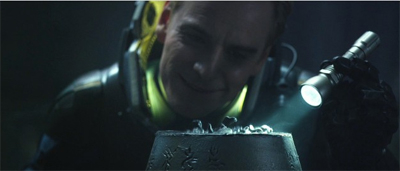
prometheus16

Continue reading

Dancing on the Edge of a Blade (Runner): Prometheus & Hyper-Intertextuality

Prometheus arrived on blu ray last week. I’m a big fan of the movie, despite the palpable sense of disappointment generated on its arrival – I suspect that I was wise not to expect answers, and instead to enough the movie for what it was. I’m not alone in considering the film’s ties to Alien to be among its weakest elements, forcing the movie to tie into something that had been a massive movie mystery for decades, rather than allowing it to be its own thing. However, it has emerged that Ridley Scott apparently hoped the movie could go further than that. Reportedly, the director had hoped that it could serve as something akin to “connective tissue” to tie together two of his most definitive science-fiction universes. Apparently, the director wanted to set the film in the same world as Blade Runner.

Continue reading