• Following Us

  • Categories

  • Check out the Archives


  • Awards & Nominations

The X-Files (Wildstorm) #1-2 (Review)

This January, to prepare for the release of the new six-part season of The X-Files, we’re wrapping up our coverage of the show, particularly handling the various odds and ends between the show’s last episode and the launch of the revival.

In some respects, comic books represent the perfect medium for The X-Files.

After all, mainstream American superhero comic books seem to exist in a perpetual “now”, a present tense that stretches out indefinitely. Peter Parker might be more than fifty years old, but he will always be a young adult immune to the ravages of time. What little material growth the character had came early in his publication history; he graduated high school just over two years into the run of The Amazing Spider-Man, the rest of his life unfolding at a much slower pace. Batman and Superman are spared the ravages of age.
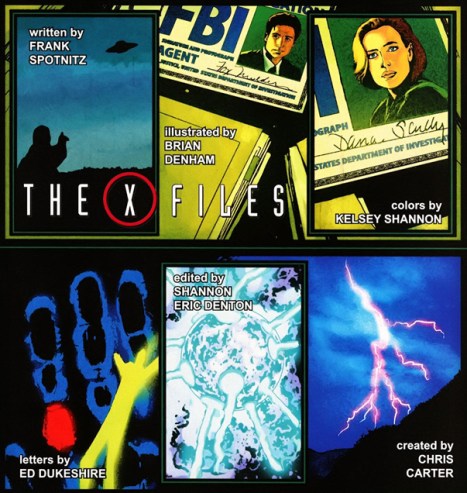
THE TRUTH IS OUT THERE

THE TRUTH IS OUT THERE

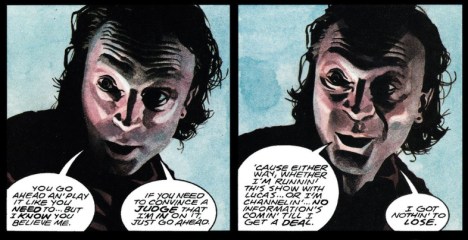
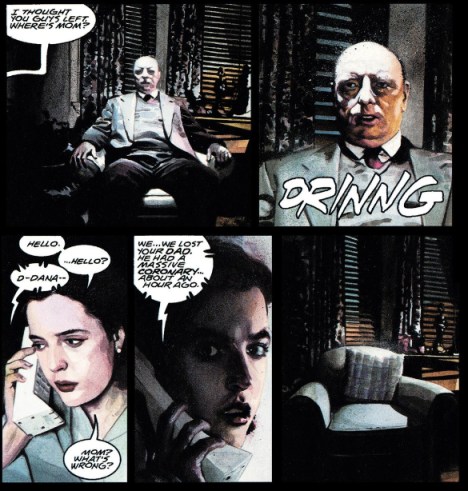
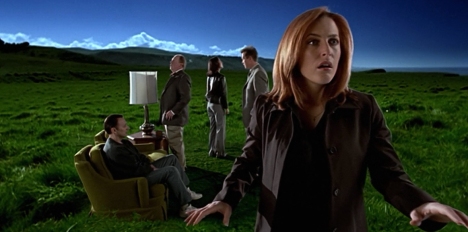
So it is with Wildstorm’s adaptation of The X-Files, a comic book that seems to operate on the same “sliding” time scale as the major superhero universes, where it seems like the characters (and their general status quo) are immune to the passage of the years. Here, it feels like the fifth season has continued indefinitely, to the point that Frank Spotnitz’s second X-Files comic book is very much a sequel to the events of Redux II. The comic picks up from the threads left hanging by that season premiere more than a decade earlier.

This is an approach that seems perfectly suited to The X-Files. Comic book stories are notorious for their long-form (albeit haphazard) serialisation, the fiction that the entirety (or even the bulk) of a fictional character’s history can be condensed down into a single story published over forty years by different creative teams under different creative circumstances. This an elaborate fiction, of course. Attempting to argue that the Marvel or DC universes are a single unified storyline requires some distortion of the truth.
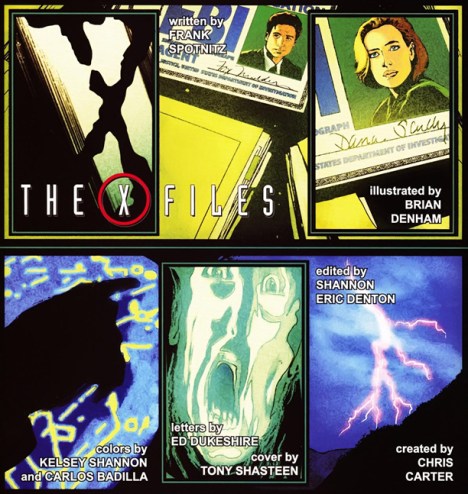
BELIEVE THE LIE

BELIEVE THE LIE

In truth, these universes frequently feel like a backdrop against which individual writers can tell their own stories; a status quo from which a creative team might begin and to which they may return. Batman’s rich decades-long history is perfect fodder for Grant Morrison’s take on the character; Daredevil provides a template against which Frank Miller may define himself; Brian Michael Bendis can use the rich history of the Avengers as a springboard for his own story. These stories frequently contrast and critique, using the background as a jumping off point.

In a way, the same is true of The X-Files. Although there was definite narrative progression to the mythology, with a few major exceptions (Patient X, The Red and the Black, Two Fathers, One Son), the mythology often felt like a backdrop that could be used to tell interesting and unique stories. The X-Files receives (and deserves) a lot of credit for re-popularising serialisation in mainstream genre entertainment, but perhaps the mythology is best examined as a springboard for storytelling rather than a story of itself.
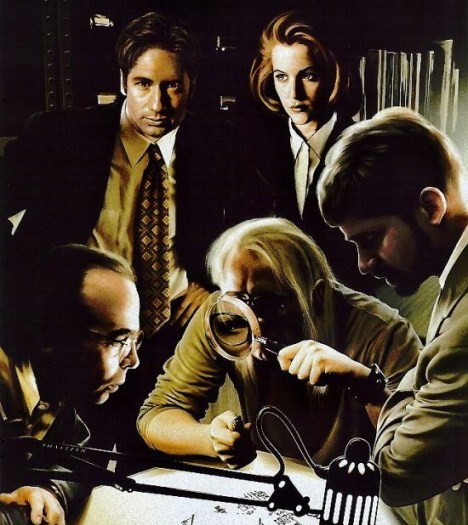
Not alone...

Not alone…

Continue reading

The X-Files (Wildstorm) #0 (Review)

This January, to prepare for the release of the new six-part season of The X-Files, we’re wrapping up our coverage of the show, particularly handling the various odds and ends between the show’s last episode and the launch of the revival.

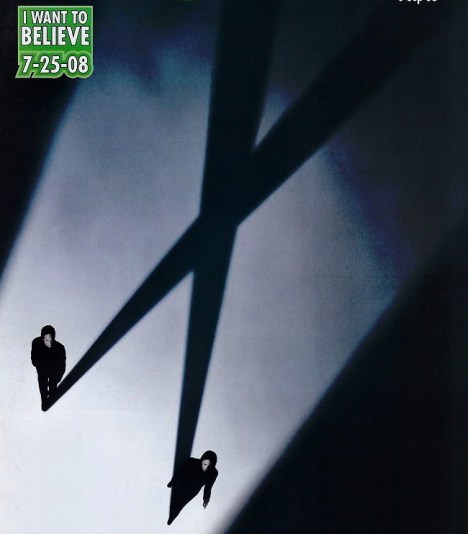
The X-Files: I Want to Believe marks a point of transition for The X-Files.

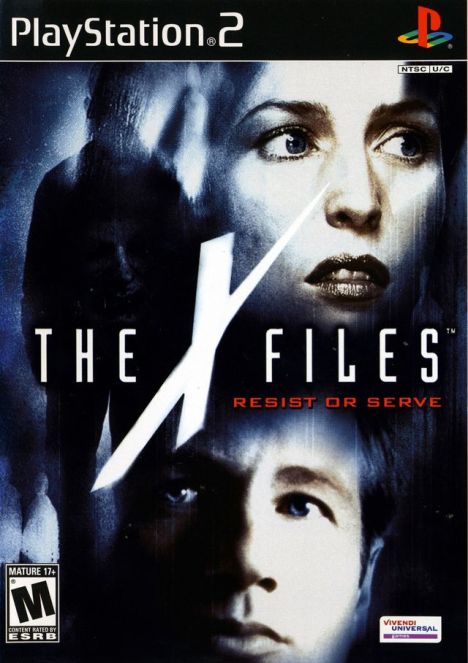
It seems to represent the point at which The X-Files truly stops its forward momentum; the point at which the show embraces its status as an artifact of the nineties rather than a living (and evolving) entity. There had been indications of this with the release of Resist or Serve, a video game which seemed to treat the seventh season as the “end” of The X-Files, but I Want to Believe embraced it on a much larger scale and on a much larger platform. The X-Files was not so much pushing forward as looking backwards.

THE TRUTH IS OUT THERE

THE TRUTH IS OUT THERE

This reality was reflected in a number of ways. The importance of the eighth and ninth seasons was consciously downplayed, to the point where a gag in I Want to Believe hinges on the audience forgetting that both Mulder and Scully had worked at the FBI during the Bush administration. Doggett and Reyes were consigned to a blu ray bonus feature, an evolutionary branch of The X-Files to be cut off for the sake of convenience. I Want to Believe even took Mulder and Scully back to snowy Vancouver, a literal journey backwards.

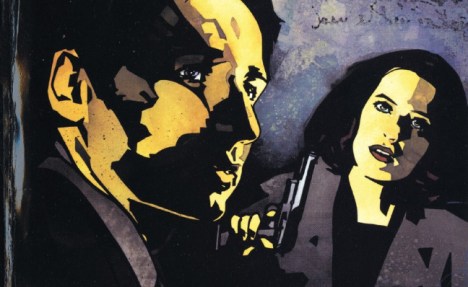
The Wildstorm comic book pushes this reconceptualisation of the show to its logical conclusion, as if imaging some alternate world where The X-Files‘ so-called “golden age” of the second through fifth seasons had somehow lasted over a decade. The Wildstorm comics tease a glimpse of The X-Files frozen in amber, trapped for an eternity.

I WANT TO BELIEVE

I WANT TO BELIEVE

Continue reading

Massive X-Files Fandom Poll!

So, for the past two years or so, I’ve been delving into the cultural history of The X-Files, doing long-form reviews of everything from the show itself to spin-offs to comic books to crossovers to pop singles. It’s been great fun, and a pleasure from beginning to end. However, that end is fast approaching, and I was thinking of a nice way to mark the occasion. So I thought it might be fun to do a poll of the show’s run, and just get a sense of the broad consensus of fandom’s opinion on the best of the show’s nine-plus year run.

So, that’s what I’m doing.

xfilespoll3

The poll is open to anybody who wants to vote. It will be open until Babylon airs on the 15th February 2016. I’ll then take a little while to tabulate results, and offer a glimpse of fandom’s favourite episode before My Struggle II airs 22nd February 2016. Submission is simple; just compile a list of up to thirty of your favourite episodes (in order) and mail them directly to email address xfilespoll@gmail.com. (Or, if you don’t want to share your email with a stranger, fill out the form here.) Please include the word “Poll” in your subject to weed out the spam, but I’ll be checking the address fairly regularly.

I’ll go through the “rules” below, but it is worth mentioning why I thought this was a good idea. The most obvious is that I’ve spent more than two years talking about The X-Files. It might be worth hearing somebody else’s opinion.  More than that, it is a nice way to acknowledge all the readers of my reviews, and to involve you guys in some way in this project. It’s been great fun for me, and I’ve greatly enjoyed engaging with fans on twitter and in the comments, so I thought this might be a great way to involve everybody.

xfilespoll1

As an aside, I am surprised at the lack of fandom polls for The X-Files compared to other popular franchises like Doctor Who or Star Trek. Fandom polls are a great way to measure popular opinion over long periods, to see how consensus has changed or solidified over long periods of time. With the revival, now seems a good moment to take  a measure. It has been over a decade since the show went off the air, but it’s very much at peak popularity. It feels like this might be useful for the next rewatch or go-round.

As an aside, please feel free to spread word of this poll. Basically, the more people take part, the more interesting the results will be and the more accurately that the results will reflect X-Files fandom at this particular moment. So share it, tweet it, facebook it. Get the word out, even if you just send out the email address and an instruction to send up to thirty ranked choices for the best X-Files episodes ever. I hope this can become something special and cool, a snapshot of where the popular opinion is on The X-Files at this moment in time.

xfilespoll

Now for the boring stuff. Organising a poll means having rules, so the results are somewhat transparent. They should be straight-forward enough, but any questions, please sound off in the comments:

Thanks for reading! Have fun! Any questions or comments, sound off below!

Note: Per feedback, people might be understandably uncomfortable emailing a random address. So I’ve put up a form you can fill out using just your alias and providing your list. The form is accessible here.

The X-Files – Resist or Serve (Review)

This January, to prepare for the release of the new six-part season of The X-Files, we’re wrapping up our coverage of the show, particularly handling the various odds and ends between the show’s last episode and the launch of the revival.

The X-Files disappeared rather quietly from television.

Despite the talk of launching a film series, the franchise was allowed to lie fallow for a couple of years. There were a number of reasons for this. Immediately following the broadcast of The Truth, Chris Carter disappeared out into the world. The creator and executive producer had worked for almost a decade without any real break. It made sense for the writer to avail of the opportunity to get away from it for an extended period of time. A breather felt more than justified after overseeing more than two hundred episodes of television.

Game on...

Game on…

The band broke up. Members of the production team took jobs elsewhere. Frank Spotnitz and Vince Gilligan worked with veteran director Michael Mann on Robbery Homicide Division. John Shiban joined the writing staff on the second season of Star Trek: Enterprise. There was a sense that The X-Files had faded into the ambient background radiation of popular culture, its constituent elements – whether writers or directors or even themes or storytelling techniques – ready to flavour a new generation of television production.

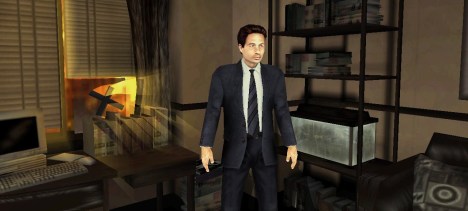
However, there were signs that the show might linger on. Even if the sequel to The X-Files: Fight the Future had yet to materialise, it lurked just over the horizon. Critical and fan consensus was starting to form around the show. Although The X-Files might have been finished, its legend was still being solidified. Resist or Serve is very much a part of this process. Released on Playstation 2 in March 2004, Resist or Serve was a very disappointing video game. However, it was also a very instructive insight into just how the legend of The X-Files was shaping up.

Feels like going home...

Feels like going home…

Continue reading

Roy Thomas’ Run on The X-Files: Season One (Topps) (Review)

We’ve recently finished our reviews of the nine seasons of The X-Files. Along the way, we tried to do tie-ins and crossovers and spin-offs. However, some of those materials weren’t available at the right time. So this week will be spent finishing Topps’ line of “Season One” comics, published during the fifth season in the lead up to The X-Files: Fight the Future.

It is hard to figure out what exactly the point of the Season One line was meant to be.

In a very superficial way, the point was obvious. The intent was to add a second regular series to Topps’ line of comics based around The X-Files. Even during the comic book bubble burst of the mid- to late-nineties, The X-Files was a good seller for the company. The monthly book sold well enough that Topps’ eagerly supplemented it. New stories were published as Digest editions, published alongside the less successful Ray Bradbury comics. Annuals were published alongside the monthly book. Collections were published frequently.

xfiles-beyondthesea13

However, this was not enough to satisfy market demand. Topps wanted to publish more X-Files material with greater frequency. However, Ten Thirteen were less interested with the supervision that the line required. A compromise seemed in order. Rather than creating a new original series of comic books, they flooded with market with new adaptations of existing X-Files media. Writer Kevin J. Anderson and artist Gordon Purcell offered a four-part comic book miniseries adapting Anderson’s Ground Zero prose novel.

The publisher also decided to put out a series of adaptations of classic first season episodes, released once every two months. These would be adaptations of stories that had already been properly vetted by Ten Thirteen, having been produced in-house. The trick would simply be translating them into comic books.

Burn with me.

Continue reading

The X-Files: Season One (Topps) #9 – Shadows (Review)

We’ve recently finished our reviews of the nine seasons of The X-Files. Along the way, we tried to do tie-ins and crossovers and spin-offs. However, some of those materials weren’t available at the right time. So this week will be spent finishing Topps’ line of “Season One” comics, published during the fifth season in the lead up to The X-Files: Fight the Future.

And, with Shadows, the Season One line comes to a close.

Although The X-Files was at the very peak of its popularity between the fifth and sixth seasons, the Topps line of comics was winding to a close. Although Topps had turned a very tidy profit on the line, Ten Thirteen had been less enthused by the relationship. The production company decided not to renew their contract with Topps, and so the X-Files line of comics was quietly retired. Shadows was published in July 1998, a month following the release of The X-Files: Fight the Future.

A shadow of itself...

A shadow of itself…

It was not the last X-Files comic book to be published by Topps. The company would release one more issue of the regular series – Severed – shortly before the start of the sixth season. There was little indication that Topps expected the contract to come to an end; the publisher had actually solicited two further issues of the Season One line beyond Shadows, adaptations of The Jersey Devil and Ghost in the Machine. These were somewhat lackluster first season episodes, but episodes with the sort of impressive visual ideas that might translate well to the comic book medium.

An adaptation of The Jersey Devil and Ghost in the Machine would certainly have made for a more visually satisfying final issue than an adaptation of Shadows.

What we do in the shadows...

What we do in the shadows…

Continue reading

The X-Files: Season One (Topps) #8 – Beyond the Sea (Review)

We’ve recently finished our reviews of the nine seasons of The X-Files. Along the way, we tried to do tie-ins and crossovers and spin-offs. However, some of those materials weren’t available at the right time. So this week will be spent finishing Topps’ line of “Season One” comics, published during the fifth season in the lead up to The X-Files: Fight the Future.

Beyond the Sea is more than just the best episode of the first season.

Beyond the Sea is one of the best episodes that the show ever produced. Airing half-way through the first season of The X-Files, Beyond the Sea demonstrated exactly what the show was capable of doing at that point in its run. It was a television masterpiece, and remains one of the very best episodes of an extended nine-season run. More than Ice, more than E.B.E., more than Darkness Falls, Beyond the Sea is the unqualified success story of the show’s first season.

Sea change...

Sea change…

This makes the decision to adapt it as part of the Season One line a relatively risky endeavour. The last two episodes adapted as part of the series – Space and Fire – are unlikely to rank highly on any fan’s assessment of the show’s first year. This was not a bad strategy. If the comic book adaptations were good, like the adaptation of Space had been, then it was a success story for everybody involved. If the comic book adaptations were not great, as was the case with Fire, then it seemed unlikely that anybody would care too much.

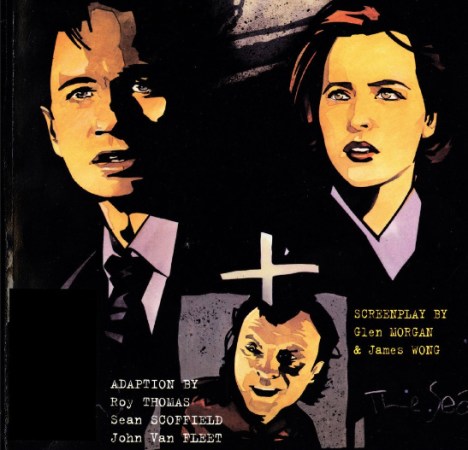
Adapting the season’s strongest episode was a bold creative decision. It seemed highly unlikely that writer Roy Thomas and artist Sean Scofield could compete with the episode written by Glen Morgan and James Wong and directed by David Nutter. The best case scenario for an adaptation of Beyond the Sea would be to serve as a reminder of just how wonderful the television episode had been, rather than a comic book that was memorable in its own right. It was very much a situation where the best possible outcome was not messing it up.

Haunting visit...

Haunting visit…

Continue reading

The X-Files: Season One (Topps) #7 – Fire (Review)

We’ve recently finished our reviews of the nine seasons of The X-Files. Along the way, we tried to do tie-ins and crossovers and spin-offs. However, some of those materials weren’t available at the right time. So this week will be spent finishing Topps’ line of “Season One” comics, published during the fifth season in the lead up to The X-Files: Fight the Future.

Space was perhaps the best of Topps’ Season One line of comics, a version of the first season episode that came much closer to realising the potential of Chris Carter’s outer space mystery than anything that appeared on a television screen during the show’s first year. In a way, Space suggested a possible sustainable model for the Season One line of comics beyond a rather cynical attempt to have two separate X-Files comics running in parallel. What if the Season One line could be used to “fix” stories that had misfired the first time around?

This makes a certain amount of sense. After all, there is little point in just rehashing the show’s strongest moments. The comic adaptation of Beyond the Sea might entertain, but it will never be the definitive or stronger example of that story. The comic adaptations lack the chemistry of David Duchovny and Gillian Anderson, but they do have an unlimited visual effects budget and the ability to filter a story through a unique artistic sensibility. So perhaps Season One should not fixate on a “greatest hits” tour of the first season, but should instead focus on the misfires.

Burn with me...

Burn with me…

Continue reading

The X-Files – The Truth (Review)

This December, we’re taking a trip back in time to review the ninth season of The X-Files.

It is interesting how the popular memory of a thing can differ from the actual thing itself.

Memory was always a key theme of The X-Files, particularly in the early years of the show. Although the aliens and the conspirators were plucked from the demented imaginations of the most paranoid tinfoil hat enthusiasts, a surprising amount of the show was rooted in real history that had been allowed to slip by under the radar: the genocide of the Native Americans; the resettlement of German and Japanese war criminals after the Second World War; radiation experiments upon prisoners; the Tuskegee syphilis experiment.

Daddy's home.

Daddy’s home.

The truth is contained in the gap between memory and history. In a way, then, it feels entirely appropriate that the popular memory of The X-Files should remain quite distinct from the show itself. The popular memory of The X-Files tends to suggest that the mythology makes no sense, that it does not fit together in any tangible form. This is an opinion repeated so often that it has become a critical shorthand when discussing the end of the show; much like the assertion “they were dead all along” tends to come when discussing Lost.

The truth is that the mythology of The X-Files largely made sense. Sure, there were lacunas and contradictions, inconsistencies and illogicalities, but the vast majority of the mythology was fairly linear and straightforward. It had been fairly straightforward for quite some time. The show had been decidedly ambiguous in its first few seasons, only confirming that colonisation was the conspiracy’s end game in Talitha Cumi at the end of the third season. Elements like the black oil and the bees tended to cloud matters, but the internal logic was clear.

Everything burns...

Everything burns…

Significant portions of both The X-Files: Fight the Future and Two Fathers and One Son had been dedicated to spelling out the finer details of the mythology in great detail. Mankind were not the original inhabitants of Earth; the former occupants had returned and were making a rightful claim; the conspirators had agreed to help them, selling out mankind for a chance to extend their own lives. Everything else was window dressing. The production team had laid everything out during the fifth and sixth seasons.

Still, the general consensus of The X-Files was that it was a show driven by mysteries that was always more interested in questions than answers. This was certainly true, but it was somewhat exaggerated. When the cancellation was announced, the media immediately demanded answers. A month before The Truth was broadcast, Tim Goodman complained about how the show offered “precious few answers to Carter’s riddles.” Two days before the broadcast, Aaron Kinney wondered of the conspirators, “Who are these people and what is their agenda?”

The Truth on trial...

The Truth on trial…

It does not matter that these answers have mostly been provided and that the truth is mostly know. This was the context of the conversation unfolding around The Truth, and it likely explains a number of the creative decisions taken during the production of the episode. The Truth plays as an extended video essay dedicated to providing answers that were offered three or four seasons earlier in relation to mysteries that are no longer part of the show. The Truth is a passionate and intense argument that the mythology of The X-Files does make sense.

For viewers tuning back into the show for the first time in years, this means long expository monologues and skilfully edited montages that do not tie into the plot of the episode in any significant way. For those who stuck with the show for these past few seasons, it means rehashing everything that the show has taken for granted since the fifth or sixth season. While it feels like The Truth is desperately longing for vindication, to the extent where the show puts itself on trial in the person of Fox Mulder, this does not make for compelling viewing.

Happy ending.

Happy ending.

Continue reading

The X-Files – Sunshine Days (Review)

This December, we’re taking a trip back in time to review the ninth season of The X-Files.

Well, here’s hopin’ the TV stays off and he learns how to love the real world.

– Doggett stops just short of adding “… and that goes for you as well.”

The X-Files was always a more romantic show than it would readily admit.

The popular image of the show might be Mulder and Scully walking through darkness searching for a truth that may never be revealed or a hideous monster preying upon innocent victims. Chris Carter’s most successful work might be rooted in the dual betrayals of Watergate and Vietnam. The characters might stalk car parks late at night or explore the darkest corners of the urban landscape. Mulder and Scully might be abducted by forces beyond their control, and subjected to the cruel whims of uncaring fate. The show’s motto might be “trust no one.”

"Let's call it a day..."

“Let’s call it a day…”

Nevertheless, that cynicism is offset with a deep-seated romance. “Trust no one” is one of the defining mantras of The X-Files, but there are other more optimistic catchphrases; “I want to believe” and “the truth is out there.” Optimism outvotes cynicism by a two-to-one majority. It is not quite a decisive victory, but it is something in this cynical and chaotic world. While Mulder and Scully might never actually find the truth which they so desperately seek, they did find one another. That is more than either could have hoped and than some people can claim.

Sunshine Days is a staggeringly romantic and optimistic piece of television. Indeed, it suggests that the cynicism of The X-Files was really just a practiced veneer. As the title suggests, Sunshine Days allows the central cast to smile more frequently over forty-five minutes than most have in the course of their entire run on the show. As with the rest of the show, Sunshine Days is rooted in the culture of the seventies. However, there is something quite heartwarming in how Vince Gilligan eschews All the President’s Men for The Brady Bunch.

Out of this world...

Out of this world…

Continue reading