• Following Us

  • Categories

  • Check out the Archives


  • Awards & Nominations

The X-Files – Irresistible (Review)

This August (and a little of September), we’re taking a trip back in time to review the second season of The X-Files. In November, we’ll be looking at the third season. And maybe more.

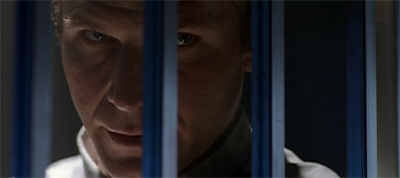
Irresistible is a fascinating piece of television and arguably one of the most iconic and important episodes of The X-Files ever broadcast.

It’s also very, very good.

Here's Donnie...

Here’s Donnie…

Continue reading

The X-Files (Topps) #1 – Not To Be Opened Until X-Mas (Review)

This August (and a little of September), we’re taking a trip back in time to review the second season of The X-Files. In November, we’ll be looking at the third season. And maybe more.

If you needed proof that The X-Files had made it, then the forty-issue Topps comic book series from the mid-nineties seems a place to start. Of course, this has less to do with the stories published in the comics themselves – though some are very interesting – and more to do with the comic book market in the nineties and the business model employed by Topps. The comic book industry was perhaps at its peak in the nineties – at least when it came to exposure and public profile.

Chris Claremont and Jim Lee’s X-Men #1 became the biggest-selling comic book of all time in 1991, selling over eight million copies. A year later, DC Comics published The Death of Superman, a sprawling highly-publicised comic book event that killed off (and then revived) the Man of Steel. The year after that, Batman got in on the action with the Knightfall trilogy, a suitably spectacular event that featured the crippling of Bruce Wayne, his replacement as Batman, and the eventual return of the Caped Crusader.
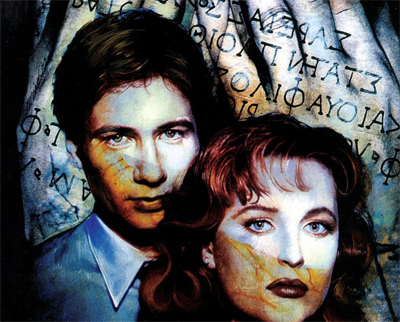
The truth is in here?

The truth is in here?

It is important to put those figures in perspective. While this was a financial peak for the comic book industry, it was still something of a fringe economy. In the mid-nineties, a television show attracting only eight million viewers would find itself on the bubble line when it came to renewal. However, that figure was the largest readership of any comic book ever. (Audience diversification means that both television audiences and comic book readers have dwindled in the years since, but the latter much more than the former.)

However, the business model for comic books in the nineties made them highly profitable, despite their smaller audience. Price gouging was not uncommon, with some retailers charging as much as $30 for Superman #75 in 1992. Poly bags, gimmick covers, variant artwork, celebrity authors – comics were largely driven by gimmicks in the nineties. More than that, the emphasis on comic books as an investment in the mainstream media helped to suggest the industry was more for collectors than for readers.
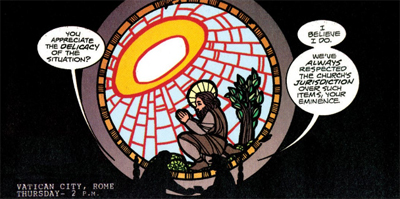
Holy conspiracy, Mulder!

Holy conspiracy, Mulder!

It is telling that the company to land the license for The X-Files was Topps, a company famous for producing sports memorabilia. The company had branched into comics in 1993, as the industry was growing and growing, hoping to license various characters and properties. The implication was that The X-Files comic had been designed more as an accessory than as a story. The cover to Not To Be Opened Until X-Mas ever features a handy “first collectors item issue” tag below the “1” at the top left-hand corner.

Licensed comic books have something of a chequered history. In the context of the mid-nineties, it would be easy to write off the forty-one issues (and change) of The X-Files as a cynical cash-in. However, the series has moments of brilliance and insight that mark it as a worth extension of the brand name.
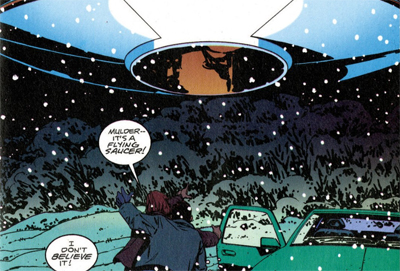
Up in the sky!

Up in the sky!

Continue reading

The X-Files – Aubrey (Review)

This August (and a little of September), we’re taking a trip back in time to review the second season of The X-Files. In November, we’ll be looking at the third season. And maybe more.

Aubrey doesn’t necessarily a make a lot of sense. Even as episodes of The X-Files go, “serial killer genes that skip a generation” feels like a logical leap. The idea that not only memories but personalities can be passed from grandfather to granddaughter is absurd even by the standards of a show that just did “magic mushrooms that cure Alzheimer’s and give people telekinesis and open portals to another world.” Perhaps it’s the fact that Aubrey tries to root its story in genetics that makes it seem so ridiculous.

And yet, once you get past that logical leap, Aubrey is a fascinating little episode. Aubrey works on quite a few levels that are disconnected from the story itself. For one thing, it is a Rob Bowman episode, and he is clearly pushing himself. For another, the guest cast features superb performances from Deborah Strang, Terry O’Quinn and Morgan Woodward. There’s also the fact that Aubrey connects almost perfectly with both the underlying themes of The X-Files as a show and of the second season in particular.

Hey little sister, what have you done?

Hey little sister, what have you done?

Continue reading

The X-Files – Excelsis Dei (Review)

This August (and a little of September), we’re taking a trip back in time to review the second season of The X-Files. In November, we’ll be looking at the third season. And maybe more.

The horror genre is much maligned.

Horror films typically fight harder for recognition than films in many other genres – often finding themselves consigned to the same ghetto as science-fiction or fantasy films. They are less likely to take home major mainstream awards, and it seems like horror films typically have to wait longer for reappraisal. Outside of aficionados, there’s a wariness of the horror genre – a skepticism towards it.

Window of opportunity...

Window of opportunity…

There are a lot of reasons for that. Some of them make sense; some of them don’t. One of the more common assumptions about horror is that the genre is more likely to produce “cheap” or “trashy” entertainment, as opposed to something more profound or insightful. There are, again, lots of reasons for this assumption. Most obviously, there’s the absurd cost-to-profit ratio of cheap terrible horror films that incentivises studios to churn out as many as they can as fast as they can. There’s a reason there’s an absurd number of Saw sequels.

However, that “cheapness” or “trashiness” isn’t just a result of business decisions. There are certain story tropes and narrative techniques that exist within the horror genre that feel like the cheapest sort of thrills. If you want to make an audience uncomfortable, just throw in something one of those trashier elements. As long as the audience squirms in their seats, it doesn’t matter what the implications of your decisions are. After all, your job is to creep them out?

Bitter little pill...

Bitter little pill…

So horror takes all manner of shortcuts, without any real thought as to what those elements actually mean. They are just something that catches the audience off-guard and makes them sit up in their seat. So horror tends to indulge in the worst sorts of racism and sexism as a means of drawing any sort of response from the audience. These tried-and-tested horror staples become effective storytelling shortcuts. The foreign becomes horrific. Conservative sexual morality is enforced with brutality. Rape – literal or metaphorical – is a cheap thrill.

The X-Files struggles with these sorts of issues as it tries to bring horror to television. It occasionally does a very good job. However, there are also times when the series gives into its baser instincts. Excelsis Dei is an absolutely terrible episode, and an example of why the horror genre gets written off by so many people so quickly. It’s a poorly constructed hour of television, one about how old men are perverts, the rape of an under-developed character is a story hook and foreigners are magic.

The writing (or fine art) is on the wall...

The writing (or fine art) is on the wall…

Continue reading

The X-Files – Red Museum (Review)

This August (and a little of September), we’re taking a trip back in time to review the second season of The X-Files. In November, we’ll be looking at the third season. And maybe more.

While Firewalker is a solid episode ill-served by its position in the schedule and its similarity to an early episode of the show, Red Museum is just a mess.

The production issues with Red Museum are infamous. It was intended as the first part of a crossover between The X-Files and Picket Fences, both airing on Friday nights. The idea was that fans could tune into The X-Files on Fox for the first part of the story, and then move over to CBS after the credits rolled to pick up the case on Picket Fences. It was an ambitious effort – too ambitious. Although showrunners Chris Carter and David E. Kelley agreed on the idea, CBS vetoed it. It resulted in two orphaned hours of television, Red Museum and Away in the Manger.

Well, not quite. The result is something of a malformed two-parter composed of two individual malformed episodes.

He likes to watch...

He likes to watch…

Continue reading

The X-Files – Firewalker (Review)

This August (and a little of September), we’re taking a trip back in time to review the second season of The X-Files. In November, we’ll be looking at the third season. And maybe more.

Firewalker is a perfectly solid episode of The X-Files.

The problem is that Firewalker needs to be so much more than “solid.” It’s the first show of the season that has Mulder and Scully working together on an X-file. Nine episodes into the season, the show has finally put the two characters together and dropped them into a regular episodic adventure plot. Scully is back. There is no Cigarette-Smoking Man, no Skinner, no Krycek. The show had waited more than two months to get back to the familiar formula, so there was a palpable sense of anticipation.

Burn, baby, burn...

Burn, baby, burn…

To be fair to Firewalker, there’s a lot to like here. It’s a nice paranoia thriller, one that could easily serve as a text book example of a stand-alone X-Files episode. As you might expect from a script by Howard Gordon, Firewalker is also a nice character study for Mulder. It has a phenomenal guest cast – featuring actors like Bradley Whitford, Leland Orser and Shawnee Smith. On paper, Firewalker is a great episode of The X-Files. Divorced from context, it holds up rather well.

Unfortunately, Firewalker can’t be divorced from context. The episode has quite a few glaring problems. It seems a little disappointing that the first episode after Gillian Anderson’s return to full-time work on the show is a character study of Mulder. The plot is just a little too archetypal, feeling like a retread of Ice from the first season. The episode tries to get back to business as usual without bother to unpack everything that has happened since The Erlenmeyer Flask.

Into darkness...

Into darkness…

Continue reading

X-Over: The X-Files & Steven Moffat’s Doctor Who

It goes without saying that The X-Files was a massively influential television show. As early as its second season, the show had launched all manner of imitations and copycats, both inside and outside the Fox Network. It seems quite likely that Fox invested two-and-a-half million dollars in the failed Doctor Who relaunch of 1996 in the hopes of spinning off another cult/mainstream science-fiction hit like The X-Files. It was launched as a two-hour television movie, failing to earn the rating necessary to spin it off into a weekly series.

However, although the 1996 telemovie provides an obvious point of intersection between The X-Files and Doctor Who, the influence of The X-Files can perhaps be most keenly felt in Steven Moffat’s work on the relaunched television series. Moffat is credited as the producer who helped the show to “break” America during his second year as showrunner, and he did so in a number of ways. Perhaps the most interesting is that he leaned rather heavily on The X-Files as a point of cultural intersection.

Shades of greys...

Continue reading

The X-Files – One Breath (Review)

This August (and a little of September), we’re taking a trip back in time to review the second season of The X-Files. In November, we’ll be looking at the third season. And maybe more.

If there were ever any doubt that The X-Files is fundamentally about faith in the nineties, One Breath should put the matter to rest.

An astounding, moving, staggering and thoughtful piece of work, One Breath not only wraps up the arc that opened the second season, it also provides closure to the themes that writers Glen Morgan and James Wong had been seeding throughout this first stretch of the season. One Breath bookends the meditation on faith that began in Little Green Men and serves as a counterpoint to the paranoia of Blood and the nihilism of 3.

One Breath is a tremendous piece of work, the best episode of the season and one that deserves to be mentioned among the very best the show ever produced.

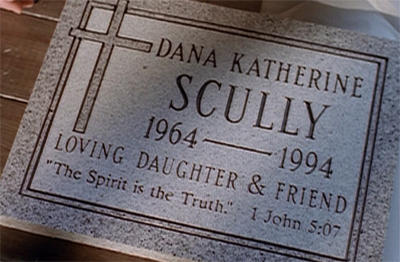
Grave stakes...

Grave stakes…

Continue reading

The X-Files – 3 (Review)

This August (and a little of September), we’re taking a trip back in time to review the second season of The X-Files. In November, we’ll be looking at the third season. And maybe more.

3 is the first absolute misfire from the second season of The X-Files.

It’s easy enough to account for the problems with 3. The production on the episode was a mess. It was the first episode produced without one of the show’s two lead characters. It existed to plug a hole in the schedule caused by factors outside the control of the production staff. Writers Glen Morgan and James Wong were working on both this and One Breath simultaneously. And it’s also a traditional monster story, which is something that The X-Files had struggled with and would struggle with again.

Vamping it up...

Vamping it up…

To be fair, 3 does what it says on the tin. It is the episode between Ascension and One Breath, a forty-five minute breather that fills a broadcast slot and allows the show to continue on while Gillian Anderson takes maternity leave. The fact that there was only one slot to fill without Anderson is a testament to both the production team’s organisational skill and Anderson’s work ethic. Really, all that 3 needs to do is exist.

Even with that in mind, 3 still feels like a disappointment. Given how Anderson’s pregnancy managed to spur the production team to create a compelling long-form story for the show, culminating in stories like Duane Barry and One Breath, it’s disappointing that her absence doesn’t inspire the same creativity. Seeing The X-Files without Scully should be the opportunity for a fascinating adventure or insightful character study; it could play with audience expectations or the show’s rigid format. Instead, the result is just a mess.

"All by myself..."

“All by myself…”

Continue reading

The X-Files – Ascension (Review)

This August (and a little of September), we’re taking a trip back in time to review the second season of The X-Files. In November, we’ll be looking at the third season. And maybe more.

Ascension is effectively a giant chase sequence and an epilogue to the first six episodes of the second season. While lacking the tight focus of Duane Barry, Ascension moves fast enough and provides enough plot momentum that it feels like a satisfactory conclusion. For an episode that was essentially written to deal with a cast member’s unexpected pregnancy, it’s a pretty fantastic piece of television.

Keep watching the skiis... er, skies!

Keep watching the skiis… er, skies!

Continue reading