• Following Us

  • Categories

  • Check out the Archives


  • Awards & Nominations

Star Trek: Voyager – Worst Case Scenario (Review)

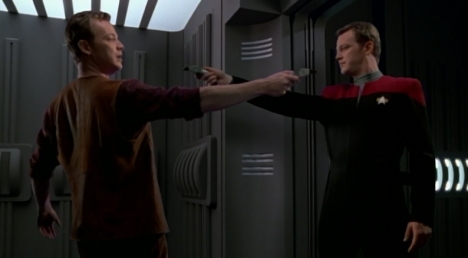
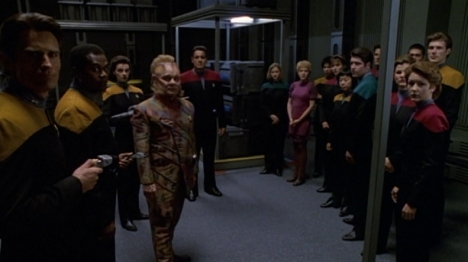
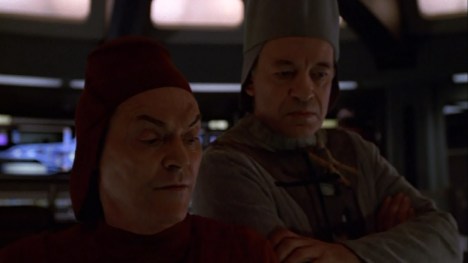
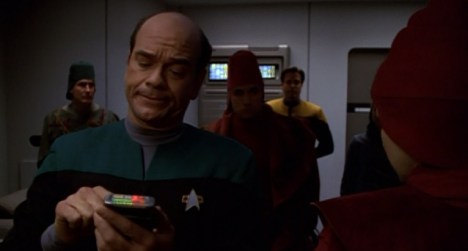
Worst Case Scenario is a flawed episode of Star Trek: Voyager. It is also breathtakingly ambitious.

There is a strong argument to be made that Worst Case Scenario is the strongest Star Trek script ever written by Kenneth Biller. It is a story about storytelling, using the holodeck as a jumping off point for all sorts of self-reflective commentary on the sort of creative compromises necessary to get an episode of television (and in particular an episode of Voyager) on the air. It also benefits from a cracking starting premise, a wonderful opening act, and some playful direction from Alexander Singer. All of these elements help to distract from obvious weaknesses.

Rebel, rebel.

Rebel, rebel.

Worst Case Scenario has a number of serious flaws. It makes very little sense from a logical perspective, with the script guilty of many of the criticisms that Tuvok makes of Paris’ approach to the craft of writing. The ending is rushed. The episode owes a sizable debt to Our Man Bashir, a much stronger episode of Star Trek: Deep Space Nine that used the holodeck to make similar (and more convincing) arguments about the nature of storytelling. Like many good-but-not-great Voyager episodes, Worst Case Scenario refuses to follow its ideas to their conclusions.

And yet, in spite of all of these issues, Worst Case Scenario is an endearing and playful piece of television. It is far too chaotic and unfocused to rank with the best of the franchise, but it is distinctive enough to stick in the memory without ever being embarrassing.

It's all up to you.

It’s all up to you.

Continue reading

Star Trek: Voyager – Displaced (Review)

The Star Trek franchise has a reputation for being liberal and open-minded.

After all, the franchise is very much rooted in an extension of Kennedy-era liberalism, with the “final frontier” very much an extension of Kennedy’s “new frontier.” It is a franchise that is supposed to celebrate “new lifeforms and new civilisations” that it meets on “strange new worlds”, embracing the alien and celebrating diversity. The franchise is rooted in a utopian version of the future that has been portrayed as at least mostly socialist dating back to Star Trek: The Motion Picture at the latest.

The end is Nyrian.

The end is Nyrian.

However, there are also points at which Star Trek could be considered to be reactionary and conservative. The original Star Trek was nowhere near as progressive on matters of race and gender as many would claim. The first two seasons of Star Trek: Enterprise frequently played as endorsements of politics of the Bush era and the fear of the unknown. The third season of Star Trek: Voyager has been particularly conservative in its outlook; consider the treatment of sex in Blood Fever or Darkling, of the traditional family in Real Life, of globalisation in Unity.

Displaced is perhaps the most striking example, an episode that is essentially a forty-five minute treatise on the risk posed by immigration.

Damn space immigrants, clogging up our space hospitals.

Damn space immigrants, clogging up our space hospitals.

Continue reading

Star Trek: Voyager – Distant Origin (Review)

Like Remember before it, Distant Origin is a really great example of how Star Trek: Voyager‘s efforts to build a “generic Star Trek series can produce memorable and satisfying episodes of television.

There is very little about Distant Origin that demands to be set in the Delta Quadrant. In fact, Distant Origin arguably makes less sense as an episode set in the Delta Quadrant than it would as an episode set in the Alpha or Beta Quadrants. Episodes like The 37’s and Distant Origin (and the lies at the heart of Favourite Son) seem to suggest a lot of traffic between Earth and the Delta Quadrant beyond the Caretaker. It seems strange the Voth would migrate so far in search of a place to call home.

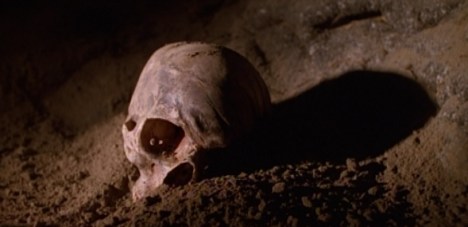
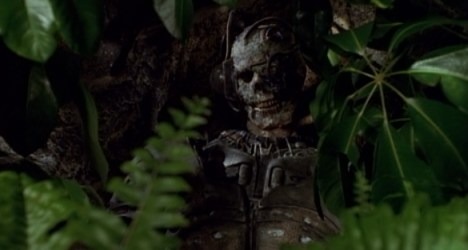
Skullduggery.

Skullduggery.

However, for all that Distant Origin feels like a strange fit for the series’ Delta Quadrant setting, it feels very much like quintessential Star Trek. Like Remember earlier in the season, Distant Origin is very much an old-fashioned Star Trek allegory that uses characters in cheesy make-up to comment upon contemporary issues. In Remember, it was the reality of holocaust denial. In Distant Origin, it is the age-old conflict of science-against-political-expedience. There is an endearing timelessness to the metaphor at the centre of the story.

With its dinosaur characters, its fixation upon evolution, and its doctrine of “origin”, Distant Origin seems very specifically tailored to the heated debates around science and creationism in American culture. However, the allegory is powerful enough that it maintains a potency even beyond that. Distant Origin has aged remarkably well, working effectively as a metaphor for climate change denial or even for historical revisionism in favour of the national myth. Distant Origin is both a season and a series highlight.

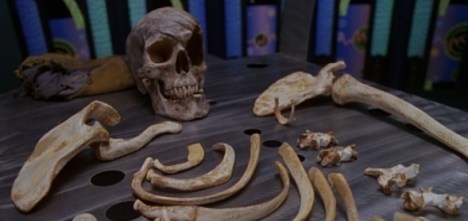
The bones of a theory.

The bare bones of a theory.

Continue reading

Star Trek: Voyager – Real Life (Review)

Real Life is in some ways a departure for Star Trek: Voyager.

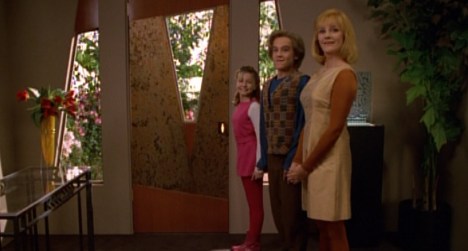
That much is obvious from the teaser, which introduces three new characters on a new set. More than that, the three characters comprise a nuclear family and the set is built to resemble the stereotypical American family home. It is a very strange image, even before the characters begin talking like they escaped from The Brady Bunch. In what might be the best teaser of the entire third season, it is revealed that the EMH has fashioned himself a holographic family and is “commuting” to work in sickbay from the holodeck.

Projections.

Projections.

It is certainly an interesting idea, one that consciously brushes up against the kinds of limitations and expectations that Voyager has faced. It feels experimental, quite removed from the broader third season attempts to position Voyager as the most generic of the Star Trek spin-offs. This does not look or feel like any other episode in the franchise’s history. Indeed, with its focus on family dynamics and conflict, it feels like an extension of Ronald D. Moore’s work on episodes like Family and Doctor Bashir, I Presume.

This makes the episode’s failure to follow through on any of that potential even more disappointing. The third season of Voyager has dramatically scaled down its ambition following the spectacular misfires of the second season. The show is no longer attempting to create long-form stories or introduce iconic new recurring alien species, instead setting more modest goals for itself. There is something disheartening in seeing Voyager set more modest challenges for itself in episodes like Macrocosm or Fair Trade, only to spectacularly bungle the handling of those challenges.

Family matters.

Family matters.

Real Life is another example of the trend. The premise is interesting, and the episode hits on any number of intriguing ideas. There is a great story to be told using this premise, exploring core themes about the human condition in a way that is quite different from the normal storytelling on Voyager. However, the episode flirts with the premise and then balks at it. Real Life is terrified of the implications of its story, padding out the plot with an unnecessary techno-babble-laden diversion and casually discarding the holographic family at the end of the script.

Real Life is an underwhelming story, rendered all the more disappointing for the promise that it squanders.

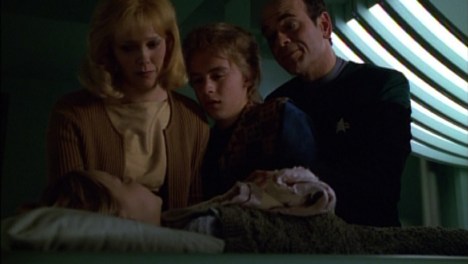
Photon father.

Photon father.

Continue reading

Star Trek: Voyager – Before and After (Review)

You might be interested in our other reviews from the third season of Star Trek: Voyager:

Before and After is an episode that should be more interesting than it ultimately is.

There is no small irony in the fact that the one future constant suggested by Before and After would be gone by the third episode of the following season, while the generic tone of the episode’s future flashes would prove entirely accurate. In some ways, Voyager was a paradox. It was generally quite professional and sleek, the show’s polished exterior seeming a little too lifeless and sterile at times. However, this was all an elaborate and well-rehearsed illusion. Behind the scenes, Voyager was a turbulent and chaotic piece of television.

voy-beforeandafter22a

Those conversations and would tweak some of the future suggested by Before and After. Jennifer Lien would depart, and Kes would be retired. Jeri Ryan would be hired, and Seven of Nine would join the crew. Much like what had happened with Deep Space Nine, the planned third season cliffhanger would be thwarted and pushed into the fourth season to make way for a much more bankable story. On Deep Space Nine, Homefront and Paradise Lost were shunted for The Way of the Warrior. On Voyager, Year of Hell, Part I would be brushed aside for Scorpion, Part I.

At the same time, it was clear that Paramount was wary and uncertain of what the future might hold for the franchise. Viewing figures had begun a decline that would continue until the end of Enterprise. The writers on Deep Space Nine had been instructed by the studio to add an existing character and focus on the Klingons early in their fourth season, hoping to shore up viewers. Similar discussions were taking place behind the scenes on Voyager, with the network and producers looking to spice things up on the series.

voy-beforeandafter35a Continue reading

Star Trek: Voyager – Favourite Son (Review)

Favourite Son feels like the culmination of something that has been festering across the third season of Star Trek: Voyager.

The Star Trek franchise is generally regarded as progressive and forward-thinking. There is some debate to be had about whether this is an accurate summary of the franchise, given some of the creative decisions made over the course of its half-century run. However, there are times at which the franchise feels particularly liberal and points at which it feels particularly reactionary. A product of the mid-nineties, running through to the turn of the millennium, Voyager tends to feel very conservative in places.

This is a little bit what watching the episode feels like.

This is a little bit what watching the episode feels like.

In the second season, this reactionary tendency played out through the treatment of the Kazon in episodes like Initiations and Alliances. In the third season, with the Kazon long gone, it seems that Voyager has turned its reactionary gaze upon its female cast members. To be fair, the show’s first two seasons had any number of unfortunate creative decisions when it came to various female characters. Most notably, the decision to turn Seska into a baby-crazed maniac in Manoeuvres did not bode for the first female-led Star Trek series.

Nevertheless, a misogynist streak has manifested itself across the third season as a whole. In some cases, this has been relatively subtle; like the awkward insistence upon sexualising three-year-old Kes in the eyes of her two mentor figures in Warlord and Darkling. In other cases, this has been the entire point of the plot; like the decision to have Q try to sleep with the franchise’s first female lead and introduce his shrewish wife in The Q and the Grey or to introduce a psycho stalker in Alter Ego.

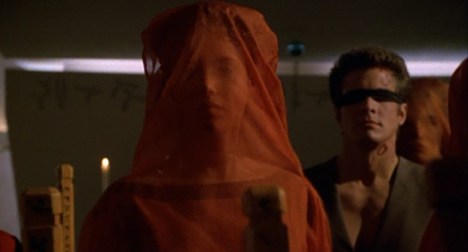
The original red wedding.

The original red wedding.

Other times, this sexist attitude has bubbled through the background of various episodes to the point that it builds to critical mass. Torres is victimised by her male colleagues over the course of three straight episodes, and none of them are held accountable; she is sexually assaulted by Vorik in Blood Fever, stunned by Chakotay in Unity, and tortured by the evil!EMH in Darkling. In each of those cases, the show seems to shrug off the violence committed by male characters against one of the show’s female leads.

All of these elements come to the fore in Favourite Son, an episode that would have been painfully retrograde had it aired as part of the original series during the sixties. Favourite Son is that most uncomfortable myth dressed up in science-fiction drag, the tale of an island of beautiful women using their sexual prowess to lure men into their clutches to emasculate them. It is terrifying to think that this episode made it to air in the late nineties.

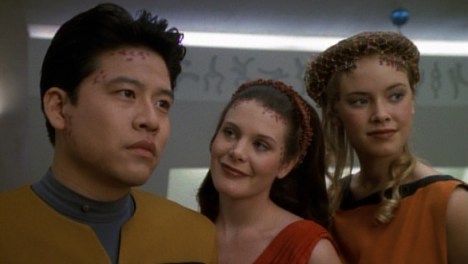
A beautiful dream.

A beautiful dream.

Continue reading

Star Trek: Voyager – Rise (Review)

Rise is in many ways a very typical episode of Star Trek: Voyager.

It is an episode that certainly has an interesting premise. For all its myriad flaws, Voyager tended to have a genuine interest in playing with science-fiction concepts. At its worst, this attitude manifested itself through the various “anomaly of the week” stories that followed a familiar pattern of the ship encounter some sort of strange phenomenon with predictable results. Often this phenomenon involved time travel or interstellar dust clouds, a trend that could be traced back to early episodes like Time and Again or The Cloud.

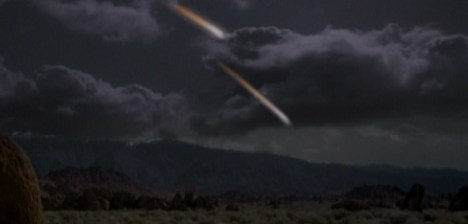
That crashing feeling.

That crashing feeling.

However, Voyager did occasionally use its interest in science-fiction storytelling to construct interesting stories. Deadlock might have set a damning precedent for the show, but it was compelling television. Blink of an Eye is a very clever little story. In true Star Trek fashion, Voyager would even use these science-fiction ideas to construct engaging allegories like the exploration of holocaust denial in Remember or the meditation on creationism in Distant Origin.

These concepts gave the series a sense of texture. They served to distinguish the show from its siblings. For example, Star Trek: Deep Space Nine was generally less interested in science-fiction high concepts than in characterisation and politics. When those sci-fi elements did show up, they were usually to torture O’Brien in episodes like Whispers, Visionary, Hard Time and Time’s Orphan. Of course, Deep Space Nine had sci-fi concept-driven stories like Playing God or One Little Ship, but they tended to stand out more from the series around them.

Up on the roof's the only place I know...

Up on the roof’s the only place I know…

Rise has a suitably high concept, a core idea that could easily have been lifted from the pages of the same pulp magazines that inspired The Cloud Minders. The episode is essentially a paranoid thriller unfolding within a confined space, but that confined space just happens to be a giant elevator that stretches from the surface of the planet into orbit. The premise is ridiculous, feeling like it was lifted from forties or fifties periodicals with giant insects and half-naked men on the cover. In other words, it feels of a piece with Innocence or The Thaw or Tuvix.

It is too much to argue that Rise has a brilliant concept, but it at least has an intriguing one. While it might be hard to use the basic elements of Rise to construct a classic, it should be relatively straightforward to construct a thrilling episode of television. Unfortunately, Rise simply does not work. More than that, Rise does not work for the most boring of reasons. As with a lot of Voyager, the episode is an interesting premise undercut by both a deeply flawed (and half-hearted) execution and the show’s own long-standing structural weaknesses. This happens all too often.

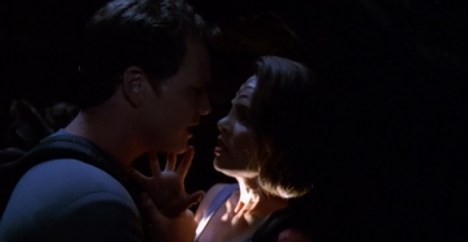
A dark moment for the series.

A dark moment for the series.

Continue reading

Star Trek: Voyager – Darkling (Review)

There is something to be said for the pulpier side of Star Trek: Voyager, the aspect of the show that plays like a cheesy sci-fi b-movie.

Brannon Braga is very much the driving force behind this aspect of the show, as evidenced by his scripts for the belated Cold War body-swapping horror of Cathexis or the psychological nightmare of Projections or the trashy psychedelic terror of Cold Fire or even the weird evolutionary anxieties of Threshold and Macrocosm. These sorts of episodes often feel like they belong in a late night movie slot reserved for forgotten horror flicks from the fifties and sixties. Of course, Braga is not alone in this; episodes like Meld and The Thaw also fit the pattern.

Blurred lines.

Blurred lines.

Of course, these episodes do not always hit the mark. Charitably, it could be argued that they land about half the time and misfire spectacularly about one third of the time. However, there is something strangely compelling about these episode. They feel distinct from what audiences expect from Star Trek. Even if they are arguably just an extension of late Star Trek: The Next Generation episodes like Sub Rosa or Genesis or Eye of the Beholder, they feel like something different from the show’s more conventional “let’s do archetypal Star Trek” plotting.

Darkling is an episode that doesn’t quite work, but which is oddly endearing in its dysfunction. It is a ridiculous central premise executed in a deeply flawed (and occasionally uncomfortable) manner. However, there is something weirdly compelling about wedding the show’s science-fiction premise to gothic horror through the fractured psyche of a computer program.

Patchy.

Patchy.

Continue reading

Star Trek: Voyager – Unity (Review)

The autopsy of the Borg corpse is underway.

– Janeway about sums it up

If the third season of Star Trek: Voyager is about the show embracing its place in the shadow of Star Trek: The Next Generation, then it makes sense that the third season would bring the crew into conflict with the Borg. The first two seasons of Voyager had leaned rather heavily upon the mythology of The Next Generation, featuring guest appearances from Q and Riker in Death Wish or Barclay in Projections, not to mention a recurring Cardassian foe and enemies heavily influenced by The Next Generation era Klingons.

However, the first two seasons had made an effort to introduce new and exciting foes for Voyager, new recurring species to reflect that the ship was traveling through an unknown part of space. For all the show featured guest appearances from Romulans and Ferengi, the first two years at least tried to do their own thing. The Kazon might have been a questionable idea horribly executed, but at least they were a new species. The Vidiians were underutilised and remain one of the most fascinating recurring aliens in the entire franchise.
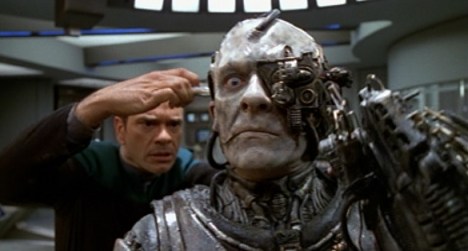
The brains of the operation.

The brains of the operation.

The third season only features a few token appearances of the recurring Delta Quadrant species. The Kazon disappear from the show after Basics, Part II. The Vidiians appear within a nightmarish time loop in Coda. A lost Talaxian pops up on a space station in Fair Trade. However, these aliens are no longer a recurring presence. There is an obvious vacancy that needs to be filled. Voyager needs a new recurring alien species. With that in mind, it is telling that the third season does not create a new alien menace like the Hirogen or the Malon.

The third season of Voyager decides that the Borg are to be the shows recurring adversaries. It makes a certain amount of sense. After all, the Borg are arguably the most iconic and effective aliens created by The Next Generation. They were a massive part of the spin-off really coming into its own with The Best of Both Worlds, Part I and The Best of Both Worlds, Part II. They were also a major part of the hugely successful feature film Star Trek: First Contact. There was definitely an appetite for more Borg stories. There always would be.

Corpsing...

Corpsing…

At the same time, the presence of the Borg feels very much like a concession or a surrender. This is Voyager effectively surrendering itself to becoming a pale imitation of The Next Generation, acknowledging that it will never create any alien species as memorable or as iconic as the Borg. That is not an unreasonable thing to accept. After all, Star Trek: Deep Space Nine did fantastic work with the Dominion, but that collection of alien species could never hope to have the same cultural penetration as the Borg.

Still, it is disheartening to see Voyager give up on itself so completely. Indeed, Unity is not even a particularly innovative Borg story, feeling very much like a retread of their last television story in Descent, Part I and Descent, Part II. This is a recurring problem for the third season of Voyager, which has spent a lot of time emulating various Next Generation episodes. However, there is also a sense that Voyager is not terrible at this imitation, even as it is lessened by it. Unity is a flawed episode, but an intriguing one.

Just what every Borg story needs! A Chakotay romance!

Just what every Borg story needs! A Chakotay romance!

Continue reading

Star Trek: Voyager – Blood Fever (Review)

Blood Fever is a strange and dysfunctional episode.

By this point in the third season, Star Trek: Voyager has abandoned any sincere attempt to develop or define its own identity. Instead, the series has committed itself to being the most generic Star Trek show imaginable. In many ways, this represents a disappointing betrayal of an interest premise and a fascinating cast of characters. In other ways, this allows the show to focus on telling archetypal Star Trek stories like Remember or Distant Origins or Living Witness, stories that deal with broad themes through science-fiction allegory.

Tunnels of love.

Tunnels of love.

In its strongest moments, Blood Fever feels like it wants to be that kind of classic Star Trek metaphorical exploration of contemporary society. In many ways, Blood Fever is an exploration of contemporary attitudes towards sex and sexuality, of the damage that can be wrought by sexual repression on levels both personal and societal. It is building upon the idea of pon’farr as introduced by Theodore Sturgeon (and refined by D.C. Fontana) in Amok Time, as the volcanic eruption of sexual desire following years of repression.

Unfortunately, Blood Fever lacks the courage of its convictions. The script feels like a victim of the same social mores that it seeks to critique, either unable or unwilling to talk about sex and sexuality in a manner that is suitably candid. As a result, Blood Fever ends up a muddled and ineffective piece of television that seems unwilling to call out its characters and which inevitably builds towards a tired rehash of an iconic Star Trek scene. Waiting seven seasons for this must be very unsatisfying.

Droning on.

Droning on.

Continue reading