• Following Us

  • Categories

  • Check out the Archives


  • Awards & Nominations

Star Trek: Deep Space Nine – Progress (Review)

Star Trek: Deep Space Nine is twenty years old this year. To celebrate, I’m taking a look at the first season. Check back daily for the latest review or retrospective.

Progress is the best episode of Star Trek: Deep Space Nine‘s first season to date. Of course, there are better episodes ahead – two of them clustered at the end of the show’s truncated first year – but Progress still represents a considerable improvement over anything that has come before. It isn’t quite perfect, but it does have a nice character focus and takes advantage of the show’s unique perspective and position. It’s evidence that the writing staff were at least engaging with the show’s status quo and trying to work with it to tell interesting stories, with Progress offering an early pure example of what Deep Space Nine story should probably look like.

While the first season has been quite bumpy (although notably less bumpy than any of the opening seasons of the other three Star Trek spin-offs), Progress offers a demonstration that we are getting somewhere. The title might apply as much to the status of the show itself as to the themes of the episode.
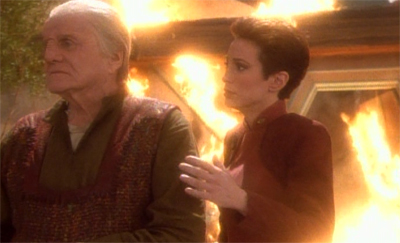
Burning down the house...

Burning down the house…

Continue reading

Star Trek: Terok Nor – Night of the Wolves by S.D. Perry & Britta Dennison (Review)

Star Trek: Deep Space Nine is twenty years old this year. To celebrate, I’m taking a look at the first season. Check back daily for the latest review or retrospective.

We’ll be supplementing our coverage of the episodes with some additional materials – mainly novels and comics and films. This is one such entry.

Prequels are a tricky business. Not just because we already know the ending – after all, we love adapting old familiar stories in new ways, and knowing the outcome can easily lend a project an air of grand tragedy or irony. However, the temptation with prequels is to make it all make sense, to tie absolutely everything up in a neat little bow, resolving all the plot threads and removing any hint of ambiguity or mystery from the original work – less of a story in its own right and more of a “fill in the blanks” approach.

James Swallow’s Day of the Vipers occasionally fell into this trap as it offered an account of the Cardassian plot to take control of Bajor, but it managed to offer its own insights and character development – giving us a suitably complex and self-justifying version of Gul Dukat. Night of the Wolves is somewhat less successful at avoiding the same problems, with a plot that appears to have been fashioned by linking off-hand references and back story from various early episodes together.

We get Odo and Kira meeting for the first time; an account of the liberation of Gallitep; a back story for a young Damar; the roots of Natima Lang’s dissatisfaction with the Central Command. None of these threads seem to build to anything insightful or clever, instead playing out predictably – pretty much exactly as we might have imagined them.

Continue reading

Star Trek: Deep Space Nine – The Storyteller (Review)

Star Trek: Deep Space Nine is twenty years old this year. To celebrate, I’m taking a look at the first season. Check back daily for the latest review or retrospective.

The Storyteller should not work half as well as it does. While some episodes this season (notably The Passenger and Battle Lines) feel like they were simply lifted directly from the “reject” pile within the writers’ room on Star Trek: The Next Generation, The Storyteller is actually a rejected pitch from that show’s first season. Written by Kurt Michael Bensmiller, the writer responsible for Time Squared, one of the stronger installments of the show’s first two years, it was also written late in 1992, about a month before Star Trek: Deep Space Nine would actually air.

And yet, despite that, The Storyteller really feels like a show that wouldn’t work on any of the other Star Trek spin-offs. A lot of that seems to be down to the work by Ira Steven Behr to polish up Bensmillers’ draft and to add a lot of character work and development to what is a decidedly high concept. As producer Michael Piller confessed in Captains’ Logs Supplemental – The Unauthorized Guide to the New Trek Voyages, “Ira did a lot of work on that script.”

O'Brien's mind is a bit clouded right now...

O’Brien’s mind is a bit clouded right now…

Continue reading

Star Trek: Deep Space Nine – Battle Lines (Review)

Star Trek: Deep Space Nine is twenty years old this year. To celebrate, I’m taking a look at the first season. Check back daily for the latest review or retrospective.

Battle Lines is, quite frankly, not a very good piece of television. Like a few of the episodes scattered throughout the first season of Star Trek: Deep Space Nine, it feels like it was pulled from a list of rejected scripts for Star Trek: The Next Generation. Ironically, it feels more like a reheated left-over than the next episode, The Storyteller, which was actually a recycled script from the first season of The Next Generation. Were it not for the involvement of Kai Opaka and a few hints about Bajoran spirituality, Battle Lines would feel almost as generic as The Passenger.

The concept is fascinating, and it represents another long-term shift in Deep Space Nine, but the script from Hilary J. Bader feels too functional and broad to do the episode justice. Instead, it feels fairly bland, which is a bit disappointing for an episode where Sisko accidentally gets the pope caught up in the universe’s most deadly game of laser tag.

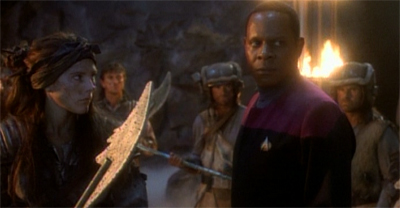
Taking a stab at bringing peace...

Taking a stab at bringing peace…

Continue reading

Star Trek: Deep Space Nine – Vortex (Review)

Star Trek: Deep Space Nine is twenty years old this year. To celebrate, I’m taking a look at the first season. Check back daily for the latest review or retrospective.

Something very interesting happens in the second half of Star Trek: Deep Space Nine‘s first season. It seems like the writers and producers are making a conscious effort to develop the show’s characters, themes and the world that these inhabit. Plot threads are hinted at, only to be left dangling. Ideas are broached, and tucked away for another day. Given that Star Trek: The Next Generation waited until the third season to broach serialisation in Sins of the Father, the approach taken here is quite striking.

These three episodes are more notable for what they set up rather than what they actually accomplish on their own terms. These adventures lay groundwork, or at least hint at laying groundwork, that will pay off throughout the show’s extended seven-year run. Okay, not exactly. There are some redundant elements here that never actually pay off, but Vortex, Battle Lines and The Storyteller all play into the show’s bigger story arc, even if it seems the writers aren’t entirely sure what those story arcs are.

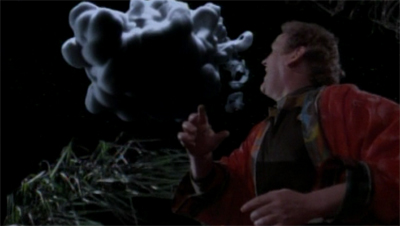
It's murky out there...

It’s murky out there…

Continue reading

Star Trek: Deep Space Nine – The Nagus (Review)

Star Trek: Deep Space Nine is twenty years old this year. To celebrate, I’m taking a look at the first season. Check back daily for the latest review or retrospective.

The Nagus starts what turns out to be an annual tradition for Star Trek: Deep Space Nine. It introduces the concept of a “Ferengi” episode, where once (or twice) a year, the show would take time out from other on-going concerns to focus on the state of affairs in the Ferengi Alliance. In a way, it’s quite like what Star Trek: The Next Generation did for the Klingons, taking an episode every once in a while to delve into the alien culture and offer a bit of exploration of a species originally created as a two-dimensional cardboard stand-in for a philosophy the franchise found unappealing.

Starting with Heart of Glory, The Next Generation developed Klingons from “those bad guys with the ridges” into a fully functioning and multi-faceted culture, largely driven by writer Ronald D. Moore from the third season. Deep Space Nine did largely the same thing with the Ferengi, largely spearheaded by producer Ira Steven Behr. Although, given the fact that the episodes concerned amoral capitalists instead of imposing warriors, Deep Space Nine opted for comedy as the genre of choice when developing the Ferengi.

He's got the lobes for business...

He’s got the lobes for business…

Continue reading

Star Trek: Deep Space Nine – Move Along Home (Review)

Star Trek: Deep Space Nine is twenty years old this year. To celebrate, I’m taking a look at the first season. Check back daily for the latest review or retrospective.

And here we hit what is commonly agreed to be the nadir of Star Trek: Deep Space Nine‘s rocky first season. Even the production staff seemed to acknowledge the problems with Move Along Home. Director David Carson conceded that it was “disappointing”, while future writer Ronald D. Moore could help  “wondering if everyone had lost their minds.” And there’s no way of getting around it. Move Along Home is a stinker in virtually every way that counts. It’s messy, contrived, confused, but without the wit to pull off the surreality of the set-up. There are no stakes, and the only way the episode can generate suspense is by lying to the audience.

And yet, despite that, I am actually much fonder of Move Along Home than I am of The Passenger. Don’t get me wrong, I don’t like either very much, but I’m more forgiving of the problems with Move Along Home, which stem from the episode’s ambition. There’s a sense that at least the episode was trying to do something a bit novel, even it backfired spectacularly. If I have to choose between flawed ambition and bland mediocrity, I’ll choose flawed ambition every time. Move Along Home might be a pretty dodgy episode, but at least its less generic than The Passenger.

A piece of the action...

A piece of the action…

Continue reading

Star Trek: Deep Space Nine – The Passenger (Review)

Star Trek: Deep Space Nine is twenty years old this year. To celebrate, I’m taking a look at the first season. Check back daily for the latest review or retrospective.

And here we hit what amounts to the rock bottom of Star Trek: Deep Space Nine‘s first season. The Passenger and Move Along Home exist as the two weakest stories in this first season, and the point from which Deep Space Nine begins to map a path towards recovery, climaxing in the best final two episodes of any first season in the history of Star Trek. We’re a long way from that, and we seem furthest from it here.

While Move Along Home is a legitimately bad episode, one with flaws that probably should have been spotted in any of the episode’s troubled development history, The Passenger suffers because it is the most bland and generic of the first season Deep Space Nine episodes. It accomplishes nothing, but it feels worse because its ambitions were so low. It’s the kind of story that could easily have been told on any Star Trek show, or any science-fiction series, but with no sense of local colour to give it distinctive flavour.

The Passenger is just as bland as the title makes it sound.

The not-so-good Doctor...

The not-so-good Doctor…

Continue reading

Star Trek: Deep Space Nine – Dax (Review)

Star Trek: Deep Space Nine is twenty years old this year. To celebrate, I’m taking a look at the first season. Check back daily for the latest review or retrospective.

Dax is a very weird episode. It is the first episode centred around Jadzia Dax, but it also demonstrates the problems that will affect Dax-centric episodes throughout Terry Farrell’s time on the show. Due to the nature of the character, the stories about Dax tend to treat her as a plot point or a macguffin rather than a character in and of herself. Here, for example, Dax finds herself on trial for the actions of her direct predecessor, Curzon Dax. It’s a fascinating moral and philosophical dilemma (can you hold somebody accountable for their actions in a past life?), but it’s a story about Dax that isn’t about the character as she currently exists. It’s fascinating and frustrating in equal measure, but at least it’s a sign that Star Trek: Deep Space Nine is content to do more than merely imitate Star Trek: The Next Generation.

Touching...

Touching…

Continue reading

Star Trek: Deep Space Nine – Q-Less (Review)

Star Trek: Deep Space Nine is twenty years old this year. To celebrate, I’m taking a look at the first season. Check back daily for the latest review or retrospective.

And the first season of Deep Space Nine continues its trend towards mediocrity. I feel I should qualify that. The first season of Deep Space Nine is never truly terrible. Even the (very) dodgy Move Along Home is superior to any number of episodes from the first season of Star Trek: The Next Generation, like Code of Honour or Angel One. The first season of Deep Space Nine just winds up feeling like it’s treading water, as if it is trying too hard to emulate The Next Generation, instead of exploring the unique storytelling opportunities offered by the show’s setting.

Q-Less is arguably the most obvious example of these attempts at imitation. While episodes like Babel and The Passenger could have been reworked as episodes of The Next Generation with a minimum of fuss, Q-Less rather cynically takes two recurring guest stars from The Next Generation and allows them to steal focus from an ensemble that is still finding its feet. It feels not only a little ill-judged, but also a bit rude.

Guess Q...

Guess Q…

Continue reading