• Following Us

  • Categories

  • Check out the Archives


  • Awards & Nominations

Star Trek: Deep Space Nine (Malibu Comics) – The Rules of Diplomacy (Review/Retrospective)

The September and October, we’re taking a look at the jam-packed 1994 to 1995 season of Star Trek, including Star Trek: Deep Space Nine and Star Trek: Voyager. Check back daily for the latest review.

One of the more interesting aspects of Star Trek: Deep Space Nine is the way that the cast actively involved themselves in the mythology of the show. Armin Shimerman originally pitched The 34th Rule as an episode of the show, along with Eric A. Sitwell and David R. George III. Andrew Robinson published A Stitch in Time, a novel based on notes he had been making about Garak during the production of the series. Even J.G. Hertzler co-wrote the Left Hand of Destiny duology.

Of course, this was not a unique occurrence. Walter Koenig had written an episode of Star Trek: The Animated Series, an issue of Marvel’s on-going Star Trek comic and even The Machiavellian Principle, a play performed at the Ultimate Fantasy convention. John DeLancie had co-written The Gift, a story published in DC’s Star Trek: The Next Generation comics. Ethan Phillips and Robert Picardo would lend their names to tie-in Star Trek: Voyager books.

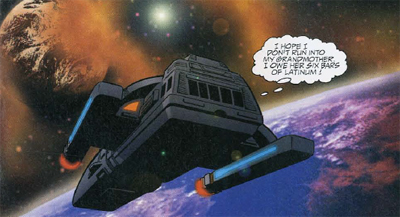
However, it seems reasonable to observe that the supporting cast on Deep Space Nine were particularly interested in fleshing out and developing their characters. So it seems appropriate that Aron Eisenberg should co-write The Rules of Diplomacy, a special about Nog earning some credits before shipping off to Starfleet Academy.
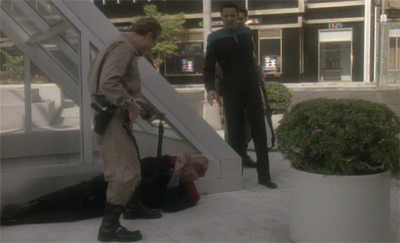
You can't go home again...

You can’t go home again…

Continue reading

Star Trek: Voyager – Phage (Review)

This September and October, we’re taking a look at the jam-packed 1994 to 1995 season of Star Trek, including Star Trek: Deep Space Nine and Star Trek: Voyager. Check back daily for the latest review.

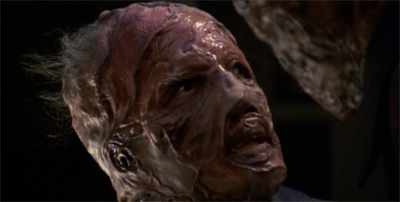
Phage is far from perfect. It is very far from perfect. However, there’s something rather endearing about this cheesy B-movie throwback written by Brannon Braga from a pitch by Timothy DeHass and first draft by Skye Dent. The Vidiians are probably the most memorably and effective aliens from the first three seasons of Star Trek: Voyager, feeling like they could have wandered into the show from some trashy late-night horror movie on another channel.

There’s a pulpy quality to the episode that makes it more enjoyable than many of the surrounding Voyager episodes, albeit one undermined by some of the more awkward resonances in the script.

The Vidiians survive by the skin of their teeth...

The Vidiians survive by the skin of their teeth…

Continue reading

Star Trek: Deep Space Nine – Life Support (Review)

This September and October, we’re taking a look at the jam-packed 1994 to 1995 season of Star Trek, including Star Trek: Deep Space Nine and Star Trek: Voyager. Check back daily for the latest review.

Life Support is the first episode of Star Trek: Deep Space Nine to air after Star Trek: Voyager went on the air. It’s amazing how quickly Deep Space Nine settled back into the role of “the other Star Trek show on television.” A lot of attention was focused on launching Voyager, with the show put in the awkward position of launching (and, in the years ahead, supporting) the new television network UPN. As a result, Voyager got a lot of press and a higher profile.

Deep Space Nine fell back into familiar routines. Life Support is far from an exceptional piece of Deep Space Nine. In fact, it’s a deeply flawed piece of television. However, it feels free of the identity crisis that dominated the first half of the third season. This is Deep Space Nine free of the expectations of being “the only Star Trek on television”, and allowed the freedom to just keep doing whatever it wants to do.

It doesn’t do any of the things that it wants to do particularly well, but it does them in its inimitable way.

Dead air...

Dead air…

Continue reading

Star Trek: Deep Space Nine – Prophecy & Change: The Orb of Opportunity by Michael A. Martin and Andy Mangels (Review/Retrospective)

The September and October, we’re taking a look at the jam-packed 1994 to 1995 season of Star Trek, including Star Trek: Deep Space Nine and Star Trek: Voyager. Check back daily for the latest review.

It is fun to imagine the negative space that exists between various episodes of Star Trek: Deep Space Nine. In its third season, the show was making nods towards serialisation, but there was never really a point where the series could not be broken down into reasonably well-defined episodic units. Even during the ten-hour series finalé, each of the constituent elements had its own narrative thrust and its own clear purpose. So it is fun sometimes to try to connect these threads together.

The ordering of episodes in a season of television is very interesting. It creates a fascinating connective tissue in the minds of fans. Although each episode is its own story, they come together to form something larger and more intriguing. On The X-Files, for example, placing Never Again directly after Leonard Betts changed the whole context of the episode. There are threads that do not necessarily exist within the individual episodes, but can be implied by the sequencing of the shows.

Placing Heart of Stone directly after Life Support is an interesting choice in several respects. It creates all sorts of interesting implications and developments, contradictions and possibilities. It is weird to have an episode about Odo’s attraction to Kira air directly after an episode focusing on the death of Kira’s long-term love interest; give her a week or two of space, guys. Similarly, it is strange to go from Nog’s characterisation in Life Support to his development in Heart of Stone.

The Orb of Opportunity is very clearly intended to bridge the gap between those two episodes, explaining how and why Nog developed in the way that he did.

ds9-prophecyandchange

Continue reading

Star Trek: Voyager – Time and Again (Review)

This September and October, we’re taking a look at the jam-packed 1994 to 1995 season of Star Trek, including Star Trek: Deep Space Nine and Star Trek: Voyager. Check back daily for the latest review.

It’s really remarkable the sense of self that Star Trek: Voyager had three issues into its run. It took Star Trek: The Next Generation two years to figure out what it wanted to be. Star Trek: Deep Space Nine only really settled down in its fourth season. Star Trek: Enterprise reinvented itself twice before it was cancelled. On the other hand, Voyager just seemed so aware of what it was and what it was going to be within only a few episodes.

Sure, there would be a few changes made in the years ahead. The Borg would appear in the third season; Seven of Nine would join the cast in the fourth. Janeway’s fickleness has yet to be firmly established; the Doctor hasn’t come to the fore. And, yet, three episodes in, it is quite possible to look at Star Trek: Voyager and get a sense of what the next seven years will be like. The shape of things to come.

Time and Again is a time travel story, but it’s also the first time that Voyager pulls a full-on end-of-episode reset. It will not be the last.

Guest starring: anomaly of the week!

Guest starring: anomaly of the week!

Continue reading

Star Trek: Voyager – Parallax (Review)

This September and October, we’re taking a look at the jam-packed 1994 to 1995 season of Star Trek, including Star Trek: Deep Space Nine and Star Trek: Voyager. Check back daily for the latest review.

Parallax feels like a seventh season episode of Star Trek: The Next Generation nested inside a first season episode of Star Trek: Voyager. It’s Brannon Braga’s first script for the show, having opted to join Star Trek: Voyager rather than moving over to Star Trek: Deep Space Nine. Braga would go on to become one of the longest-serving creative forces on televised Star Trek, becoming an executive producer on Star Trek: Voyager and creating (and producing) Star Trek: Enterprise.

Braga is a fantastic high-concept science-fiction writer. His scripts for The Next Generation count among the best the show ever produced – Cause and Effect, Parallels, Frame of Mind. The team of Brannon Braga and Ronald D. Moore ranks as one of the most consistently great collaborations in the history of Star Trek. On his own, Braga writes fascinating sci-fi concepts. His scripts for the various shows support that.

The problem is that Braga isn’t the franchise’s strongest character writer. Indeed, among the staff writers working on the first season of Voyager, Braga seems like the worst candid to draft in to write the big “establishing character dynamics” episode directly following the pilot. The problem with Parallax is that it’s a nice premise featuring a bunch of characters we don’t care about yet, and the script is more interested in the anomaly of the week than it is in getting us to care about those characters.

"It's like looking into the future..."

“It’s like looking into the future…”

Continue reading

Star Trek: Voyager – Caretaker (Review)

This September and October, we’re taking a look at the jam-packed 1994 to 1995 season of Star Trek, including Star Trek: Deep Space Nine and Star Trek: Voyager. Check back daily for the latest review.

So, Star Trek: Voyager.

Where do we begin? Voyager is probably the most divisive and controversial of the Star Trek spin-offs, the one that carries a lot of the blame for the franchise’s decline and decay in the mid to late nineties. It is the series that connects the tail end of the success story that was Star Trek: The Next Generation to the start of the dying gasp that was Star Trek: Enterprise. This spin-off had the misfortune to launch at the height of a revived franchise’s popularity and to finish as public interest waned.

Feels like going home...

Feels like going home…

Star Trek: Voyager felt like an act of hubris. It was positioned by Paramount to be the studio’s highest-profile television show. It was a feature of the television landscape, finally allowing Paramount the chance to leverage its own television network – a plan delayed since the late seventies, but deemed feasible in the mid-nineties. UPN branded itself “the first network of the new century”, a rather arrogant declaration. Caretaker was the first thing broadcast on UPN in early 1995, débuting to an audience of more than 21 million. However, Voyager would never reach those figures again.

Despite that success, things fell apart quickly. None of the shows that aired on UPN’s second night received a second season. The only shows to limp on to renewal from the network’s rocky first year were Voyager, The Sentinel and Moesha. Of these meagre freshmen hits. Voyager lasted the longest, with one more season to its name than Moesha. Over the summer of 1995, it was identified by The Los Angeles Times as the network’s “star survivor”, and the show upon which all of the network’s hopes rested. By 2000, five years later, the network had run up a debt of $800,000.

"I hope you don't mind, our tailors measured you while you were unconscious. It's all part of a standard probe."

“I hope you don’t mind, our tailors measured you while you were unconscious. It’s all part of a standard probe.”

That’s a lot of pressure for any television series to bear. Following (and, in the eyes of many, replacing) an illustrious predecessor, supporting the weight of a new television network, pushing into the future while remaining anchored to the past, it’s no wonder that Star Trek: Voyager wound up the confused mess that it became. Indeed, one can recognise many of the problems that would haunt the show through to its final season tied up in this pilot episode.

Continue reading

Star Trek: Deep Space Nine – Past Tense, Part II (Review)

This September and October, we’re taking a look at the jam-packed 1994 to 1995 season of Star Trek, including Star Trek: Deep Space Nine and Star Trek: Voyager. Check back daily for the latest review.

Past Tense, Part II is a nice way to close out Star Trek: Deep Space Nine‘s solo run, the only period in the show’s history where it was the only Star Trek on television. Caretaker, the première of Star Trek: Voyager, would be the next episode of the franchise to air. Deep Space Nine spent a lot of its early third season attacking various foundations of the Star Trek universe, as if hoping to demonstrate how profoundly different the show was from its predecessors.

The Search promised a war brewing on the horizon, and presented a cynical view of Starfleet foreign policy, where pacifism amount to appeasement. House of Quark reduced the Klingon Empire to a joke. Equilibrium suggested that Sisko could live with (and passively enable) a government lie if it kept his friend alive. Second Skin hinted that things might not be as they appear to be. The Abandoned embraced the idea that sometimes people are incapable of being anything more than what their genes might tell them to be. Defiant was the story of sibling desperately trying to prove his unique identity.

Everything is under control...

Everything is under control…

Part of me wonders if this very cynical stretch of episodes is responsible for the perception of Deep Space Nine as an incredibly cynical and pessimistic television show – one consciously at odds with the utopian ideals of the franchise. After all, this was the stretch where Deep Space Nine was most in the spotlight. It had the spot previously allocated to Star Trek: The Next Generation in most markets. It had no televised competition. If ever Star Trek fans were going to jump on board Deep Space Nine, this was the moment. It seems quite possible that this run of episodes cemented the show’s reputation.

So it seems strange that Deep Space Nine should wait until its last possible moment in the sun to embrace the humanism and optimism at the heart of the franchise. Past Tense is a story about building paradise, and about how humanity has the capacity to be so much better than we currently are. In short, it’s quintessential Star Trek, right down to the occasionally heavy-handed moralising and utopian idealism.

Keep your hat on...

Keep your hat on…

Continue reading

Star Trek: Deep Space Nine – Past Tense, Part I (Review)

This September and October, we’re taking a look at the jam-packed 1994 to 1995 season of Star Trek, including Star Trek: Deep Space Nine and Star Trek: Voyager. Check back daily for the latest review.

It’s weird to think that Past Tense aired at the very end of the period where Star Trek: Deep Space Nine was the only Star Trek on television. The two parts were broadcast in early January 1995, after the release of Star Trek: Generations but before the broadcast of Caretaker, the pilot episode of Star Trek: Voyager.

In a way, these are the most “Star Trek”-y episodes of the third season of Deep Space Nine. Embracing the franchise’s utopianism and optimism, the two episodes are even structured as a gigantic homage to The City on the Edge of Forever. Unlike the somewhat cynical and jaded run of episodes leading into them, Past Tense seems to exist as an episode that could draw fans of Star Trek: The Next Generation into Deep Space Nine.

Panic in the streets...

Panic in the streets…

It would have made sense to position the episodes earlier in the season, where they might have done a better job of attracting casual Star Trek viewers jonesing for a fix after The Next Generation went off the air. Unconnected to the serialised long-form plot of Deep Space Nine, engaging with important social issues of contemporary society and playing with familiar Star Trek tropes like time travel, it’s hard to imagine an episode of the third season of Deep Space Nine better suited to reeling in viewers.

As it stands, though, Past Tense aired at the last possible moment where Deep Space Nine could truly claim to be “the only Star Trek on television”, making the two-parter feel more like a footnote than a crescendo. It’s a shame, as Past Tense remains a vastly underrated instalment of the show’s third season.

Arresting drama...

Arresting drama…

Continue reading

Win! A Copy of David Gerrold’s World of Star Trek!

As you may have picked up, we are big fans of Star Trek here at the m0vie blog, and we are big fans of David Gerrold as well. Mr. Gerrold has recent released a number of his classic novels in eBook format, including The World of Star Trek. Originally published in 1973 and updated in 1984, the book offered a behind-the-scenes glimpse of the franchise and is an invaluable glimpse behind the curtain. A full list of Mr. Gerrold’s eBooks are available via his official site, or by clicking the image below.

We have an excerpt from the classic below and Mr. Gerrold has kindly volunteered to host a give away here. For your chance to win a copy – and four of David Gerrold’s eBooks of your choosing – simply leave a comment below. Simply leave a comment on the article stating you would like to be entered in the draw and we’ll pick a name from a hat. Enjoy!

World of Star Trek_giveaway

Continue reading