• Following Us

  • Categories

  • Check out the Archives


  • Awards & Nominations

Star Trek – All Our Yesterdays (Review)

This July and August, we’re celebrating the release of Star Trek Beyond by taking a look back at the third season of the original Star Trek. Check back every Monday, Wednesday and Friday for the latest update.

It is almost as though the Star Trek franchise doesn’t want to end.

For a fifty-year-old franchise, Star Trek has a hilarious near-miss ratio when it comes to offering satisfying conclusions. There are exceptions, of course. The franchise seems quite good at closing smaller chapters while the rest of the property rattles on. Star Trek VI: The Undiscovered Country was the best place to leave the cast of the original show. The final season of Star Trek: Deep Space Nine might have been rocky, but What You Leave Behind bid an emotional farewell to the cast and crew. Beyond that? The franchise struggles.

A cold reception.

A cold reception.

It often seems like the ideal closing instalment is buried one or two stories shy of the actual ending. All Good Things… would have been a great place to leave the cast of Star Trek: The Next Generation, particularly since Star Trek: Nemesis wound up being such a damp squib of a conclusion. Demons and Terra Prime provided a satisfying conclusion to the final two years of Star Trek: Enterprise, only for These Are the Voyages… to air as the final episode of the franchise for well over a decade.

This is something that the franchise inherited from the original show. Star Trek was remarkably terrible at choosing a high (or even an appropriate) note on which to end. Although some of this can be down to the fact that sixties television seasons did not build to a finale in the way that modern television does, the three seasons of Star Trek all end in disappointing fashions. The City on the Edge of Forever would have been a great close to a first season that built incredible momentum across its run. Instead, the year ended on Operation — Annihilate!
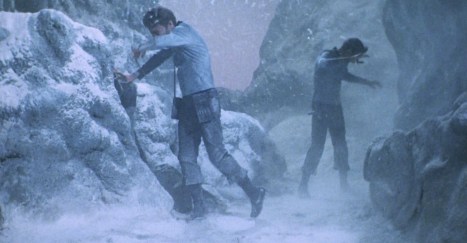
Snow escape.

Snow escape.

This was a bigger issue during the second season, when it was entirely possible that Star Trek would be cancelled. Ending on a strong note was imperative. Instead, Gene Roddenberry chose to give over the last broadcast and production slot of the season to Assignment: Earth, a thinly-disguised (and ultimately underwhelming) pilot for a series that never got off the ground. Even in terms of production, the penultimate episode of the season was Roddenberry’s vile passion project, The Omega Glory. (The Ultimate Computer would have made a much better ending.)

So it is with the third season. The last episode of the third season is an infamous disaster, Turnabout Intruder ranking as one of the very worst episodes of Star Trek ever produced. Even the misguided and mean-spirited cynicism of These Are the Voyages… has nothing on the rank sexism of Turnabout Intruder. It was an ignominious episode upon which to draw down the curtain, to wrap up three years and seventy-nine episodes of storytelling. It is hard to tell whether the episode is more or less awful than The Omega Glory or Assignment: Earth, but it is in contention.

Dying free(ze)...

Dying free(ze)…

This is all the more frustrating because a perfectly good alternative rests right along side it. All Our Yesterdays is a flawed and imperfect episode in some key ways, like many of the third season episodes around it. It is a story that flows on dream logic rather than rational plotting, relying on a bizarre fairy tale version of time travel and falling back on some of Fred Freiberger’s best-loved tropes. It is also a tough sell as a “final” episode, given that the series had not been cancelled by the point that the episode entered production, and it does not offer too much in the way of closure.

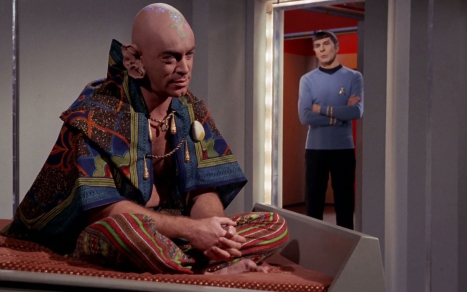
And yet. All Our Yesterdays feels like the culmination of the morose themes that have been building through the third season, all the dead worlds and the ghost stories and the doomed romances. It is a story about escaping to the past when there seems to be no future. It is populated by barren wastelands and death sentences, about the literal end of the world and survival beyond that point. It is a quiet and withdrawn affair, morbid and reflective more than heightened or action driven. It is a story about death, which feels entirely appropriate at this interval.

How BiZara...

How BiZara…

Continue reading

Star Trek – The Savage Curtain (Review)

This July and August, we’re celebrating the release of Star Trek Beyond by taking a look back at the third season of the original Star Trek. Check back every Monday, Wednesday and Friday for the latest update.

Gene Roddenberry returns to Star Trek, to put the show to rest.

Two of the final three episodes of this third season originated with Roddenberry, putting paid to the idea that the veteran executive producer was entirely absent from the year. Roddenberry had departed the show at the start of the season, after issuing NBC with an ultimatum regarding the scheduling of his series. He had moved out of the Star Trek production offices and across the lot to develop his own projects. The standard narrative of the third season suggests that Roddenberry was no longer around to keep the show on the rails.

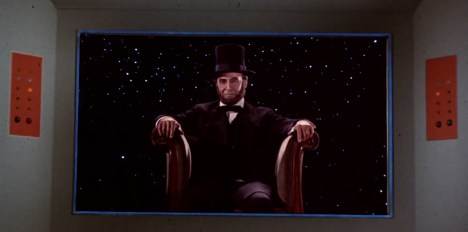
Holy space!Lincoln...!

Holy space!Lincoln…!

This is untrue, in a number of respects. Roddenberry was involved in the production of the third season, just not as actively as he had been. He was responsible for commissioning and championing a number of early third season episodes inherited by Fred Freiberger, including Elaan of Troyius and The Paradise Syndrome. He had even used his remaining leverage to shamelessly try to shoehorn merchandise into Spock’s Brain and Is There in Truth No Beauty? He was also drawing an executive producer salary and nabbed two late-season production slots.

Of course, this argument also relies on the assumption that Roddenberry understood Star Trek better than anybody else. Roddenberry had created Star Trek, but he was not the singular vision behind it. Writers like Dorothy Fontana and producers like Gene L. Coon were as responsible for shaping the show as Roddenberry in many respects. Roddenberry might have talked a good game, but he was also a producer who believed that The Omega Glory would have made a good pilot for the show.

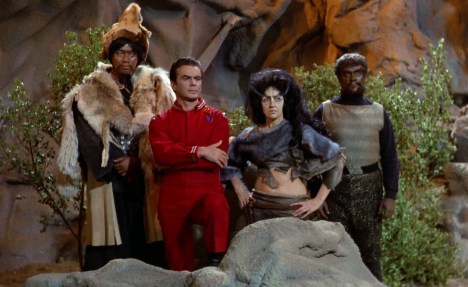
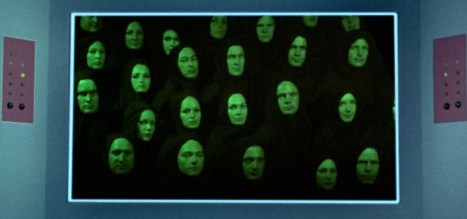
Legion of Doom!

Legion of Doom!

If anything, there is something faintly damning about Gene Roddenberry’s triumphant return to the series at the end of its third year. Neither The Savage Curtain nor Turnabout Intruder are good episodes. In fact, the best thing that can be said about Roddenberry’s two final contributions is that The Savage Curtain probably isn’t quite as bad as And the Children Shall Lead or The Way to Eden. Still, both episodes feel regressive and awkward. Roddenberry’s writing is a reminder of just how far the show had come in the care of other producers.

However, at least The Savage Curtain is memorable.

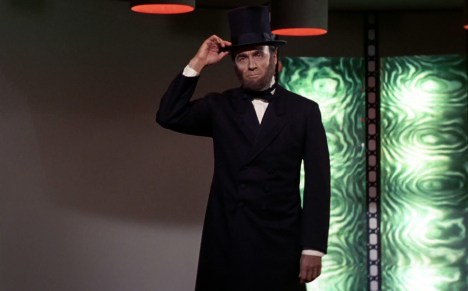
Topping it all off.

Topping it all off.

Continue reading

Star Trek – Requiem for Methuselah (Review)

This July and August, we’re celebrating the release of Star Trek Beyond by taking a look back at the third season of the original Star Trek. Check back every Monday, Wednesday and Friday for the latest update.

Requiem for Methuselah is a surprisingly quiet episode.

The basic premise of the episode suggests sound and fury. The crew of the Enterprise have been infected by a deadly illness. McCoy speculates that there are only four hours in which to save the crew. Desperately searching for a cure, Kirk leads an away team down to a planet rich in the necessary minerals. When a man claiming to be the planet’s sole inhabitant refuses to allow Kirk access to the mineral, there is a tense stand-off; Kirk threatens to have the Enterprise obliterate the man and take the compound by force.

"You know, falling in love with the surrogate daughter of the man who can save my ship might not be the best tactical move here. Particularly since I've known her all of two hours."

“You know, falling in love with the surrogate daughter of the man who can save my ship might not be the best tactical move here. Particularly since I’ve known her all of two hours.”

Despite this rather high-stakes set up, the rest of Requiem for Methuselah is rather low-key. Despite his initial hostility to the uninvited guests, the mysterious stranger invites Kirk and the away team to his home. The episode spares the audience the sight of crew members sick and dying, with Scotty and Uhura (and a “skeleton crew”) doing a respectable job of holding down the fort as the end approaches. Even when the first couple of attempts to manufacture a cure fall flat, McCoy and his colleagues remain professional and dignified through to the end.

In a way, this would seem to capture the tone of this stretch of the third season.

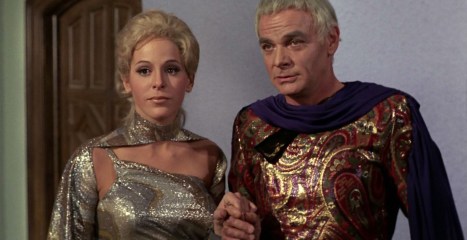
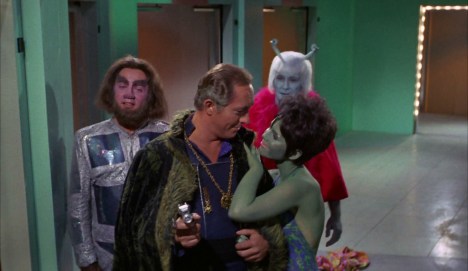
Our man Flint.

Our man Flint.

Continue reading

Star Trek – The Way to Eden (Review)

This July and August, we’re celebrating the release of Star Trek Beyond by taking a look back at the third season of the original Star Trek. Check back every Monday, Wednesday and Friday for the latest update.

Like any television, or any piece of popular culture, Star Trek is a product of its time.

That does not mean that the show speaks only to its time or that it has no relevance beyond that moment in time, but in means that the series is very much anchored in the zeitgeist of the late sixties. Sometimes that influence is obscured by advances in the intervening years, like the fascination with the novelty of transplant surgery that played out in the background of Spock’s Brain. Sometimes that tangible connection is more like ambient background noise than direct influence, as with the sense of apocalyptic dread that permeates the third season as a whole.

"You reach?"

“You reach?”

Sometimes, however, it is impossible to look upon Star Trek as anything other than a product of the late sixties. Let That Be Your Last Battlefield was undeniably a product of 1968, with its anxiety about civil strife and civil rights, its somewhat reductive metaphor for race relations and its general production aesthetic. However, that is nothing compared to The Way to Eden, which might be the most flamboyantly and stereotypically sixties episode of the entire original run.

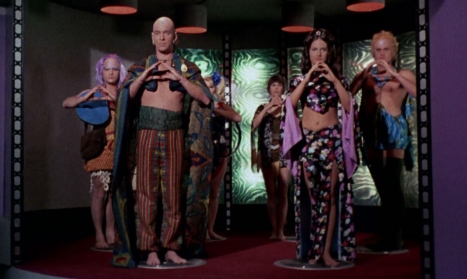
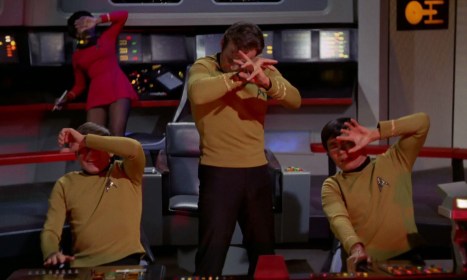
The Way to Eden is the episode that opens with a bunch of space!hippies staging a sit-in in the Enterprise transporter room and escalates from there.

Trippy hippie shakedown.

Trippy hippie shakedown.

Continue reading

Star Trek – The Cloud Minders (Review)

This July and August, we’re celebrating the release of Star Trek Beyond by taking a look back at the third season of the original Star Trek. Check back every Monday, Wednesday and Friday for the latest update.

The Cloud Minders is another reminder of the third season’s unique ability to produce memorable Star Trek.

There is something about the third season of Star Trek that draws fandom’s imagination to it. The general consensus is that the season is a disappointment filled with lacklustre episodes, questionable characterisation and crippling cutbacks. Nevertheless, the third season is also the source of a lot of the franchise’s core iconography like the Klingon D7 cruiser introduced in Elaan of Troyius or the IDIC in Is There in Truth No Beauty? That is to say nothing of the little curiosities sprinkled across the season.

Above all else.

Above all else.

Garth of Izar and Axanar are one such example, tied to the clumsy and awkward Whom Gods Destroy. Nevertheless, the concept of the “Battle of Axanar” was enough to launch a high-profile fan film that would become a flashpoint for twenty-first century fan productions. Indeed, there has even been speculation that Garth of Izar might be the commanding officer (although not the protagonist) in Bryan Fuller’s Star Trek: Discovery. This is not bad for concepts tied to an episode of which nobody seems particularly fond.

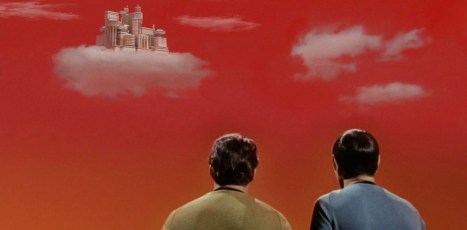
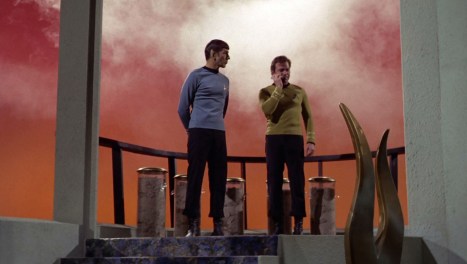
The same is arguably true of The Cloud Minders. It is a very clumsy and flawed piece of television, with a number of sizable script-related issues. However, it also has a number of very memorable visuals and ideas that have allowed it to take on an oversized place in the cultural memory of Star Trek.

Clouded judgement...

Clouded judgement…

Continue reading

Star Trek – The Lights of Zetar (Review)

This July and August, we’re celebrating the release of Star Trek Beyond by taking a look back at the third season of the original Star Trek. Check back every Monday, Wednesday and Friday for the latest update.

The Lights of Zetar is another third season ghost story.

The third season of Star Trek is populated with these weird stories about long-dead souls refusing to pass on. There is Kirk’s haunting of the Enterprise in The Tholian Web, the dead world of Scalos in Wink of an Eye, the replicas of the long-dead Losira in That Which Survives, the title character in Requiem for Methuselah, the escapes into the past in All Our Yesterdays. It is almost as though the third season is working through its anxieties, a season television trapped between two cancellations.

Flash of inspiration.

Flash of inspiration.

The Light of Zetar features yet more death and destruction. The mangled bodies inside the Memory Alpha facility, contorted over the furniture. The lone survivor, screaming in agony. The eponymous spectral apparition that “cannot be a phenomenon of nature.” The inhabitants of Zetar, rendered non-corporeal through the destruction of their world, refusing to acknowledge that they have truly been dead for thousands upon thousands years. The argument that Mira Romaine must sacrifice herself so that the Zetar might live.

More than a ghost story, The Lights of Zetar is an exorcism story.

More like Memory Omega.

More like Memory Omega.

Continue reading

Star Trek – The Mark of Gideon (Review)

This July and August, we’re celebrating the release of Star Trek Beyond by taking a look back at the third season of the original Star Trek. Check back every Monday, Wednesday and Friday for the latest update.

The Mark of Gideon is in many ways a direct counterpoint to Whom Gods Destroy.

Both The Mark of Gideon and Whom Gods Destroy have what might charitably be described as “major logic problems.” Both episodes were produced on a tiny budget, with those constraints bleeding through into almost every frame of the finished production. Both stories engage with the idea of utopianism as an essential ingredient in Star Trek storytelling. Both episodes are very much third season episodes, in terms of production and construction and storytelling.

Viewing screen on.

Viewing screen on.

However, Whom Gods Destroy manages to turn all of these elements into an ambitious mess. Although far from the strongest episode of the season, or even a half-decent episode of television, there is an endearing charm to Whom Gods Destroy that carries the episode far further than it should. In contrast, The Mark of Gideon is dead at arrival. It is an episode with a striking premise and set-up that has no idea where to go from that starting point and so meanders limply and lifelessly through forty-five minutes of television.

It also offers a pretty reprehensible vision of the franchise’s utopia.

This is an accurate representation of the third season's viewing figures.

This is an accurate representation of the third season’s viewing figures.

Continue reading

Star Trek – Whom Gods Destroy (Review)

This July and August, we’re celebrating the release of Star Trek Beyond by taking a look back at the third season of the original Star Trek. Check back every Monday, Wednesday and Friday for the latest update.

Whom Gods Destroy is a mess.

In a lot of ways, Whom Gods Destroy is shoddy and lazy. In many ways, the episode plays like a collection of familiar Star Trek elements blended together to pad out forty-odd minutes of television with no regard for internal logic or plotting and with minimal regard for the characters caught in the middle of it all. There are very few ideas in Whom Gods Destroy that have not been done before, and done better. The episode is not only a rehash of familiar concepts, but it is an exercise in diminishing returns.

Dance with destiny.

Dance with destiny.

This is to say nothing of the chaos unfolding behind the scenes during the production of the episode. It seemed only appropriate that Kirk’s latest mission would take him to what is effectively a gothic asylum in outer space, because it seemed more and more that Star Trek was turning into a madhouse. Veteran staffers were leaving the show in droves, while tensions were mounting on the set, and Fred Freiberger was struggling to keep the budget under control. More than that, there was a clear sense that the series was over, and this was the end of the line.

Whom Gods Destroy really sounds like a disaster. It is certainly not a good episode of television. However, this is the third season. Whom Gods Destroy is interesting enough that it works much better than the season’s weaker episodes. It is elevated by a manic energy that goes some way towards covering for the more illogical elements of the plot, and three central performances that play into the high camp of the premise. Whom Gods Destroy is far from classic Star Trek, but it is much better than it has any right to be.

Absolute madness.

Absolute madness.

Continue reading

Star Trek – Let That Be Your Last Battlefield (Review)

This July and August, we’re celebrating the release of Star Trek Beyond by taking a look back at the third season of the original Star Trek. Check back every Monday, Wednesday and Friday for the latest update.

Let That Be Your Last Battlefield is iconic Star Trek.

Let That Be Your Last Battlefield is a reminder that the iconic Star Trek is not necessarily good Star Trek.

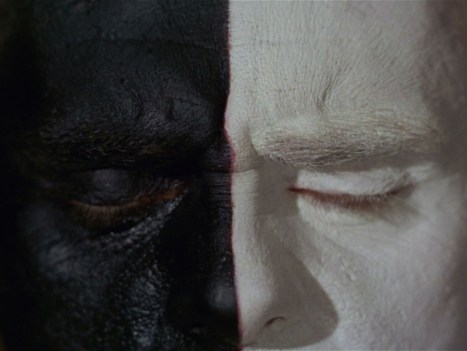
Half and half.

Half and half.

Let That Be Your Last Battlefield has become a cultural shorthand for the show.

Let That Be Your Last Battlefield is a testament to the weird influence that the dysfunctional third season has on the cultural memory of Star Trek.

Two sides of the same coin.

Two sides of the same coin.

Continue reading

Star Trek – That Which Survives (Review)

This July and August, we’re celebrating the release of Star Trek Beyond by taking a look back at the third season of the original Star Trek. Check back every Monday, Wednesday and Friday for the latest update.

Even the title feels morbid.

That Which Survives is sad and mournful. It is a story about returning, but wrong. It is the story of a dead world that by all accounts should not be, haunted by the image of a woman who has been dead for millennia. This spectre both is the original woman and is not; it is mechanical guardian that retains just enough of its subjects personality to be horrified by what it is doing. It is an unsettling premise, particularly for an episode that features Lee Meriwether menacing the crew with her arm outstretched while repeating “I am for you.”

The more, the Meriwether.

The more, the Meriwether.

However, Losira is not the only character who “comes back wrong” over the course of the episode. Over the course of That Which Survives, the crew of the Enterprise are thrown throw space and find themselves racing to rescue Captain Kirk. However, mysterious malfunctions begin to affect the script. Eventually, Spock deduces the cause. “The Enterprise was put through a molecular transporter and reassembled slightly out of phase.” In other words, the Enterprise was taken apart and put back together wrong.

This seems like as an apt a metaphor for the third season as any. Star Trek had been killed at the end of its second season, cancelled by NBC. The show was resurrected for a third season, although it did not return at full strength. Vital members of the production team departed the show. The budget was cut. An outside producer with no previous experience of working on the show was drafted. For many watching at home, there was a sense that the third season had changed. In some ways, Star Trek had come back wrong.

"At least we got in before the purple rain."

“At least we got in before the purple rain.”

Continue reading