• Following Us

  • Categories

  • Check out the Archives


  • Awards & Nominations

Star Trek: Voyager – Concerning Flight (Review)

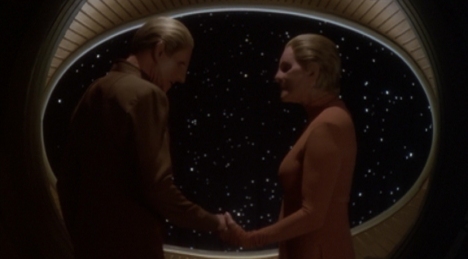
Concerning Flight is a lovely, whimsical little episode.

Of course, the actual plot of the episode is complete nonsense. During a raid by alien pirates, a bunch of advanced technology is stolen from Voyager. Among that advanced technology is the EMH’s mobile admitted, the holodeck database, and the primary computer core. Somehow, the pirate prince responsible for this raid has the wherewithal to download a character from the holodeck database into the mobile emitter and employ him as an inventor. Conveniently enough, the hologram is Leonardo da Vinci and the arrangement resembles medieval patronage.
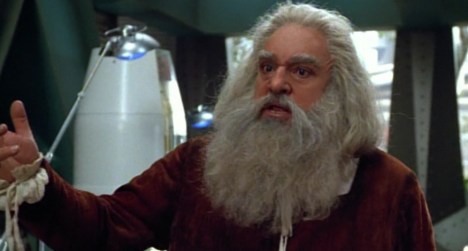
da Vinci's demons.

da Vinci’s demons.

It is all very ridiculous, relying on insane contrivance and random leaps in logic. At any given moment, the audience might be inclined to ask exactly what chain of decisions have led the characters to this exact point, right down to the sheer coincidence of having Leonardo da Vinci’s prototyple glider resting on a hilltop on the escape route that Janeway and da Vinci take in the final act. All of these criticisms are valid, and all of them are perfectly reasonable. Concerning Flight does not require suspension of disbelief, it requires a suspension bridge of disbelief.

However, the episode largely earns that trust. There is an incredible charm to this very simple and straightforward (if awkwardly contrived) story, a surprising warmth and engagement to the tale of the ultimate renaissance man confronted with the ultimate new world. Concerning Flight is a fun episode that places a lot of faith in the interplay between Kate Mulgrew and John Rhys-Davies. It is a choice that pays dividends.

O brave new world, That has such people in 't!

O brave new world,
That has such people in ‘t!

Continue reading

Star Trek: Deep Space Nine – Statistical Probabilities (Review)

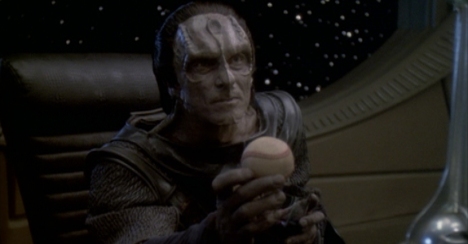
Statistical Probabilities is an interesting episode of Star Trek: Deep Space Nine, on a number of levels.

Most notably, it is the first episode to truly engage deal with the fallout from Doctor Bashir, I Presume. After all, the mid-fifth-season episode dropped a fairly substantial bombshell into the back story of Julian Bashir. In that episode, Bashir became the first Star Trek regular to be a genetically-engineered human, something that made him unique in the franchise. Bashir effectively became a character who could trace his lineage back to Khan Noonien Singh, from Space Seed and Star Trek II: The Wrath of Khan.

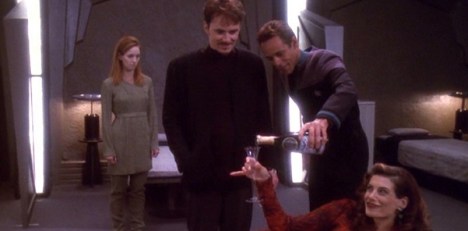
Gambling with people's lives.

Gambling with people’s lives.

However, Deep Space Nine had done very little with that interesting little nugget of a character idea. There had been token attempts to emphasise Bashir’s transformation through dialogue, by having the character speak like a computer and having Garak draw attention to it in A Time to Stand. However, Alexander Siddig was quite uncomfortable with this direction for the character, and made his distaste known. However, even those dialogue flourishes and exposition dumps were a superficial way of addressing a substantial change to the character.

Then again, Deep Space Nine is still getting used to serialisation. It takes a little while for the consequences of individual episodes to trickle down to later scripts. The alliance between Cardassia and the Dominion in By Inferno’s Light was left on the backburner for episodes like A Simple Investigation or Business as Usual before being explored in Ties of Blood and Water. Despite the impressive and sprawling six-episode opening arc, the delay between Doctor Bashir, I Presume and Statistical Probabilities suggests that delay is still in effect.

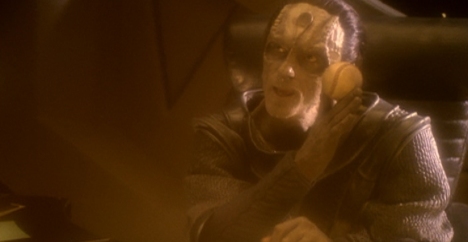
Drinking it in.

Drinking it in.

However, Statistical Probabilities is notable for the fact that it represents what might be the most direct point of intersection between the Star Trek franchise and the work of Isaac Asimov. Asimov is one of the most influential and iconic writers to work in science-fiction, formulating ideas and concepts that are taken for granted as genre shorthand by modern audiences. Asimov casts a long shadow over popular culture, including Star Trek. However, it is striking that Statistical Probabilities represents the most overt acknowledgement of his work.

Statistical Probabilities is essentially a Star Trek exploration of the concept of “psychohistory”, the fictional science at the heart of Asimov’s towering Foundation series.

Don't worry. Bashir would NEVER be that unprofessional.

Don’t worry. Bashir would NEVER be that unprofessional. Well, not this season.

Continue reading

Star Trek: Voyager – Random Thoughts (Review)

Random Thoughts is another example of Star Trek: Voyager as generic issue-driven Star Trek.

Random Thoughts is a fairly standard political-commentary-as-science-fiction-allegory plot, with the crew encountering a race of telepaths who have built a utopian society through the careful regulation of thoughts. When Torres is implicated in a very rare violent crime, the crew find themselves embroiled within mystery to determine the origin of the violent thought and the means of its transmission. Along the way, there is a hefty dose of commentary on a broad range of themes.

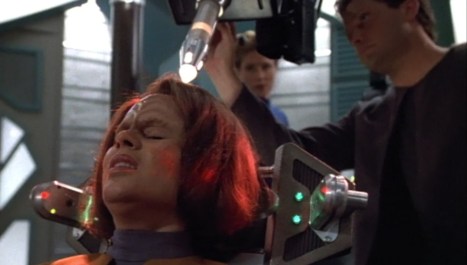
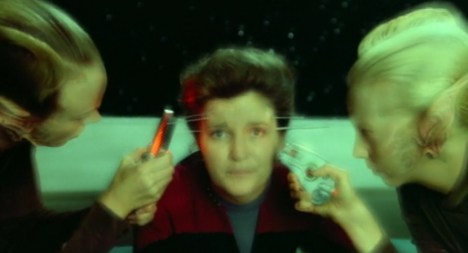
Scrambling the subversives.

Scrambling the subversives.

In theory, Random Thoughts is very much of a piece with Nemesis or Scientific Method, other fourth season episodes less interested in character and more driven by commentary. However, Random Thoughts is a good deal more muddled. The allegory at the centre of the story is a mess, in part because the script is so intentionally vague. Are these violent thoughts a metaphor for violence in media? Are they a commentary on heat speech? Are they an analogy for drug addiction? What about non-heteronormative sexuality?

Random Thoughts never seems to decide on one central metaphor, and so casts an exceptionally broad net. The problem is that these issues are radically different from one another, and the all-encompassing nature of the central analogy robs the episode of any nuance or sophistication. An episode advocating for the legalisation of drug use is radically different from an episode against the criminalisation of heat speech. It is very difficult to work out exactly what Random Thoughts is saying, let alone what it wants to say.

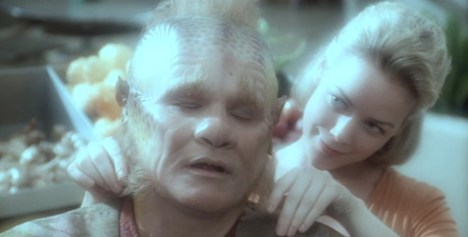
Whisked away.

Whisked away.

This muddled storytelling plays out in other ways. Random Thoughts is a mess episode, in terms of storytelling and structure. The plot wanders in various different directions, shifting focus from one member of the ensemble to another; for a story about Torres’ emotions, Torres is afforded very little agency. The narrative also diverts along pointless tangents, with obvious filler scenes like Paris and Chakotay discussing a rescue that never happens or Seven of Nine stopping by the Ready Room to discuss the moral of the episode.

There is something distractingly unfocused about Random Thoughts.

Secure in his convictions.

Secure in his convictions.

Continue reading

Star Trek: Deep Space Nine – Resurrection (Review)

In many ways, Resurrection is the mirror universe story that Star Trek: Deep Space Nine has been trying to tell for the better part of three seasons.

It is the most obvious of parallel universes, the classic variant on the “there but for the grace of God…” story that science-fiction tackles so effectively. After all, both Mirror, Mirror and Crossover were episodes that used the mirror universe to posit alternate versions of the Federation and the Occupation. It makes sense that the next logical extension of this Star Trek high concept would be an episode focusing on alternate versions of specific characters. How different would a person be, if they were to be transposed to an entirely different context?

Mirrors of one another.

Mirrors of one another.

Deep Space Nine tried to touch on this with Through the Looking Glass and Shattered Mirror, two mirror universe episodes that centred around the character of mirror!Jennifer Sisko. Through the Looking Glass allowed Benjamin Sisko to come face-to-face with his long-dead wife, while Shattered Mirror allowed Jake Sisko to spend some time with his deceased mother. Unfortunately, neither episode really lived up to that potential, hampered by weak performances from Felecia Bell and by the distraction of high camp.

Resurrection is very much the third attempt that this very basic story, and suffers a little bit from that sense of fatigue. However, the execution is substantially better this time around. While Philip Anglim is hardly the franchise’s strongest guest performer, he is a better actor than Bell. More than that, keeping the action anchored on the “real” Deep Space Nine stops the story from veering into high camp. It might be damning with faint praise, but Resurrection is probably Deep Space Nine‘s second best mirror universe episode.

Holy ex-boyfriend, Kira!

Holy ex-boyfriend, Kira!

Continue reading

Star Trek: Voyager – Year of Hell, Part II (Review)

Year of Hell, Part I and Year of Hell, Part II might just be the most representative episodes of Star Trek: Voyager.

Taken together, these episodes perfectly embody the restrictions placed upon the third Star Trek spin-off. They are a boldly ambitious story of a ship that finds itself in hostile territory surrounded by a hostile force with superior firepower, all while playing into the recurring themes and fascinations of the wider series. However, they are also a two-parter that wraps up with an incredibly convenient resolution that handily resets the status quo in a manner that allows the ship (and the series) to avoid any lasting consequences from this blockbuster story.

The hole in things.

The hole in things.

The result is one of the most thrilling and engaging stories of Voyager‘s seven-season run, among the most satisfying of the series’ impressive “blockbuster” two-parters. However, its sense of scale and scope exists very much in contrast to the episodes around it, a truly epic story that leaves no lasting mark. An audience member skipping from Scientific Method to Random Thoughts would be completely oblivious of the episode. For an episode of such weight, great care is taken to ensure that its passage causes no disturbance.

Year of Hell, Part I and Year of Hell, Part II do an excellent job capturing the essence of Voyager.

Annorax-ed with guilt.

Annorax-ed with guilt.

Continue reading

Star Trek: Deep Space Nine – You Are Cordially Invited… (Review)

You Are Cordially Invited… is very much a breather episode.

After all, that introductory six-episode arc was exhausting. It was breathtaking in its scope and ambition, a sketch of life during wartime that spanned light-years and divided the cast for half a dozen episodes. It makes sense that You Are Cordially Invited…, the first episode to feature the crew reunited on Deep Space Nine, would attempt to strike a lighter tone. Star Trek: Deep Space Nine might be crafting a long-form war story, but that does not mean that the show is abandoning its warmth and humanity.

Their first argument.

Their first argument.

Indeed, You Are Cordially Invited… makes a great of sense from a structural perspective. There is an obvious impulse to contrast the show’s darker moments with lighter touches. In the Cards was an endearing comedy about the interconnected lives on the station, airing right before the show scattered those lives in Call to Arms. More than that, Call to Arms featured the wedding of Rom and Leeta as a prelude to the Dominion invasion. Following up the occupation arc with a comedy about the wedding of Worf and Dax adds a sense of symmetry to it all.

You Are Cordially Invited… might not be the strongest comedy episode in the run of Deep Space Nine, suffering a little bit from being overly conventional and entirely predictable, but it does have an infectious sense of enthusiasm that works well in contrast to the high intergalactic stakes of the previous seven episodes.

Relight my fire...

Relight my fire…

Continue reading

Star Trek: Voyager – Year of Hell, Part I (Review)

Year of Hell, Part I and Year of Hell, Part II might just be the perfect episodes of Star Trek: Voyager.

Taken together, these episodes perfectly demonstrate the raw potential and strength of the third Star Trek spin-off. They are a boldly ambitious story of a ship that finds itself in hostile territory surrounded by a hostile force with superior firepower, all while playing into the recurring themes and fascinations of the wider series. Year of Hell, Part I and Year of Hell, Part II are effectively a story that finds history itself under threat, while emphasising Brannon Braga’s interpretation of Janeway by setting her against a similarly obsessive opponent.

Things fall apart.

Things fall apart.

The result is one of the most thrilling and engaging stories of Voyager‘s seven-season run, among the most satisfying of the series’ impressive “blockbuster” two-parters. Although the show is still being broadcast in the standard nineties 4:3 aspect ratio, it feels like a widescreen story. Part of that is due to the fact that the two-parter unfolds over three quarters of an entire year, part of that is the expanded room for storytelling, part of that is the fact that history itself hangs in the balance, part of that is the fact that Voyager itself feels at stake.

Year of Hell, Part I and Year of Hell, Part II do an excellent job capturing the essence of Voyager.

The Voyager cast Christmas party took a heavier toll than usual.

The Voyager cast Christmas party took a heavier toll than usual.

Continue reading

Star Trek: Deep Space Nine – Sacrifice of Angels (Review)

Sacrifice of Angels goes like the clappers.

If Favour the Bold worked so well because it took its time and invested in character dynamics in the shadows this epic confrontation, then Sacrifice of Angels works so well because it just powers through to the end of the story. Sacrifice of Angels is an immaculately paced piece of science-fiction television, an episode that kicks into gear that the spectacular effects shot of the Starfleet fighters swooping down over those Galor-class destroyers in a haze of phaser fire and chaos. The episode doesn’t let up, powering through the plot to get back to the familiar status quo.

Fields of fire.

Fields of fire.

Sacrifice of Angels is also a meticulously constructed piece of television, with all of the dominoes aligned over the previous five episodes dropping at just the right point in a way that seems organic and natural, allowing for moments that are both surprising and inevitable. It is a very clean and sleek episode of television, one built to a singular purpose with a minimum of superfluous material. It really is a triumphant conclusion to an ambitious six-episode opening arc, one of the most daring narrative experiments in the entire history of the Star Trek franchise.

More striking is the sense that Sacrifice of Angels is very pointedly not the end of the larger arc. The Dominion War that began with Call to Arms does not end in Sacrifice of Angels, even though Sisko retakes the station and the characters return home. The Female Changeling even acknowledges as much in her dialogue, “Contact our forces in the Alpha Quadrant. Tell them to fall back to Cardassian territory. It appears this war is going to take longer than expected.” This is not over, despite the assurances that the writing staff gave Rick Berman on launching the arc.

The whole damn ballgame.

The whole damn ballgame.

Then again, this makes perfect sense. Star Trek: Deep Space Nine was constantly and continuously reinventing itself over the course of its run, with several of the show’s season premieres serving as de facto pilots for a new and improved version of the show and several season-enders serving as de facto series finales bookending a particularly iteration of the series. The Way of the Warrior and Call to Arms are a great example, the fourth and fifth seasons bookended by the First and Second Battles of Deep Space Nine.

As such, it is probably more satisfying to look at Sacrifice of Angels as the end of another new beginning for the series, the end of an extended opening arc that is setting up themes and ideas that might hope to pay off over the following two seasons. In some ways, Sacrifice of Angels brings the show back to the end of Emissary. Once again, the Cardassian Occupation has come to an end. Sisko finds himself affirmed as the Emissary of the Prophets and the Commander of Deep Space Nine. This is the order of things.

Going for gold.

Going for gold.

Continue reading

Star Trek: Voyager – Scientific Method (Review)

Scientific Method is in many ways the flip side of the coin to episodes like Nemesis, Distant Origin or Remember.

Nemesis, Distant Origin and Remember were effective demonstrations of Jeri Taylor’s approach to Star Trek: Voyager, a conscious effort to downplay the unique premise of the show in favour of pitching a more generic sort of Star Trek. With that in mind, Nemesis, Distant Origin and Remember constructed powerful allegories to examine pressing contemporary issues through the lens of science-fiction, resulting in episodes that represented one of the most defining aspects of the franchise: the sci-fi-tinged morality play.

Built into Voyager's DNA.

Built into Voyager’s DNA.

Not every example of this approach worked as well as those three episodes. Voyager began leaning into this more archetypal and generic Star Trek storytelling at the start of its third season, and the results were quite hit-and-miss. There were certainly brilliant examples in the seasons ahead, like Living Witness or Blink of an Eye. But not every allegory worked as well. Sometimes, the episodes were too didactic, like Critical Care or Repentance. Sometimes, the episodes were too generic, like The Chute. Sometimes, they were just ill-judged, as with Retrospect.

Scientific Method is a very bland and forgettable episode of Star Trek. It is not necessarily bad, but it is also not particularly memorable. In some ways, it demonstrates the limitations of the “generic Star Trek” approach to scripting for Voyager. Without a set of interesting and well-developed characters with strong dynamics in a series with a unique identity, an average episode can feel rather flat.

Give her head peace.

Give her head peace.

Continue reading

Star Trek: Deep Space Nine – Favour the Bold (Review)

With Favour the Bold, the writers begin winding down the ambitious six-episode arc that opens the sixth season of Star Trek: Deep Space Nine.

Indeed, Favour the Bold plays almost like the first part of a two-parter nestled at the end of the sprawling six-episode arc that opens the sixth season. At the end of the teaser, Sisko unveils his ambitious plan to Dax, boasting, “We’re going to retake Deep Space Nine.” It is the story that very clearly moves the arc that began with Call to Arms towards its conclusion, manoeuvring the series back towards the familiar status quo in which Captain Benjamin Sisko commands a lone Federation outpost near the distant planet of Bajor.

Point man.

Point man.

Favour the Bold is very much about lining up everything for the climax of the arc, moving the pieces into place so that that the dominoes can begin falling as early as possible in Sacrifice of Angels. However, the episode benefits from the fact that a lot of the heavy-lifting has already been done by this point in the arc. Behind the Lines already had Odo betray Kira, Rom get arrested and Damar figure out how best to dismantle those pesky self-replicating mines. That is already a lot of the table-setting for the arc’s epic conclusion, before Favour the Bold even begins.

As such, Favour the Bold has the luxury of beginning with a lot of its work already done and ending at the point where the action truly commences. The result is a surprisingly relaxed penultimate episode for this ambitious arc, one with the freedom to indulge in smaller character-driven scenes and the space in which to breathe.

They just need some space.

They just need some space.

Continue reading