• Following Us

  • Categories

  • Check out the Archives


  • Awards & Nominations

Star Trek: Enterprise – United (Review)

This May, we’re taking a look at the fourth (and final) season of Star Trek: Enterprise. Check back daily for the latest review.

The Romulans are a very curious species.

They have a long history within the Star Trek franchise. They were introduced less than half-way through the first season of the show, in Balance of Terror. The Klingons would not show up until Errand of Mercy, towards the end of that first year. The Romulans have appeared in just about every iteration of the franchise, their reappearance in the final episode of the first season of Star Trek: The Next Generation serving to connect the show to its legacy. Appearing in both Star Trek: Nemesis and Star Trek, they appeared on both sides of the film franchise reboot.
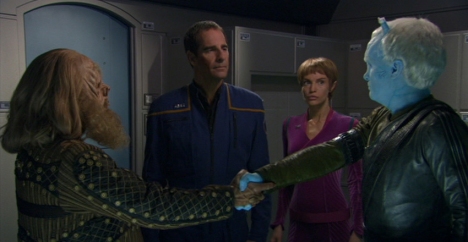
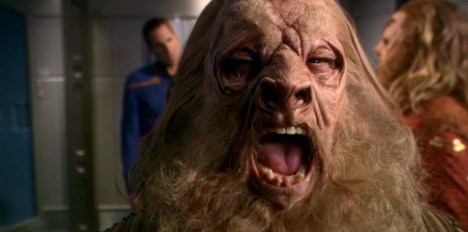
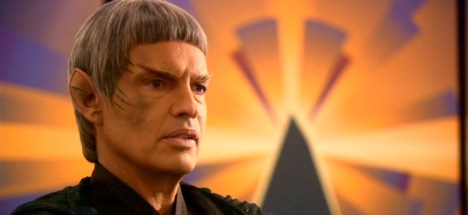
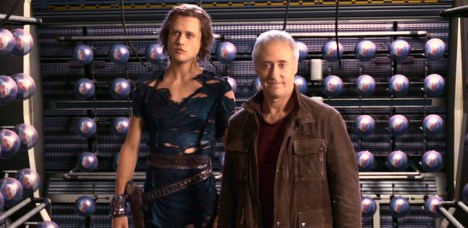
This could be the start of a beautiful friendship...

This could be the start of a beautiful friendship…

Still, the Romulans have never truly been defined. Unlike the Klingons or the Cardassians, the Romulans have never been developed into a fully-formed culture. There are great episodes built around the Romulans, from Balance of Terror and The Enterprise Incident to Face of the Enemy and In the Pale Moonlight. However, there has never been recurring Romulan character afforded the depth of Worf, Martok, Quark, Dukat, Damar or Garak; if populating that list with Star Trek: Deep Space Nine characters feels like cheating, no Romulan measures up to Soval or Shran.

Although they only appear in four episodes of the season, exerting influence over another two, it feels like the fourth season of Star Trek: Enterprise affords more attention to the Romulans than they have received in a long time.
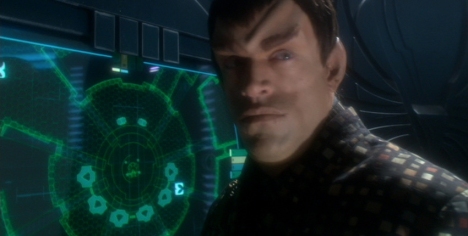
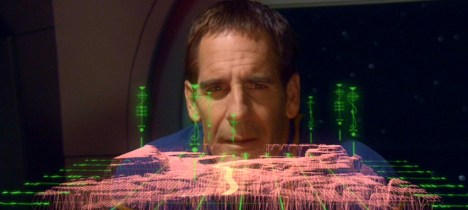
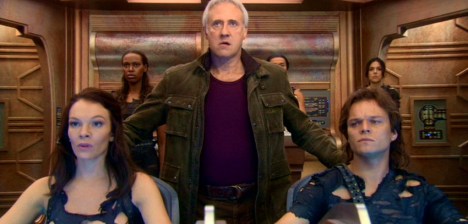
"All right, who arranged the bridge power display to form a smiley face?"

“All right, who arranged the bridge power display to form a smiley face?”

Continue reading

Star Trek: Enterprise – Babel One (Review)

This May, we’re taking a look at the fourth (and final) season of Star Trek: Enterprise. Check back daily for the latest review.

It seems entirely appropriate that the United trilogy sits in the middle of the fourth season.

The three-parter is not the strongest of the season’s multi-episode epics, abandoning the clean three-act structure that made the Kir’Shara trilogy so successful in favour of a disjointed two-parter-and-coda format that prevents the story from feeling as cohesive as it might. It jolts and starts, never really finding the proper flow for the story that it wants to tell. There is a sense that the production team’s desire to do both a “birth of the Federation” story and a “visit to Andoria” story within the same three-part narrative ultimately hinders the storytelling.

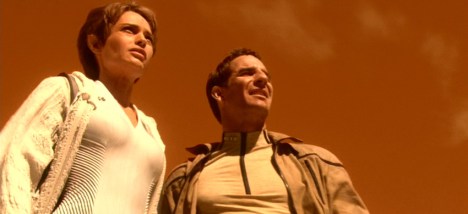
"What do you mean I'm not in the third part?!"

“What do you mean I’m not in the third part?!”

However, there is something satisfying in watching Star Trek: Enterprise commit to the idea of the birth of the Federation. It could be argued that this is an example of the fourth season’s continuity pandering, but the Federation is far more fundamental to the fabric of the franchise than something like Klingon foreheads or that ghost ship from that third season episode. If Enterprise is to be a prequel, it should devote some attention to building the fabric of the shared universe. The Federation is an essential part of the idealistic future of Star Trek.

However, the most compelling aspect of the United has nothing to do with continuity and history. Instead, it is simply reassuring to see Enterprise embracing the franchise’s utopianism and hope for the future, particularly in the context of January 2004.

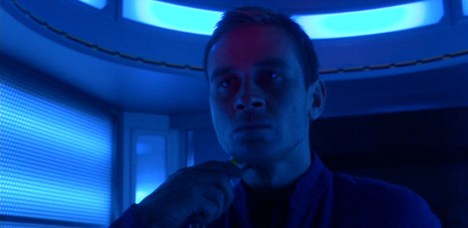
Shran, Shran, he's our Andorian...

Shran, Shran, he’s our Andorian…

Continue reading

Star Trek: Enterprise – Observer Effect (Review)

This May, we’re taking a look at the fourth (and final) season of Star Trek: Enterprise. Check back daily for the latest review.

Much as with Daedalus, there is a weirdly mournful tone to Observer Effect.

The basic plot of the episode follows two Organian characters hopping from body to body while watching Archer and his crew confront a deadly virus that infected Trip and Hoshi during a routine planetary investigation. The closing line of the teaser even features organian!Reed promising “somebody always dies.” Sure enough, that turns out to be true. Both Trip and Hoshi “die” over the course of the episode, while Archer himself is sentenced to certain death. These deaths are ultimately reversed, but they set a tone for the episode.

Trip gets it in the neck.

Trip gets it in the neck.

Observer Effect seems to be a tacit acknowledgement that Star Trek: Enterprise is effectively dead in the water, that the show is now limping towards the end of the fourth season where it might be retired permanently. Two weeks after Observer Effect aired, UPN would announce that Enterprise was cancelled. There would be no last-minute reprieve for the show. Although Observer Effect had been written months before the decision was made, the production team knew that the writing was on the wall.

However, what is most interesting about Observer Effect is not so much the fascination with the inevitable death of Enterprise, but the episode’s fascination with those watching (and commentating upon) the spectacle from the sidelines.

They like to watch.

They like to watch.

Continue reading

Star Trek: Enterprise – Daedalus (Review)

This May, we’re taking a look at the fourth (and final) season of Star Trek: Enterprise. Check back daily for the latest review.

Discussions of the fourth season of Star Trek: Enterprise tend to focus on the multi-part episodes.

That makes a great deal of sense. After all, no Star Trek show had ever built a season around a collection of multi-part arcs. While Star Trek: Deep Space Nine had embraced serialisation in the second half of its run and Star Trek: Voyager had embraced an aesthetic that supported two-part “event” episodes, there had never been a season of the franchise constructed around a string of two- or three-part adventures. Even the third season of Enterprise had really been on long form story with the occasional episodic diversion.

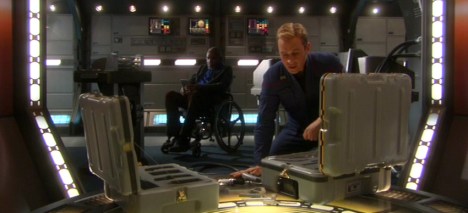
Padding it out.

Padding it out.

These multi-part stories dominate the fourth season. Of the twenty-two episodes of the fourth season, seventeen are part of seven multi-part stories. Of the five episodes that nominally stand alone, Home is very much a thematic introduction to the season that sets up all manner of ideas to pay off later in the run and These Are the Voyages… is effectively an attempt at a coda for the eighteen years (and twenty-five television seasons) of the Berman era as a whole. Discounting these two “bookends”, that leaves only three standalone episodes.

Two of those episodes, Daedalus and Observer Effect aired back to back in the middle of the season. However, although each episode is self-contained in terms of plot, they do feel like spiritual companion pieces.

Turn the lights off on the way out...

Turn the lights off on the way out…

Continue reading

Star Trek: Enterprise – Kir’Shara (Review)

This May, we’re taking a look at the fourth (and final) season of Star Trek: Enterprise. Check back daily for the latest review.

The fourth season of Star Trek: Enterprise is renowned for its focus upon continuity.

That is as true of the Kir’Shara trilogy as of any other episode. The script is saturated with references and nods to the rest of the franchise, tying together thirty-eight years of Vulcan continuity into a cohesive narrative structure. The Kir’Shara trilogy ties together everything from the Romulan schism in Balance of Terror to the symbolic importance of Mount Seleya in Star Trek III: The Search for Spock to the story behind the IDIC symbol that had first appeared in Is There in Truth No Beauty?

A short and not-so-prosperous future.

A short and not-so-prosperous future.

However, what is most striking the Kir’Shara trilogy is that the episode’s continuity really doesn’t fit in a very rigid way. Although the Kir’Shara trilogy is nominally about explaining how the secretive and distrustful Vulcans of Enterprise became the iconic and well-loved aliens associated with the rest of the franchise, offering an epic three-part story about Archer and T’Pol singlehandedly saving Vulcan society by putting them back in touch with the values espoused by the legendary Vulcan philosopher Surak. (Surak had appeared in The Savage Curtain.)

This makes for a very satisfying story within the larger narrative arc of Enterprise, demonstrating that Earth and Vulcan might be more compatable than Ambassador Soval would ever admit. It paves the way for stories like Babel One, United, Demons and Terra Prime. However, it also stands quite at odds with the larger continuity of the franchise, where the Vulcans have consistently been portrayed as secretive and superior. There is nothing wrong with that continuity contradiction, but it is interesting in the larger context of the fourth season.

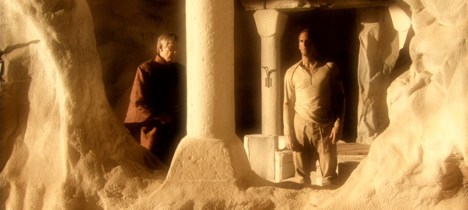
Homecoming.

Homecoming.

Continue reading

Star Trek: Enterprise – Awakening (Review)

This May, we’re taking a look at the fourth (and final) season of Star Trek: Enterprise. Check back daily for the latest review.

9/11 forever changed the world.

In doing so, it also changed popular culture. As part of that, it also changed Star Trek. When it comes to discussing the way that the franchise was shaped and moulded by 9/11, there are a number of easy points upon which to focus. The third season of Star Trek: Enterprise quite blatantly positions itself as an allegory for those terrorist attacks, with Archer directly responding to a terror attack upon Earth and seeking to hold those responsible to account. Star Trek Into Darkness evokes those attacks both in its imagery and its conspiracy theory subtext.

Fallout warning.

Fallout warning.

However, the influence is much stronger than any of that. JJ Abrams’ Star Trek touched on the themes of trauma and loss that inform a lot of post-9/11 culture by making both Kirk and Spock survivors of horrific and unprovoked destruction. Similarly, the cosmology of Enterprise had been shaped and defined by those attacks since at least Shadows of P’Jem, reflected in the hostile and paranoid universe suggested in episodes like The SeventhCease Fire and The Crossing or the destruction of the timeline in Shockwave, Part I and Shockwave, Part II.

The fourth season is no less shaped by the War on Terror than the third season had been, even if that influence is less overt. The chaotic asymmetrical warfare of Storm Front, Part I and Storm Front, Part II evoke the political quagmire of foreign intervention in the twenty-first century. Home explores responses to traumas both personal and cultural. However the Kir’Shara trilogy is most overt in its War on Terror imagery, paralleling Archer’s journey into the desert following a terror attack with the looming spectre of war.

Have we reached peak Vulcan?

Have we reached peak Vulcan?

Continue reading

Star Trek: Enterprise – The Forge (Review)

This May, we’re taking a look at the fourth (and final) season of Star Trek: Enterprise. Check back daily for the latest review.

The Kir’Shara trilogy is the strongest three-parter of Star Trek: Enterprise‘s fourth season. It could legitimately be argued that the Kir’Shara trilogy is the strongest story of the entire season and one of the strongest stories of the show’s four-season run.

There are a lot of reasons why this is the case. The Kir’Shara trilogy makes great use of the franchise’s continuity and history, without getting too tied down into references for the sake of references. Indeed, there is a valid argument to be made that the trilogy represents the most overt rewriting of continuity across the fourth season, an ironic touch for a season so committed to continuity. The story does excellent work the show’s under-utilised supporting cast. The adventure actually merits three episodes, the story never dragging or wandering off on tangents.

Under a not quite blood red sky...

Under a not quite blood red sky…

However, a large part of why this trilogy of episodes works better than the Borderland trilogy or the United trilogy is a simple piece of structuring. The Kir’Shara trilogy has a very clear and linear three-act structure, with each of the three episodes fitting comfortably together while doing their bit to advance and escalate the plot. There are no strange structural detours like the siege in Cold Station 12 or the visit to Andoria in The Aenar. Each of these three episodes is recognisable part of a singular larger story that builds to a crescendo.

The Forge does an excellent job setting up the arc, Awakening does an excellent job raising the stakes, and Kir’Shara does an excellent job tying it all together. The result is a satisfying two-hour television movie broadcast in three forty-minute chunks.

Mapping out an adventure...

Mapping out an adventure…

Continue reading

Star Trek: Enterprise – The Augments (Review)

This May, we’re taking a look at the fourth (and final) season of Star Trek: Enterprise. Check back daily for the latest review.

The fourth season of Star Trek: Enterprise is obsessed with continuity.

More than any other season of Star Trek, the fourth season drips with references and nods towards the franchise’s rich history. Nothing is off limits. The fourth season explains how the Klingons lost their ridges, what happened to the Defiant, how the Federation came to be, the origins of the Earth-Romulan War. It features prominent guest appearances from Brent Spiner, Jonathan Frakes and Marina Sirtis in roles explicitly tied to their part in the franchise. There are trips to Vulcan and the mirror universe, Romulus and Andoria.

Hitting rewind...

Hitting rewind…

This obsession with continuity is part of a double-edged sword. On the one hand, it arguably serves to make the show more insular and introspective at a point when the franchise was on the cusp of collapse. These references could distract from storytelling and feel like indulgence for the sake of indulgence. On the other hand, it is not as if a broader audience was watching Enterprise at this point. Pandering to the fanbase makes sense when the fans are the only ones left. More than that, if the franchise is dying, it makes sense to have its life flash before its eyes.

However, what is most striking about the nostalgia running through the final season of Enterprise is the way that it feels almost ahead of its time. In the way that fourth season looks backwards, it seems to almost be looking forwards.

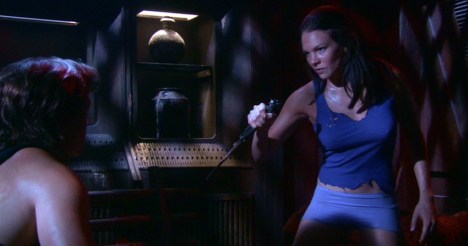
Obligatory sexy underwear fight, in case you forgot this is till airing on UPN.

Obligatory sexy underwear fight, in case you forgot this is till airing on UPN.

Continue reading

Star Trek: Enterprise – Cold Station 12 (Review)

This May, we’re taking a look at the fourth (and final) season of Star Trek: Enterprise. Check back daily for the latest review.

It seems like everybody loves Star Trek II: The Wrath of Khan. At the very least, Star Trek fans love the movie. Dearly.

The film has featured on several AFI ballots, even if it rarely placed. The film was included in The Guardian‘s 2011 “my favourite film” cycle. It placed second in a Rolling Stone readers’ poll of the best movies adapted from television series. A 2013 fan poll placed it as the best loved of all the Star Trek movies, the same poll that (ridiculously) ranked Into Darkness as the worst film in the franchise. In 2016, the film’s final conversation between Kirk and Spock topped a fandom poll of the duo’s best moments.

"The Wrath of Khan had a LOT of influence."

The Wrath of Khan had a LOT of influence.”

As such, The Wrath of Khan casts a long shadow. Four of the ten Star Trek films that followed borrow its structure and tone. Star Trek: First Contact swaps Khan for the Borg as the returning television antagonist. Star Trek: Nemesis casts Tom Hardy in the villainous role, complete with super weapon and nebula battle. Star Trek finds Eric Bana doing his best Ricardo Montalban impression. It is practically a relief (and a surprise to absolutely no one) when Benedict Cumberbatch finally announces, “My name is Khan.” At least he’s being candid.

Star Trek: Enterprise paved the way for all of this with its Borderland trilogy, which amounts to one gigantic nostalgic tribute to that second Star Trek film. Although the episodes bookending the trilogy are hardly subtle, the middle instalment of that trilogy is perhaps the most egregious example. There are points at which Cold Station 12 plays like a forty-minute deleted scene from The Wrath of Khan.

"I'm in command! And there's no Timothy Carhart to stop me now!"

“I’m in command! And there’s no Timothy Carhart to stop me now!”

Continue reading

Star Trek: Enterprise – Borderland (Review)

This May, we’re taking a look at the fourth (and final) season of Star Trek: Enterprise. Check back daily for the latest review.

Borderland establishes the format that will come to define the fourth season of Star Trek: Enterprise; the mini-arc, a single story told over two or three episodes before moving along to the next adventure.

Technically speaking, Storm Front, Part I and Storm Front, Part II established the format for the season. However, the franchise had done multi-part season premieres before. Star Trek: Deep Space Nine was particularly fond of the format, seguing from a status quo altering season finale into a multi-part season opener; The Homecoming, The Circle, The Siege, The Search, Part I, The Search, Part II, The Way of the Warrior, Image in the Sand, Shadows and Symbols. This is to say nothing of the massive six episode arc that opened the sixth season.

Put your hands together for Mister Brent Spiner.

Put your hands together for Mister Brent Spiner.

Borderland represents a departure because it signals that the fourth season of Enterprise will be comprised entirely of multi-episode stories. Historically, Star Trek shows had typically done one or two multi-part stories in a season, give or take a cliffhanger to bridge two years of the show. The fourth season of Enterprise would tell seven multi-part stories eating up seventeen episodes of the twenty-two episode season order. It was certainly a bold departure for the series and the franchise.

In fact, Borderland begins the franchise’s first three-part episode since the second season of Deep Space Nine. (Although determined fans could likely stretch logic a little to suggest that Tears of the Prophets or Zero Hour were season finales that formed a three-parter when tied into the two-part premieres that followed.) It is a curious departure, and one that immediately helps to establish the fourth season of Enterprise as something quite distinct.

A slave to continuity...

A slave to continuity…

Continue reading