• Following Us

  • Categories

  • Check out the Archives


  • Awards & Nominations

Star Trek: Deep Space Nine – The Begotten (Review)

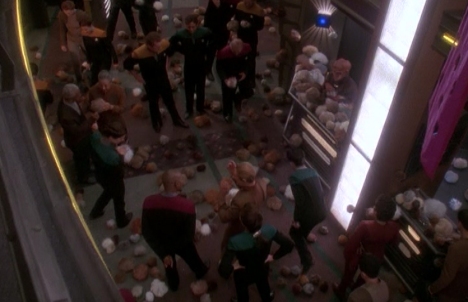
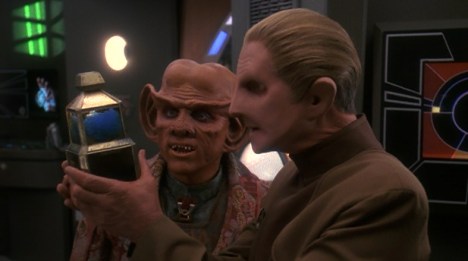
From a mechanical perspective, The Begotten is very much about clearing up the leftover pieces from the first half of the season before the second half can really begin.

Watching the fifth season of Star Trek: Deep Space Nine with the benefit of hindsight demonstrates just how carefully the production team have paced the season. The fifth season clearly turns on a number of different points, pivoting over In Purgatory’s Shadow and By Inferno’s Light in the middle of the year. However, a lot of the first half of the season can be seen as a build to that two-parter. The production team are very consciously lining up the remaining dominoes for that big plot development.
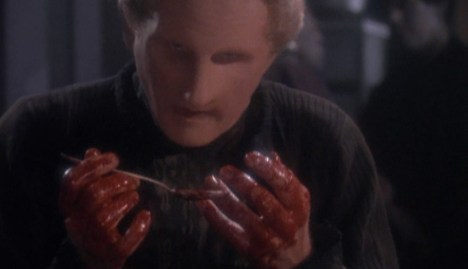
A life in his hands.

A life in his hands.

The most obvious example is the prophecy of Rapture, which foreshadows the events of both By Inferno’s Light and Call to Arms while keeping Bajor neutral for what is to come. But there are others. Apocalypse Rising folds the Klingon War into the looming battle with the Dominion. The Ship and … Nor the Battle to the Strong are proofs of concept for a Star Trek series about war. Things Past and The Darkness and the Light keep the Cardassian Occupation fresh in the viewers’ mind. The Ascent is a story that could only work while Odo is humanoid.

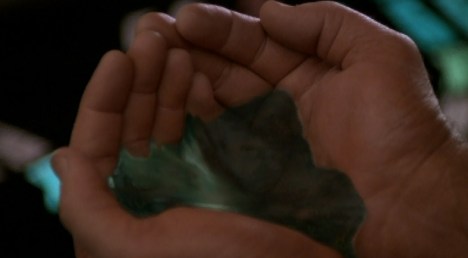
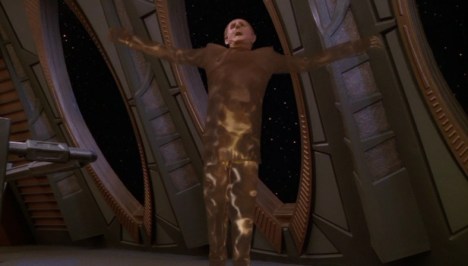
There is a clear purpose to most of the storytelling decisions made during this stretch of the season, designed to streamline what is to come. The Begotten takes care of two rather major plot points that need to be addressed; Odo’s status as a humanoid following Broken Link and Kira’s surrogate pregnancy from Body Parts. Sure, For the Uniform sits between this episode and the big mid-season twist, providing the opportunity to do one last Maquis story before the political board is reset. But that feels almost like an afterthought.
Soaking it in.

Soaking it in.

The Begotten dedicates itself to wrapping up the two biggest plot elements hanging over from the end of the fourth season, closing that chapter of the show before a new one is opened. There is a certain functional quality to The Begotten, a utilitarian approach to plotting. It would be very easy for The Begotten to feel stale or trite, contrived or obligatory. It is to the credit of writer René Echevarria that The Begotten never feels forced. The subplot focusing on Kira’s birth has a number of very serious issues, but the primary plot driven by Odo is genuinely affecting.

It is a testament to the writers working on Deep Space Nine that even the act of decluttering the long-form narrative can lead to affecting television.
Free as a bird.

Free as a bird.

Continue reading

Star Trek: Deep Space Nine – The Darkness and the Light (Review)

The Darkness and the Light is the first television credit for writer Bryan Fuller.

There is no way around that. It puts a lot of emphasis on this fifth season episode, drawing a lot attention to the story. Fuller didn’t even write the script, instead pitching a story that would be developed by Ronald D. Moore. However, later in the fifth season, Fuller would pitch the story for Empok Nor. After that, he would be recruited on to the writing staff on Star Trek: Voyager. Then Fuller would begin developing his own shows. Dead Like Me. Wonderfalls. Pushing Daisies. Hannibal. American Gods. Star Trek: Discovery.

Face-off.

Face-off.

That naturally casts a shadow over his first television pitch, the premise sold to the writing staff of Star Trek: Deep Space Nine. Even watching Fuller’s idea filtered through the lens of Ronald D. Moore, there is a strong urge to read too much into this forty-five-minute piece of television. How much of it represents Bryan Fuller’s vision of Star Trek? How have its themes and ideas resonated across the rest of the writer’s work? What insight might it offer into the producer’s vision for the future of the franchise?

A lesser episode would crumple under that weight. It helps that The Darkness and the Light is an ambitious and exciting piece of television, a triumph of concept and execution that stands as one of the most distinctive and memorable episodes in the fifty-year history of the franchise.

A time to heal.

A time to heal.

Continue reading

Star Trek: Deep Space Nine – Rapture (Review)

Faith can be a tricky issue.

At one point in Rapture, the primary cast take a moment to reflect upon it. Kira tries to explain her belief in Sisko and the Prophets to Dax and O’Brien. She struggles. They have difficulty understanding how Kira can invest so much certainty in something so intangible. Eventually, Worf interjects. “Do not attempt to convince them, Major,” he urges her. “They cannot understand.” Dax is a little surprised by Worf’s interest in the topic. “Since when did you believe in the Prophets?” she asks. Worf responds, “What I believe in is faith.”

Gotta have faith.

Gotta have faith.

It is a short conversation, but one that reveals a lot about Star Trek: Deep Space Nine. As a rule, the Star Trek franchise tends towards a strong atheism, rejecting notions of religion and spirituality as the hallmarks of an underdeveloped civilisation; Return of the Archons, The Apple, For the World is Hollow and I have Touched the Sky, Who Watches the Watchers?, Devil’s Due, False Profits, Chosen Realm. This makes a certain amount of sense, given that the franchise prides itself on its rationalism. However, it also feels a little narrow-minded.

Rapture might just be the franchise’s most compelling exploration of unquestioning faith, a harrowing portrayal of devotion and inspiration that captures at once the ecstasy of unwavering belief and the discomforting aspects of watching someone embrace something outside a rational frame of reference. Rapture is a mesmerising piece of television.

"I, for one, welcome our new Klingon overlords."

“I, for one, welcome our new Klingon overlords.”

Continue reading

Star Trek: Deep Space Nine – The Ascent (Review)

Discussions of Star Trek: Deep Space Nine tend to focus on the big sweeping events and the epic scope.

It is easy to see why this is the case. Over the course of the show, alliances break and empires fall. Characters are elevated from the lowest rungs of the social ladder to command over entire planets. Whereas Star Trek: The Next Generation worked hard to flesh out alien cultures like the Romulans and the Klingons, it never committed to the kinds of sweeping long-form narratives that unfolded across the run of its younger sibling. The fall (and rise and fall again) of Cardassia, the broken and mended peace with the Klingons, the Dominion War.

"And to round out the thirtieth anniversary, we're going to climb the Paramount logo."

“And to round out the thirtieth anniversary, we’re going to climb the Paramount logo.”

Deep Space Nine deserves (and receives) a great deal of credit for telling these stories. Indeed, the franchise would not make another attempt at storytelling on this scale until the final two seasons of Star Trek: Enterprise. However, focusing on the bigger picture tends to gloss over the other strengths of Deep Space Nine. As much as the show crafts epic long-running stories of betrayal and redemption that span seasons of broadcast television, it interspaces these epic beats with lots of smaller character moments.

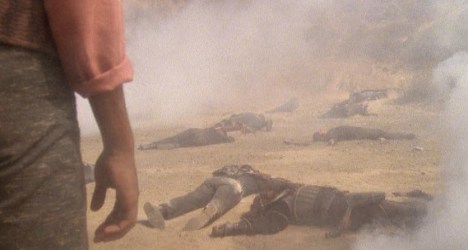
The Ascent is a wonderful example of this. The fifth season of Deep Space Nine is one of the most sweeping and epic seasons in the history of the franchise, but it still finds time for the smaller beats. The Ascent is essentially a set of low key character studies, playing to the strengths of both the cast and the characters.

An uphill struggle.

An uphill struggle.

Continue reading

Star Trek: Deep Space Nine – Things Past (Review)

At a time when Star Trek: Voyager was working very hard to disentangle itself from its own past, Star Trek: Deep Space Nine committed to exploring its own.

Things Past hits on one the big recurring themes of the series in general and fifth season in particular. Deep Space Nine has always been a show about memory and history, the relationship between past, present and future that is seldom as clear-cut as one might like it to be. Across the show’s run, characters are constantly exploring and re-evaluating their own histories. This has always been the case, dating back to Sisko working through his trauma with the Prophets in Emissary, Kira facing her past in Past Prologue and Odo doing the same in A Man Alone.

"You know, my subconscious can be pretty heavy handed."

“You know, my subconscious can be pretty heavy handed.”

At this point, Deep Space Nine has been on the air for over four years. Many other shows would already have moved on from their foundational premises. Voyager has already completely forgotten what it originally promised, and it is less than half way through its third season. However, the fifth season finds Deep Space Nine engaging repeatedly and enthusiastically with a history that stems back to before the events of the first episode. The characters on Deep Space Nine are shaped and informed by events that occurred long before fate or chance brought them together.

Some of these episodes work better than others, but the fifth season is still fascinated with the characters’ lives long before the series began. Let He Who Is Without Sin… attempted to build a story like this around Worf, playing almost as a parody of this kind of storytelling. Doctor Bashir, I Presume walks a very fine line between when it comes to exploring Bashir’s secret history. Empok Nor returns to the question of whether O’Brien is an engineer or a soldier in a much pulpier and trashier vein than earlier episodes like Hippocratic Oath.

The hole in things...

The hole in things…

Unsurprisingly, the best examples of these sorts of stories tend to focus on the characters who were actually around Terok Nor during the Occupation. The Darkness and the Light and Ties of Blood and Water, the two episodes focusing on Kira, are among the strongest of the season. They also have some pretty great titles, although neither is quite Wrongs Darker Than Death or Night. However, it is Things Past that marks the fifth season’s first trip back to the Cardassian Occupation, telling the story from Odo’s perspective.

It is an episode that really pushes Odo, to the point where it seems like the changeling might snap. “Nobody ever had to teach me the justice trick,” Odo monologued in Necessary Evil, way back in the second season. “That’s something I’ve always known.” Over the course of Things Past, Odo must eventually admit that this is not the case.

Barriers to entry.

Barriers to entry.

Continue reading

Star Trek: Deep Space Nine – Let He Who Is Without Sin… (Review)

It would be tempting to treat Let He Who Is Without Sin… as an anomaly.

After all, it is very much the worst episode of the fifth season. There is a very strong argument to be made that it is the worst episode between Meridian and Profit and Lace, which makes it easier to forgive. After all, it is not as though Star Trek: Deep Space Nine has been regularly churning out episodes like Twisted, Tattoo, Alliances, Threshold and Investigations. The second worst episode of the fifth season is The Assignment, and the biggest problem with that episode is that it is both painfully generic and ground zero for a set of major future problems.

This episode is pants.

This episode is pants.

Still, it is important not to gloss over just how terrible Let He Who Is Without Sin… actually is and the very specific ways in which it is terrible. While these sorts of misfires are quite rare in the context of the series’ fourth and fifth seasons, Let He Who Is Without Sin… is not a fluke. The episode did not materialise from nowhere. It is very much the result of a number of creative impulses within Deep Space Nine firing in the worst possible ways. Unlike The Assignment, this episode does not fail because the concept and execution is an awkward fit for Deep Space Nine.

Let Who Is Without Sin… fails in ways that are very specifically tied to Deep Space Nine.

"It's okay, Worf. The writers promised that was only the first draft they sent through."

“It’s okay, Worf. The writers promised that was only the first draft they sent through.”

Continue reading

Star Trek: Deep Space Nine – Trials and Tribble-ations (Review)

Trials and Tribble-ations is a love letter to the franchise.

The thirtieth anniversary of Star Trek was a big deal. In many ways, the thirtieth anniversary celebration marks the end of the franchise’s cultural peak. Star Trek: The Next Generation is still fresh enough in the cultural consciousness that the anniversary is a big deal, even if the ratings on Star Trek: Deep Space Nine and Star Trek: Voyager are not necessarily what everybody would want them to be. The decline that would last through to the end of Star Trek: Enterprise only really comes into play in the wake of the big anniversary.

You know when you've been Gumped.

You know when you’ve been Gumped.

The thirtieth anniversary of the franchise was an embarrassment of riches, particularly from the perspective of a rather limp fiftieth celebration. Even the disappointment of Flashback was dwarfed by the abundance of affectionate homages and triumphant celebrations of a television series that had gone from a cult failure repeating endlessly in syndication to a pop cultural juggernaut with two television series and a successful film franchise running simultaneously. Trials and Tribble-ations was very much the cornerstone of all this.

Sure, there were other celebrations to mark the franchise’s big three-oh. While Flashback might of been a bit of a disappointment as a big anniversary special, Future’s End, Part I and Future’s End, Part II were a loving ode to Star Trek IV: The Voyage Home. Indeed, Star Trek: First Contact went even further and threw Star Trek II: The Wrath of Khan into the mix, blending the franchise’s most acclaimed and most financially successful films together for the occasion. Captain Janeway even crossed paths with the cast of Frasier to mark the occasion.

Quite the lineup.

Quite the lineup.

In spite of all of that, Trials and Tribble-ations stands quite apart from all the noise around it. There is a legitimate debate to be had about whether it is unequivocally the best of these productions, although it stands a very strong chance of winning that particular argument. However, there is no denying that it is the best celebration of the thirtieth anniversary. It is an adoring and affectionate love letter to the Star Trek franchise, one that seems to have been produced with giddy grin on its face and a skip in its step.

However, Trials and Tribble-ations works even beyond that. It is not simply a loving tribute to a monument of American popular culture, although that would be entirely justified. It is an acknowledgement to the decades of fandom that kept Star Trek alive during its occasional adventures in the wilderness.  Trials and Tribble-ations does not just praise Star Trek for surviving thirty years despite being cancelled after three seasons, but which captures the enthusiasm that sustained the series across those thirty years.

Doesn't scan.

Doesn’t scan.

It would be easy for a thirtieth anniversary special to treat the occasion as an act of cultural archeology, the careful and ritual unearthing of a popular artifact with all due reverence paid. Indeed, this was arguably the central problem with Flashback, an episode more interested in Star Trek as a memory and as a subject of nostalgia than a living breathing organism. Trials and Tribble-ations instead opts to treat Star Trek as a living and breathing organism, something tangible and material rather than abstract and ethereal.

Indeed, the episode ends with the revelation that the past is not another country. Sometimes you can bring something back. Even if that thing is a tribble.

You can go home again...

You can go home again…

Continue reading

Star Trek: Deep Space Nine – The Assignment (Review)

The Assignment is perhaps the most conventional episode of the fifth season of Star Trek: Deep Space Nine. It is also one of the most disappointing.

The Star Trek franchise has long been fond of “possession” and “imitation” stories, dating back through Whom Gods Destroy and Turnabout Intruder to Lonely Among Us and Datalore and Power Play. It is easy to see the appeal of these stories from a production standpoint. An effective possession story can likely be filmed on standing sets and relies primarily upon an established member of the ensemble. For an actor, it provides an exciting opportunity to play against type, which is a great way to keep a weekly television series exciting.

O'Brien must suffer... through a terrible script.

O’Brien must suffer… through a terrible script.

However, it is very much a stock plot. There are only so many variations that a long-running franchise can put on the tried-and-tested formula before it begins to feel a little tired. Deep Space Nine has already had more than its fair share of “out of character” plots, from The Passenger to Dramatis Personae through to Crossover and all the other mirror universe episodes. It gets to the point where “there’s an evil alien inside Keiko O’Brien” feels like a fairly bland iteration of this particular type of Star Trek story.

In a season where Deep Space Nine spends so much time pushing the boundaries of Star Trek, it is frustrating to see the show offer up such a generic installment.

Rom is in a bit of a fix...

Rom is in a bit of a fix…

Continue reading

Star Trek: Deep Space Nine – … Nor the Battle to the Strong (Review)

“The world breaks everyone and afterward many are strong in the broken places.”

– Hemingway, A Farewell to Arms (1929)

Far a field.

Far afield.

Continue reading

Star Trek: Deep Space Nine – Looking for Par’Mach in All the Wrong Places (Review)

In some ways, the fifth season of Star Trek: Deep Space Nine serves as an amalgation of the third and fourth seasons of the show, reconciling the bold new direction that began in The Search, Part I with the detour that commenced in The Way of the Warrior.

In some respects, the fifth season feels like an attempt to get the show back on a track that it largely abandoned in favour of the (studio suggested) Klingon focus of the fourth season, but incorporating the lessons learned during that fourth season. One of the more interesting aspects of the fifth season is how much time the show spends rolling back from the bigger decisions of the fourth season. The war with the Klingons (mostly) ends in Apocalypse Rising. Odo gets his groove back in The Begotten. Worf gets his honour back in Soldiers of the Empire.

Klingon Love Songs.

Klingon Love Songs.

The fifth season also very clearly and very closely adheres to the format of the third season rather than the fourth. The fifth year’s big mid-season two-parter, In Purgatory’s Shadow and By Inferno’s Light, is very clearly intended to mirror the third season’s two-part adventure Improbable Cause and The Die is Cast more than the fourth season’s Homefront and Paradise Lost. That focus is also quite apparent in Looking for Par’Mach in All the Wrong Places, the third episode of the fifth season that is a direct sequel to the third episode of the third season.

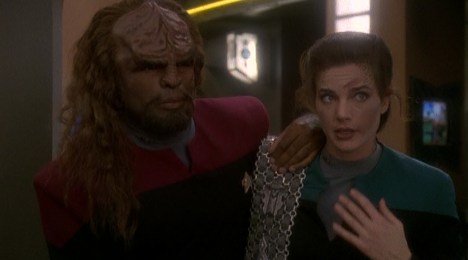
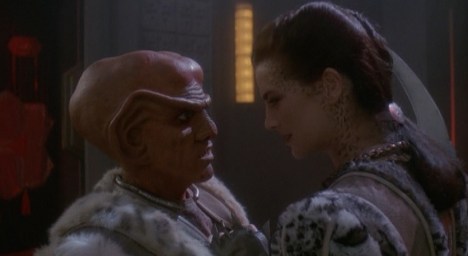
It is also perhaps Deep Space Nine‘s best attempt at doing a sex farce.

A Quarky love story...

A Quarky love story…

Continue reading