• Following Us

  • Categories

  • Check out the Archives


  • Awards & Nominations

Star Trek: Voyager – Worst Case Scenario (Review)

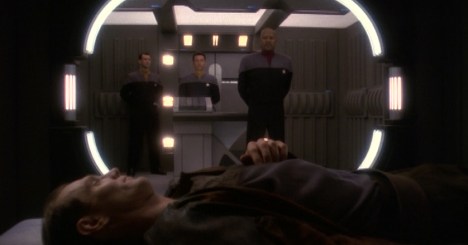
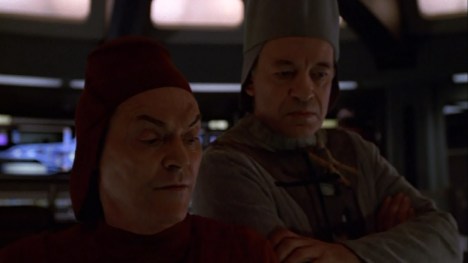
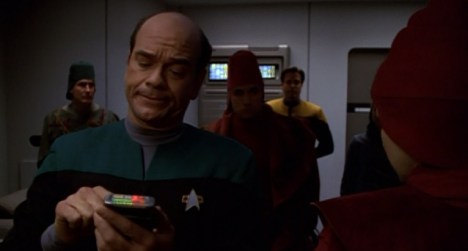
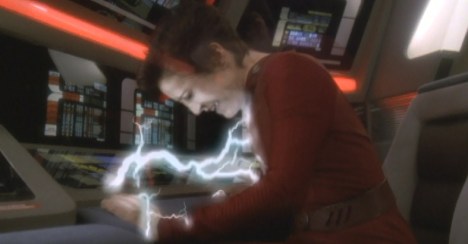
Worst Case Scenario is a flawed episode of Star Trek: Voyager. It is also breathtakingly ambitious.

There is a strong argument to be made that Worst Case Scenario is the strongest Star Trek script ever written by Kenneth Biller. It is a story about storytelling, using the holodeck as a jumping off point for all sorts of self-reflective commentary on the sort of creative compromises necessary to get an episode of television (and in particular an episode of Voyager) on the air. It also benefits from a cracking starting premise, a wonderful opening act, and some playful direction from Alexander Singer. All of these elements help to distract from obvious weaknesses.
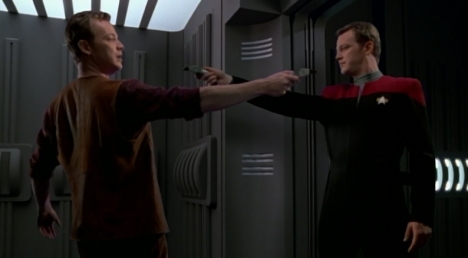
Rebel, rebel.

Rebel, rebel.

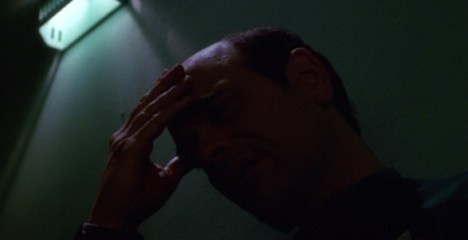
Worst Case Scenario has a number of serious flaws. It makes very little sense from a logical perspective, with the script guilty of many of the criticisms that Tuvok makes of Paris’ approach to the craft of writing. The ending is rushed. The episode owes a sizable debt to Our Man Bashir, a much stronger episode of Star Trek: Deep Space Nine that used the holodeck to make similar (and more convincing) arguments about the nature of storytelling. Like many good-but-not-great Voyager episodes, Worst Case Scenario refuses to follow its ideas to their conclusions.

And yet, in spite of all of these issues, Worst Case Scenario is an endearing and playful piece of television. It is far too chaotic and unfocused to rank with the best of the franchise, but it is distinctive enough to stick in the memory without ever being embarrassing.
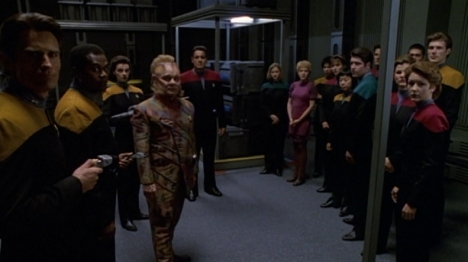
It's all up to you.

It’s all up to you.

Continue reading

Star Trek: Deep Space Nine – Blaze of Glory (Review)

Blaze of Glory is a spectacular piece of television.

It is an episode that serves a very clear plot function in the larger context of Star Trek: Deep Space Nine. It is clearly designed to tidy away some of the dangling loose ends before the show transitions into the Dominion War. Much like Children of Time was really the last “strange Gamma Quadrant phenomenon” episode, Blaze of Glory is the last Maquis episode. It also marks the last appearance of Michael Eddington, a character who has come a long way since his first appearance as the station’s new security officer in The Search, Part I.

Michael Eddington, Noted Brigand.

Michael Eddington, Noted Brigand.

However, even ignoring the fact that Blaze of Glory fulfils these larger obligations in terms of the show’s long-running plot threads, the episode is an engaging and exciting buddy action film that finds Benjamin Sisko paired with one of his most hated adversaries on a dangerous mission into the heart of enemy territory. Ira Steven Behr and Robert Hewitt Wolfe prepare a script laced with wry banter for unlikely action heroes Avery Brooks and Ken Marshall, while Kim Friedman directs the episode as if it were a lost Reagan era Shane Black script.

However, Blaze of Glory also feels very much like Deep Space Nine at its best. It is an episode that celebrates how much these characters can grow and change, while also revelling in the diversity of perspectives that make Deep Space Nine such a compelling show. It is an episode that understands Sisko and Eddington are perhaps more alike than either would concede, but which explores those parallels in a way that never obscures their key differences or their mutual mistrust.

Disarming conversation.

Disarming conversation.

Continue reading

Star Trek: Voyager – Displaced (Review)

The Star Trek franchise has a reputation for being liberal and open-minded.

After all, the franchise is very much rooted in an extension of Kennedy-era liberalism, with the “final frontier” very much an extension of Kennedy’s “new frontier.” It is a franchise that is supposed to celebrate “new lifeforms and new civilisations” that it meets on “strange new worlds”, embracing the alien and celebrating diversity. The franchise is rooted in a utopian version of the future that has been portrayed as at least mostly socialist dating back to Star Trek: The Motion Picture at the latest.

The end is Nyrian.

The end is Nyrian.

However, there are also points at which Star Trek could be considered to be reactionary and conservative. The original Star Trek was nowhere near as progressive on matters of race and gender as many would claim. The first two seasons of Star Trek: Enterprise frequently played as endorsements of politics of the Bush era and the fear of the unknown. The third season of Star Trek: Voyager has been particularly conservative in its outlook; consider the treatment of sex in Blood Fever or Darkling, of the traditional family in Real Life, of globalisation in Unity.

Displaced is perhaps the most striking example, an episode that is essentially a forty-five minute treatise on the risk posed by immigration.

Damn space immigrants, clogging up our space hospitals.

Damn space immigrants, clogging up our space hospitals.

Continue reading

Star Trek: Deep Space Nine – Children of Time (Review)

Time is the fire in which we burn.

Children of Time comes towards the end of the franchise’s thirtieth anniversary season. By all accounts, the thirtieth anniversary season had been a resounding success. Star Trek: First Contact managed to please audiences and critics with a journey back to the beginning of the Star Trek universe. Star Trek: Deep Space Nine offered a crowd-pleasing homage to The Trouble With Tribbles in Trials and Tribble-ations. Even Star Trek: Voyager got in on the act with Flashback, Future’s End, Part I and Future’s End, Part II.

More than that, the franchise was thriving by just about any measure. Three casts were active simultaneously; two casts on television and one in cinemas. The thirtieth anniversary had garnered incredible media attention and had helped to remind audiences that the franchise was still chugging along a decade after its resurrection. To many observers, it appeared that the Star Trek had been resurrected. Against all odds, the television show that had been cancelled by NBC after only three seasons seemed to have been granted a form of immortality.

Walking into the sunset.

Walking into the sunset.

However, things were not as rosy behind the scenes. In fact, the franchise had been underperforming since the end of Star Trek: The Next Generation. The ratings would not become a real problem until the launch of Star Trek: Enterprise, but there were early signs that the franchise was in decline. Both Deep Space Nine and Voyager underwent cast revisions in their fourth seasons to try to solidify the ratings. Deep Space Nine got to keep its existing cast and add one new face, while Voyager had to fire one cast member to make room for the newest player.

Children of Time feels very much like a meditation and contemplation upon the theme of legacy, asking the characters on Deep Space Nine to wonder what they might leave behind.

Shocking.

Shocking.

Continue reading

Star Trek: Voyager – Distant Origin (Review)

Like Remember before it, Distant Origin is a really great example of how Star Trek: Voyager‘s efforts to build a “generic Star Trek series can produce memorable and satisfying episodes of television.

There is very little about Distant Origin that demands to be set in the Delta Quadrant. In fact, Distant Origin arguably makes less sense as an episode set in the Delta Quadrant than it would as an episode set in the Alpha or Beta Quadrants. Episodes like The 37’s and Distant Origin (and the lies at the heart of Favourite Son) seem to suggest a lot of traffic between Earth and the Delta Quadrant beyond the Caretaker. It seems strange the Voth would migrate so far in search of a place to call home.

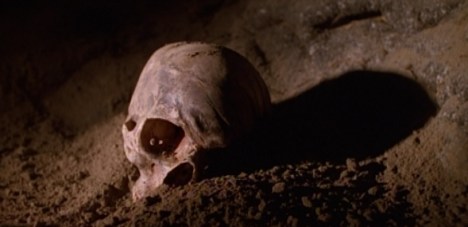
Skullduggery.

Skullduggery.

However, for all that Distant Origin feels like a strange fit for the series’ Delta Quadrant setting, it feels very much like quintessential Star Trek. Like Remember earlier in the season, Distant Origin is very much an old-fashioned Star Trek allegory that uses characters in cheesy make-up to comment upon contemporary issues. In Remember, it was the reality of holocaust denial. In Distant Origin, it is the age-old conflict of science-against-political-expedience. There is an endearing timelessness to the metaphor at the centre of the story.

With its dinosaur characters, its fixation upon evolution, and its doctrine of “origin”, Distant Origin seems very specifically tailored to the heated debates around science and creationism in American culture. However, the allegory is powerful enough that it maintains a potency even beyond that. Distant Origin has aged remarkably well, working effectively as a metaphor for climate change denial or even for historical revisionism in favour of the national myth. Distant Origin is both a season and a series highlight.

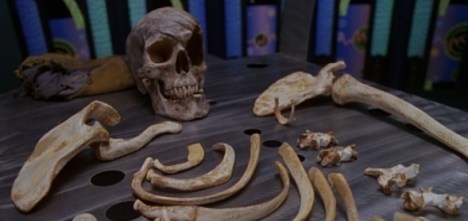
The bones of a theory.

The bare bones of a theory.

Continue reading

Star Trek: Deep Space Nine – Soldiers of the Empire (Review)

Soldiers of the Empire is a very effective illustration of just how far Star Trek: Deep Space Nine was willing to push the Star Trek franchise.

It is an episode that unfolds primarily on a Klingon Bird of Prey. This is nothing new. After all, Star Trek: The Next Generation produced A Matter of Honour in its second season, assigning Riker to serve on a Klingon ship as part of an exchange programme. However, that episode was told primary from a human perspective, the story centring on Riker adjusting and adapting to an alien culture before saving the day. When Worf joined the Klingon fleet in Redemption, Part II, the story kept cutting back to life on the Enterprise in his absence.

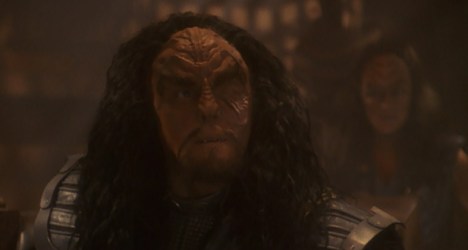
"Mahk-cha!"

“Mahk-cha!”

In contrast, Soldiers of the Empire is primarily focused upon the Klingon cast and the Klingon crew. Worf and Dax join the IKS Rotarran to support General Martok in his first command since escaping the Dominion prison camp at the end of By Inferno’s Light, but they are very much bystanders. Although Worf and Dax provide vital narrative functions in introducing the audience to Klingon customs and cultures, the narrative arc of the show belongs to Martok and the crew of the Rotarran. This is not a story about Worf and Dax, this is a story about Martok.

The result is an episode that really pushes the limits of the storytelling possibilities on Deep Space Nine, a reminder that the production team remain as ambitious as ever in the show’s fifth season. Soldiers of the Empire suffers from a few minor plotting issues, but it is exciting and compelling in a way that captures the very best of Deep Space Nine.

A sharp stabbing pain.

A sharp stabbing pain.

Continue reading

Star Trek: Voyager – Real Life (Review)

Real Life is in some ways a departure for Star Trek: Voyager.

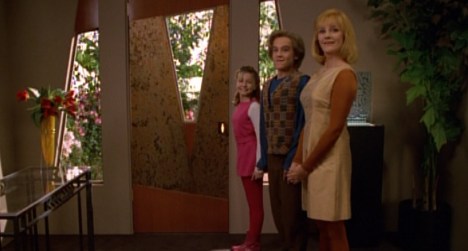
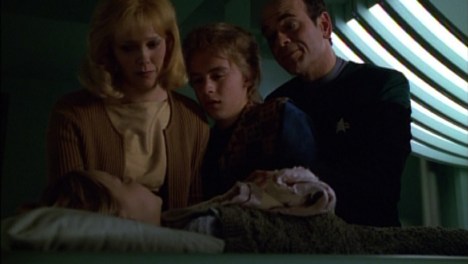
That much is obvious from the teaser, which introduces three new characters on a new set. More than that, the three characters comprise a nuclear family and the set is built to resemble the stereotypical American family home. It is a very strange image, even before the characters begin talking like they escaped from The Brady Bunch. In what might be the best teaser of the entire third season, it is revealed that the EMH has fashioned himself a holographic family and is “commuting” to work in sickbay from the holodeck.

Projections.

Projections.

It is certainly an interesting idea, one that consciously brushes up against the kinds of limitations and expectations that Voyager has faced. It feels experimental, quite removed from the broader third season attempts to position Voyager as the most generic of the Star Trek spin-offs. This does not look or feel like any other episode in the franchise’s history. Indeed, with its focus on family dynamics and conflict, it feels like an extension of Ronald D. Moore’s work on episodes like Family and Doctor Bashir, I Presume.

This makes the episode’s failure to follow through on any of that potential even more disappointing. The third season of Voyager has dramatically scaled down its ambition following the spectacular misfires of the second season. The show is no longer attempting to create long-form stories or introduce iconic new recurring alien species, instead setting more modest goals for itself. There is something disheartening in seeing Voyager set more modest challenges for itself in episodes like Macrocosm or Fair Trade, only to spectacularly bungle the handling of those challenges.

Family matters.

Family matters.

Real Life is another example of the trend. The premise is interesting, and the episode hits on any number of intriguing ideas. There is a great story to be told using this premise, exploring core themes about the human condition in a way that is quite different from the normal storytelling on Voyager. However, the episode flirts with the premise and then balks at it. Real Life is terrified of the implications of its story, padding out the plot with an unnecessary techno-babble-laden diversion and casually discarding the holographic family at the end of the script.

Real Life is an underwhelming story, rendered all the more disappointing for the promise that it squanders.

Photon father.

Photon father.

Continue reading

Star Trek: Deep Space Nine – Ferengi Love Songs (Review)

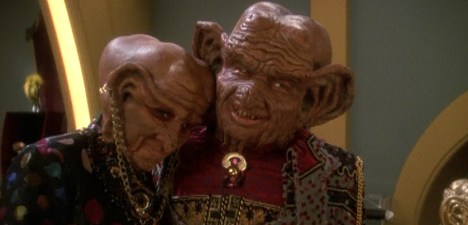
Ferengi Love Songs has one really good joke. In the episode’s defence, it might just be a great joke.

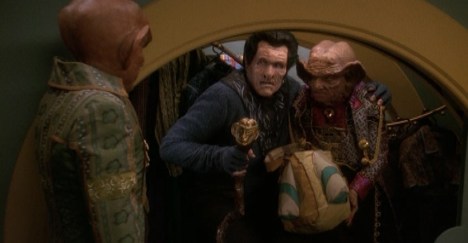
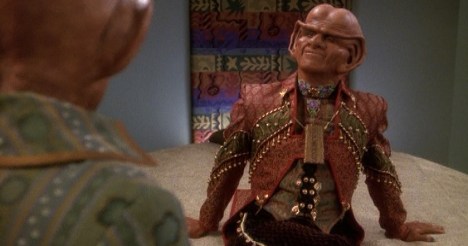
The most striking moment in Ferengi Love Songs comes eight minutes into the episode. In fact, the teaser rushes along so fast that it feels like the production team were pushing for that moment to serve as the sting that would segue into the opening credits. Instead, it arrives during an otherwise short and indistinct first act, providing an effective ad break on syndication. Still, the image is strong enough that it lingers. The image is the sequence in Quark discovers that the Grand Nagus, the most powerful of Ferengi, is hiding in his closet.

Imagine me and you, I do, I think about you day and night, it's only right...

Imagine me and you, I do,
I think about you day and night, it’s only right…

It is a great comedy moment, in both concept and execution. The idea of the leader of a vast interstellar empire hiding in somebody’s bedroom is ridiculous in a way that Star Trek is very rarely ridiculous, at least during the Rick Berman era. It is very much a stock sit-com trope, except it has been dressed up in the trappings of a franchise that has a long record of taking itself incredibly seriously. There is an endearing absurdity to the gag that feels almost like the Star Trek: Deep Space Nine writers are affectionately poking fun at the franchise’s self-seriousness.

Even the execution of the joke works very well. Quark absent-mindedly opens his closet and puts his travel bag inside. The Grand Negus is waiting inside and accepts the bag that is offered. Quark closes the closet, and then does a double-take. He reopens the closet, at which point the Grand Nagus points out that Quark shouldn’t even be here. In a panic, Quark immediately grabs his bag and prepares to leave his house (and the planet) before he properly processes what has happened. “What’s the Nagus doing in my closet?”

He comes with a lot of baggage.

He comes with a lot of baggage.

It is a scene that might have been lifted from some forgotten thirties screwball comedy, which makes sense considering the interests of the Deep Space Nine production team. Rene Auberjonois directs the sequence in which to play into that absurdity, and Armin Shimerman proves quite game at delivering double-takes and exaggerated moments of realisation. It is a great gag, skilfully executed, that is brilliantly silly in the way that Deep Space Nine is not afraid to be.

The biggest problem with Ferengi Love Songs is the challenge of where it needs to go from that brilliant little gag. There is an interesting kernel of a story idea here, the writers’ obvious affection for these Ferengi characters shining through. Unfortunately, none of that fits with the tone of the episode’s central gag, which leads a plot that feels strangely dissonant as it tries to wring drama and conflict from the image of the Grand Nagus crouched over in Quark’s closet.

Strange bedfellows...

Strange bedfellows…

Continue reading

Star Trek: Deep Space Nine – Ties of Blood and Water (Review)

Ties of Blood and Water is a phenomenal piece of television, and a great example of the strengths of Star Trek: Deep Space Nine.

It is an episode that is tied to the personal and the political, a thriller about great powers squaring off against one another set against the more intimate story of a woman nursing her surrogate father in the final hours of his life. Ties of Blood and Water is both intimate and epic, never sacrificing one for the other. Its larger political story beats feel entirely in keeping with the demands of the larger shared universe, but it never loses sight of the story’s emotional centre. There is a very personal aspect to this tale, one firmly grounded in the characters and their relationships.

The ties that bind.

The ties that bind.

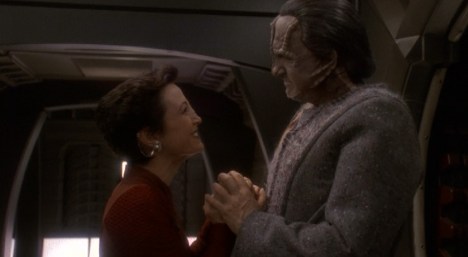
Ties of Blood and Water focuses on Tekeny Ghemor, the Cardassian Legate featured in Second Skin. There, he was convinced that Kira was his daughter who had been sent to infiltrate the Shakaar Resistance. In Ties of Blood and Water, Ghemor returns to the station as the relationship turns a full circle. In Second Skin, Kira Nerys had been a surrogate daughter to Ghemor, standing in for the lost Iliana. In Ties of Blood and Water, Ghemor finds himself cast as a surrogate father to Kira, providing her with a means to work through the loss of her biological father.

Ties of Blood and Water has a certain poetry to it, extending beyond the memorable title.

Greener pastures.

Greener pastures.

Continue reading

Star Trek: Voyager – Before and After (Review)

You might be interested in our other reviews from the third season of Star Trek: Voyager:

Before and After is an episode that should be more interesting than it ultimately is.

There is no small irony in the fact that the one future constant suggested by Before and After would be gone by the third episode of the following season, while the generic tone of the episode’s future flashes would prove entirely accurate. In some ways, Voyager was a paradox. It was generally quite professional and sleek, the show’s polished exterior seeming a little too lifeless and sterile at times. However, this was all an elaborate and well-rehearsed illusion. Behind the scenes, Voyager was a turbulent and chaotic piece of television.

voy-beforeandafter22a

Those conversations and would tweak some of the future suggested by Before and After. Jennifer Lien would depart, and Kes would be retired. Jeri Ryan would be hired, and Seven of Nine would join the crew. Much like what had happened with Deep Space Nine, the planned third season cliffhanger would be thwarted and pushed into the fourth season to make way for a much more bankable story. On Deep Space Nine, Homefront and Paradise Lost were shunted for The Way of the Warrior. On Voyager, Year of Hell, Part I would be brushed aside for Scorpion, Part I.

At the same time, it was clear that Paramount was wary and uncertain of what the future might hold for the franchise. Viewing figures had begun a decline that would continue until the end of Enterprise. The writers on Deep Space Nine had been instructed by the studio to add an existing character and focus on the Klingons early in their fourth season, hoping to shore up viewers. Similar discussions were taking place behind the scenes on Voyager, with the network and producers looking to spice things up on the series.

voy-beforeandafter35a Continue reading