• Following Us

  • Categories

  • Check out the Archives


  • Awards & Nominations

Star Trek: The Next Generation – A Matter of Perspective (Review)

This January and February, we’ll be finishing up our look at the second season of Star Trek: The Next Generation and moving on to the third year of the show, both recently and lovingly remastered for high definition. Check back daily for the latest review.

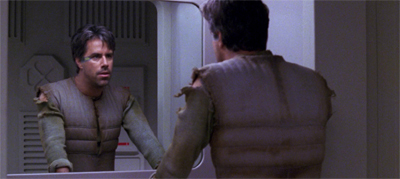
A Matter of Perspective is a bit of a disappointment. However, it’s a disappointment for the same reason that The High Ground is a disappointment. The third season of Star Trek: The Next Generation is at least trying new things, and playing with big ideas for a syndicated television science-fiction show in the late eighties and early nineties. There is some charm to the episode’s basic premise (Rashomon in space… with the holodeck!”), but the script never quite manages to deliver on that wonderful set up.

Instead, we end up with a show that lacks the nuance to follow through on its central themes, and a mystery that confuses techno-babble for a satisfying solution.

Painting a pretty picture...

Painting a pretty picture…

Continue reading

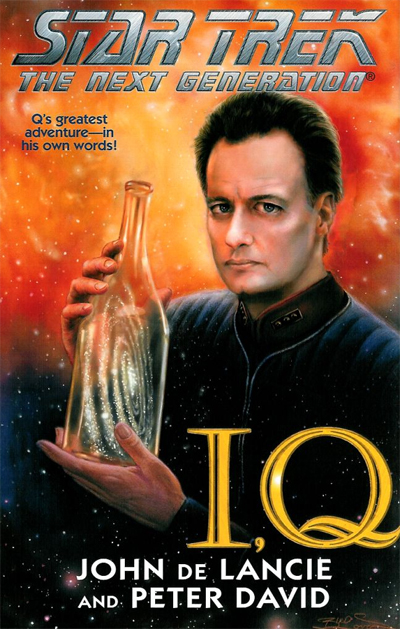
Star Trek: The Next Generation – I, Q by John deLancie & Peter David (Review)

This January and February, we’ll be finishing up our look at the second season of Star Trek: The Next Generation and moving on to the third year of the show, both recently and lovingly remastered for high definition. Check back daily for the latest review.

We’ll be supplementing our coverage of the episodes with some additional materials – mainly novels and comics and films. This is one such entry.

I, Q is John deLancie’s second attempt to write a story featuring his popular and iconic Star Trek: The Next Generation character. As with The Gift, he is teamed with an experienced Star Trek tie-in writer to help bring his vision to life. While Michael Jan Friedman’s collaboration with deLancie for the first annual of DC’s first Next Generation series was a less than promising debut for the actor-turned-writer, I, Q works a lot better.

It’s hard to tell if this is because deLancie works better with Peter David as a collaborator, or that his style works better in prose, or simply that he has developed as a writer in the years since that first comic was published. I, Q is far from the perfect Star Trek novel, but it’s an enjoyable enough read – it captures the voice of its celebrity author quite well, and breezes along inoffensively. There are moments when the novel seems to bask a little too heavily in its central character’s filibustering, but it’s a perfectly serviceable read.

tng-iq

Continue reading

Star Trek: The Next Generation – Déjà Q (Review)

This January and February, we’ll be finishing up our look at the second season of Star Trek: The Next Generation and moving on to the third year of the show, both recently and lovingly remastered for high definition. Check back daily for the latest review.

Déjà Q is, in a way, the most quintessential of Star Trek: The Next Generation stories, one of the most perfect embodiments of the show’s philosophy. It’s the story about an alien who engages on a voyage of self-discovery, with the Enterprise crew serving as guides. It’s essentially an episode about what it means to be human, and is built upon the fundamentally assumption that being human allows a person the capacity for altruism and self-sacrifice.

It’s easy to imagine Déjà Q turning out unwatchable. This sort of “humans are brilliant!” storytelling was a staple of the show’s troubled first season, leading to episodes like The Last Outpost and Lonely Among Us. However, Déjà Q turns out to be quite the treat. It’s helped by the presence of John de Lancie’s superbly sardonic Q and Richard Danus’ decidedly wry script. Both of these help to temper the episode’s earnestness, leading to a show that is endearing rather than irritating.

Watching Déjà Q, there’s a sense that this is very much what Gene Roddenberry wanted the first two seasons of The Next Generation to be, but – at that stage in its young life – the show was never quite capable of producing something this charming.

Well, he knows how to make an entrance...

Well, he knows how to make an entrance…

Continue reading

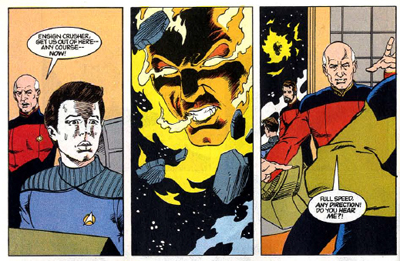
Star Trek: The Next Generation (DC, 1989) Annual #1 – The Gift (Review)

This January and February, we’ll be finishing up our look at the second season of Star Trek: The Next Generation and moving on to the third year of the show, both recently and lovingly remastered for high definition. Check back daily for the latest review.

We’ll be supplementing our coverage of the episodes with some additional materials – mainly novels and comics and films.

You can see why DC comics jumped at the chance to publish The Gift. After all, a comic about Q written by the actor playing Q is a hell of a hook. The publisher had already done something similar, with actor Walter Koenig providing a script for the nineteenth issue of DC’s first Star Trek comic book series. At the same time that The Gift was published, George Takei collaborated with Peter David on a Star Trek annual story, So Near the Touch.

John deLancie isn’t a bad storyteller. Indeed, his published tie-in novel – I, Q written with Peter David – is quite enjoyable. However, The Gift is just an absolute mess of a story, with a couple of interesting high concepts buried beneath two horrible clichés tied together to create a rather unfortunate narrative. The Gift is a disappointment on just about every level.

Cue Q!

Cue Q!

Continue reading

Star Trek: The Next Generation – The High Ground (Review)

This January and February, we’ll be finishing up our look at the second season of Star Trek: The Next Generation and moving on to the third year of the show, both recently and lovingly remastered for high definition. Check back daily for the latest review.

The High Ground is a rather earnest issue-driven episode of Star Trek: The Next Generation, dealing with one of the big issues of the day: international terrorism. However, the moral ambiguity of terrorism was a decidedly more contentious and controversial issue in early 1990 than the plight of Vietnam veterans explored in The Hunted or the Cold War politics of The Defector.

The High Ground is an allegory for the Troubles in Northern Ireland at a point in time where the Troubles were on-going. 1990 saw a number of high-profile terrorist actions conducted by the IRA. They bombed the London Stock Exchange in July. Using an explosive device, they murdered Sergeant Charles Chapman in May. Nobody has ever been prosecuted for his death. In February 1991, the IRA launched a mortar attack on 10 Downing Street. So this was the context in which The High Ground aired.

And, to be fair, there’s something admirable about the show’s willingness to engage with a controversial issue, even if the end result leaves a lot to be desired.

Holding hands around the universe...

Holding hands around the universe…

Continue reading

Star Trek: The Next Generation – Embrace the Wolf (Review)

This January and February, we’ll be finishing up our look at the second season of Star Trek: The Next Generation and moving on to the third year of the show, both recently and lovingly remastered for high definition. Check back daily for the latest review.

We’ll be supplementing our coverage of the episodes with some additional materials – mainly novels and comics and films. This is one such entry. This is actually supplementary to the episode Elementary, Dear Data.

The concept behind Embrace the Wolf is quite ingenious. The execution is slightly less so. Recognising that Star Trek: The Next Generation had a recurring interest in Victorian London, in Data’s interest in Sherlock Holmes, it seemed quite logical to drop Redjac into that scenario. Redjac was the non-corporeal serial killing entity introduced in Wolf in the Fold, one of Robert Bloch’s contributions to the second season of the classic Star Trek. As part of Wolf in the Fold, and playing into Bloch’s fascination with the notorious serial killer, Redjac was explicitly identified as the spirit of Jack the Ripper. As you do

So, pairing up Data’s Sherlock Holmes with Redjac’s Jack the Ripper should make for a decidedly pulpy adventure. Unfortunately, the end result is a little generic and unsatisfying.

Wolf in the holodeck...

Wolf in the holodeck…

Continue reading

Star Trek: The Next Generation – The Hunted (Review)

This January and February, we’ll be finishing up our look at the second season of Star Trek: The Next Generation and moving on to the third year of the show, both recently and lovingly remastered for high definition. Check back daily for the latest review.

The Hunted is a piece of allegorical Star Trek. Like The Defector before it, there’s a sense that the show is a little behind the curve – that it’s really dealing with issues that aren’t at the peak of their relevance. The Cold War with the Romulans felt like a bit of a throwback in the era of glasnost, and the ghosts of Vietnam raised by The Hunted feel like echoes of a national debate that had already taken place in the mid- to late-eighties.

And yet, despite that, it works. Like The Defector, there’s a sense that The Next Generation is distant enough from the issue that it can engage objectively. The treatment of Jarok in The Defector or Roga Danar in The Hunted feels infinitely more nuanced and sophisticated than the portrayal of Finn in The High Ground, when The Next Generation was rather consciously trying to engage with a more relevant and topical issue.

Effectively The Next Generation‘s Vietnam story, The Hunted serves as a startlingly effective piece of television. It might be the best action-driven episode of the show to date.

Keep soldiering on...

Keep soldiering on…

Continue reading

Star Trek: Phase II (1978) – The Child (Review)

This January and February, we’ll be finishing up our look at the second season of Star Trek: The Next Generation and moving on to the third year of the show, both recently and lovingly remastered for high definition. Check back daily for the latest review.

We’ll be supplementing our coverage of the episodes with some additional materials – mainly novels and comics and films. This is actually supplementary to the second season of the Next Generation, specifically the episode The Child.

The Child is not one of the strongest episodes of Star Trek: The Next Generation. In fact, it’s not even one of the strongest episodes of the show’s troubled second season. There’s a valid argument to be made that the script – hastily cobbled together from a draft originally planned for Star Trek: Phase II back in 1978 in order to get something to air despite the 1988 Writers’ Guild Strike – is one of the weakest ever produced by the franchise. A combination of casual sexism and trite life lessons, wrapped up and presented as an optimistic space-age fable.

To be fair, pulling The Child into production was an act of sheer desperation from the producers of The Next Generation. The writing staff was clearly groping in the darkness and grabbed the first thing they could think to use. In this case, it was a completed script planned for the first season of the aborted 1978 Star Trek spin-off, Phase II. Reading the script, it’s hard not to pity Maurice Hurley the task of reworking the story into something that could be produced for prime time television in 1978. While the finished episode is nothing to be proud of, it still represents a vast improvement on the original script.

tng-thechild12

Continue reading

Star Trek: The Next Generation – The Defector (Review)

This January and February, we’ll be finishing up our look at the second season of Star Trek: The Next Generation and moving on to the third year of the show, both recently and lovingly remastered for high definition. Check back daily for the latest review.

The Defector is the script that earned Ronald D. Moore his place on the writing staff of Star Trek: The Next Generation. The writer had contributed the first script produced by Michael Piller, The Bonding, but it was his second pitch – improvised in the heat of the moment – that cemented Moore’s place with the franchise. He would stay on The Next Generation until it finished, before moving on to Star Trek: Deep Space Nine and eventually Star Trek: Voyager, although he departed Voyager quite quickly.

Although Moore retains the credit on the finished episode, apparently – like so many third season scripts – the final draft of The Defector was a collaborative effort involving the whole writing staff. The episode, the first instalment of The Next Generation to air in the nineties, turned out surprisingly well. Indeed, The Defector is one of the strongest episodes of a very strong season.

A defective defector?

A defective defector?

Continue reading

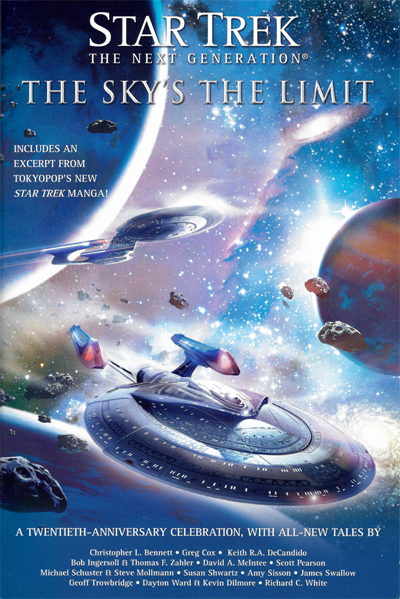
Star Trek: The Next Generation – The Sky’s the Limit: Suicide Note by Geoff Trowbridge (Review)

This January and February, we’ll be finishing up our look at the second season of Star Trek: The Next Generation and moving on to the third year of the show, both recently and lovingly remastered for high definition. Check back daily for the latest review.

We’ll be supplementing our coverage of the episodes with some additional materials – mainly novels and comics and films.

Suicide Note is another one of those great “expanding from dangling plot threads left at the conclusion of an episode of Star Trek: The Next Generation stories that are popular in tie-in media. In this case, writer Geoff Trowbridge is building off the end of The Defector, which saw Captain Picard receiving a suicide note from the eponymous defector Admiral Jarok. Jarok had asked Picard to pass the not on to his family, which was not possible at the time.

Of course, The Next Generation never really dealt with these threads, because – put quite simply – it wasn’t that kind of show. So it’s fun to pick up these threads and to try to recontextualise them in terms of everything that has unfolded since. In this case, Trowbridge is able to explore Jarok’s sacrifice in the context of the Federation and Romulan alliance towards the end of Star Trek: Deep Space Nine, in the wake of In the Pale Moonlight.

In keeping with Trowbridge’s The Chimes at Midnight, Suicide Note is structured as a critical exploration of American history, through the prism of Star Trek. While The Chimes at Midnight was a brutal deconstruction of the franchise’s roots in the Second World War, Suicide Note is framed in a more modern context.

tng-theskysthelimit

Continue reading