• Following Us

  • Categories

  • Check out the Archives


  • Awards & Nominations

My 12 for ’13: Honorable Mentions

Over the next few days, I’ll be revealing my favourite twelve films of 2013. I suspect that it will be a slightly quirky and eccentric list – I doubt anybody but myself will agree on every choice, but I hope that encapsulates the diversity and brilliance of the year that we’ve had. Indeed, I was actually quite impressed with the quality of films that were released in 2013, from large tentpoles through to more intimate and low-key film-making.

In fact, I was so impressed that I thought I’d put together a list of brief honourable mentions of the films that didn’t quite make the cut for my top twelve films of 2013.

broken3

Continue reading

Non-Review Review: The Railway Man

The Railway Man is certainly an ambitious film. Adapting the true story of British Second World War veteran Eric Lomax, who won the 1996 NCR Book Award and the J. R. Ackerley Prize for The Railway Man, his autobiographical account of his time in Japanese captivity and the aftermath of the war. Adapted by Frank Cottrell Boyce and Andy Paterson, and directed by Jonathan Teplitzky, it remains a fascinating and compelling exploration of the wounds left festering by war.

The biggest problem with The Railway Man is that it is perhaps too ambitious; it tries to include too much, and to cover too much ground in the space available. Despite that, it remains a moving and harrowing look at the remarkable life of one veteran.

Trained for this...

Trained for this…

Continue reading

Non-Review Review: Walking With Dinosaurs – The 3D Movie

You never really grow up past the love of dinosaurs. Sure, you are probably never as relentlessly fascinated with the gigantic reptiles as you were when you were a kid, but those prehistoric creatures still garner affection from children of all ages. That was, after all, the basic premise of Jurassic Park, which got a high-profile 20th anniversary re-release this year. It was also the driving force behind Walking With Dinosaurs, the ground-breaking CGI documentary broadcast on the BBC in the UK and on Discovery in America.

So adapting the show to film seems like a logical step, and Walking With Dinosaurs: The 3D Movie is a bit of a no-brainer for a holiday family release, especially with families that have children too young to watch The Hobbit: The Desolation of Smaug or Anchorman: The Legend Continues and who have already seen Frozen. It’s a concept that really sells itself, which makes it incredibly frustrating that Walking With Dinosaurs: The 3D Movie goes out of its way to sabotage itself.

"It was a night like this, forty million years ago..."

“It was a night like this, forty million years ago…”

Continue reading

Non-Review Review: The Hobbit – The Desolation of Smaug

The Hobbit: The Desolation of Smaug represents a considerable improvement on The Hobbit: An Unexpected Journey. Some of the same problems still lurk at the edge of the frame: the pacing needs a bit of work; the movie is about half-an-hour too long; it feels a little too consciously like one extended prelude to The Lord of the Rings. And yet, despite all these flaws, The Desolation of Smaug accomplishes a lot of what it sets out to do.

This is very clearly the same Middle Earth that viewers remember from The Lord of the Rings. Even the least obsessive viewer will still recognise the occasional familiar landmark or setting from the early film. It’s not just the New Zealand locations that shine through; great care has been taken to establish a geography of this fictional landscape. Viewers who have yet to memorise the names and routes on Tolkien’s meticulously-prepared maps can see that this is the same world.

It’s just being seen from a different perspective. The Hobbit isn’t really an adaptation of that much-loved adventure tale, at least not exclusively. It is instead being crafted as a companion piece, with the heroes’ quest providing a handy travelogue of a world in turmoil.

The gold standard?

The gold standard?

Continue reading

Non-Review Review: The Secret Life of Walter Mitty (2013)

Ben Stiller recently explained that he was growing more interested in directing and less interested in acting in front of the camera. Even if he hadn’t confessed that in an interview, it would be hard to shake that feeling while watching The Secret Life of Walter Mitty. It’s beautifully shot and contains a number of impressive sequences and set pieces, but ultimately feels a little hollow – like a beautifully-sketched picture inhabited by two-dimensional characters.

There are moments of splendor and beauty to be found in The Secret Life of Walter Mitty, but often in spite Steve Conrad’s script rather than because of it.

Daydream believer...

Daydream believer…

Continue reading

Non-Review Review: Kill Your Darlings

Kill Your Darlings feels like several different films all rolled into one. Is it an English major detective story about investigating one ruthless act through character and theme and other literary devices? Is it a coming of age story about a young man finding himself at college in New York City against the back drop of the Second World War? Is it a condemnation of the recklessness and the irreverence of the young Beat movement? Is it a standard college adventure story about young students sticking it to the man, and refusing to let authority figures tell them how to live their lives?

Kill Your Darlings is most interesting in the space between the familiar genre trappings, when it focuses on the characters at the dawn of the emerging literary movement. Indeed, the spirit of the film is best captured in one drug-induces segue in which our characters find themselves slipping between the reality and existing in a gap between moments. Kill Your Darlings is by turns romantic and cynical in its handling of Allen Ginsberg and his development as a young artist, featuring a wealth of superb central performances which can’t quite hold the film together.

Given the literary cut-up technique that we see the gang experiment with here, it feels strangely appropriate that Kill Your Darlings should be an uneven mess of a film, with a wealth of great ideas existing in the space between plot and tone and substance and reality. It just doesn’t make for a particularly satisfying film.

Talkin' 'bout the Beat Generation...

Talkin’ ’bout the Beat Generation…

Continue reading

Agents of S.H.I.E.L.D. – The Well (Review)

So this is what a tie-in to Thor: The Dark World looks like. This is the episode of Agents of S.H.I.E.L.D. broadcast specifically to tie into the major motion picture blockbuster. In essence, this is as close as Agents of S.H.I.E.L.D. will ever get to integrating with the shared Marvel universe. Given the fact that the show’s official title includes the prefix “Marvel’s”, that cross-media synchronicity is a large part of Agents of S.H.I.E.L.D.‘s branding.

The result is… disappointing, to say the least. It’s just a generic “strange phenomena of the week” episode with even more crossed wires than usual, a tiresome bit of back story for a bland character played by a mediocre actor and an unwillingness to take advantage of any of the benefits of being a television show tied into a blockbuster franchise while remaining firmly anchored to the weaknesses associated with the medium.

Hot rod...

Hot rod…

Continue reading

Doctor Who: Gridlock (Review)

To celebrate the fiftieth anniversary of the longest-running science-fiction show in the world, I’ll be taking weekly looks at some of my own personal favourite stories and arcs, from the old and new series, with a view to encapsulating the sublime, the clever and the fiendishly odd of the BBC’s Doctor Who.

Gridlock originally aired in 2007.

The sky’s a burnt orange, with the Citadel enclosed in a mighty glass dome, shining under the twin suns. Beyond that, the mountains go on forever. Slopes of deep red grass, capped with snow.

– the Doctor takes us to Gallifrey, for the first time in ages

Gridlock is the final (and best) of Davies’ “New Earth” trilogy, encompassing The End of the World and New Earth. The decision to focus the opening futuristic stories of the first three seasons around the same strand of “future history” is a very clever move, and perhaps an indication of how acutely aware Davies is of the way the modern television differs from television when the classic show aired. In short, it creates a pleasing sense of continuity between episodes that are very disconnected from the show’s main continuity.

This is far from the Powell Estate as you can get, and yet – three years in – it also feels strangely familiar.

The skyline's the limit...

The skyline’s the limit…

Continue reading

Non-Review Review: Mandela – Long Walk to Freedom

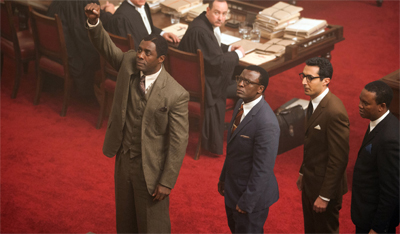
Mandela: Long Walk to Freedom is very clearly a sentimental life-affirming true story, very clearly pitching itself as an upbeat and hopeful account of one of the most iconic statesmen of our time. A collection of all the “greatest hits” of Mandela’s struggle against oppression and hatred, Mandela is an efficiently calculated piece of cinema. It’s a grand sweeping historical epic that never really pulls back the layers of the character it examines, instead opting (mostly) to film the legend.

And it works. After all, what other world leader in the past half-century can lay claim to such an inspirational narrative? Nelson Mandela’s journey lends itself to this sort of optimistic and inspirational adaptation, and the subject is a comfortable fit for this sort of sweeping life-affirming whirl-wind exploration of Mandela’s personal history.

Courting public opinion...

Courting public opinion…

Continue reading

Doctor Who: The Sun Makers (Review)

To celebrate the fiftieth anniversary of the longest-running science-fiction show in the world, I’ll be taking weekly looks at some of my own personal favourite stories and arcs, from the old and new series, with a view to encapsulating the sublime, the clever and the fiendishly odd of the BBC’s Doctor Who.

The Sun Makers originally aired in 1977.

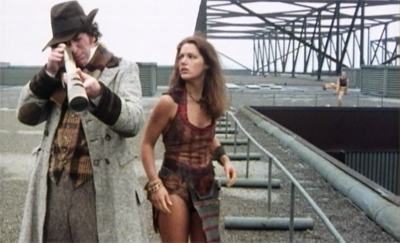
Why did you come here, then?

Because my new little chum here seemed unhappy about something.

Mandrell discovers all he needs to know about the Doctor

The Sun Makers was reportedly written as a result of a disagreement between writer Robert Holmes and the British Revenue and Customs. That’s the oft-cited background to the story, so well known that it’s even included on the notes included in the DVD release. With that summary, you’d expect The Sun Makers to be a condemnation of the tax system, and a protest at the government’s funnelling off of money from the individual to pay like pesky things like roads or schools or hospitals.

Instead, Holmes has crafted The Sun Makers as something altogether more compelling and instructive. Rather pointedly, while The Sun Maker is a story about excessive taxation, the episode casts a large interstellar corporation as the villain of the piece. The episode’s primary antagonist isn’t a state official, it’s a single-minded number-crunching accountant who operates a large corporation that has managed to turn light itself into a financial commodity. This isn’t the story about individuals fighting for the right not to pay tax, it’s people fighting for decent working and living conditions.

Indeed, it’s quite easy to read The Sun Makers as a rather socialist piece of Doctor Who, ending with the massive organisation of the working class to resist their greedy capitalist overlords. That’s quite a radical shift from the story you’d expect given the background. In that respect, it seems almost like a call-forward to the pointed subversive social commentary of the Cartmel and even Davies eras.
I see the future...

I see the future…

Continue reading