• Following Us

  • Categories

  • Check out the Archives


  • Awards & Nominations

Non-Review Review: Blair Witch

Blair Witch is more clever than scary, which is at once the best and worst thing about it.

Reteaming veteran collaborators director Adam Wingard and writer Simon Barrett, the film is nominally a long-delayed sequel to the classic 1999 found footage horror. The Blair Witch Project was something of a game-changer when it arrived. At a point in time when movies like The Matrix and The Truman Show (not to mention eXistenz and The Thirteenth Floor) teased out the idea of characters trapped in unreal surroundings, The Blair Witch Project applied that aesthetic to a horror movie in the style of Cannibal Holocaust.

Any witch way but loose...

Any witch way but loose…

The Blair Witch Project kickstarted an entire genre of contemporary horror framed as documentary footage of horrible happenings; Cloverfield, [rec], Diary of the Dead, The Last Exorcism, Paranormal Activity. Such films appealed to studios because they were cheap to make, relying on no-name casts and minimal special effects as part of the premise. They also resonated with audiences, perhaps because they spoke to the postmodern anxieties at the cusp of the twenty-first century, perhaps because they mirrored the use of amateur footage in news and online.

Blair Witch marks a return to that premise, perhaps a fond farewell to a genre that has been in decline for the past few years. At their best, Wingard and Barrett push the premise of found footage horror to its limit. This is a film that wallows in its self-awareness and referential integrity, one that feels postmodern and cheeky, one that draws attention to its own status as a sequel by pointedly trapping its characters within a sequel. It is all very clever, and Blair Witch works best when it plays with these ideas. Unfortunately, its scares are nowhere near as clever.

Branching out.

Branching out.

Continue reading

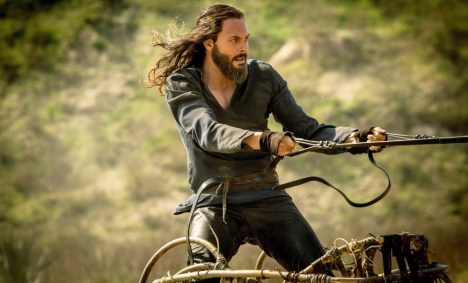
Non-Review Review: Ben Hur (2016)

What does a biblical blockbuster look like in the twenty-first century?

Hollywood has wrestled with the question of how best to resurrect old genres. The past couple of years have seen a resurgence in revisionist westerns like The Hateful Eight or Bone Tomahawk or The Revenant. There have even been a smaller number of contemporary swords-and-sandals epics like The Eagle or Centurion or Pompeii. These genre were once a staple of Hollywood production, but they fell by the wayside in the intervening years. Barring an occasional breakout success, they are considered dead genres.

Chariots of fire!

Chariots of fire!

Biblical epics are very much an example of such a genre, to the point that Hail, Caesar! focused on the production of such a film as a celebration of the Golden Age of Hollywood. More people can probably point to the iconic version of Ben-Hur starring Charleton Heston as the eponymous chariot rider than can name Lew Wallace as the author of the book upon which it was based. When Hollywood attempted a blockbuster adaptation of C.S. Lewis’ Narnia books, they did so by stripping out a lot of the more overt Christian themes.

Ben-Hur is part of a mini modern revival of these classic biblical epics for a new age, alongside films like Exodus: Gods and Kings or Noah or Risen. It is a film which struggles with the question of what a biblical epic needs to look like in this day and age, but is primarily useful as a counter-example. Whatever a successful modern biblical epic might look like, it is not this.

"Is Game of Thrones hiring, by any chance?"

“Is Game of Thrones hiring, by any chance?”

Continue reading

Non-Review Review: Hell or High Water

Hell or High Water is a modern western, a tale of the land and the people shaped by it.

Hell or High Water revels in the old cowboy tropes. Repeatedly over the course of the film’s runtime, eye witnesses liken the outlaw pair at the centre of the story to “cowboys” or “cowpokes.” Set in West Texas, the film unfolds in a world of cowboy hats and rattlesnakes. This is a story about lonely men in the desert, land and self-determination. At one point, a half-Native American half-Mexican character pauses to reflect upon the idea that this is essentially the foundational myth of the frontier playing out again. The actors might change, but the roles remain the same.

No Country for Young Men.

No Country for Young Men.

Hell or High Water is bitter and cynical reflection on the concept of land and ownership, and the importance that it plays to the American identity. Towards the end of the film, bank robber Toby Howard justifies his actions by reference to generations of struggle; the generations that came before and the generations that will follow, and the land that has either condemned or sustained them. Toby is quite literally building his own future out there on the frontier, his bank robberies motivated by the urge to wrest back his family’s land so he might wrest a profit from it.

Like its lead characters, and like the land that drives them to this desperate course of action, Taylor Sheridan’s script is reserved and restrained. There is an economy to it, a sparseness and a leanness that suits this tale and the people inhabiting it. However, Sheridan’s script implicitly trusts director David Mackenzie, who manages to find a striking beauty and a stunning brutality in this rugged landscape inhabited by these rugged men.

At home on the Ranger...

At home on the Ranger…

Continue reading

Non-Review: Don’t Breathe

Don’t Breathe works reasonably well for about two thirds of its runtime.

The premise of Fede Alvarez’s Detroit-based horror is quite clever, a stew of familiar ideas thrown into a blender and delivered in a very stylish manner. Don’t Breathe is a film that begs to be summarised in pithy one-liners that bridge movie titles using the dreaded “… with …” In those terms, Don’t Breathe is Home Alone meets Halloween, Wait Until Dark meets The Bling Ring, Panic Room meets Saw. The combinations are infinite, as are the influences. And there is a charm to that.

Firing blind.

Firing blind.

Horror is a visceral genre; doing something new is great, but so is doing something familiar in a novel way. For its first two thirds, Don’t Breathe is an exciting and tense horror movie with an ingenious high concept and with a number of reliable jump scares. Fede Alvarez does not necessarily innovate, but he understands how to pace a sequence for maximum tension and he has a great eye for cinematic influences. Contemporary culture can often feel like “remix” culture, mashing old ideas together to create something interesting. Don’t Breathe fits with that.

The problem comes during the movie’s third act, when the thrills and horror slow down just long enough to flesh out the “monster” at the centre of the film. As it pushes into its climax, Don’t Breathe becomes a lot less intriguing and effective. In those final twenty minutes, Don’t Breathe indulges the baser impulses of the horror genre in a manner that is crass and cheap. Don’t Breathe begins as a series of inventive homages to the best that horror genre has to offer. Unfortunately, it ends as a demonstration of the genre’s worst attributes.

Setting his (gun) sight on them.

Setting his (gun) sight on them.

Continue reading

Non-Review Review: The Young Offenders

The Young Offenders is mighty Cork, boi.

Perhaps the most enjoyable aspect of Peter Foott’s coming of age adventure comedy is its sense of place. There are any number of Irish films that depict modern rural life, most obviously the films of John McDonagh (Calvary or The Guard) or Garage or even Smalltown. However, for all that those stories deal with big themes and bold ideas, it is rare to get a perfect sense of place. As with just about any country, Ireland offers a rich and diverse cultural landscape, and The Young Offenders is interested in exploring that landscape even before the first use of a map insert.

theyoungoffenders1

Continue reading

Non-Review Review: Anthropoid

“Concentrate on the details.”

The phrase is repeated in Anthropoid, and it speaks to the aesthetic of Sean Ellis’ tense Second World War assassination thriller. Ellis is very much fascinated with the details. This is reflected in the standard clandestine war movie fare; the reliance on maps and the maintaining of schedules, the decoding of messages and the construction of weapons. However, it is also reflected in Ellis’ directorial choices, with an emphasis on tight claustrophobic shots and meticulous care to ensure what the audience can or cannot see at any given moment.

Wet work.

Wet work.

The result is an engaging entry in the subgenre, a familiar story elevated by the craft on display. Ellis very skilfully and successfully ramps up the tension over the film’s two-hour runtime, mainly by keeping in complete control of the frame. Anthropoid is distinguished from other undercover war movies through the sheer scale of paranoia and dread that Ellis manages to generate, leading to a spectacular (and sustained) pay-off in the film’s third act. As its protagonists argue, the details are key.

There a few minor problems. Ellis is over-reliant on shaky camera work to keep the audience off-balance, a technique that is occasionally disorienting in a literal rather than a figurative sense. There are also moments when Anthropoid drifts away from its gritty grounding into easy visual metaphors and stock war movie tropes; crushed symbols of innocence trampled underfoot and a soaring triumphant score over silent scenes of carnage. However, these are the exception rather than the rule. As long as Anthropoid focuses on the details, it never loses track of itself.

Driving ambition.

Driving ambition.

Continue reading

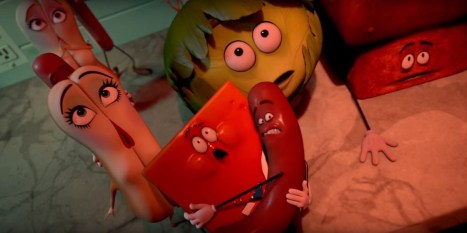
Non-Review Review: Sausage Party

Perhaps the most charming thing about Sausage Party is that it exists in the first place.

After all, a computer-generated animated movie about foul-mouthed hyper-violent and aggressively sexual anthropomorphised food products was always going to be something of a tough sell. More than that, there was always a risk that the film’s best joke could not sustain the necessary ninety-minute runtime. “Let’s do an R-rated comedy animated in the style of a Dreamworks or Pixar film!” is very wry, but it seems like the kind of idea that brews in the early hours of the morning at a wild party and is promptly forgotten.

Food for thought...

Food for thought…

At one point in Sausage Party, the heroic hotdog Frank encounters a group of ancient foodstuffs hiding out in the liquor aisle of the shopping market that he calls home. These old and experience foodstuffs recall how they carefully cultivated and curated the mythology of the supermarket, building a religion that treated consumers as “gods” and which encouraged the store’s food and drink to dream of being “chosen.” There is even a hymn that the food sings every morning. A wisened old liquor bottle explains that this whole plan was the result of a massive stoner session.

In some ways, Sausage Party feels like it had a similar genesis, beginning with a goofy joke among friends that escalated and evolved into a surprisingly fleshed-out and developed world. Sausage Party works remarkably well given that it is essentially one very clever joke spread across ninety minutes, padded out with healthy doses of absurdity and puns. While the movie can occasionally feel a little indulgent and meandering, that charm carries it a long way. Sausage Party is one extended gag, but it is just about funny enough to pull it off.

Sweet mother of mercy...

Sweet mother of mercy…

Continue reading

Non-Review Review: War Dogs

At one point in the movie War Dogs, manipulative sociopath Efraim Diveroli presents his naive business partner David Packouz with a gift.

It is a sequence that is as illustrative of War Dogs as it is key for Efraim. The gift in question is a golden hand grenade, a gesture of tremendous subtlety on the part of the film and its secondary lead. See, Efraim and David are self-described gun runners. More than that, they are ostentatious over-the-top gun runners with no sense of tact and the bare minimum of business sense. What better way for Efraim to convey this to David (and for the film to convey it to the audience) than through the gift of a gold-plated hand grenade.

"Quick question: do we HAVE to be framed with these picture of Bush and Cheney? I mean, I think people get it."

“Quick question: do we HAVE to be framed with these picture of Bush and Cheney? I mean, I think people get it.”

However, the kicker comes in the inscription that Efraim has engraved on the bottom of the ridiculous gift. “The world is yours,” the grenade seems to promise its owner. It is, of course, a line from Scarface. It is, in fact, a line from both versions of Scarface. It is the bitterly ironic sentiment that closes out the film, an encapsulation of the greed and hubris that led the two gangster protagonists their downfall. Conveyed through advertising, it was also a stinging commentary on the American Dream. It was the height of irony, a cynical sting at the end of a moral fable.

There is a sense that Efraim does not necessarily understand irony. Having watched War Dogs, it is not entirely clear that the film does either.

Cool gun runnings.

Cool gun runnings.

Continue reading

Non-Review Review: Lights Out

For the bulk of its runtime, Lights Out is a very old-fashioned and very clever horror movie.

The basic premise of Lights Out is quite clever, even on its own terms. The central antagonist of the film is a demonic entity that seems to move through darkness. Characters are safe from its influence so long as they remain in the light. It is a very smart riff on a primal fear. The fear of darkness is the most primal of fears, the anxiety about the unknown and what might lurk in the shadows. Lights Out takes that universal fear and mines it for scares, in a fashion that is very classic while also quite clever.

A bit of the old ultraviolet...

A bit of the old ultraviolet…

The premise alone is enough to drive Lights Out, to power an eighty-one-minute horror film. However, director David Sandberg and writer Eric Heisserer go a great deal further. In the style of many classic horror stories, Lights Out positions its demon as an allegorical device. This demon that stalks its prey through darkness is treated as an apt metaphor for depression, a creature that has latched on to a small suburban family and tormented them quietly for years. It is a premise that The Babadook used to great effect, and it adds a little extra heft to Lights Out.

However, there is a sense that Lights Out is just a little bit too clever for its own good. The film follows its basic premise to a very clever and innovative conclusion within the world that it has created. The problem is that the movie’s final big plot development rather brutally undercuts the central allegory in such a way that the film trips over its own wit. Still, discounting those final few minutes, Lights Out is a visceral thrill-ride and a joy from start to almost-finish.

Red sky at night...

Red sky at night…

Continue reading

Non-Review Review: David Brent – Life on the Road

Perhaps David Brent: Life on the Road represents the edge case for the current wave of nineties nostalgia.

The Office premiered in July 2001. It was the first year of the twenty-first century, but spiritually near the end of what might be termed “the long nineties.” The mockumentary sit-com was something of a novelty at the time, building upon the rich history and legacy of British comedy personalities like Alan Partridge, with Ricky Gervais introducing the character of David Brent. Gervais did not invent cringe-comedy, but he certainly pushed it forward. Gervais’ work in The Office and Extras would inspire a whole generation of awkward social comedy.

He's got a t-shirt gun and he's not afraid to use it.

He’s got a t-shirt gun and he’s not afraid to use it.

David Brent is an interesting beast. On the one hand, it seems like a nostalgic return to familiar ground for a comedian who has long evolved past this persona. Barring a brief reprisal of the role for Red Nose Day in March 2013, Gervais retired the role of David Brent more than a decade ago. In some respects, David Brent finds the comedian retreading old ground that had been ceded to a generation of imitators and innovators years earlier. Gervais slips effortless back into the role, but there is a sense that the world has changed around him.

Despite Gervais’ best efforts, there is an awkwardness to David Brent. It is hard to tell whether Gervais has soften in the intervening years or whether the world has gotten harder, but David Brent feels trapped between two extremes. The feature film adaptation feels at once too mean-spirited and too kind-hearted towards its protagonist, offering a version of the character who is as awkward and offensive as he has even been while constructing a film that coddles the obnoxious former manager. The result is a film that feels off-balance, an old standard played out of tune.

Get Brent.

Get Brent.

Continue reading