• Following Us

  • Categories

  • Check out the Archives


  • Awards & Nominations

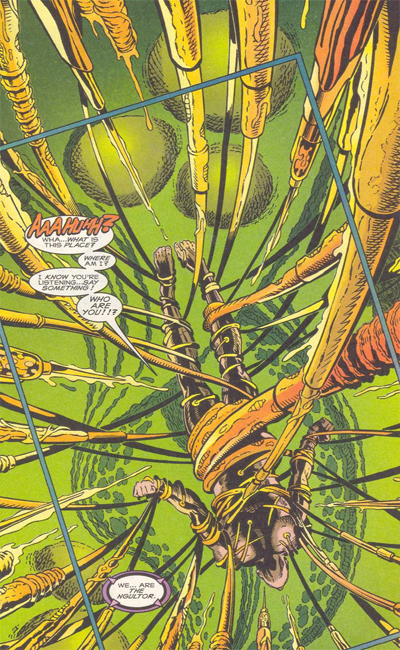
The Fantastic Four #108 – The Monstrous Mystery of the Nega-Man (Review)

To celebrate the release of Star Trek: Into Darkness this month, we’ll be running through the first season of the classic Star Trek all this month. Check back daily to get ready to boldly go. It’s only logical.

We’ll be supplementing our coverage of the episodes with some additional materials – mainly novels and comics and films. This is one such entry.

Jack Kirby is one of the defining comic book creators of the twentieth century. He started out working in the medium during the Great Depression. He was a major force during the Golden Age of comics, creating the character of Captain America in 1940. However, Kirby displayed an incredible ability to evolve and adapt over time. In the 1970s, for example, Kirby would move towards crafting cosmic odysseys and epic god-like conflicts. However, during the 1960s, he played a huge role in the development of Marvel Comics during the 1960s. With a flair for science-fiction story-telling and a knack for crafting iconic characters, Kirby came to be one of the talents who defined the period known as “the Silver Age.” Working with Stan Lee, Kirby created characters like The Fantastic Four and The X-Men, who defined not just Marvel, but the entire medium.

I think it’s fair to cite Star Trek as a major influence on Jack Kirby’s work in comic books, particularly his later work on The Fantastic Four. I know that his fans can be very protective of their idol, and he certainly deserves a lot of the praise heaped upon him. I know that Kirby’s possible influence on Star Wars remains a massive bone of contention. That said, I suspect that Star Trek made quite an impression on Kirby.
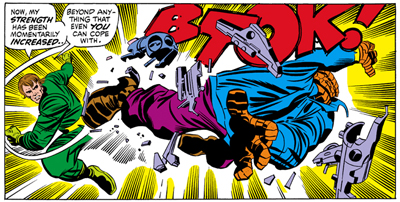
A smashing time...

A smashing time…

Continue reading

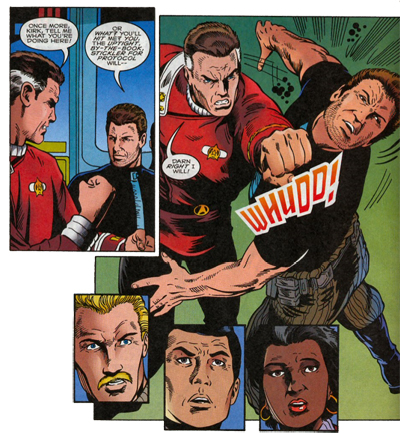
Star Trek: Early Voyages #12-15 – Futures, Parts I, II, III & IV (Review)

To celebrate the release of Star Trek: Into Darkness this month, we’ll be running through the first season of the classic Star Trek all this month. Check back daily to get ready to boldly go. It’s only logical.

We’ll be supplementing our coverage of the episodes with some additional materials – mainly novels and comics and films. This is one such entry.

As we discussed before, Star Trek: Early Voyages is about as close to a series starring Christopher Pike as we are ever likely see. A monthly comic book running for about a year-and-a-half, told by Dan Abnett and Ian Edginton, the book followed the adventures of Christopher Pike’s Enterprise, a prelude to the classic Star Trek television show, filling some gaps left by The Cage and The Menagerie. However, the comic had the benefit of being told after a lot of Star Trek had aired.

First published in 1997, it hit stands after the big-screen adventures of the Kirk era had officially wrapped up in Star Trek: Generations, and long after Star Trek: The Next Generation had gone off the air. Even Star Trek: Deep Space Nine was more than half way through its run. This puts Early Voyages in an interesting place. It is set in the past, but knows how the future plays out. The epic four-part Futures storyline plays with this concept, offering us a glimpse of an imperfect future where Captain Kirk is a rogue running a cargo ship, the Klingons have annexed considerable portions of the Federation and are on the verge of war…

Oh, and Christopher Pike is happy. That’s how you know it’s a flawed universe.

"And THAT is for stealing my show!"

“And THAT is for stealing my show!”

Continue reading

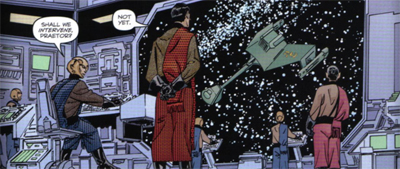
Star Trek – Romulans: Pawns of War by John Byrne (Review)

To celebrate the release of Star Trek: Into Darkness this month, we’ll be running through the first season of the classic Star Trek all this month. Check back daily to get ready to boldly go. It’s only logical.

We’ll be supplementing our coverage of the episodes with some additional materials – mainly novels and comics and films. This is one such entry.

Where were the Klingons? That seems to be one of the most frequently asked questions when a modern writer re-visits the early part of the first season of Star Trek. It makes sense. The Klingons are the franchise’s flagship aliens, and their long-term relations with the Federation mark one of the show’s earliest examples of continuity. The Organian Peace Treaty from Errand of Mercy is mentioned once or twice, but it informs a lot of the appearances of the Klingons in the classic Star Trek, as the warriors are prevented from engaging in direct warfare with the Federation.

However, when first introduced in Errand of Mercy, towards the end of the first season, the Klingons have just declared war on the Federation. However, it seems like this has been expected for a long time. Kirk speaks of the Klingons like old enemies. Kor knows that captain of the Enterprise by name. There’s a sense of a pre-established history, which makes their appearance towards the tale-end of the season all the more perplexing. Apparently they have been there all along, even if we haven’t seen them before.

John Byrne’s Alien Spotlight issue might have been themed around the Romulans, and the collected edition might be Romulans: Pawns of War, but it seems more devoted to exploring what exactly the Klingons were up to behind the scenes between their appearances on Star Trek.

Cry havok, and let slip the dogs of war...!

Cry havok, and let slip the dogs of war…!

Continue reading

Star Trek – Crew by John Byrne (Review)

To celebrate the release of Star Trek: Into Darkness this month, we’ll be running through the first season of the classic Star Trek all this month. Check back daily to get ready to boldly go. It’s only logical.

We’ll be supplementing our coverage of the episodes with some additional materials – mainly novels and comics and films. This is one such entry.

Majel Barrett Roddenberry was the first lady of the Star Trek franchise, in more ways than one. She was married to Gene Roddenberry and remained a part of the franchise after his death. She guest starred on the shows occasionally, continued to lend her voice to the computers and offered the occasional interview to the press. Although her actual influence on the television shows was relatively minimal (and she was occasionally prone to protesting various plot developments including the Dominion War on Star Trek: Deep Space Nine), she did remain involved in Star Trek until she passed away in 2008.

However, she was also involved from the start. She had the recurring role of Christine Chapel throughout the original television show, and appeared in the unaired pilot, The Cage, as Christopher Pike’s first officer. Identified only as “Number One”, this almost made her the literal “first lady” of Star Trek. I’m surprised that Number One hasn’t been used more often as a character, with her appearances in tie-ins generally restricted to her time on board Pike’s Enterprise.

John Byrne’s miniseries might have the title Crew, and feature supporting roles for Christopher Pike and Mister Spock, but it is very much the story of Number One. Published a year after her death, and dedicated to her memory, Crew feels like a fitting farewell to the actress responsible for one of the franchise’s earliest and most intriguing supporting characters.

Fate protects fools, little children... and ships named Enterprise.

Fate protects fools, little children… and ships named Enterprise.

Continue reading

Star Trek: Early Voyages #1 – Flesh of my Flesh (Review)

To celebrate the release of Star Trek: Into Darkness this month, we’ll be running through the first season of the classic Star Trek all this month. Check back daily to get ready to boldly go. It’s only logical.

We’ll be supplementing our coverage of the episodes with some additional materials – mainly novels and comics and films. This is one such entry.

In the late nineties, Marvel were publishing Star Trek comic books. One of those books, perhaps the book garnering the most critical praise, was Star Trek: Early Voyages. Written by Dan Abnett and Ian Edginton, the series was intended to follow the mission of the USS Enterprise under the command of Captain Christopher Pike. Published monthly, the comic is perhaps the best indication of what a Star Trek show starring Christopher Pike might have actually looked like. Although the series was cancelled suddenly after only seventeen issues, ending on a cliffhanger, it is still a fascinating look at what might have been.

Looks like they've hooked a Pike...

Looks like they’ve hooked a Pike…

Continue reading

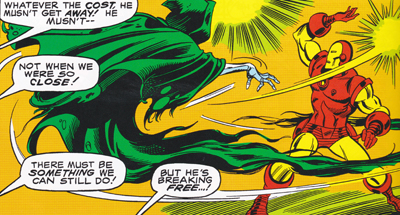
Archie Goodwin’s (& George Tuska’s) Run on The Invincible Iron Man – The Invincible Iron Man Omnibus, Vol. 2 (Review/Retrospective)

To get ready for Iron Man 3, we’ll be taking a look at some Iron Man and Avengers stories, both modern and classic. We hope to do two or three a week throughout the month, so check back regularly for the latest update.

The second omnibus contains both the tail end of Stan Lee run on Tales of Suspense and the Archie Goodwin run on The Invincible Iron Man. To make matters easier, I’ve split the review in half. This half covers Archie Goodwin’s Iron Man.

Archie Goodwin is one of the best editors to work in comic books. During his time working at DC, the editor was responsible for The Long Halloween and also James Robinson’s long-running Starman. While Goodwin was an exceptional editor, he was arguably a weaker writer. As his run on The Invincible Iron Man demonstrates, Goodwin has a very clear idea of what concepts work and won’t work with the character, and how to start “fixing” some of the more obvious flaws present in the character from his inception during Stan Lee’s Tales of Suspense run. However, Goodwin isn’t quite as deft when it comes to story construction or plot mechanics. He lacks Lee’s flair for soap opera angst and interpersonal drama.

However, his run on The Invincible Iron Man remains quite impressive, and just as influential and formative as anything written by Stan Lee. I’d argue that Goodwin’s conceptual model of the character is a lot closer to the modern version of Iron Man, and that his version of Tony Stark bleeds through the work of later writers and also into the massive billion-dollar film franchise as well. So Goodwin’s work on The Invincible Iron Man is quite iconic. It’s just some of the nuts-and-bolts scripting that seems to catch him, from time to time.

That's why they call him the Invincible Iron Man...

That’s why they call him the Invincible Iron Man…

Continue reading

Earth X (Review/Retrospective)

To get ready for Iron Man 3, we’ll be taking a look at some Iron Man and Avengers stories, both modern and classic. We hope to do two or three a week throughout the month, so check back regularly for the latest update.

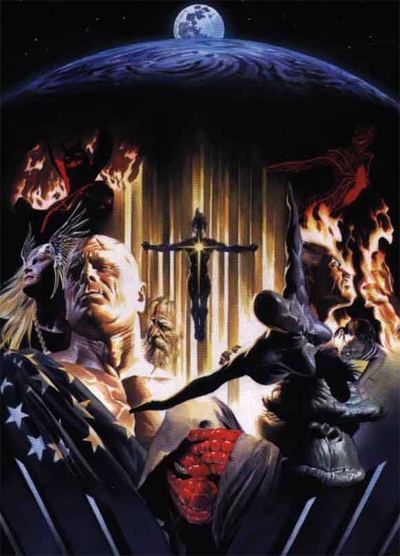
“Your kind does love to rewrite history, Richards,” the Watcher observes towards the end of Earth X, after we get an introduction and brief recap of the life of Tony Stark. Almost every issue of the collection opens with a review of an iconic Marvel character’s back story, as writer Jim Krueger and plotter Alex Ross attempt to tie the tapestry of the Marvel universe together in some way. It turns out that everything a character underwent wasn’t just their own personal development, but part of a broader tapestry of history within the Marvel universe. No character evolution, it seems, happens in isolation. Everything is interconnected, even if we (or the writers or the characters) never realised it at the time.

Earth X is really just an attempt to tie most of the Marvel universe up in one gigantic knot, to connect everything to everything else. In a way, published in 1999, it seems to foreshadow the current era of Marvel publishing, where absolutely everything within in the shared universe must somehow be connected to something else. Avengers vs. X-Men, for example, would connect the Phoenix from the X-Men to the Iron Fist mythology. Grant Morrison’s New X-Men connected the Weapon X project to the development of Captain America. The X-Men and the Avengers must be united as part of Uncanny Avengers.

In many ways, Earth X reads more interestingly as a treatise than as a comic story. It’s far stronger as a thought-experiment than an actual narrative. It’s more fun on purely technical level, watching Jim Krueger and Alex Cross connect all those dots, than it is as an adventure in its own right.

Stellar...

Stellar…

Continue reading

Jason Aaron’s Run on The Incredible Hulk – Vol. 1-2 (Review/Retrospective)

To get ready for Iron Man 3, we’ll be taking a look at some Iron Man and Avengers stories, both modern and classic. We hope to do two or three a week throughout the month, so check back regularly for the latest update.

Of the major writers currently working at Marvel, Jason Aaron seems the best fit for the Hulk. Aaron has an undeniably charming pulpy style, an approach to mainstream superhero comics that has given the creator enjoyable and engaging runs on characters like Ghost Rider or Wolverine. As such, Aaron would seem to be the perfect fit for a character who likes to smash things. Aaron’s run isn’t perfect. It’s too scattershot to really offer an insight into the character, too short and all over the map to be a “definitive” take on the Hulk.

However, the run consists a fun and amusing set of comic book stories, where thoughtful high-concepts combine with absurd set pieces to create something the feels quite unique. While certainly not the strongest one there is, nor the best run for character or author, there’s a wit and a charming energy to Aaron’s run on The Incredible Hulk.

Green with envy...

Green with envy…

Continue reading

Stan Lee & Gene Colan’s Iron Man – The Invincible Iron Man Omnibus, Vol. 2 (Review/Retrospective)

To get ready for Iron Man 3, we’ll be taking a look at some Iron Man and Avengers stories, both modern and classic. We hope to do two or three a week throughout the month, so check back regularly for the latest update.

The second omnibus contains both the tail end of Stan Lee run on Tales of Suspense and the Archie Goodwin run on The Invincible Iron Man. To make matters easier, I’ve split the review in half. This half covers the end of Stan Lee’s Iron Man.

And so we come to the end of Stan Lee’s work on the character of Iron Man as part of the Tales of Suspense magazine. This part of the run is consistently illustrated by the wonderful Gene Colan, who is among my favourite artists of the era, and Colan’s pencils do a lot to give the tail-end of Lee’s work with Tony Stark a bit of weight and gravitas. Because, as we reach the end of the character’s time as one-half of Tales of Suspense, it’s hard to argue that Lee still hasn’t quite figured out what he wants to do with Iron Man as a character. While Tony Stark’s teething problems are nowhere near as severe as those of The Incredible Hulk, it still feels like the character isn’t gelling nearly as well as he should.

If you can't stand the heat...

If you can’t stand the heat…

Continue reading

Ultimate Comics: Divided We Fall, United We Stand – Ultimates (Review/Retrospective)

To get ready for Iron Man 3, we’ll be taking a look at some Iron Man and Avengers stories, both modern and classic. We hope to do two or three a week throughout the month, so check back regularly for the latest update.

There was a time when Marvel’s Ultimate Universe was the place to be. Ultimate Spider-Man, Ultimate X-Men and The Ultimates were among the best-reviewed and best-selling books published at Marvel in the early part of the last decade, offering a fresh new take on classic comic book characters, and offering readers an opportunity to engage with a continuity-free world just as the super-hero movie craze took off. I’ll always be fond of the Ultimate Universe, because without The Ultimates and Ultimate Spider-Man, I simply wouldn’t be a comic book fan today.

However, in the last number of years, for any number of reasons, the line has wavered a little bit. Despite attracting Mark Millar back to write Ultimate Comics: Avengers, and Brian Michael Bendis generating massive headlines by writing The Death of Spider-Man, it seemed like the publishing brand was fading a bit. There have been several attempts to re-energise the line. Divided We Fall is just the most recent one, a crossover between the three books currently making up the Ultimate imprint.

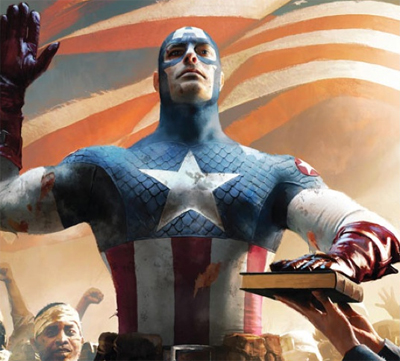
The story of America falling apart, told from three different perspectives, it’s certainly timely. And, as crossovers go, shrewdly constructed. While Divided We Fall suffers a bit from the fact that Marvel is no longer consistently collecting the books leading into it, it is still an interesting comic book story, and one that takes advantage of the Ultimate Universe setting to tell a story that would be impossible in the mainstream Marvel brand.

President Cap...

President Cap…

Continue reading