• Following Us

  • Categories

  • Check out the Archives


  • Awards & Nominations

Star Trek – The Ashes of Eden by William Shatner et al (DC Comics) (Review)

This August, to celebrate the upcoming release of Star Trek: Into Darkness on DVD and blu ray, we’re taking a look at the Star Trek movies featuring the original cast. Movie reviews are every Tuesday and Thursday.

We’ll be supplementing our coverage of the movies with tie-ins around (and related to) the films. We’ll be doing one of these every week day. This is one such article.

The Ashes of Eden is effectively professionally published Star Trek fan fiction, written by William Shatner. The actor gets some assistance from veteran Star Trek writers Judith and Garfield Reeves-Stevens, but it’s clear that Shatner is the driving force behind The Ashes of Eden. Indeed, an astute reader will spot quite a few thematic overlaps with Shatner’s much-maligned directorial effort, only without the rest of the cast around to temper his efforts to make this a story about Kirk and Kirk alone.

Still, The Ashes of Eden isn’t as bad as it might be. After all, just because something is fan fiction – professionally published or otherwise – says nothing of its quality. The story is probably best read as an exploration between Shatner and his alter ego, but it holds together quite well, providing a much more solid (if still far from perfect) exploration of the themes hinted at in Shatner’s Star Trek V: The Final Frontier.
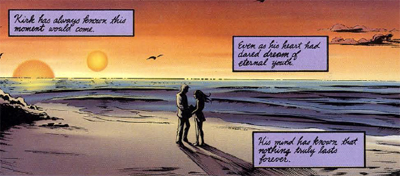
The dusk of an era...

The dusk of an era…

Continue reading

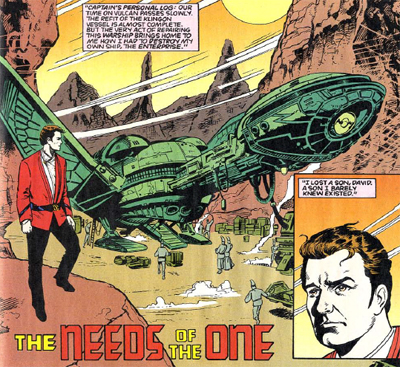
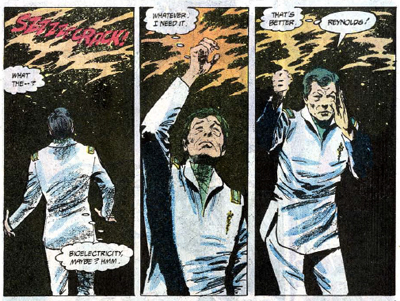
Star Trek Special #1 (1994) – The Needs of the One (Review)

This August, to celebrate the upcoming release of Star Trek: Into Darkness on DVD and blu ray, we’re taking a look at the Star Trek movies featuring the original cast. Movie reviews are every Tuesday and Thursday.

We’ll be supplementing our coverage of the movies with tie-ins around (and related to) the films. We’ll be doing one of these every week day. This is one such article.

In many ways, the Star Trek movies feature more character development and exploration for the cast than the entire three seasons of the television show. Star Trek III: The Search for Spock and Star Trek IV: The Voyage Home are true ensemble pieces, but there’s also more of a sense that this is a family rather than a bunch of people who just hang out together. I’d argue that the cast of Star Trek: The Next Generation remain the tightest ensemble that the franchise has ever produced, but the first six movies portray the crew of the original Enterprise as a bunch of people who have been to hell and back together.

Michael Collins’ The Needs of the One represents a bit of an interlude between The Search for Spock and The Voyage Home, taking place during the crew’s three month “Vulcan exile.” While Collins’ script suffers from its inability to decide whether it’s a Spock-centric character drama or a day-in-the-life of the renegade crew, it’s a fascinating story situated in a lacuna of the movies’ chronology. It cements the idea that Spock has been radically altered over the course of the film series, and that his character arc spans the first four films.

Indeed, Collins’ opening sequence tying together his failure to achieve Kolinahr in Star Trek: The Motion Picture with his decision to once again rejoin the crew in The Voyage Home.

When all Kirk asked for was a tall ship, he probably should have been more specific...

When all Kirk asked for was a tall ship, he probably should have been more specific…

Continue reading

Star Trek (DC Comics, 1984) #28 – The Last Word (Review)

This August, to celebrate the upcoming release of Star Trek: Into Darkness on DVD and blu ray, we’re taking a look at the Star Trek movies featuring the original cast. Movie reviews are every Tuesday and Thursday.

We’ll be supplementing our coverage of the movies with tie-ins around (and related to) the films. We’ll be doing one of these every week day. This is one such article.

Star Trek II: The Wrath of Khan, Star Trek III: The Search for Spock and Star Trek IV: The Voyage Home form a trilogy that tells a single story, covering Spock’s death and resurrection, the loss of the Enterprise and the construction of its replacement and Kirk’s journey from washed-up old commander to saviour of the planet Earth. Although the three films weren’t planned as a single story, they worked out surprisingly well as a Star Trek epic told across three films and four years.

Four years is a remarkable turn-around for three franchise films, let alone three well-received franchise films. However, it’s worth conceding that the storyline had a fairly significant impact on the tie-in media. Books could be published set in the existing gaps in chronology, but DC’s plan for their first volume of Star Trek comics was to feature stories set in the contemporary film universe. Since that universe was in the middle of its own story, and the comic publishers had no idea how it would play out, the results are interesting.

Lighten up...

Lighten up…

Continue reading

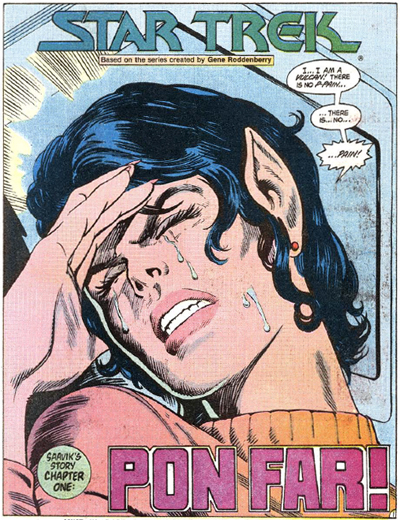
Star Trek (DC Comics, 1984) #7-8 – Saavik’s Story (Review)

This August, to celebrate the upcoming release of Star Trek: Into Darkness on DVD and blu ray, we’re taking a look at the Star Trek movies featuring the original cast. Movie reviews are every Tuesday and Thursday.

We’ll be supplementing our coverage of the movies with tie-ins around (and related to) the films. We’ll be doing one of these every week day. This is one such article.

Star Trek comics are an interesting way of catching a glimpse at the franchise one-step away from the heart of production. While there are other forms of tie-in media, comics are produced on a monthly schedule. While scripts need to be written and art needs to be drawn, there’s less lead-in time required, meaning that contemporary Star Trek comics are often able to react dynamically to on-screen events. While novels might take up to a year from original pitch to the time they hit the stands, there’s something rather more urgent about tie-in comic books.

This is an issue for many tie-ins comics. For example, the syndicated Star Trek newspaper strip launched shortly before the release of Star Trek: The Motion Picture made a point to feature Ilia as a bridge officer on a relaunched USS Enterprise. She rather suddenly disappeared after those involved actually saw the movie and realised that she didn’t quite survive the adventure. Similarly, when it came to detailing the adventures of Kirk and company in the wake of Star Trek III: The Search for Spock, writer Mike W. Barr moved the crew over to the USS Excelsior, in accordance with writer Harve Bennett’s original plan.

That said, Mike W. Barr’s comic book origin story for Lt. Saavik holds up rather well, fitting quite comfortably with Carolyn Clowes’ origin for the character offered in the superb 1990 book The Pandora Principle. Of course, Barr’s origin sketches the broadest of outlines, and is clearly more preoccupied with crafting a pulpy space opera adventure.

Saving Saavik!

Saving Saavik!

Continue reading

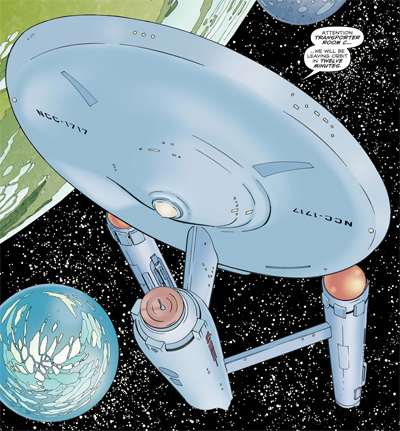
Star Trek – Leonard McCoy, Frontier Doctor by John Byrne (Review)

The August, to celebrate the upcoming release of Star Trek: Into Darkness on DVD and blu ray, we’re taking a look at the Star Trek movies featuring the original cast. Movie reviews are every Tuesday and Thursday.

We’ll be supplementing our coverage of the movies with tie-ins around (and related to) the films. We’ll be doing one of these every week day. This is one such article.

It’s fascinating how few stories take place around Star Trek: The Motion Picture. There’s a rake of tie-in material that exists to flesh-out the Enterprise’s five-year mission, and a large volume of material set during the period from Star Trek II: The Wrath of Khan straight through to Star Trek VI: The Undiscovered Country. However, the space around The Motion Picture has been somewhat overlooked by writers delving into the expanded world of Star Trek tie-in fiction.

To be fair, there are reasons for this. Although it was a box office success, looked stunning for the time, had a rake of big ideas and welcomed the crew to the screen, The Motion Picture isn’t generally considered to be one of the high points of the franchise. As such, it seems reasonable that it garners less attention, the affection shown by a few writers aside. There’s also the fact that The Motion Picture opens with the crew of the Enterprise broken up, scattered amongst the cosmos.

The Motion Picture sees Kirk putting the band back together after the universe seems to have forgotten about them, pulling them out of mothballs. Any story set in the lead-up to The Motion Picture would have to feature the ensemble all separated and going about their own thing. This limits the kind of stories that can be told in the setting, and makes it less appealing than other settings in Star Trek continuity.

John Byrne’s Leonard McCoy, Frontier Doctor gives us a glimpse of what a project set between the end of the Enterprise’s mission and the start of The Motion Picture might look like. It’s essentially a solo adventure series focusing on one member of the cast, and it’s absolutely fascinating.

These are the voyages of the Starship... Yorktown...

These are the voyages of the Starship… Yorktown…

Continue reading

Avengers vs. X-Men – Consequences (Review/Retrospective)

To celebrate the release of The Wolverine this month, we’re taking a look at some new and classic X-Men and Wolverine comics. I’m also writing a series of reviews of the classic X-Men television show at comicbuzz every weekday, so feel free to check those out.

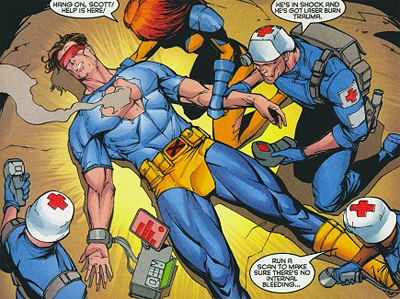
Avengers vs. X-Men: Consequences feels like it really should be a light event cash-in, designed to generate some quick sales off the popularity of the latest gigantic crossover story arc. However, writer Kieron Gillen takes advantage of the five-issue miniseries’ location – situated between Avengers vs. X-Men and Marvel’s high-profile Marvel NOW relaunch – to turn the comic into something of a transition. It represents a clear shift from Kieron Gillen’s run on Uncanny X-Men to the relaunch of the book (and the spin-off All-New X-Men) by writer Brian Michael Bendis.

Oddly enough, thanks to Gillen’s skill, Consequences plays out as a character-centric storyline, capping off Gillen’s work on the mutant hero Cyclops and positioning him for his role future role in the shared Marvel universe.

Cyke out!

Cyke out!

Continue reading

X-Men: Operation Zero Tolerance (Review/Retrospective)

To celebrate the release of The Wolverine this month, we’re taking a look at some classic and modern X-Men and Wolverine comics. I’m also writing a series of reviews of the classic X-Men television show at comicbuzz every weekday, so feel free to check those out.

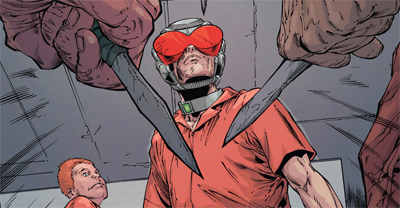
Operation Zero Tolerance is very much an artefact of the nineties. It’s a big bombastic X-Men romp, one that manages to hit on a lot of the key themes and ideas of the franchise (making them resonate with the public mood), while still seeming loud and simply and incredibly hollow. After all, it’s a comic about the prejudice facing a minority in the nineties, with repeated references to the Holocaust. “Zero tolerance?” Senator Robert Kelly asks towards the end of the event. “Isn’t that what the Nazis had for the Jews in the last World War?” The villain, Bastion, is presented as a “wannabe Hitler.”

Operation Zero Tolerance is, in a word, blunt. With so many of the high-profile comics of the nineties, from both Marvel and DC, “subtlety” is an alien concept. This is an X-Men comic where racial intolerance and prejudice are expressed through nothing short of attempted genocide. On the one hand, it’s very clearly the mutant prejudice idea pushed to its logical extreme. On the other hand, the notion of the United States government even passively condoning an attempted genocide feels like it robs the franchise of the social relevance which had made it so compelling and intriguing.

Still, the event’s impact is quite obvious. It’s hard not to see Operation Zero Tolerance as the driving influence on the entire X-Men franchise from House of M through to Second Coming.

Chances of survival are Slim...

Chances of survival are Slim…

Continue reading

Jason Aaron’s Run on Wolverine & The X-Men – #1-8, 17 (Review/Retrospective)

To celebrate the release of The Wolverine later in the month, we’re taking a look at some classic X-Men and Wolverine comics every Monday, Wednesday and Friday here. I’m also writing a series of reviews of the classic X-Men television show at comicbuzz every weekday, so feel free to check those out.

Superhero comic books have had a somewhat rocky relationship with the concept of “growing up” since the mid-eighties. Books like The Dark Knight Returns and Watchmen proved that it was possible to craft mature tales with incredible depth using these icons. However, it seemed like the industry learnt all the wrong lessons from the success of Frank Miller and Alan Moore. For the past couple of decades, it seems like the ideal for superhero comics is grim and nihilistic nonsense, that “maturity” is measured in blood and bodycount.

There was a sense that the comic book industry was afraid of being seen as childish or unsophisticated, which created an ironic situation where the industry’s immaturity was on show in its fixation with adult material. “When I was ten,” C.S. Lewis once mused, “I read fairy tales in secret and would have been ashamed if I had been found doing so. Now that I am fifty I read them openly. When I became a man I put away childish things, including the fear of childishness and the desire to be very grown up.”

Jason Aaron’s Wolverine and the X-Men feels like it subscribes to this philosophy. It’s an incredibly silly and  goofy piece of work, revelling in the clichés of the superhero genre, but it’s also a surprisingly sincere and intelligent one.

It's a bit of a gamble...

It’s a bit of a gamble…

Continue reading

Roy Thomas & Werner Roth’s X-Men – X-Men Omnibus, Vol. 1-2 (Review/Retrospective)

To celebrate the release of The Wolverine later in the month, we’re taking a look at some classic X-Men and Wolverine comics every Monday, Wednesday and Friday here. I’m also writing a series of reviews of the classic X-Men television show at comicbuzz every weekday, so feel free to check those out.

The X-Men were not, to put it frankly, a comic book franchise that hit the ground running. Despite the considerable talent involved in their first nineteen issues, the comic struggled to find its own niche, unsure of just how far it dared to venture from the standard superhero template, and how confined it was by the whole “mutant superhero” bit. Writer Roy Thomas was tapped to take over the book when Stan Lee left.

Thomas is one of the underrated Silver Age writers. His work on The Avengers, spanning more than a half-a-decade, is arguably more influential and definitive than Lee’s original run on the title. He is responsible for The Kree-Skrull War, which remains one of the stronger early Avengers stories. He would work on X-Men twice before the book was finally cancelled. His second run, with Neal Adams pencilling, is arguably a lot stronger than his work here, which feels a little muddled and unfocused.

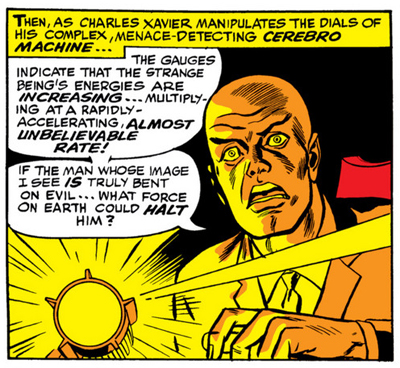
To be fair to Thomas, it’s quite clear that he recognised that the X-Men needed a shake-up and to find their own voice distinct from the initial run written by Lee and Kirby. Unfortunately, Thomas doesn’t seem entirely sure of what that voice is.

Lighten up, Charles!

Lighten up, Charles!

Continue reading

Rick Remender’s Uncanny X-Force (Review/Retrospective)

To celebrate the release of The Wolverine later in the month, we’re taking a look at some classic X-Men and Wolverine comics every Monday, Wednesday and Friday here. I’m also writing a series of reviews of the classic X-Men television show at comicbuzz every weekday, so feel free to check those out.

Between Uncanny X-Force and Venom (and arguably his run on The Punisher), Rick Remender seems to have built a comic book career out of rehabilitating symbols of nineties excess. Taking a bunch of grim and nihilistic concepts that were very popular in mainstream comics during the nineties, Remender uses them to craft a compelling story about the wages of vengeance. Its premise and pedigree might lead you to believe that Uncanny X-Force is another throwaway comic about gratuitous violence. Instead, it’s a masterpiece about profound consequences.

Welcome to the World...

Welcome to the World…

Continue reading