• Following Us

  • Categories

  • Check out the Archives


  • Awards & Nominations

Star Trek: The Next Generation (DC Comics, 1989) #47-50 – The Worst of Both Worlds (Review)

This November and December, we’ll be finishing up our look at the second season of Star Trek: The Next Generation and moving on to the third year of the show, both recently and lovingly remastered for high definition. Check back daily for the latest review.

We’ll be supplementing our coverage of the episodes with some additional materials – mainly novels and comics and films. This is one such entry.

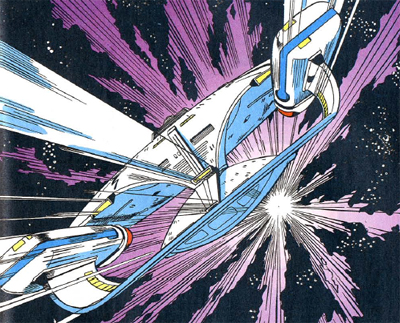
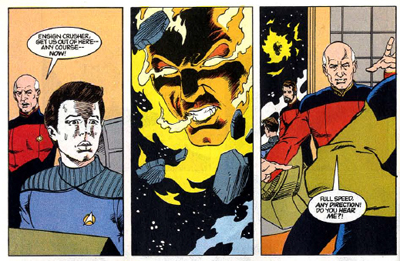
The Worst of Both Worlds, as the name implies, is an excuse to revisit one of the pivotal moments of Star Trek: The Next Generation. (Go on, guess which one!) Unfortunately, it’s not quite up to the task – a failing down to both to the scripts from Michael Jan Friedman and the artwork from Peter Krause. It winds up feeling like an interesting idea, given a rather lackluster execution, working best as a study of the impact that the show’s third season cliffhanger had on the franchise.

A time warp...

A time warp…

Continue reading

Star Trek/X-Men: Star TreX (Review)

This January and February, we’ll be finishing up our look at the second season of Star Trek: The Next Generation and moving on to the third year of the show, both recently and lovingly remastered for high definition. Check back daily for the latest review.

We’ll be supplementing our coverage of the episodes with some additional materials – mainly novels and comics and films. This is one such entry.

Being honest, I’m surprised that it took this long for one of the comic book publishers working with a Star Trek license to come up with the idea of crossing over Star Trek with one of their comic book properties. After all, Barbara Hambly’s Ishmael crossed the franchise over with Here Come the Brides, another piece of cult sixties television. Crossing Star Trek over with a decidedly pulpy comic book franchise was really the next logical step.

Indeed, while DC Comics would eventually get involved in the publication of a crossover with The Legion of Superheroes, I remain surprised that they never tried to cross the franchise over with Green Lantern while they were publishing monthly Star Trek comic books. Both franchises are products of a sixties outlook on space travel and on America’s post-war role in the wider world (and, well, universe), and they’d be tailor-made to fit together.

However, it wasn’t until Marvel managed to secure the Star Trek license in 1996 that our heroes had their first encounter with a proper superhero franchise.

X-over...

X-over…

Continue reading

Star Trek: The Next Generation – The Last Generation (Review)

This January and February, we’ll be finishing up our look at the second season of Star Trek: The Next Generation and moving on to the third year of the show, both recently and lovingly remastered for high definition. Check back daily for the latest review.

We’ll be supplementing our coverage of the episodes with some additional materials – mainly novels and comics and films.

The Last Generation, a five-issue miniseries written by Andrew Steven Harris and illustrated by the wonderful Gordon Purcell, feels like a companion piece to Harris’ Alien Spotlight: Borg issue. Both are essentially stories about the morality of using time travel to re-write history, and both can be read as a reflection on Star Trek continuity as a whole.

Published from November 2008 through to March 2009, The Last Generation feels like something of a preemptive rebuttal to JJ Abrams’ May 2009 reboot of Star Trek. Much like Alien Spotlight: Borg before it, it feels like a conscious attempt to vindicate and validate the franchise from the era of Star Trek: The Next Generation onwards.

Given the fact that the “reboot-in-all-but-name” back-to-Kirk nature of Abrams’ film was openly discussed well ahead of the release, it’s hard not to read The Last Generation and Alien Spotlight: Borg as protests against the decision to set the clock back on the franchise and start with Kirk yet again.

A shot in the dark...

A shot in the dark…

Continue reading

Star Trek: The Next Generation (DC, 1989) Annual #1 – The Gift (Review)

This January and February, we’ll be finishing up our look at the second season of Star Trek: The Next Generation and moving on to the third year of the show, both recently and lovingly remastered for high definition. Check back daily for the latest review.

We’ll be supplementing our coverage of the episodes with some additional materials – mainly novels and comics and films.

You can see why DC comics jumped at the chance to publish The Gift. After all, a comic about Q written by the actor playing Q is a hell of a hook. The publisher had already done something similar, with actor Walter Koenig providing a script for the nineteenth issue of DC’s first Star Trek comic book series. At the same time that The Gift was published, George Takei collaborated with Peter David on a Star Trek annual story, So Near the Touch.

John deLancie isn’t a bad storyteller. Indeed, his published tie-in novel – I, Q written with Peter David – is quite enjoyable. However, The Gift is just an absolute mess of a story, with a couple of interesting high concepts buried beneath two horrible clichés tied together to create a rather unfortunate narrative. The Gift is a disappointment on just about every level.

Cue Q!

Cue Q!

Continue reading

Star Trek: The Next Generation – Embrace the Wolf (Review)

This January and February, we’ll be finishing up our look at the second season of Star Trek: The Next Generation and moving on to the third year of the show, both recently and lovingly remastered for high definition. Check back daily for the latest review.

We’ll be supplementing our coverage of the episodes with some additional materials – mainly novels and comics and films. This is one such entry. This is actually supplementary to the episode Elementary, Dear Data.

The concept behind Embrace the Wolf is quite ingenious. The execution is slightly less so. Recognising that Star Trek: The Next Generation had a recurring interest in Victorian London, in Data’s interest in Sherlock Holmes, it seemed quite logical to drop Redjac into that scenario. Redjac was the non-corporeal serial killing entity introduced in Wolf in the Fold, one of Robert Bloch’s contributions to the second season of the classic Star Trek. As part of Wolf in the Fold, and playing into Bloch’s fascination with the notorious serial killer, Redjac was explicitly identified as the spirit of Jack the Ripper. As you do

So, pairing up Data’s Sherlock Holmes with Redjac’s Jack the Ripper should make for a decidedly pulpy adventure. Unfortunately, the end result is a little generic and unsatisfying.

Wolf in the holodeck...

Wolf in the holodeck…

Continue reading

Star Trek: The Next Generation (DC Comics, 1989) #19 – The Lesson (Review)

This January and February, we’ll be finishing up our look at the second season of Star Trek: The Next Generation and moving on to the third year of the show, both recently and lovingly remastered for high definition. Check back daily for the latest review.

We’ll be supplementing our coverage of the episodes with some additional materials – mainly novels and comics and films. This is one such entry.

One of the biggest problems that the writing staff had on Star Trek: The Next Generation was the insistence that the show was episodic. Themes and characters were rarely carried from week to week. Occasionally, a plot point or character might recur, but the bulk of the show was intentionally designed to be readily accessible in just about any order imaginable. In the era of HBO and “televisual novels”, this approach seems quite quaint, but it was very much the reality of late eighties and early nineties television.

However, there were no such restrictions on comic book story telling. Far from downplaying continuity and long-term plotting, mainstream American comics pride themselves on their serialised nature. It’s quite common for characters to suddenly reappear after absences of considerable time, and for writers to make callbacks to events that occurred decades ago. Publishing twelve issues a year, typically from the same author, The Next Generation comic book did afford the opportunity for a slightly different type of storytelling.
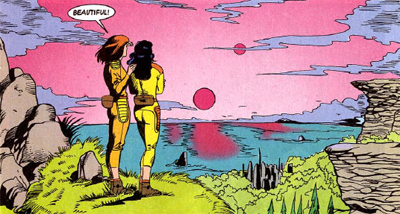
All set...

All set…

And, to be fair, that was one of the strengths of Michael Jan Friedman’s approach to The Next Generation comic book. He was fond of focusing on supporting characters, or giving page space to characterisation, or even basking in the show’s continuity in a way that wasn’t possible on television. Sure, Friedman could occasionally get a little obsessive in his continuity references, and could occasionally have difficulty tying everything into a cohesive story, but this was one way the author capitalised on the shift in the medium.

The Lesson is a single-issue story that is all the more intriguing for essentially existing as a series of character moments, with little in the way of an over-arching plot. The writing is a little clumsy and on-the-nose, with the comic earnestly offering its readers a rather ham-fisted message of the week, but it’s notable for the way that Friedman seems to bask in the freedom afforded to him by virtue of the fact that he’s writing a comic book (rather than an episode) of The Next Generation.

They've really bonded...

They’ve really bonded…

Continue reading

Star Trek (DC Comics, 1989) #19 – Once a Hero… (Review)

This January and February, we’ll be finishing up our look at the second season of Star Trek: The Next Generation and moving on to the third year of the show, both recently and lovingly remastered for high definition. Check back daily for the latest review.

We’ll be supplementing our coverage of the episodes with some additional materials – mainly novels and comics and films. This is one such entry.

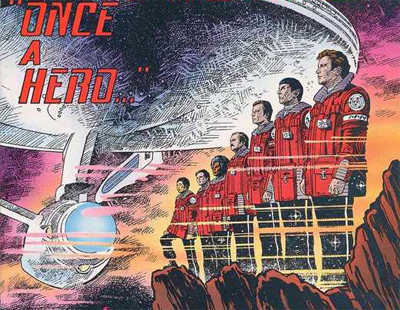
Once a Hero… is a notable story for a number of reasons. The most obvious is that it’s Peter David’s last issue of DC’s monthly Star Trek comic, departing the comic book after a pretty bitter disagreement with Richard Arnold, who was overseeing Star Trek licensing at the time. Given that David wrote The Incredible Hulk for twelve years and remains a prolific and well-liked comic book creator among the comic community, as well as a guiding light in Star Trek tie-in fiction, that’s a pretty damning indictment of Richard Arnold right there.

However, Once a Hero… is also notable for being an in-depth exploration and reflection on the “red shirt” narrative convention that the franchise loved so dearly.

A grave adventure...

A grave adventure…

Continue reading

Star Trek – Operation Assimilation (Review)

This January and February, we’ll be finishing up our look at the second season of Star Trek: The Next Generation and moving on to the third year of the show, both recently and lovingly remastered for high definition. Check back daily for the latest review.

We’ll be supplementing our coverage of the episodes with some additional materials – mainly novels and comics and films. This is one such entry.

In many ways, Operation Assimilation feels like a cynical cash-in. It’s a one-shot Marvel comic book published in the wake of the release of Star Trek: First Contact that doesn’t seem to go anywhere, doesn’t seem to seed any story points that might pay off later and doesn’t seem like it has anything particularly insightful to say. It really feels like Marvel just wanted to reaffirm the fact that they had the license to publish Star Trek comics towards the end of First Contact‘s theatrical release cycle and before the film’s home media release.

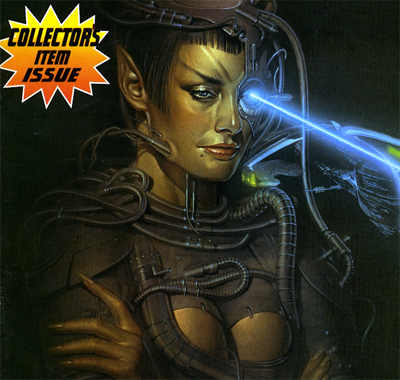
The cover does little to help this impression. Several months before Star Trek: Voyager would introduce the world to a sexy Borg drone, the cover of Operation Assimilation features a female Borg drawn in a pose (and with a costume) intended to emphasise her cleavage. “Collector’s Item Issue!” the cover boasts, reminding the reader that it is a product of the late nineties comic speculation boom that almost destroyed the industry. The shiny “1” on the cover makes it feel like more of a marketing exercise, along with a fairly light interview with Jonathan Frakes on the last few pages.

It feels almost like Operation Assimilation says more about late nineties comic books than it does about Star Trek.

Cue cheap joke about implants...

Cue cheap joke about implants…

Continue reading

Star Trek: The Next Generation (DC) Annual #3 – The Broken Moon (Review)

This January and February, we’ll be finishing up our look at the second season of Star Trek: The Next Generation and moving on to the third year of the show, both recently and lovingly remastered for high definition. Check back daily for the latest review.

We’ll be supplementing our coverage of the episodes with some additional materials – mainly novels and comics and films. This is one such entry. This is actually supplementary to the first season of the Next Generation, specifically the episode Conspiracy.

If you were to construct a list of the most niggling unresolved plot threads in the history of the Star Trek franchise, “what was up with those things from Conspiracy?” would likely rank up there alongside “so, did Bajor ever join the Federation?” Funnily enough, author S.D. Perry would tie those two dangling plot points up in her Deep Space Nine relaunch book, Unity.

However, several other writers have tried to figure out what exactly was going on with those mind-controlling parasites who appeared at the end of the first season of Star Trek: The Next Generation and were never heard from again. According to Ronald D. Moore on Inside the Writers’ Room on the third Next Generation blu ray box set, various writers for the show tried to revisit the idea, but Roddenberry hated that episode so much nothing was ever developed.

The Broken Moon, the third annual for DC’s Next Generation comic book series, offers its own take on the mind-controlling parasites. While writer Michael Jan Friedman wisely avoids revealing too much about these creatures, the story suffers because it never figures out anything interesting to do with them.

It always bugged me...

It always bugged me…

Continue reading

Star Trek: The Next Generation (DC Comics, 1989) #1-2 – Return to Raimon/Murder, Most Foul (Review)

This January and February, we’ll be finishing up our look at the second season of Star Trek: The Next Generation and moving on to the third year of the show, both recently and lovingly remastered for high definition. Check back daily for the latest review.

We’ll be supplementing our coverage of the episodes with some additional materials – mainly novels and comics and films. This is one such entry.

DC Comics’ limited six-issue tie-in to the launch of Star Trek: The Next Generation might have made an interesting read, but it was a success for the company. It was such a success that the company decided to launch an on-going monthly series tying into Star Trek: The Next Generation. It launched in October 1989, just as the show’s third season was starting on television. It continued throughout the show’s run, wrapping up eighty issues later in February 1996, when Marvel bought the license.

For the bulk of its run, The Next Generation was written by Michael Jan Friedman. Barring a couple of fill-ins scattered across the six-and-a-half year run, Friedman churned out monthly stories with remarkable consistency. Indeed, DC’s second volume of Next Generation would be the most consistent comic book tie-in published during any of the spin-off shows, with the licence for the franchise bouncing around Marvel, Malibu, Wildstorm and IDW in the late nineties and early years of the twenty-first century.

There’s something strangely appropriate about publishing Return to Raimon in tandem with the launch of The Next Generation‘s third season. The third season of The Next Generation is generally regarded as the point where the show really came of age, and the season that laid the foundation for that entire generation of Star Trek spin-offs. It was the point at which the vision of Star Trek proposed by The Next Generation finally came into its own, so it seems fitting that it’s also the point at which one of the franchise’s most consistent and long-running tie-ins begins.

New worlds...

New worlds…

Continue reading