• Following Us

  • Categories

  • Check out the Archives


  • Awards & Nominations

Legends of the Dark Knight: Shaman (Review/Retrospective)

23rd July is Batman Day, celebrating the character’s 75th anniversary. To celebrate, this July we’re taking a look at some new and classic Batman (and Batman related) stories. Check back daily for the latest review.

Given the success of the Batman line in general and Year One in particular, a comic book like Legends of the Dark Knight made a great deal of sense. First published in 1989, the original objective was to tell stand-alone stories that could be positioned at any point in the life of Batman. As such, the book was not tied on any status quo at the publisher or any demands of the on-going Batman or Detective Comics books.

These were continuity-light stories that would allow writers to tell any story they wanted, unhindered by the larger editorial direction of the Batman line. Legends of the Dark Knight filled a pretty great niche in the Batman line. In a superficial way, it allowed the comics to reconnect with the success of Frank Miller’s Year One, giving the company the option of publishing more comics set in the rough early days of the Caped Crusader.
A dark night...

A dark night…

However, the continuity-hopping nature of the title meant that Legends of the Dark Knight could welcome all sorts of creative teams for short runs without tying them down. Batman and Detective Comics were traditionally books where creative teams would enjoy “runs”, with the occasional fill-in. In contrast, Legends of the Dark Knight could rotate through creators, allowing for different flavours at different times.

More than that, free from the burden of having to tie into a larger context of Batman, many of these Legends of the Dark Knight stories were friendly to casual readers who did not care about the on-going titles. Eventually Legends of the Dark Knight found itself tying into events like Knightfall and No Man’s Land, but the bulk of the run was accessible on its own terms. Featuring a varied assortment of creators free to tell the stories that they wanted to tell, Legends of the Dark Knight was a great idea.
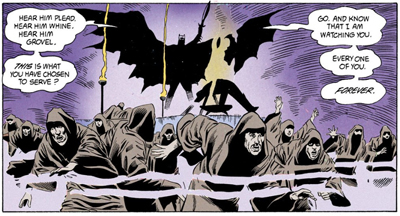
I am the lord, your Bat-god!

I am the lord, your Bat-god!

As a whole, the two-hundred-and-fourteen issue run of Legends of the Dark Knight holds up remarkably well. The run contains a number of genuinely classic Batman stories like Gothic or Prey or Faces or Blades or Hothouse or Going Sane. The first twenty issues of the title are remarkably strong, and there is a very series argument to be made that the anthology nature of Legends of the Dark Knight made it the best Batman comic book of the nineties.

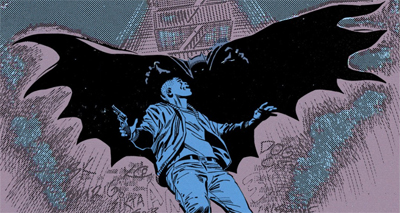
However, when it came to launching Legends of the Dark Knight, it made sense for Batman veteran Denny O’Neil to write the first story. O’Neil had been an essential part of the Batman line since the seventies. He was a prolific creator who had contributed an incredible amount of material to the wider universe of Batman. During a short run on Batman with artist Neal Adams, O’Neil had helped to restore some of the character’s darkness and mystery following the bright and colourful sixties.

The mask comes off...

The mask comes off…

Continue reading

Batman – Arkham Asylum: Living Hell (Review/Retrospective)

23rd July is Batman Day, celebrating the character’s 75th anniversary. To celebrate, this July we’re taking a look at some new and classic Batman (and Batman related) stories. Check back daily for the latest review.

There is something absolutely compelling about witnessing the surreal and the impossible through the eyes of ordinary people. In the middle of the first decade of the twentieth century, DC seemed to take a novel approach to the larger Batman mythos. Acknowledging the absurdity of the world inhabited by the Caped Crusader, comic book fans were asked to look at that strange world from the perspective of the ordinary people inhabiting it.

Greg Rucka, Ed Brubaker and Michael Lark all collaborated on Gotham Central, the wonderful police procedural that offered a new way of examining the streets of Gotham. As observed by the members of the Gotham Police Department’s Major Crimes Unit, Gotham’s population of heroes and villains seemed particularly unsettling and ethereal. It is one thing to imagine the weird and wonderful world inhabited by the Batman and the Joker and the Mad Hatter. It is another to imagine sharing that world.

He knows how to make an entrance...

He knows how to make an entrance…

Launched a few months after the first issue of Gotham Central, Dan Slott and Ryan Sook’s wonderful Arkham Asylum: Living Hell is a six-issue miniseries that invites the reader inside the eponymous institution. As glimpsed through the eyes of white-collar criminal Warren White, Arkham Asylum is a place that defies explanation – a macabre and horrific environment that is home to all sorts of depravity and brutality.

Batman himself barely appears in Arkham Asylum: Living Hell, existing at the fringes of the book as he does with Gotham Central. However, despite these limited appearances, it remains clear that Warren White has found his way to the other side of the looking glass.

We all face our demons...

We all face our demons…

Continue reading

Batman – Year Two (Review/Retrospective)

23rd July is Batman Day, celebrating the character’s 75th anniversary. To celebrate, this July we’re taking a look at some new and classic Batman (and Batman related) stories. Check back daily for the latest review.

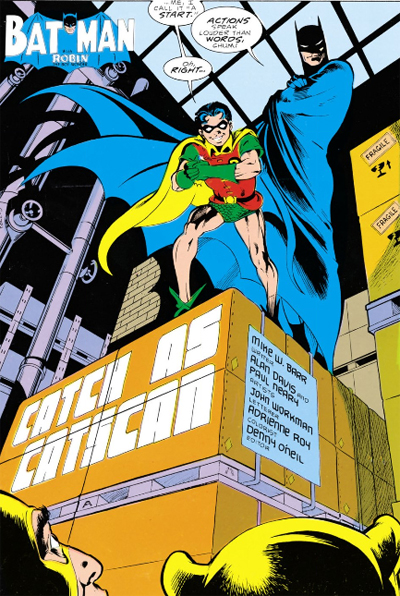
Batman: Year Two is an… interesting read. It’s much-maligned by comic book fans, and there are a lot of reasons for that. Most obviously there’s the fact that it really doesn’t make a lot of sense, but there’s also the fact that it was published by DC as a way of capitalising on the success of Frank Miller’s Batman: Year One. Year One is a classic comic book story, one of the greatest origins ever written, and one that endures to this day, where even Scott Snyder felt intimidated in writing over it more than two decades after it was published.

Batman: Year Two is not that sort of classic.

In fact, it’s not any sort of classic. However, divorced from context, it’s an interesting read. It feels like writer Mike W. Barr is consciously and gleefully subverting absolutely everything that worked so well in Miller’s Batman: Year One, rejecting the notion of a version of Batman anchored in something approaching the real world, and getting right down to the comic-book-y-ness of the character. Positioning it as a sequel to Batman: Year One feels odd. It would almost read better as a rebuke.

Welcome to the late eighties...

Welcome to the late eighties…

Continue reading

Peter Tomasi & Patrick Gleason’s Run on Batman & Robin – Pearl & Death of the Family (Review)

23rd July is Batman Day, celebrating the character’s 75th anniversary. To celebrate, this July we’re taking a look at some new and classic Batman (and Batman related) stories. Check back daily for the latest review.

Peter Tomasi is one of the best supporting writers in comics. Writing a supporting title in a shared superhero universe is a very daunting task. It requires a unique ability to weave into (and out of) events and storylines dictated by more high-profile writers on more popular books. Due to the structuring of superhero publishing, the direction for an entirely line is typically dictated by one (or maybe two) books, with the rest of the line alternating between supporting those books and trying not to make waves.

Tomasi is very good at this. His Green Lantern Corps book provided a suitably solid support for Geoff Johns’ more high-profile Green Lantern comic. He was the logical choice to take over Batman & Robin after Grant Morrison departed, even if the book did cycle through a variety of creators including Paul Cornell and Judd Winick. Tomasi is a writer with a lot of experience as an editor, and – as such – has a knack for picking up on themes and core values of particular writers.

He shall become a bat...

He shall become a bat…

Following the “new 52” relaunch, Batman & Robin was very much a satellite book in DC’s Batman line. It was a holding pattern, a book designed to feature Damian Wayne while Grant Morrison prepared to launch into Batman Incorporated. It was part of a line that was largely being driven by Scott Snyder and Greg Capullo’s work on Batman. There was no sense writer Peter Tomasi and Patrick Gleason would be doing anything particularly bold or daunting with the book at this moment in time.

Dutifully, following an eight-issue introductory arc, Born to Kill, Batman & Robin found itself bouncing around between various high-profile crossovers in the Batman line and in the wider context of DC’s publishing schedule. In the spate of issues between Born to Kill and the end of Grant Morrison’s Batman Incorporated run, Tomasi and Gleason find themselves navigating a veritable minefield of DC continuity and crossovers.

Everything burns...

Everything burns…

Continue reading

Geoff Johns’ Run on Justice League – Throne of Atlantis (Review/Retrospective)

23rd July is Batman Day, celebrating the character’s 75th anniversary. To celebrate, this July we’re taking a look at some new and classic Batman (and Batman related) stories. Check back daily for the latest review.

Geoff Johns on Justice League should be one of the defining superhero comic books of the twenty-first century.

After all, Johns has done a lot to define DC over the past decade or so. Johns is one of the defining voices in superhero comics. He has enjoyed long and successful runs on iconic characters. His work sells well and has generally garnered positive reviews over the course of his career. Johns knows how to “centre” a character and to help cut to their core. 52 is generally regarded as a high watermark of twenty-first century DC comics, and Johns is the only one of the four authors still consistently working at DC comics.

Everybody out of the water!

Everybody out of the water!

So putting Geoff Johns on Justice League is a no-brainer. Indeed, many fans had been expecting a high-profile run from Geoff Johns on the title long before the “new 52” relaunch. Given Johns’ successful runs on Action Comics, Green Lantern and The Flash, writing all of these characters together should be a recipe for success. When it was announced that writer Geoff Johns and artist Jim Lee would be handling the relaunched Justice League title, it seemed like a veritable worldbeater of a title.

In sales terms, Johns’ Justice League remains a success. However, it has been less satisfying from a creative standpoint. Artist Jim Lee departed the book after a year – with several fill-in artists along the way. However, even with DC drafting Ivan Reis to replace Lee, Justice League is not as satisfying as it should be. There are lots of reasons for this, but the biggest problem with Johns’ Justice League is that it always seems so fixated on what is happening next that it never appreciates the moment.

She really sweeps him off his feet...

She really sweeps him off his feet…

Continue reading

Peter Milligan and Kieron Dwyer’s Run on Batman – Dark Knight, Dark City (Review/Retrospective)

23rd July is Batman Day, celebrating the character’s 75th anniversary. To celebrate, this July we’re taking a look at some new and classic Batman (and Batman related) stories. Check back daily for the latest review.

Peter Milligan and Kieron Dwyer’s Dark Knight, Dark City shot to prominence when writer Grant Morrison incorporated some of its elements into his expansive Batman epic. This three-issue 1990 Batman story arc garnered a lot of attention and even earned a reprint in 2011 as part of the DC Comics Presents line. That is certainly deserved, as Dark Knight, Dark City is a genuinely classic Batman story.

Milligan hits on a lot of the themes that he would develop over his subsequent Detective Comics run. There’s a sense that the writer is scripting a version of Batman that owes at least as much to the tradition of horror comics as it does to traditional superhero narratives. Indeed, Milligan could easily have reworked most of his Batman stories for Hellblazer with only a minimum amount of changes.

Suit up...

Suit up…

Portraying Batman as a strange and surreal character inhabiting a strange and surreal world, Milligan paved the way for a lot of occult weirdness that would become a fixture of the Batman line into the nineties and beyond. It is very difficult to imagine Grant Morrison’s extended run without Milligan’s influence. It could also be argued that Milligan paved the way for the distinctive and stylised portrayal of the Dark Knight in Doug Moench and Kelley Jones’ mid-nineties run.

Haunting, thoughtful and influential, Dark Knight, Dark City is an underrated masterpiece.

Who is afraid of the big, bad bat...

Who is afraid of the big, bad bat…?

Continue reading

Batman – The Cult (Review/Retrospective)

23rd July is Batman Day, celebrating the character’s 75th anniversary. To celebrate, this July we’re taking a look at some new and classic Batman (and Batman related) stories. Check back daily for the latest review.

The Dark Knight Returns has a lot to answer for.

Although written “out of continuity” as the last Batman story, critically deconstructing and examining the Caped Crusader, The Dark Knight Returns remains a hugely influential piece of the Batman canon. It’s a story that was hugely influential in comics as a whole, but which understandably had a major influence on Batman. To pick an easy example, both of the recent “guiding” writers on the Batman franchise – Scott Snyder and Grant Morrison – can be seen to react to The Dark Knight Returns a variety of ways.

They are dead to him.

They are dead to him.

In a way, no author was more responsible for porting over concepts from The Dark Knight Returns as effectively as Jim Starlin. Although Starlin is perhaps most associated with Marvel’s cosmic saga, the author did write two massively iconic and distinctive Batman stories. Starlin was the author who wrote A Death in the Family, the story that killed off Jason Todd. He also wrote The Cult, a story about Gotham under siege from an evil religious leader who manages to “break” Batman.

The Cult itself was influential. Aspects of The Cult can be seen in Christopher Nolan’s The Dark Knight Rises, a story about an urban uprising from the sewers and Batman’s attempts to rebuild himself to save Gotham. Unfortunately, as with Starlin’s other iconic Batman story, there’s a sense that The Cult works better in theory than in execution.

A Deacon of light...

A Deacon of light…

Continue reading

Mike W. Barr and Alan Davis’ Run on Detective Comics (Review/Retrospective)

23rd July is Batman Day, celebrating the character’s 75th anniversary. To celebrate, this July we’re taking a look at some new and classic Batman (and Batman related) stories. Check back daily for the latest review.

When DC comics published Crisis on Infinite Earths, it was a brave new world. Everything was new again. Nothing could be taken for granted. The company had the opportunity to start again with its characters and properties, offering a new beginning to iconic heroes that would hopefully welcome new readers while learning from prior successes and past failures. It was an exciting time in the industry, one bristling with potential.

In many respects, the defining Batman story in the immediate aftermath of Crisis on Infinite Earths was Batman: Year One. Even today, Year One remains a foundational text for Batman, one of the best (and most influential) stories ever told using the character. It defined Batman for the eighties and nineties, and beyond. Frank Miller offered readers a new and updated origin for the Caped Crusader that teased a new way of looking at Gotham City and its inhabitants.

"It's a trap!"

“It’s a trap!”

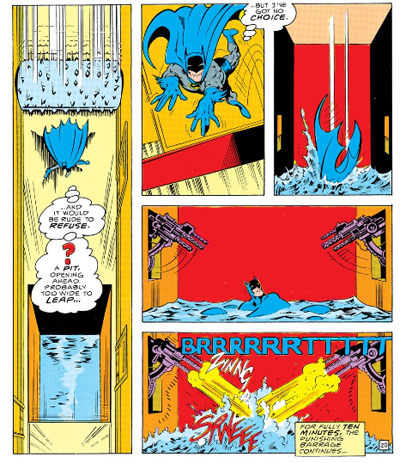
Meanwhile, a more quiet revolution was in progress over on Detective Comics. Writer Mike W. Barr and Alan Davis began their run on Detective Comics in the immediate aftermath of the now-all-but-forgotten Legends crossover. Although the duo were lucky enough to work on the book over the fiftieth anniversary of Detective Comics, their work was somewhat overshadowed by the publication of Year One in their sister publication – to the point that their run culminates in Year Two, a sequel to Year One.

Still, while it never got the attention that it deserved, Barr and Davis did a lot to offer an alternative to Miller’s gritty and grounded reimagining. Featuring death traps and puns and brainwashing and dodgy jokes, Barr and Davis seem almost subversive. It is as if the duo are working hard to import all the stuff that might otherwise be washed away by Crisis on Infinite Earths, reminding readers that with world of Batman has always been absurd, and that is not necessarily a bad thing.

Talk about making an entrance...

Talk about making an entrance…

Continue reading

Scott Snyder & Greg Capullo’s Run on Batman – Death of the Family (Review/Retrospective)

23rd July is Batman Day, celebrating the character’s 75th anniversary. To celebrate, this July we’re taking a look at some new and classic Batman (and Batman related) stories. Check back daily for the latest review.

In many respects, despite the massive hype that it received and the gigantic crossover that it spawned, Death of the Family is structured as an anti-epic. The triumphant return of the Joker to the world of Batman over a year into the “new 52” instead turns into a deconstruction and criticism (and arguably a rejection) of the character. Sandwiched between Scott Snyder and Greg Capullo’s much larger and more ambitious epic Batman stories, Death of the Family is a story about how small the Joker really is.

In many respects, Death of the Family reads best as the story of a collapsing relationship, where one partner refuses to deal with the fact that the other has outgrown them.

Ever dance with the devil in the pale moonlight?

Ever dance with the devil in the pale moonlight?

Continue reading

Mark Waid’s Run on Justice League of America – Tower of Babel (Review/Retrospective)

23rd July is Batman Day, celebrating the character’s 75th anniversary. To celebrate, this July we’re taking a look at some new and classic Batman (and Batman related) stories. Check back daily for the latest review.

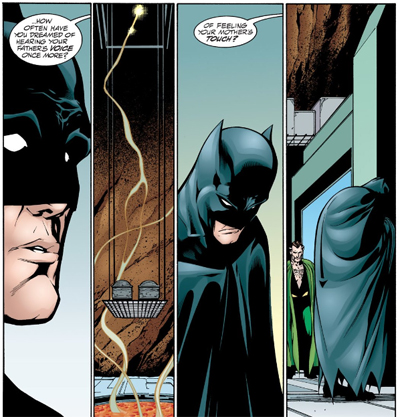
Although actually published in 2000, Tower of Babel is the third definitive Batman story of the nineties. Running only four issues instead of a massive sprawling crossover across an entire line of comic books, Tower of Babel is certainly more condensed than either Knightfall or No Man’s Land, hitting on many of the same themes and concepts. It is very much constructed as a cautionary tale – a warning about taking a particularly cynical approach to Batman to its logical extreme.

Due to his stand-off-ish nature, the nineties iteration of Batman is sometimes affectionately (or not so affectionately) referred to a “Batjerk.” This version of the character has a wonderful knack of pushing his friends and allies away, making enemies, and escalating problems due to arrogance and ego. In many respects, Tower of Babel is a quintessential “Batjerk” story, where Batman’s anti-social tendencies lead to the humiliation and defeat of the entire Justice League using his own plans.

The last temptation of Batman...

The last temptation of Batman…

Continue reading