• Following Us

  • Categories

  • Check out the Archives


  • Awards & Nominations

Star Trek (Gold Key) #1 – The Planet of No Return! (Review)

The first Star Trek pilot, The Cage, was produced in 1964. To celebrate its fiftieth anniversary, this December we are reviewing the second season of the original Star Trek show. You can check out our first season reviews here. Check back daily for the latest review.

The Star Trek comics published by Gold Key are somewhat infamous additions to the Star Trek canon. The company began publishing comic book tie-ins in July 1967, in the gap between the first and second seasons of the original Star Trek show. They continued to publish those tie-ins until 1978, when the license passed to Marvel. These early comics have become the source of much derision over the years, with fans dismissing them as hollow cash-ins produced by people with little understanding of the franchise itself.

However, recent years have seen something of a reappraisal of these early comic books. Once IDW Publishing secured the rights to produce tie-in Star Trek comic books, they devoted considerable effort to archiving and releasing classic and little-seen material from the franchise’s history. They released the Star Trek newspaper strips in a two-volume set, before turning their attention to the classic Gold Key comic books. It is a very worthwhile attempt to provide fans with a glimpse of oft-overlooked chapters in the franchise’s history.

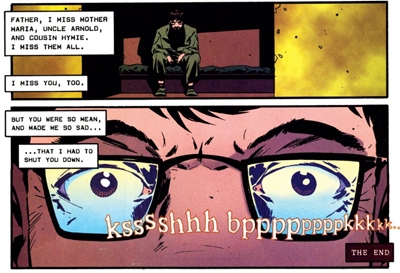
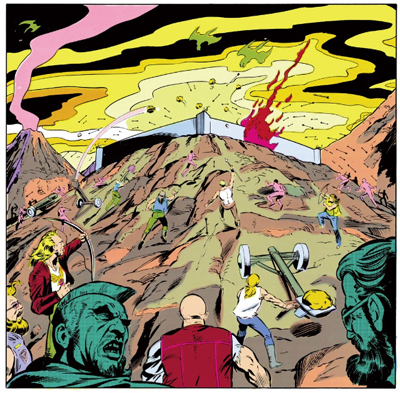
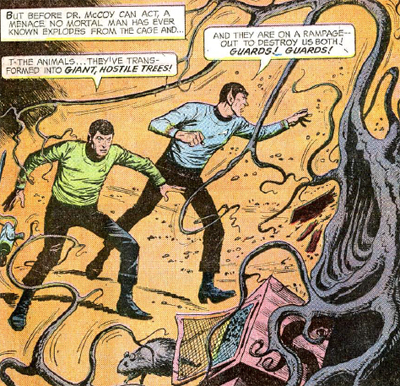
Plant life...

Plant life…

The Gold Key Star Trek comics are messy. A lot of the criticisms hold true. There are all manner of continuity errors in the production of the comic. Artist Alberto Giolitti takes quite some time to figure out what Scotty looks like, and the colourists take a bit of time to figure out what uniforms various cast members should be wearing. The writing is similarly clunky, with characters sounding a little out of sort as the basic plot details seem to stand at odds with still-relatively-small Star Trek canon had been established by the closing credit of Operation — Annihilate!

And yet, despite all these considerable flaws, these comics do make for an interesting time capsule. They don’t feel quite like Star Trek so much as an impression of what Star Trek would look described to somebody who has never seen it, filtered through the lense of fifties and sixties science-fiction comics. The early issues feel like three blind men describing an elephant, and it is glorious.
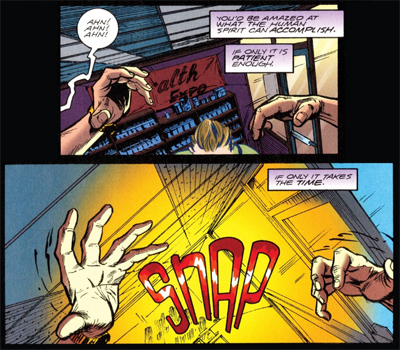
Branching out...

Branching out…

Continue reading

The X-Files (Topps) #13 – One Player Only (Review)

This November (and a little of December), we’re taking a trip back in time to review the third season of The X-Files and the first (and only) season of Space: Above and Beyond.

After a twelve-issue opening mega-arc of interconnected stories about conspiracies-within-conspiracies and wheels-within-wheels, author Stefan Petrucha and artist Charles Adlard step back a little bit to close out their run with a series of standalone stories. The four issues (and three stories) that make up the rest of their run on Topps’ X-Files comic stand alone. They are connected by themes and subtext, but very clearly stand apart from what came before. Indeed, they play out almost like a postscript to the main body of work, a series of smaller bite-sized chunks.

In that light, it is interesting that One Player Only feels – superficially, at least – a lot more in step with the television show. The early issues of the comic had seen Petrucha and Adlard creating their own supporting cast and their own conspiracy, so as to avoid stepping on the toes of the production company. The Cigarette-Smoking Man was largely reduced to a number of cameos, with Skinner popping up once or twice along the way.

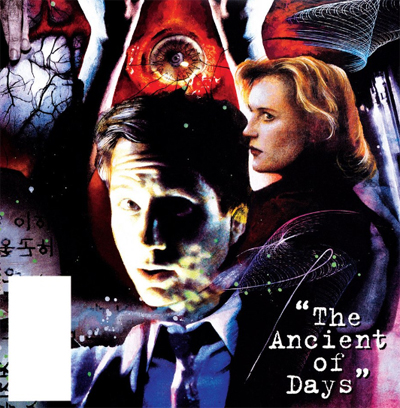
Ghosts in the machines?

Ghosts in the machines?

Not only does One Player Only feature a guest appearance from supporting characters like Mr. X or yhe Lone Gunmen, it also harks back to the structure and format of the first season of the show. On the most basic of levels, One Player Only feels like a more cyberpunk take on Ghost in the Machine, right down to the fact that Mulder is drawn into a murder at a tech company by an acquaintance from his days in the Violent Crimes Division. At one point, Mulder and Scully stumble on a ransacked house, for Mulder to deadpan, “Hm. Nothing new.”

However, if one peels back the layers, One Player Only is a fascinating piece that sets the tone for Petrucha and Adlard’s last three issues on the series, while infusing the comic with a host of fascinating cyberpunk stylings and body horror that seem to call forward to William Gibson’s future writing for the show.

Coding out...

Coding out…

Continue reading

The Flash (1987-2009) #12-14 – Velocity 9/Savage Vandalism/Wipe Out (Review)

So, I’m considering reviewing this season of The Flash, because the pilot looks interesting and I’ve always had a soft spot for the Scarlet Speedster. I’m also considering taking a storyline-by-storyline trek through the 1987-2009 Flash on-going series as a companion piece. If you are interested in reading either of these, please let me know in the comments.

Does anything date a mainstream superhero comic worse than the almost obligatory anti-drug issue?

In the wake of Crisis on Infinite Earths, DC made a rather conscious effort to engage with younger readers. Some of these worked, but quite a few were cringe-induncing in execution. On paper, introducing more diversity into the shared universe via New Guardians was a good idea; in practice, these diverse characters were little more than stereotypes. On paper, killing Barry Allen and replacing him with the younger Wally West was worth doing; in practice, it seemed like the company had no idea how to make him relatable.

Drugs are bad, m'kay?

Drugs are bad, m’kay?

Quite a few of the comics published around this time have dated poorly. They seem like awkward attempts to reengage with the cultural zietgeist, without understanding that zietgeist at all. Mike Baron had given fans a younger and more grounded version of the Flash, but immediately had the character win the lottery and move to the Hamptons. There was a sense that the comic wanted to dispel criticisms that DC was old-fashioned or stuffy, but had no idea of how to actually go about that.

This leads to stories like Velocity 9, the obligatory “winners don’t use drugs” story that tries to be timely and cutting edge, but simply doesn’t work.

Tripping himself up...

Tripping himself up…

Continue reading

The X-Files (Topps) #1/2 – Tiptoe Through the Tulpa (Review)

This November (and a little of December), we’re taking a trip back in time to review the third season of The X-Files and the first (and only) season of Space: Above and Beyond.

Tiptoe Through the Tulpa is another nice “extra” from Topps’ licensing of The X-Files. The comic book was Topps’ most successful property, and the company worked very hard to promote it across various platforms. They tried to recruit potential readers from within the comic book industry and outside the comic book industry, devoting considerable time and energy to advertising the ongoing series.

Stefan Petrucha and Charles Adlard had provided promotional strips for TV Guide and for Hero Illustrated, both very clear attempts at courting potential new readers. Both strips adopted very different approaches. Aimed at as broad an audience as possible, the strip for TV GuideCircle Game – was a tight five-page story that covered a lot of ground in a very efficient manner. In contrast, the strip for Hero IllustratedTrick of the Light – was very clearly targeted at a much more niche audience, featuring in-jokes and references for fans and geeks.

He's not 1/2 the man he used to be...

Herbert’s not 1/2 the man he used to be…

Tiptoe Through the Tulpa was written as a tie-in promotion for Wizard magazine, a giveaway for people who read the comic industry’s most popular collector and insider magazine. People would buy Wizard #53, fill out a form and then send away for their copy of the seventeen-page X-Files #1/2. It was a gimmick, but it was a gimmick that was very clearly aimed at broadening the comic’s audience, convincing a few readers who wouldn’t otherwise try the book to check out a “free” sample comic.

As such, Tiptoe Through the Tulpa is written as a seventeen-page comic that could serve as a potential jumping-on point for new readers. It is rather light, rather simple, but nevertheless makes for a clean and effective X-Files one-shot.

Cue theme music...

Cue theme music…

Continue reading

The X-Files (Topps) – The Pit (Review)

This November (and a little of December), we’re taking a trip back in time to review the third season of The X-Files and the first (and only) season of Space: Above and Beyond.

Tucked away in the Winter 1996 issue of The X-Files Magazine and republished with The Silent Sword in September 1996, The Pit is an atmospheric short story from Petrucha and Adlard, demonstrating the two work quite well together across a variety of formats. The Pit is only nine pages long, including two splash pages – and another half-page splash. There isn’t a lot of room for plot or detail. Instead, Petrucha and Adlard opt for mood and atmosphere, crafting a weird and spooky little diversion.

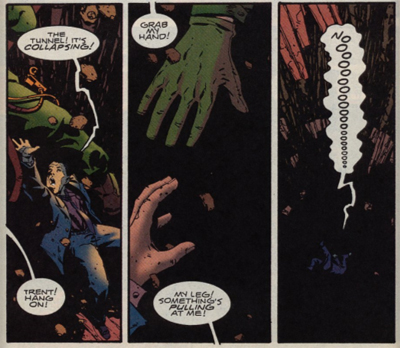
All fall down...

All fall down…

Continue reading

The X-Files (Topps) Digest #1 – Big Foot, Warm Heart (Review)

This November (and a little of December), we’re taking a trip back in time to review the third season of The X-Files and the first (and only) season of Space: Above and Beyond.

It is very odd to think that The X-Files has never done an episode about Bigfoot, perhaps America’s most recognisable and iconic mythological figure.

Perhaps there’s a reason for this. The show did a Bigfoot-type creature early in its first season, with The Jersey Devil. The fifth episode of the first season, The Jersey Devil helped to solidify the impression that The X-Files was better at abstract horrors than familiar monsters. It is not too difficult to imagine that the production team looked at The Jersey Devil and decided that Bigfoot was unlikely to be a runner.

Here there be monsters...

Here there be monsters…

Still, the show has waded into cryptozoology on occasion – with somewhat mixed results. Quagmire featured the agents hunting a mysterious reptile in a rural lake. When the show had to relaunch itself during the eighth season, Scully and Doggett bonded over their pursuit of a giant bat-like creature in Patience, the first standalone episode within that new status quo. Even Bigfoot was frequently referenced and cited. Most obviously, the final montage of Jose Chung’s “From Outer Space” suggests that Mulder treats the Roger Patterson footage as an almost holy text.

Perhaps it’s appropriate, then, that Mulder and Scully would come face to face with Bigfoot in the pages of the licensed tie-in, as part of the “digest” that Topps released at the end of their first year publishing the comic.

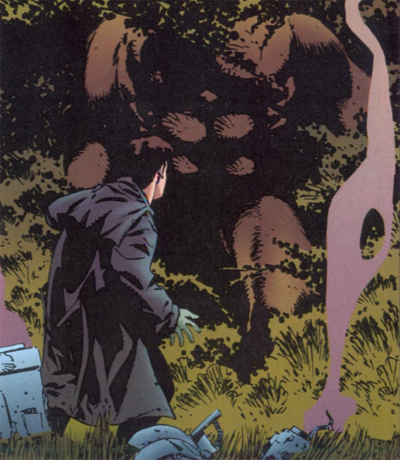
Eye see...

Eye see…

Continue reading

The Flash (1987-2009) #9-11 – The Chunk/Chunk in the Void/Chunk Barges In (Review)

So, I’m considering reviewing this season of The Flash, because the pilot looks interesting and I’ve always had a soft spot for the Scarlet Speedster. I’m also considering taking a storyline-by-storyline trek through the 1987-2009 Flash on-going series as a companion piece. If you are interested in reading either of these, please let me know in the comments.

While writing The Flash, Mike Baron tended to avoid established villains.

While appearances from Vandal Savage bookend the run, most of the character’s iconic rogues are completely missing from the first year of the title. There is no Reverse-Flash, no Captain Cold, no Weather Wizard, no Heatwave, no Captain Boomerang, no Trickster. Instead, Baron tended to create his own antagonists for Wally West. To be fair, his creatures tended to pop up here and there over the years, but none of them really broke through into the character’s regular supporting cast.

It's the end of the world as we know it...

It’s the end of the world as we know it…

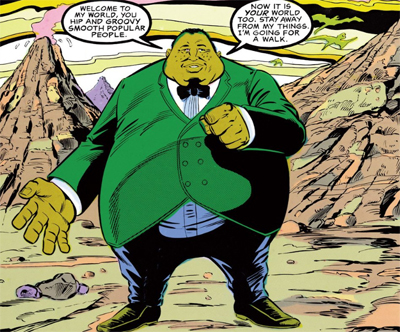
Perhaps Chunk came closest. Chester Runk is the most memorable and well-defined new character to appear during Baron’s run on the title. The character would never become a regular fixture of The Flash, but he would pop up time and again over the years. It is easy to see that might be the case. He is rather distinct from most of the other baddies to debut under Baron’s pen. He looks visually distinctive, has a nice character hook, and fits quite comfortably in the world of The Flash. He’s a nice adversary.

Sadly, his debut story is not a good story.

The big man...

The big man…

Continue reading

The X-Files (Topps) #10-12 – Feelings of Unreality (Review)

This November (and a little of December), we’re taking a trip back in time to review the third season of The X-Files and the first (and only) season of Space: Above and Beyond.

Feelings of Unreality marks the end of Stefan Petrucha and Charles Adlard’s first year on Topps’ licensed X-Files comic book.

It also marks the end of their extended arc. It became clear around six issue into their run that Petrucha and Adlard were really just telling one large and expansive story that could be broken down into small bite-sized chunks. From Not To Be Opened Until X-Mas through A Dismembrance of Things Past through Firebird and Silent Cities of the Mind, these were all separate pieces of a larger puzzle waiting to be fitted together. Feelings of Unreality marks a conclusion to this ambitious and expansive arc.

Slightly unreal...

Slightly unreal…

What has been fascinating about Petrucha and Adlard’s run on The X-Files comic book as been the way that the team has adapted the show’s format to fit within this distinct medium. Writing a tie-in like this, it would would be very tempting to do “a television episode, in comic book form!” There’s a very serious argument to be made that the comics would be pushed in that direction after Petrucha departed. However, there’s something much more compelling about a story that takes advantage of its own medium, rather than offering a flat imitation of another.

For all its flaws, Feelings of Unreality – like Petrucha and Adlard’s epic Firebird before it – feels like a comic book story. It’s pulpy, exciting, ambitious, expansive, silly. And just a little brilliant.

Lift me up...

Lift me up…

Continue reading

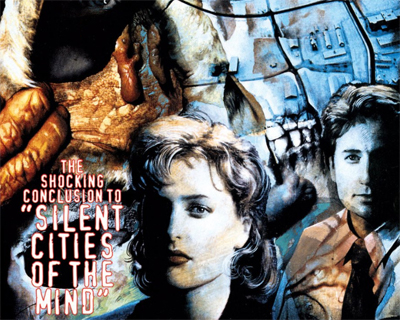
The X-Files (Topps) #8-9 – Silent Cities of the Mind (Review)

This November (and a little of December), we’re taking a trip back in time to review the third season of The X-Files and the first (and only) season of Space: Above and Beyond.

Silent Cities of the Mind is a very “comic book” story – it’s a story that might easily seem outlandish or ridiculous if committed to film, but which works very well within its medium. After all, the plot centres around a bunch of ancient Aztec priests who built an elaborate underground city that could project itself above ground as a mirage. Indeed, the story seems to accept this as a given, with Scully instead spending most of the adventure questioning whether memories can be transmitted via cannibalism.

It’s a concept that could easily seem ridiculous, and it’s a testament to writer Stefan Petrucha and artist Charles Adlard that it works as well as it does. Silent Cities of the Mind is a decidedly pulpy adventure, but that lends the story an undeniable charm. It’s a story packed to the brim with clever and fascinating ideas – from ancient aliens to ritual cannibalism to hidden cities to crystal skulls. All this is crammed tightly into two issues, meaning that everything moves so fast there’s no real time to stop and nitpick it all.

It's all in the mind...

It’s all in the mind…

Mulder is negotiating with survivalists! There are memories transferred through the act of ritual cannibalism! Mulder and Scully are shot down over Alaska! Mulder is trapped with a cannibal! There’s a hidden Aztec city buried underground! Mulder has discovered ancient Aztec mythology! There’s an army rescue team that isn’t a rescue team! There’s a macguffin that allows its wearer to commune with the gods! There’s a stand-off!

It’s all rather exhausting, but in a fun and exciting sort of way. Silent Cities of the Mind is perhaps the best example of how Petrucha and Adlard were writing The X-Files as a comic book, positioning the show’s tropes and iconography within the framework of comic book conventions.

Bonfire of the vanities...

Bonfire of the vanities…

Continue reading

The X-Files (Topps) – Circle Game (Review)

This November (and a little of December), we’re taking a trip back in time to review the third season of The X-Files and the first (and only) season of Space: Above and Beyond.

There are any number of events that suggest The X-Files was on the cusp of exploding into a phenomenon. The show was spawning conventions and merchandise. It was becoming a hot property in international markets, moving from BBC 2 up to BBC 1 and then across to Sky. It was quickly becoming compelling water-cooler television. The first season had been lucky to avoid cancellation. The second season had rocketed up the ratings. The third was going to be a pretty big deal.

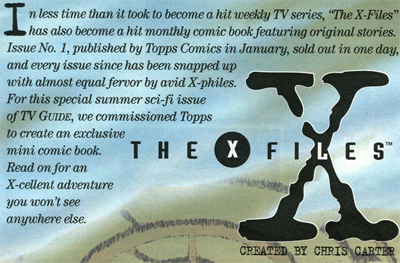
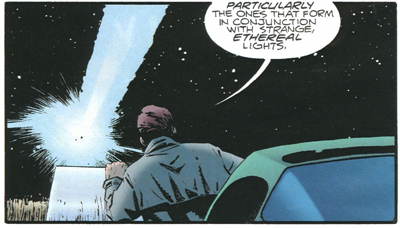
In light of all of this going on around it, a five-page comic doesn’t seem like that big a deal. Written by Stefan Petrucha and illustrated by Charles Adlard, Circle Game would almost seem as business-as-usual for Topps’ popular X-Files tie-in comic. The only significant difference was that Circle Game had been written and illustrated specifically for the July 15th issue of TV Guide. As part of their “stellar summer sci-fi issue!”, the magazine had given over five pages to Petrucha and Adlard to tell an entire X-Files story.

X marks the spot...

X marks the spot…

Even ignoring the narrative challenges posed by such an assignment, that’s a pretty big deal. Even in the age of the internet, time-shifted viewing and multi-channel television, TV Guide still has a circulation of over two million readers. To give a sense of scale, the biggest-selling contemporary comic books would have a readership of less than a tenth of that. To give it a more relevant sense of scale, the July 1995 issue of The X-Files comic book – the version on the stands at this point – sold approximately 72,000 copies.

All of this is just to stress that giving The X-Files comic book five pages of TV Guide was a pretty big deal.

Lights in the sky...

Lights in the sky…

Continue reading