• Following Us

  • Categories

  • Check out the Archives


  • Awards & Nominations

The X-Files: Season 10 (IDW) #11-15 – Pilgrims (Review)

This June, we’re going to be taking a look at the current run of The X-Files, beginning with the IDW comic book revival and perhaps taking some detours along the way. Check back daily for the latest review.

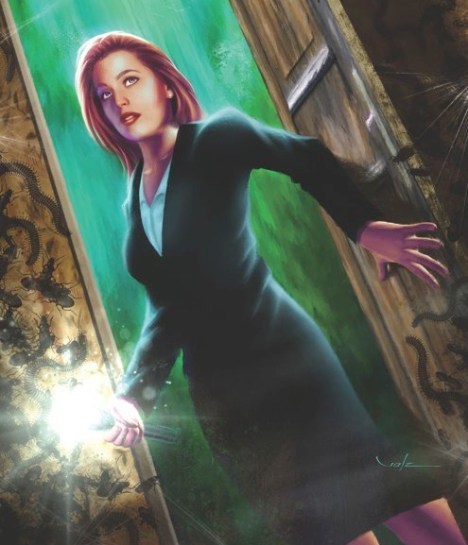
Pilgrims is essentially an attempt to do a mid-season mythology episode in the style of Colony and End Game or Tunguska and Terma, a big sprawling epic populated by familiar faces and impossible scale that is driven more by questions and mysteries than by answers or revelations. It is in many ways a testament to writer Joe Harris’ desire to emulate the basic structure and framework of The X-Files, right down to the manner in which he structures The X-Files: Season 10.

There are a lot of obvious markers and touches that help Pilgrims to feel like a classic mid-season mythology episode. There is an international scope, as seen in the trip to the Arctic in End Game or to Hong Kong in Piper Maru or to Russia in Terma. The first half of Pilgrims unfolds in Saudi Arabia, with Mulder and Scully dispatched to investigate what initially appears to be a terrorist attack on an oil operation but is promptly revealed to be something far more sinister.
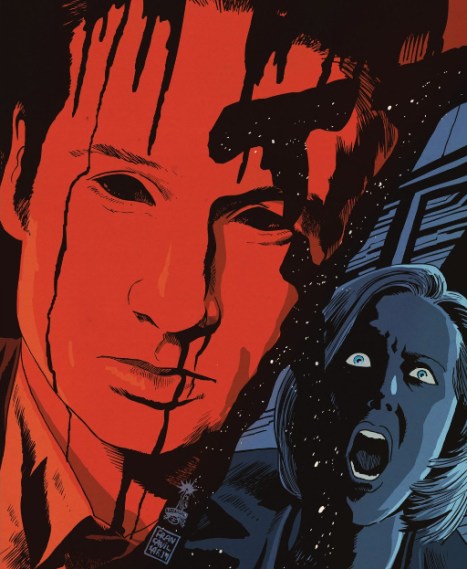
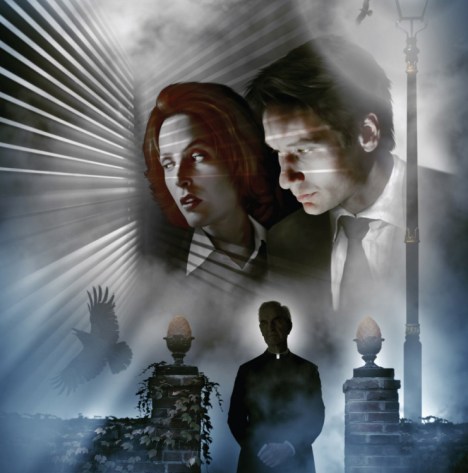
The red and the black.

The red and the black.

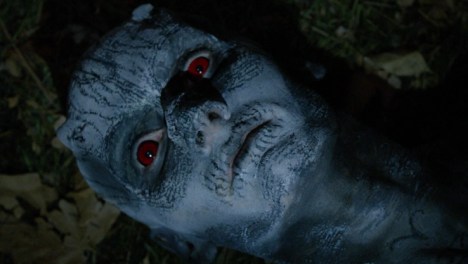
Similarly, in keeping with the style and tone of many of the best mythology two-parters, the basic plot is relatively straightforward even as complications appear at the edge of the frame. In End Game, Mulder is racing to recover his lost sister as details about secret cloning experiments spill out around him. In Nisei, Mulder is trapped in a traincar with a ticking time bomb and a dangerous assassin as he digs away at the conspiracy. In Apocrypha, the black oil just wants to go home. The same is true in Pilgrims, which follows an alien trying to escape.

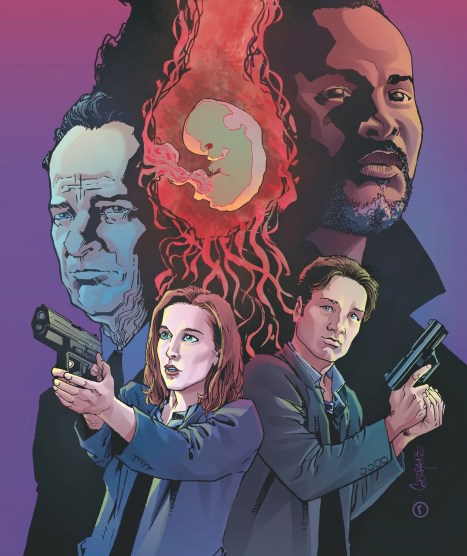
Even the structure of the five-issue arc recalls that of many X-Files two-parters, with a massive pivot coming between the third and fourth issues in the same way that many two-parters would switch premises at the half-way point. The Saudi Arabia plot wraps up at the end of the third issue, while Gibson Praise is introduced at the start of the fourth. The first three issues focus on the mystery of the Saudi attack, while the final two put a much greater emphasis on the traditional trappings of the X-Files mythology including the conspirators and Skyland Mountain.
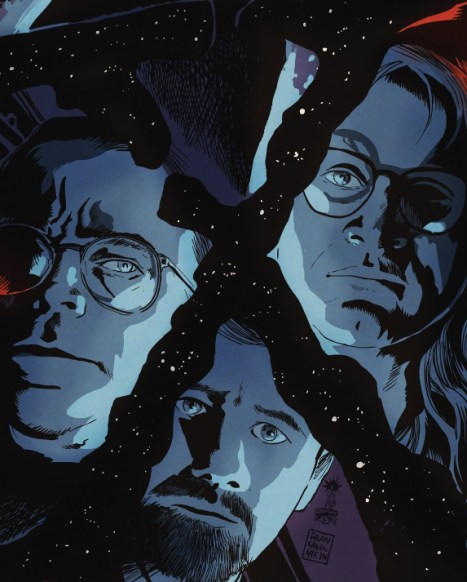
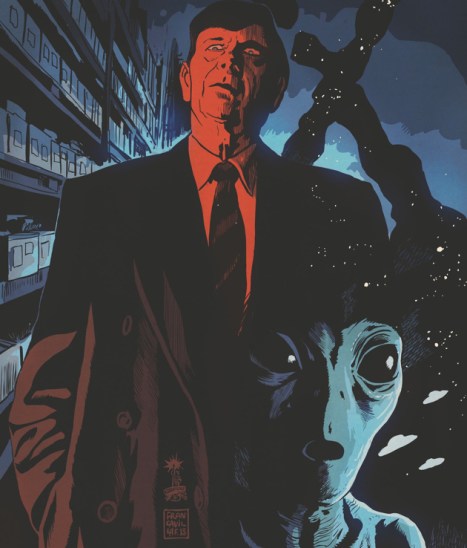
Lone survivors.

Lone survivors.

It is remarkable how faithful Joe Harris is to the format of those classic X-Files mythology episodes. Of course, this is something of a double-edged sword. As with a lot of The X-Files: Season 10, the biggest weakness of Pilgrims is the fact that it all feels a little overly familiar and a little too indulgent. Krycek was one of the most popular supporting characters from the nine-season run of The X-Files, but bringing him back at the centre of a five-part epic mythology story feels like pandering and fan service. Harris is not inventing his own mythology, but resurrecting an old one.

Then again, that might seem to be the point. The black oil discovered in Pilgrims is compared to the oil resting beneath Saudia Arabia. In that respect, it is the remains of long-dead organisms compressed and decayed and converted into fuel. There is something more than a little appropriate about that.
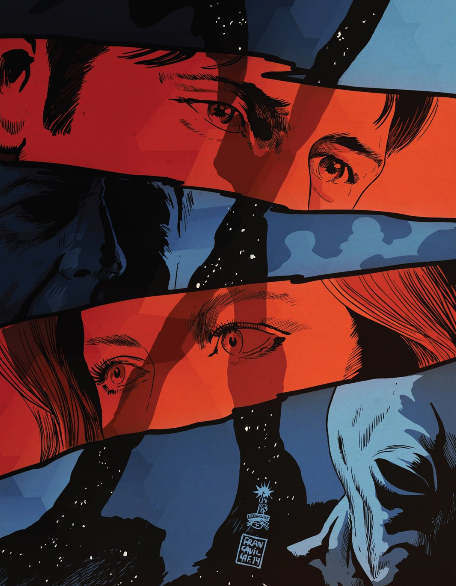
Eye see.

Eye see.

Continue reading

The X-Files (IDW) Annual 2014 (Review)

This June, we’re going to be taking a look at the current run of The X-Files, beginning with the IDW comic book revival and perhaps taking some detours along the way. Check back daily for the latest review.

The X-Files: Season 10 was a massive success for IDW publishing.

Although the monthly series had been announced in January 2013, it hit the stands in June 2013. That meant that the opening arc, Believers, basically ran through the summer season and towards the big twentieth anniversary coverage in October 2013. The X-Files: Season 10 was one of the first indicators that there was a public appetite for The X-Files, with behind-the-scenes talks about a live action revival only really coming to a head after that first issue hit shelves.

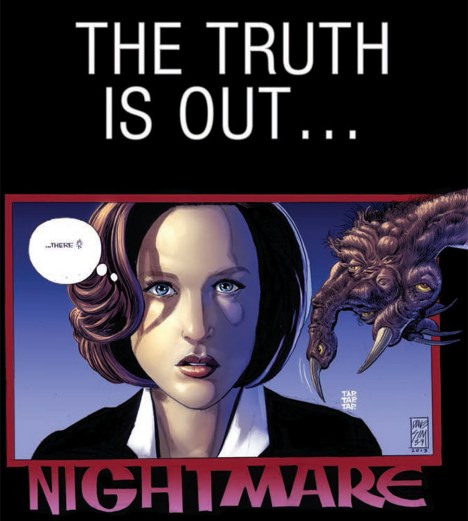
... and so is the fact that they let Dave Sim write a Scully story.

… and so is the fact that they let Dave Sim write a Scully story.

It is perhaps too much to credit The X-Files: Season 10 for building or sustaining momentum towards the revival. However, the monthly comic series spoke very clearly to the series’ continued relevance and to the audience very eagerly invested in the idea of more stories built around these iconic characters. IDW moved to capitalise on the hunger quite quickly, and it is telling that the publisher moved to publish at least two X-Files books per month for most of the comic’s run. Fans wanted more X-Files, and IDW wanted to give it to them.

This explains The X-Files Annual 2014, a book published outside the monthly schedule of The X-Files: Season 10 and drawing two big-name creators to draft their own short stories focusing on Mulder and Scully. Neither of these stories is particularly brilliant or insightful, and neither feels like it really needed to be told, creating the impression that the comic exists mainly so that fans can have more Mulder and Scully in their lives.

"Have you seen The Exorcist?" "No, but I've seen The Calusari."

“Have you seen The Exorcist?”
“No, but I’ve seen The Calusari.”

Continue reading

The X-Files: Season 10 (IDW) #10 – More Musings of a Cigarette-Smoking Man

This June, we’re going to be taking a look at the current run of The X-Files, beginning with the IDW comic book revival and perhaps taking some detours along the way. Check back daily for the latest review.

More Musings of a Cigarette-Smoking Man is certainly an ambitious story.

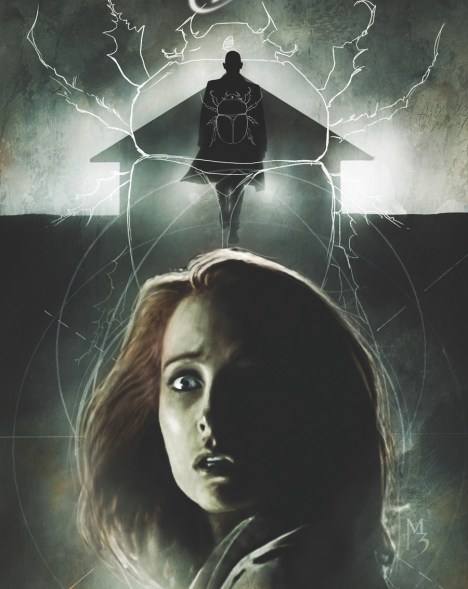
As the title suggests, writer Joe Harris and artist menton3 position this one-shot as a spiritual sequel to Musings of a Cigarette-Smoking Man, the controversial fourth season episode written by Glen Morgan and directed by James Wong. Musings of a Cigarette-Smoking Man offered a window into the past of the Cigarette-Smoking Man, a possible glimpse of who he had been and how he had come to be. It was also one of the most consciously stylised and ambiguous episodes in the entire nine-year run of the show.

Wheels within wheels.

Wheels within wheels.

Writing a spiritual sequel to that classic episode is a bold decision from the creative team. As with a lot of the big creative decisions concerning The X-Files: Season 10, More Musings of a Cigarette-Smoking Man seems too focused on the past. There is a sense that the monthly series is a little too beholden to what came before, too rooted in continuity, too dedicated to revisiting the iconography of the series. Writing a single-issue standalone story positioned as a sequel to on of the most unique episodes of the original run only emphasises this unease.

And, yet, in spite of these legitimate concerns, More Musings of a Cigarette-Smoking Man works reasonably well. It is indulgent and obsessive, but it is also rich and mysterious. It is disjointed and uneven, but that feels like the point. In keeping with the spirit of Musings of a Cigarette-Smoking Man, it feels like More Musings of a Cigarette-Smoking Man is a reflection on the comic book itself. This is a comic book contemplating its own identity and purpose, even as it finds itself being made redundant.

X marks the spot.

X marks the spot.

Continue reading

Non-Review Review: The Conjuring 2

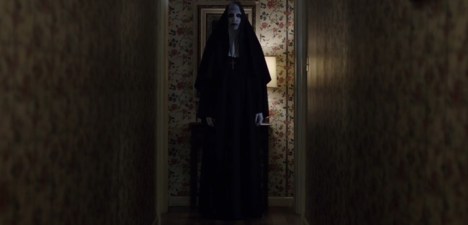
The Conjuring 2 is effectively a tentpole horror.

It is very much a horror film, with James Wan demonstrating all the skill and technique that he had honed over years working in the genre. There some wonderful slow pans and creepy camera movements that emphasise negative space, some very effective use of timing and mounting dread, and a palpable sense of menace. There are jump scares and slow scares, and enough false alarms to keep the audience on the edge of their seats. The Conjuring 2 is in many ways an old-school archetypal horror film.

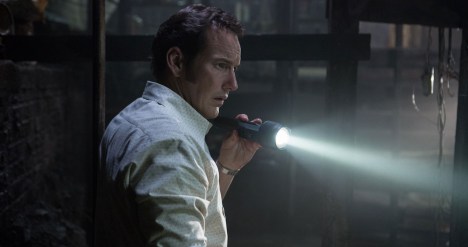
He ain't afraid of no ghost...

He ain’t afraid of no ghost…

However, there is something interesting happening in the background. The Conjuring 2 might have all the basic ingredients of a horror movie, but they are assembled in the style of a tentpole blockbuster. To be fair, the big summer release date is a bit of a clue, as is the climax that features a sweeping race-against-time as the heroes try to desperately make it back from the train station. Indeed, The Conjuring already launched something of a shared horror universe with the spin-off Annabelle.

In some respects, The Conjuring 2 feels like something of a mash-up, reflecting contemporary pop culture’s fascination with mashing existing concepts together to form intriguing cocktails. What is really surprising about the film is how well it works.

"I'm sorry, you wouldn't happen to be able to direct me to the Marilyn Manson concert, would you?"

“I’m sorry, you wouldn’t happen to be able to direct me to the Marilyn Manson concert, would you?”

Continue reading

The X-Files: Conspiracy (IDW) (Review)

This June, we’re going to be taking a look at the current run of The X-Files, beginning with the IDW comic book revival and perhaps taking some detours along the way. Check back daily for the latest review.

IDW is quite different from Topps and Wildstorm, the two prior comic book companies to hold the license for The X-Files.

Part of that simply reflects changes in the comic book industry over time, with a greater fixation on concepts like shared universes and continuity, along with an increased emphasis on the importance of “the canon.” Part of that is simply down to the way that IDW operates as a publisher. The company is the fourth-largest comic book publisher in America, behind Marvel, DC and Image. While the company publishes a number of creator-owned properties, its success has largely been based around licensing properties.

A mutant phenomenon...

A mutant phenomenon…

In doing so, the company has adopted a model quite close to that of Marvel or DC. It tends to organise its books around these properties in the same way that Marvel or DC might organise themselves around the so-called “families.” Much like books like Detective Comics, Nightwing or Batgirl are considered part of the “Batman” family or books like Wolverine, Namor and X-Force fall under the X-Men banner, IDW tends to group its books into familiar families based around licensed properties. Transformers, G.I. Joe, Teenage Mutant Ninja Turtles.

It is not uncommon for each of those lines to support multiple books. For example, the company would publish a number of miniseries as companion pieces to their monthly Star Trek or Doctor Who comics. The same would be true of The X-Files: Season 1o, with the company publishing a number of tie-in books around that. Year Zero and Millennium are the most obvious example, providing the company with the opportunity to publish several branded X-Files books within the same month.

I bet super soldiers wish that they could do this.

I bet super soldiers wish that they could do this.

At the same time, the company engages with its properties in much the same way that Marvel or DC might. Marvel and DC tend to fall into a pattern of massive so-called “events” that serve to draw particular books away from their own internal narratives and towards a more “epic” story. Civil War focused on a fight between Captain America and Iron Man, but crossed over into over one hundred comic book issues published over seven months. There are countless other examples, from House of M to Crisis on Infinite Earths to Siege to Final Crisis.

IDW has organised several of its own blockbuster events to tie together its own licensed properties; Infestation and and Infes2ation come to mind. To celebrate the landing of the license, it was decided that the 2014 crossover would be themed around The X-Files. It is just a shame that the result was terrible.

We ain't afraid of no ghosts...

We ain’t afraid of no ghosts…

Continue reading

The X-Files: Season 10 (IDW) #9 – Chitter (Review)

This June, we’re going to be taking a look at the current run of The X-Files, beginning with the IDW comic book revival and perhaps taking some detours along the way. Check back daily for the latest review.

Chitter is an interesting single-issue story.

In many ways, Chitter feels very much like a throwback. It is a “monster of the week” story, the first such story to be written by Joe Harris focusing on an original creation. In fact, Harris acknowledged as much on his blog, remarking, “It’s my first, original ‘Monster of the Month’ (a term I’m taking sole credit for) story and it’s utterly disgusting, I’m sorry.” Although the plot includes a few nods towards the overarching themes of The X-Files: Season 10, the story stands almost completely alone. It would be possible to skip the issue entirely without missing much of importance.

Bugging out...

Bugging out…

This is very much an oddity in terms of The X-Files: Season 10, a monthly comic book series that has been very focused on the mythology and continuity of The X-Files. The first eight issues of the series were given over to threads dangling from the original show, whether the continuation of the mythology in Believers or the fate of the Fluke Man in Hosts or the origin of Mister X in Being for the Benefit of Mister X. This is the first time that the comic book has told a story that feels self-contained and truly standalone.

There is something very refreshing in that, with Harris constructing a story that feels very much in keeping with the tone and mood of The X-Files without relying on specific details. In many ways, it feels more like a classic episode than any of the previous issues. More than that, it actually feels very much like one of the early X-Files comics written for Topps by writers like Stefan Petrucha or John Rozum. It is a very strong piece of work.

Crawl good...

Crawl good…

Continue reading

The After – Pilot (Review)

This June, we’re going to be taking a look at the current run of The X-Files, beginning with the IDW comic book revival and perhaps taking some detours along the way. Check back daily for the latest review.

And I to him: “Poet, I thee entreat, 

By that same God whom thou didst never know,  

So that I may escape this woe and worse, 


Thou wouldst conduct me there where thou hast said,  

That I may see the portal of Saint Peter,  

And those thou makest so disconsolate.”


Then he moved on, and I behind him followed.

Devil's in the details...

Devil’s in the details…

Continue reading

Star Trek: Enterprise – Season 4 (Review)

This May, we’re taking a look at the fourth (and final) season of Star Trek: Enterprise. Check back daily for the latest review.

This is the end.

Star Trek: Enterprise would be the first live action Star Trek spin-off to run less than seven seasons. It would mark the end of eighteen years (and twenty-five seasons) of uninterrupted Star Trek on television. It would be the first of the spin-offs to be actively cancelled instead of passively retired on its own terms. It represented the end of the Berman era. The show had been lucky to scrape a fourth season, with UPN considering axing the show after the end of the third season. The fourth season only came about as a result of a lot of compromise by all involved.

ent-home6a

This shadow hangs over the fourth season. It seems quite clear from the outset that nobody involved is counting upon a fifth season. There was massive staff attrition, with veteran writers like Chris Black, David A. Goodman and Phyllis Strong all departing the writers’ room. Rick Berman and Brannon Braga took a step back from the day-to-day running the series. As the year grinds on, the show becomes increasingly (and morbidly) fixated upon its own impending demise. The clock is counting down, and the show is aware of it.

All of this is a massive shame, because the fourth season features some of the best work of the show’s four-year run. It also seems surprisingly aligned with where pop culture is going in the decade ahead, for better and for worse. The result is a season that is intriguing and ambitious, insightful and worthy. The fourth season has a lot to recommend it, and even the elements that do not work are interesting in the way that they do not work. As much as the fourth season closes the book on an era of Star Trek, it also summons the future.

ent-divergence20a

Continue reading

The X-Files: Season 10 (IDW) #8 – Being for the Benefit of Mr. X (Review)

This June, we’re going to be taking a look at the current run of The X-Files, beginning with the IDW comic book revival and perhaps taking some detours along the way. Check back daily for the latest review.

Being for the Benefit of Mr. X is effectively another origin story, following on from Hosts.

While Hosts explained exactly how the Fluke Man came to be, and even gave the character tangible motivation, Being for the Benefit of Mr. X is largely driven by flashbacks that proceed to explain and elaborate upon Mulder’s second informant. Mister X has long been one of the franchise’s most interesting and underdeveloped character, in part owing to the fact that the show fleshed out very little about him and in part due to Steven Williams’ performance. While the show revealed a lot about Deep Throat or the Cigarette-Smoking Man, Mister X remains a mystery.

Marking the spot.

Marking the spot.

The question, of course, is what this actually adds to the story being told. It is fun to revisit the origin of Mister X, but he is very much an outdated concern at this point in the show’s life. In fact, the character’s last appearance was in flashback in Unusual Suspects at the start of the fifth season, following his death in Herrenvolk at the start of the fourth season. Unlike the Cigarette-Smoking Man, Mister X was never literally resurrected. Unlike Deep Throat, he never turned up to haunt Mulder in episodes like The Blessing Way or The Sixth Extinction II: Amor Fati.

It is not as if writer Joe Harris has constructed a particularly compelling origin story for Mister X. The story told in Being for the Benefit of Mr. X is solid and sturdy, integrating quite smoothly with the continuity of the show and the character as we understand it. However, there are no real surprises or tangents, no twists or surprises. Being for the Benefit of Mr. X is a solid “done in one” story. It just feels a tad unnecessary.

In too Deep (Throat)...

In too Deep (Throat)…

Continue reading

Non-Review Review: Teenage Mutant Ninja Turtles – Out of the Shadows

There is something extraordinarily cynical about Teenage Mutant Ninja Turtles: Out of the Shadows.

The issue is not that movie refuses to make sense. The issue is not that its characters are (at best) archetypes and (at worst) plot functions. The issue is not that the script is at once thin on detail and heavy on exposition. The issue is not that the direction is clunky and unfocused, lacking basic technique and cluttering up would should be fairly standard set pieces. The issue is not even that the computer-generated imagery is ropey in places, with a lot of detail on the four turtles but great difficulty bringing Splinter to life.

I like Mike.

I like Mike.

The issue is that the move is completely unapologetic about any of these issues. It is not that the movie abandons plot logic to focus on character dynamics, or that it ignores character development in order to get to impressive set pieces. The clunky expository dialogue is not countered by witty banter or knowing irony. There is a sense that Out of the Shadows is a film comfortable with its own shoddiness. It isn’t that the film tries and fails, it is that the film barely tries at all. There is a leaden and lifeless quality to it all.

The issue is not that Out of the Shadows is a stupid dumb action movie, because stupid dumb action movies can be great fun on their own merits. The issues is that Out of the Shadows assumes that its audience is just as dumb as it is.

Turtle power.

Turtle power.

Continue reading