












“Did I just fly through space on a confetti cannon?”
“Yeah.”
“Camp.”
The Interstellar Song Contest is a very strange episode of Doctor Who, both inside and outside the narrative.
Internally, there is a surprising tension within the episode, which is transparently “Die Hard at Eurovision.” This is an inherently camp premise. It is, in classic Doctor Who tradition, a “frock” premise. It is goofy, silly, and inherent queer-coded. However, once the episode gets moving, it shifts gears into something much darker and more intense; this is an episode which opens with the audience blown into space, weaves through genocide and builds to a sequence of the Doctor sadistically torturing the villain. The episode balances on a tonal knife-edge.

Spaced out.
However, there is also an uncomfortable tension in the air around The Interstellar Song Contest, a story that was conceived and written two years ago, intended to air on the night of Eurovision, and which was obviously intended as a criticism of consumptive capitalism, but which takes on a lot more weight by simple virtue of the events that have unfolded in the time between when the episode was commissioned and when it was broadcast. The Interstellar Song Contest is an episode is watched in a different context than it was made, despite being ostensibly tailored for this moment.
The result is a deeply fascinating and unsettling episode of television, one that demonstrates both the urgency and the immediacy of television as a medium, but which also illustrates the risks that come with that.
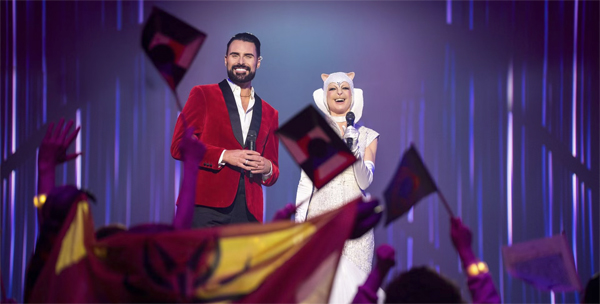
Tune in.
One of the prevailing arguments about Doctor Who is that there is an internal tension between two competing visions of what the show should it: “the guns” and “the frocks.” By this logic, most Doctor Who stories can be handily divided into one of those two camps. “Gun” stories are serious, gritty and edgy. Ascension of the Cybermen and The Timeless Children would be an archetypal “gun” story. In contrast, “frock” stories are lighter and camper, more playful and self-aware, more inherently silly.
On paper, “the Doctor goes to space!Eurovision” would be an inherently camp premise. Indeed, it’s tempting to read The Interstellar Song Contest as an episode twinned with its counterpart in the previous season, Rogue. That episode explicitly queered the Fifteenth Doctor, giving him his first kiss and his first romance. Building an entire episode around Eurovision is an extension of that. Eurovision is one of the most overtly queer-coded events in the British television calendar. Incidentally, Rogue was very literally a “frock” story, in that characters wore frocks.
Even with the addition of the Die Hard plot elements, the assumption would be that The Interstellar Song Contest would still be camp. After all, there is something inherently silly and goofy about introducing a potentially earnest and macho heist movie into the queerest possible setting. There is a version of “Die Hard at Eurovision” that is pure, undiluted sugar. The Interstellar Song Contest repeatedly gestures at this version of the premise, with the Doctor literally riding a confetti cannon like a rocket through space or getting lost in the Eurovision museum with a holographic Graham Norton.
However, almost immediately, The Interstellar Song Contest veers off that track. The episode gets surprisingly heavy surprisingly quickly. It very quickly becomes apparent that Kid is not some criminal mastermind looking to steal millions of intergalactic credits in an insanely convoluted plan that required him to take and hold the Harmony Arena. Instead, Kid is a victim of genocide whose plan involves weaponising the broadcast to commit mass murder on an almost unimaginable scale.
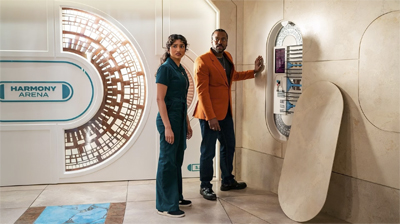
“And now we get back to our panel…”
There is a sense that “the goofy fun Eurovision episode” cannot sustain a premise that heavy, which invites uncomfortable questions about whether terrorism is ever justified or whether those who derive joy from the products of exploitative systems are morally culpable. It’s very hard for The Interstellar Song Contest to pivot back to “fun, camp runaround” from that conceptual starting point.
To give credit to writer Juno Dawson, The Interstellar Song Contest is aware of this reality. Indeed, the episode leans into it. Dawson’s script derives considerable tension from the perversity of the juxtaposition of space!Eurovision with this loaded and charged imagery. Kid’s opening gambit involves flushing the entire live audience into space. While this is inevitably reversed at the climax of the episode, it sets a strange tone for what is about to follow. The audience is meant to take this story at least somewhat seriously.
The episode then delves into the plight of the Hellions, which it takes seriously. The Hellions are never treated as a joke. Kid is treated relatively sympathetically for a character who plans to murder billions, primarily in how he is framed by Cora Saint Bavier, a character for whom the narrative has complete empathy. The revelation that Cora was forced to surgically remover her own horns in order to pass, as well as the way that Wynn Aura-Kin is treated by her coworkers, invites the audience to understand why Kid is doing what he is doing.
The victims of this terrorist attack are fairly consistently portrayed as horrific racists, which does upset the simple moral dichotomy that is traditionally employed in these sorts of stories. “We took a chance on you,” Nina admonishes Wynn. “No one implies Hellions, but we did.” Len, Cora’s partner, casually indulges in racist talking points about the Hellions, describing them as a “weird lot. They say they practice cannibalism. And witchcraft. They’ve got these horns. People say they give them psychic powers.”
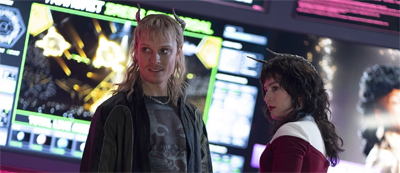
Grabbing the bull by the horns…
The Interstellar Song Contest is very consciously leaning into the more charged aspects of its premise, to the point that it’s really not a surprise when the Doctor crosses a moral event horizon by brutally torturing an already-defeated Kid, motivated by the fear that Belinda is dead. Kid is already disabled and on the ground, he is no longer a threat to anyone, but the Doctor tortures his adversary like he’s Jack Bauer on an episode of 24.
It is very much to the credit of The Interstellar Song Contest that it is willing to be this weird and uncomfortable and unpleasant, that it is willing to take what should be the lightest and most disposable episode of this run and turn it into something that feels more bitter and poisonous. There is, as with a lot of Davies’ return to Doctor Who, an anger and a darkness to The Interstellar Song Contest that complicates the show in interesting and compelling ways.
Of course, it doesn’t quite work. There is perhaps too much ambition in trying balance on this tonal knife-edge. The Interstellar Song Contest can’t quite pull off the pivot between the contradictory tones. Given the brutality of the episode to that point, it feels like a cheat that Kid’s murder of the live audience, which is covered in painstaking detail, is just magically reversed. While Belinda is clearly horrified to see the Doctor torture Kid, the Doctor himself never seems to realise that he has gone too far. The decision to end on Cora’s performance feels almost trite.
However, while the episode doesn’t ultimately cohere, it’s exciting to see this level of ambition on display. There is a commendable thorniness to The Interstellar Song Contest, which is particularly compelling given how much has shifted in the two years since the adventure was commissioned and written. It seems like The Interstellar Song Contest is a much more charged episode that Davies and Dawson ever intended it to be.
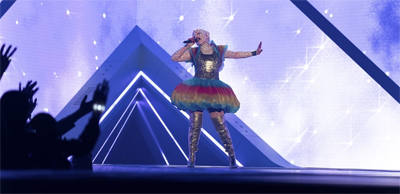
Well-staged action sequences.
The Interstellar Song Contest is an episode about television. Davies’ vision of Doctor Who has always been informed by the show’s relationship to the wider media landscape. His first season climaxed by dropping the Doctor into Big Brother and Rose into The Weakest Link. Even Rogue was characterised by Ruby as “so Brigerton.” The three sixtieth anniversary specials culminated in The Giggle, a story about how television could be weaponised to spread fear and hate.
Television is very overly weaponised in The Interstellar Song Contest. In The Parting of the Ways, the Doctor planned to turn the GameStation into a giant transmitter that could literally fry people’s brains using Delta Waves. Kid plans one doing the exact same thing, burying “a Delta Wave” in the broadcast signal and so killing the entire audience. Appropriately enough, the Doctor defeats Kid by using a hologram, a projection of light brought to life using “hard light” to prove “a hologram can hurt.” Images have power, particularly when shared through mass media.
It’s interesting that Davies’ return to Doctor Who is so preoccupied with the power of television specifically, given that the partnership with Disney has meant that every episode of the era to date has premiered on Disney+ or the BBC iPlayer ahead of its broadcast. Under this model, Doctor Who is a effectively streaming show that happens to broadcast its reruns on television. It is tension within the fabric of the show. Perhaps this explains Davies’ interest in television as a medium. With the show moving into a liminal space in terms of broadcast, that identity is more important than ever.
Indeed, it’s notable that The Interstellar Song Context releases so soon after that it was confirmed that The Reality War would not be releasing at the usual time on Disney+ and the BBC iPlayer, but would instead be broadcast live on television and streamed into theatres. There is a real sense that Doctor Who exists in a strange space where, in terms of format, it is neither fish nor fowl. It is no longer broadcast television, but it’s also not quite a streaming show, but sometimes it also releases in cinemas.
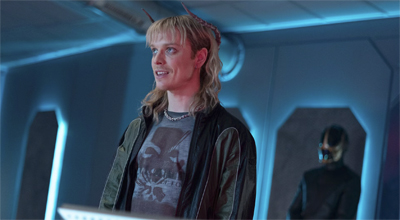
Not Kidding around.
The Interstellar Song Contest itself is an episode very consciously designed to affirm itself as television. This is an event. This is an episode that only really makes sense in terms of its original broadcast context. It is an episode that is designed to air on BBC One between the FA Cup Final and the Eurovision Song Contest, with Ncuti Gatwa serving as the spokesperson for the British jury. It is an episode that will obviously exist in perpetuity, but it is tied to the moment of its original television broadcast.
Doctor Who has a history of doing this. Part of the magic of Death in Heaven was the pointed political commentary of making an episode about an army of zombie soldiers returning from the grave on the eve of Remembrance Sunday. Even the inclusion of the Stenza in the first season of Chris Chibnall’s era, in episodes like The Woman Who Fell to Earth and The Battle of Ranskoor Av Kolos felt like it was built on the assumption that the release of The Predator would be a bigger deal than it was.
This is part of the magic of television, which has always been more dynamic and immediate than film. Film exists in its own vacuum and space. Movies are produced and developed years before they are released, with their releases moved around and staggered. Movies are intended to have longer shelf lives, in the hope that they will be just as relevant when they are released on home media as when they were in theatres, and just as compelling when they broadcast on television as they were on home media.
In contrast, television is much more of a conveyor belt. It has traditionally had a much quicker turnaround and been designed to be less of a perennial product. It took cinema years to properly process and react to the terrorist attacks of 9/11 in movies like The War of the Worlds or The Dark Knight. However, television was able to offer a much more immediate reaction in shows like 24 or The West Wing.
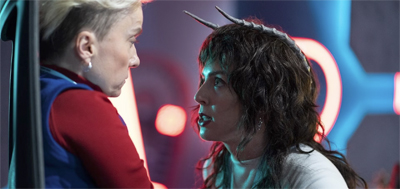
Raising Hellion.
Films exist somewhat in isolation as completed objects. Television episodes exist in context, whether the context of the larger season of the show around them or the broadcast schedule in which they release. It’s very telling that Disney’s efforts to treat a major blockbuster franchise like television with the Marvel Cinematic Universe eventually unravelled because film doesn’t work like television and television doesn’t work like film.
Of course, the episode is itself an illustration of the inherent tension within the production of television. The Interstellar Song Contest was written and developed more than a year ago, but tailored for this specific night. There is no way that Davies and the production team could have calculated all of the variables at that distance, and so there is a huge risk in pinning an episode like this to a specific moment.
After all, as this review is published, there is no way of knowing whether The Interstellar Song Contest will actually air on television. It is entirely possible that the FA Cup Final will push into extra time, and that will leave insufficient room between that and the Eurovision Song Contest to fit a forty-minute episode. Davies openly acknowledges the gamble that the show made in scheduling this episode for that slot, not knowing all of the variables, describing it as “the sexiest f&!king risk.”
However, this tension simmers through the episode in other ways. The Interstellar Song Contest exists in a very different context than was originally conceived. According to Davies, four scripts for this season had been completed by June 2023. By 16th October 2023, Davies confirmed that “a lot“ of the season had been written. In other words, if The Interstellar Song Contest was not finished by the time that Israel launched its invasion of Gaza on 27th October 2023, it was certainly close to completion.
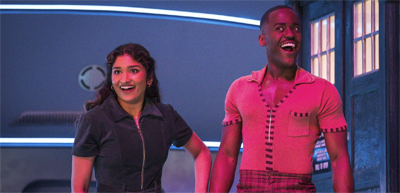
Quite the Vision.
It is impossible to discuss The Interstellar Song Contest without considering the Israeli invasion of Gaza and the humanitarian crisis unfolding in real time. Israel has long been involved in Eurovision. Indeed, Israel is part of the queer history of Eurovision, submitting Dana International, the first transgender winner of the competition.
Understandably, given the human rights abuses and atrocities taking place in Gaza, there has been some debate about Israel’s ongoing participation in the Eurovision Song Contest, to the point that there are observers advocating a boycott of the competition. As such, it becomes very hard to read The Interstellar Song Context outside of this context, a context that did not exist when the story was initially developed and written.
Obviously, the colonial exploitation in The Interstellar Song Contest is committed by a larger intergalactic corporation rather than a nation state. However, the Hellions work as a metaphor for the oppressed Palestinians, an ethnic group that are marginalized and victimised, subject to racialised stereotypes, with their suffering largely ignored by the international community.
Indeed, there are moments when The Interstellar Song Contest comes close to acknowledging this subtext. “Your planet was invaded for honey?” Belinda asks Cora, wondering if the company destroyed the Hellions to steal their crops. Cora responds, “My planet was invaded for honey flavouring.” The invasion wasn’t to take honey, but simply to assure the company’s market dominance as a provider of honey. It feels notable that Israel has traditionally been known as “the land of milk and honey.”
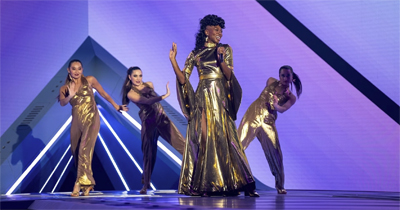
Making a big song and dance about it.
As with Lucky Day, there is a clear sense that The Interstellar Song Contest has its heart in the right place, even as it stumbles awkwardly over its central metaphor. In this context, while it is motivated by the plot, the Doctor’s complete lack of empathy for Kid is striking. “I have met so many versions of you, Kid,” the Doctor explains. “And revenge is just an excuse. Because your cold, filthy heart just likes to kill.” The entire text of this sequence is that the Doctor is going too far, but it’s very close to the justifications used for the Israeli invasion of Gaza, and it’s never really walked back.
Central to The Interstellar Song Contest is the idea that the suffering of the Hellions is being suppressed. This ties back into that central thematic plank of the Davies era, the power of mass media to shape opinions and discourse. After all, the victims of genocide are often denied personhood or empathy in media narratives – they are often the subjects of propaganda to justify the violence inflicted up them.
Across his second tenure showrunning Doctor Who, Davies has been keenly away of how the media becomes complicit, how it enables the spread of toxic and dangerous ideologies; the signals that drove the aliens mad in Wild Blue Yonder, the contagious selfish madness in The Giggle, the insulated self-obsessed bubbles in Dot and Bubble, the right-wing eco-sphere in Lucky Day. Perhaps the boldest aspect of The Interstellar Song Context is the extent to which the episode is willing to implicate something as inherently progressive and universally beloved as Eurovision.
There is, of course, an inherent problem with this. While Davies is correct in focusing on the power of media to shift narratives and to change minds, and it’s thrilling to see Doctor Who position itself directly in opposition to this toxicity, it occasionally veers into the self-important or the maudlin. While it is hard to overstate the damage that media can do to public discourse, it is perhaps possible to overestimate the good that it can do.
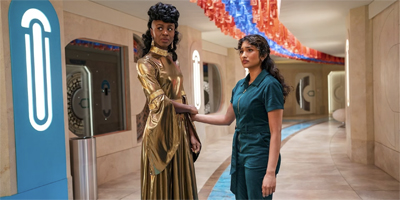
Cora concerns.
The Interstellar Song Contest builds to a conclusion in which Cora sings a traditional Hellion song to a live broadcast audience of trillions of people, moving those people with the plight of the Hellions and awakening some universal sense of empathy, compassion and humanism. It is a deeply hopeful ending about the transformative power of mass media, proposing an alternative to the corrosive power of propaganda. What if the power of television were used for good instead of evil?
It is sweet, but it feels unearned. More than that, it feels unconvincing. It feels indulgent and self-important, like the show is patting itself on the back for nothing more than acknowledging the horror of what is happening. Davies has always been a deeply cynical writer when it comes to people. He is inherently skeptical of human beings, as demonstrated by scripts like Turn Left and Midnight.
As such, the happy ending of The Interstellar Song Contest does not feel entirely satisfying. It feels like Davies and Dawson are trying to channel the more optimistic perspective of Steven Moffat, with the thawing of the spectators providing an “everyone lives!” ending and the “transformative power of television” beat evoking Extremis. However, given the larger context of the episode and the themes that it invokes, the ending winds up filling dissonant and disorienting.
To be fair, The Interstellar Song Contest could not have known that it would be broadcasting in the midst of a human rights catastrophe that Amnesty International has classified as a genocide. Things have gotten so bad so quickly that it feels almost churlish to complain about Doctor Who not being able to keep up with events in an episode that was written two years previously and shot more than a year ago. Still, The Interstellar Song Contest is an episode that is designed to exist in the specific context of its broadcast, and so needs to be considered in that frame of reference.
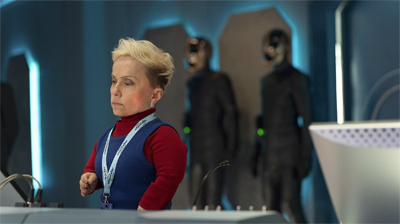
In-console-able.
There is one more tension tucked away within The Interstellar Song Contest. This is clearly designed to be a blockbuster episode of the show, broadcast between two of the biggest television events of the year. It’s clearly intended to serve as a big populist episode that will draw eyes to the show, potentially luring the audience in for the two-part season finale that kicks off with Wish World. As such, “Die Hard at Eurovision… in space!” is a pretty compelling pitch. It’s a concept that can be parsed by any audience member, regardless of their familiarity with Doctor Who.
On paper, The Interstellar Song Contest should be an accessible episode of Doctor Who for general audiences. It features “the Immortal Rylan” as a significant guest star and includes a cameo from Graham Norton. Die Hard is one of the most iconic movies ever made and “Die Hard on a [blank]” is a straightforward pitch, so it blends nicely with another television institution.
However, The Interstellar Song Contest is designed to lead directly into the two-part finale in a more direct manner than Rogue did. Theoretically, this makes sense. The Interstellar Song Contest seems likely to be seen by a large audience, so why not rope them into the finale? However, it does this in an incredibly intrusive and clumsy way, with cameos from Carole Ann Ford that come out of nowhere, with not context within the episode itself.
To be fair to Davies, his return to Doctor Who seems to have been leading to Susan’s return. In The Church on Ruby Road, Davies recontextualised “the Timeless Child” away from some grand mythology and reworked it as a story about an abandoned and orphaned child. This served to create a thematic connection between the Doctor and Ruby. Both were children abandoned by their parents and cast out into a hostile and alien world.
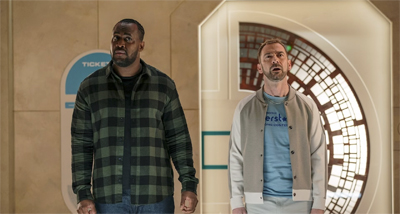
Continuity locked out.
These seasons have been preoccupied with abandoned and neglected children. The Church on Ruby Road was about goblins who kidnap children. Space Babies found the Doctor and Ruby helping a bunch of abandoned children in deep space. The first members of “the Pantheon” faced by the Doctor and Ruby were the Toymaker and his daughter the Maestro. In The Story and the Engine, the Doctor confronts Abena, the daughter of the trickster god Anansi. Even in Lucky Day, Conrad is a young child who feels abandoned by the Doctor.
This is a solid thematic hook on which to hang the return of Susan, the granddaughter that the Doctor abandoned in The Dalek Invasion of Earth and – allowing for cameos in stories like The Five Doctors – never returned to. While the show has subtly invoked Susan in the abstract with episode titles like The Doctor’s Daughter or in photographs in episodes like The Pilot, Davies has brought the character to the fore. The Doctor mentioned Susan explicitly in The Devil’s Chord. The central recurring hook in the previous season was an actress literally named “Susan Twist.”
More broadly, Davies’ era has been preoccupied with the existential weight of continuity in a way that feels like a commentary on how these sorts of franchises are expected to function nowadays. The Legend of Ruby Sunday brought back Sutekh, a villain from Pyramids of Mars beloved by fans but whose very presence represented the idea of death and decay. The Well found the Doctor confronting the monster from Midnight, now reimagined as a monster that attaches itself to its victim’s back, never seen but always present, the weight of continuity.
There are good reasons to bring Susan back. There is a palpable anxiety that Doctor Who might be facing a hiatus, and so it’s understandable for the show to tie up a dangling thread that has been left hanging for over sixty years. More than that, Carole Ann Ford is eighty-four years old. In pragmatic and practical terms, the window to bring the character back and to recognise her importance to the show’s history is closing.
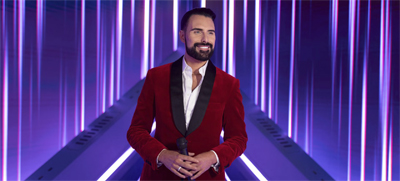
Raising a whole host of continuity questions…
Susan’s return is a momentous occasion. Susan was the first companion, and she was the first companion to leave. She is the rare firm tie to the Doctor’s past and history, a bit of continuity that is hard to reconcile with all the lore that has built up over the ensuing decades. However, while Davies has gone out of his way to remind audiences of the existence of Susan, he has never quite committed to the practical implications of Susan’s return.
It feels like Susan’s return deserves more context and weight than a couple of clumsily editted flashbacks in the penultimate story of the season, with minimal context and set-up. It’s clear that Davies is trying to preserve the surprise and to avoid any potential leaks. If Susan is more properly seeded in episodes like The Robot Revolution or Lux, then the internet has more time to figure out that she is returning in the series finale. So the pragmatic choice is to delay foreshadowing until the last possible minute.
It’s a deeply cynical choice, one that prioritises “surprise” over quality. Then again, this is how Davies has always worked. His seasons aren’t really arcs or long-form stories. They are instead built around recurring phrases and images that are designed to tease and build excitement. For all the criticisms that Moffat attracted for his arcs and mythologies, Moffat did a much better job of setting up and paying off threads across a season. In contrast, Davies throws in a few arbitrary teases and ends up having to backload the season with exposition.
This is not to suggest that the return of Susan has to feel so “inside baseball”, so alienating to the sorts of fans tuning in to watch something after the football and before Eurovision. With a little extra polish, and a little willingness to forego suspense and surprise in exchange for narrative clarity, Davies could easily have lured causal viewers into the question of what it means for the Doctor to have a granddaughter, let alone a granddaughter who is played by a white actor fifty-two years older than Ncuti Gatwa.
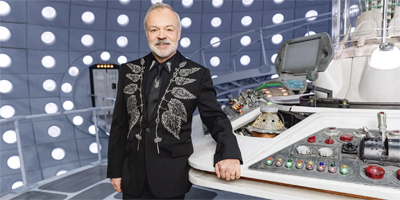
Nor(ton) the battle to the strong…
This is the role of the companion, to explicate this sort of dense mythology and lore. The companion serves as the audience’s guide into the world of Doctor Who, and so if Davies had been a little more willing to make the Susan thread part of the larger story of the season around it, it would have been entirely possible to fold it neatly into what is sure to be one of the biggest episodes of the season. Instead, Susan’s appearances are disjointed cameos that are wildly disorienting to anybody not intimately familiar with sixty-plus years of Doctor Who, a strange choice for such a broad episode.
Interestingly, the mid-credits appearance of the Rani skirts around this. The Rani is obviously a rather dense bit of Doctor Who continuity. There is a palpable “… have we run out of monsters that audiences will actually remember?” desperation to bringing the character back, particularly as the focus of the season finale. However, The Interstellar Song Contest wisely skirts around the character’s continuity, and instead just communicates that the Rani is another Time Lord.
There is, ironically given fandom’s complaints about Davies returning too frequently to the well of “the last of the Time Lords” angst, a question of whether the Doctor has made enough of his status as “the Last of the Time Lords” for the appearance of another Time Lord to feel like a big deal to the average viewer. The Fifteenth Doctor has mentioned his status to Belinda a couple of times, but Gatwa has never played sorrow or loneliness in the same way that Tennant did during his tenure, in the lead-up to the return of the Master.
Still, the reveal sort of works in the broader context of The Interstellar Song Contest as a piece of unashamed stunt television, in that Archie Panjabi is a legitimately impressive “get” for the show, in the same way that Maisie Williams was. Panjabi is an actor who means something to audiences not already steeped in the lore of Doctor Who, and “hey! it’s a big guest star!” is a decent enough hook for a big cliffhanger airing right before Eurovision, particularly in the context of Panjabi as something of a queer icon having played one of the rare bisexual characters on prime-time American television.
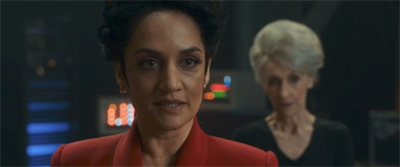
Make it Rani.
The Interstellar Song Contest is a mess of an episode, a set of competing and irreconcilable tensions driving in multiple directions simultaneously, pulled by the gravity of factors that exist outside the confines of the episode itself. On the one hand, this is frustrating. There is a version of this episode that works, and this is not it. On the other hand, it’s oddly endearing. It’s no surprise that an episode with this many balls in the air should fail to cohere. Indeed, it feels like a miracle that an of The Interstellar Song Contest works at all.
Filed under: Television | Tagged: Broadcast, doctor who, eurovision, film, gaza, israel, ncuti gatwa, palestine, russell t. davies, song, streaming, Television, the interstellar song contest |



 the m0vie blog
Leave a comment