












“There’s still hope.”
“Hope is irrelevant.”
The Well is a strange and triumphant exercise, a collection of contradictions that coheres remarkably well.
It is a chamber piece, a very basic Doctor Who story that could easily have been executed on the classic BBC budget, blown up with Disney+ money. It is a very obvious sequel to at least one beloved story from Davies’ original tenure as showrunner, and saturated with references to others, while still feeling undeniably like a produce of his second era overseeing the show. It is an exercise in nostalgia, but also a story about how that nostalgia is cursed. It is also Russell T. Davies revisiting his early work, while taking cues from Steven Moffat.
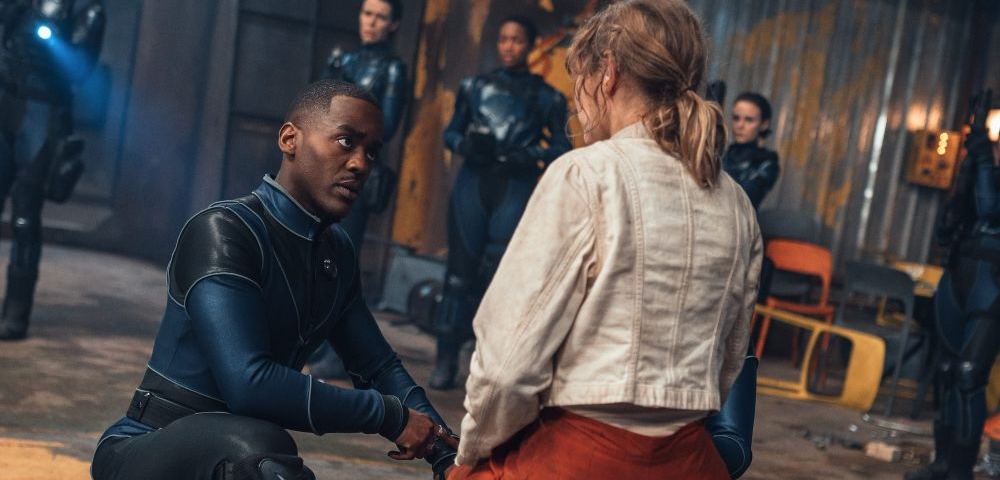
All’s well…
It shouldn’t work. The Well should collapse under its own weight. It should feel like an indulgent mess, a collection of clashing recycled imagery and iconography. However, The Well manages to strike a very careful balance between its competing priorities, allowing the individual elements to add up to more than the sum of its individual parts. It’s an episode that feels like an extension of Davies work in both The Robot Revolution and Lux, solidifying a rich thematic vein running through the first three stories of the season.
The Well is a remarkable accomplishment.
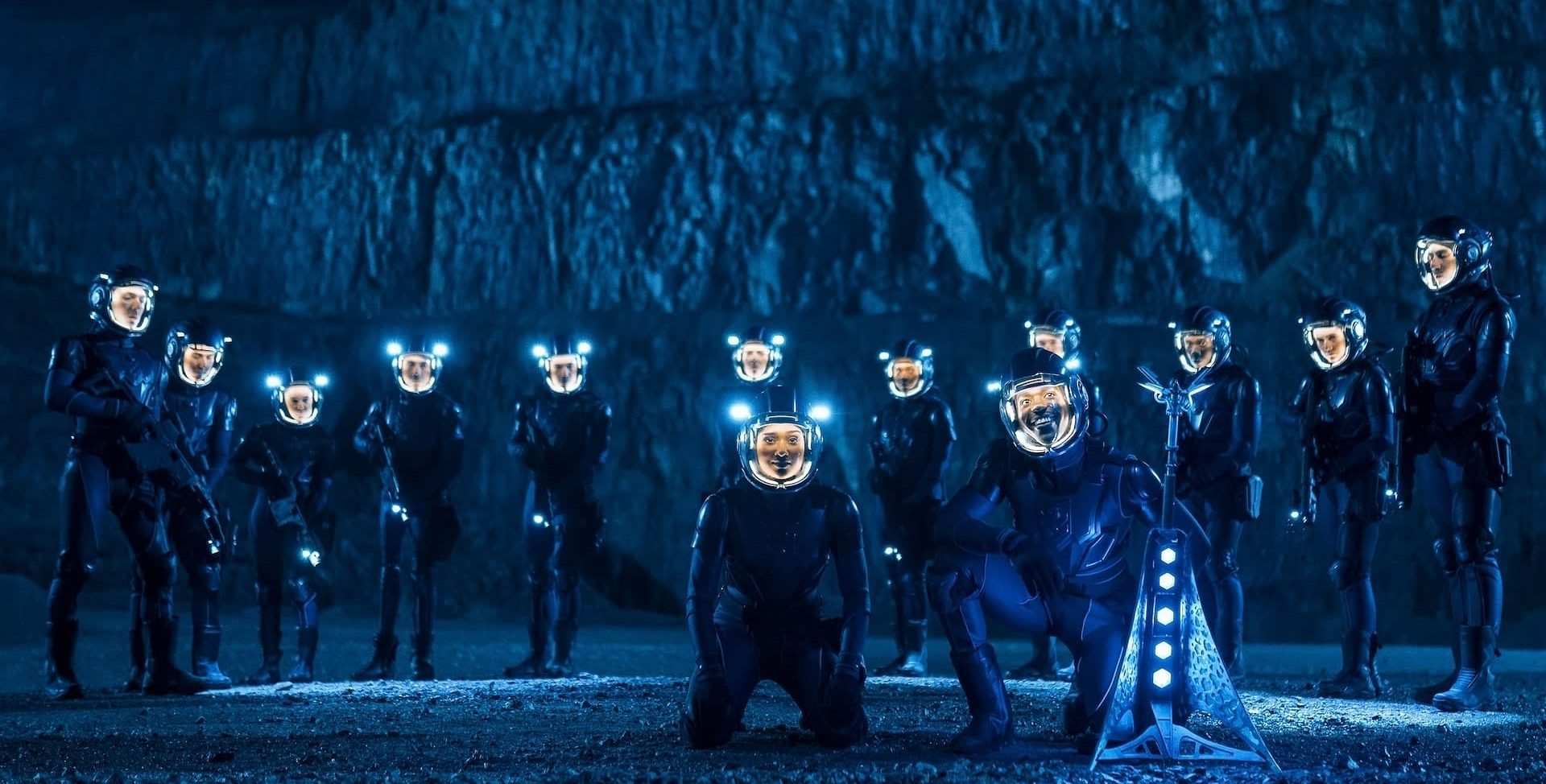
Spaced out…
Inevitably, discussions of The Well are going to get drawn to the continuity of it all. This makes sense. Talking about a Doctor Who story, the impulse is going to be to talk about Doctor Who. However, before getting into all of that, it is worth considering what type of story The Well is supposed to be. Setting aside the allusions to classic Doctor Who stories, The Well belongs to a particular strand of science-fiction. If The Robot Revolution harked back to the now-retro-futurist-aesthetic of the fifties and sixties, The Well evokes the grittier science-fiction of the seventies through nineties.
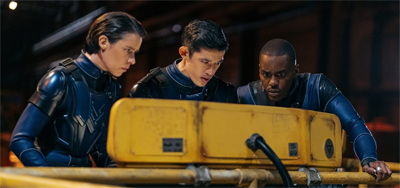
The Well is a story about an armed platoon of troopers. For most of the episode, the characters are not identified by name, but instead by designation: “trooper one”, “trooper two”, “trooper three.” These soldiers carry big guns and visit worlds that are inherently hostile to human life, bathed as thy are in the galvonic radiation of a dying star. The Well opens with the science-fiction equivalent of a halo jump, which might feel like an allusion to the opening of Dune: Part Two, if the episode weren’t shot long before it released.
There is a grimness to The Well. Shaya Costallion has been in military service since she was fourteen years old, having grown up in “the wildlands.” Via completely gratuitous flashbacks, the audience understands that these wastelands are populated by dinosaur skulls and fire. She was raised “shooting drought sharks from the age of six. I could run faster than a snake-lighter.” She warns the Doctor, “The fight began the day I was born.”
The Well does little to hide its obvious frames of reference. This is a mission about a squad of space marines sent to investigate a colony that has fallen strangely silent, discovering a sole survivor. “What if no one’s alive?” Belinda asks at one point. “What do we do then?” Cassio Palin-Paleen responds, “What we should have done in the first place. Nuke this site from orbit.” There is a sense that he believes it is the only way to be sure.
Soldiering on.
It is interesting to wonder if the allusion to Aliens is a sly nod to Davies’ new production partner, Disney+, in the same way that the allusions to Star Wars in The Robot Revolution felt like a playful tease of the international conglomerate. Still, while Aliens is the most pronounced reference point for The Well, the episode also feels like it’s drawing more broadly from that vein of militaristic science-fiction and science-fiction horror. The “base commander’s final statement” certainly evokes Event Horizon.
Indeed, as with Lux, there is something a little cheeky about The Well. The episode obviously benefits from the increased production value owing to the Disney partnership. The sets are large and lavish. There are new space suits. There are far more extras than there need to be. However, it’s also very striking that this is exactly the sort of story that Doctor Who could easily have done on an old BBC budget. There is no need for a new creature design. The story could be done with minimal computer-generated effects. The bulk of the story is a group of characters chatting in a room.
This feels a lot like Boom, which rather wryly used the massive Disney+ production budget to build a massive set of the sort of quarry that the show had been filming in for decades. It is endearing that Davies has not lost himself in the show’s increased budget, that he has worked hard to ensure that Doctor Who still looks and feels like Doctor Who, just with a significantly increased budget. While Lux could only exist in the show’s current state, there is a cheap-and-cheerful version of The Well that could have aired on the BBC in 1989, but this is not it.
More broadly, the aesthetics of the episode are steeped in the language of so-called “hard” science-fiction, science-fiction that eschews any real sense of fantasy or magic and which is rooted in scientifically plausible concepts. Hard science-fiction traditionally avoids things like teleporting or faster-than-light technology. It is a different sort of science-fiction than that traditionally featured in franchises like Doctor Who and Star Wars. Indeed, there is often an implied superiority of “hard” science-fiction over its “softer” variants, because it is more rigourous.
Into the wild blue yonder.
The Well is steeped in the tropes of hard science-fiction. It is a story about troopers visiting a mining colony on a dead world, with big guns. There’s an emphasis on procedure, hierarchy and structure – the limit on the number of troops inside the base, the Doctor posing as a superior officer. There’s a lot of time given over to the limitations of the technology that the characters are working with – the “restraining bolt” on the base computer, the five hours that the ship will take to land.
Indeed, The Well is so “hard” that the mining colony is literally mining diamonds, although the soldiers refer to these diamonds as “carbon-46” to make them seem especially technical and precise. Much like the retro-futurism of The Robot Revolution, this is a very traditionalist approach to the genre, one that can often feel conservative and reactionary. Hard science-fiction was a major campaign plank for the “sad puppies” and the “rabid puppies”, reactionary groups trying to seize control of the Hugo Awards back from more progressive elements.
As with The Robot Revolution, there is a clear sense of playfulness in this. Davies is once again crashing Doctor Who into a particular strand of mainstream science-fiction storytelling. In doing so, he is perhaps drawing attention to how rarely these sorts of narratives found space to centre actors like Ncuti Gatwa and Varada Sethu. It’s never made explicit – in fact, it’s much less central here than in The Robot Revolution – but it feels like a logical extension of what Davies did in the season premiere, making room in these kinds of stories for characters who aren’t often welcomed.
However, there is also a very clear tension simmering through The Well, which makes the episode feel more interesting than a classic gritty “base under siege” narrative. The Well takes these familiar elements of hard science-fiction and throws them into conflict with something more abstract and surreal. Davies has openly talked about how much his second era draws from folklore and fairy tales, and so Costallion leads her team into a story that they don’t completely understand.
Enemy mine.
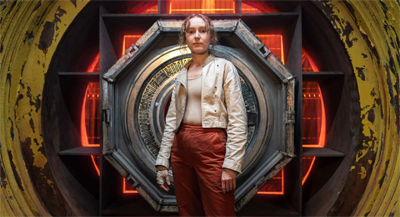
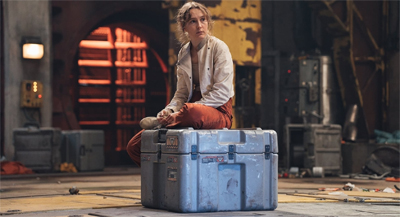
It feels appropriate that the sole survivor is Aliss Fenly, whose name is just a slight science-fiction twist on “Alice.” Arriving at the base, the marines find that every mirror has been destroyed. “They broke all the mirrors,” Belinda notes. “Every single room. There’s no mirrors.” This is a major thematic point for the episode. The Doctor notes that the mineshaft “operates as a mercury drop”, mercury being a key component in the construction of old mirrors.
Indeed, mirrors and reflections become key to trapping the monster that lurks at the heart of The Well. Aliss ultimately goes on an adventure “through the looking glass.” Mirrors are, after all, steeped in superstition and mythology. Indeed, while the creature in The Well is explicitly the same monster from Midnight, it presents more like the spectre in 73 Yards, something from a ghost story rather than a science-fiction tale. This is Davies channelling the same energy that he brought to Wild Blue Yonder, crashing superstition and science-fiction together.
The Well is also recognisably of a piece with The Giggle, reflecting Davies’ skepticism and cynicism about the state of the modern world. The opening acts of the episode suggest that the base succumbed to some sort of collective insanity that caused all of the residents to turn on one another, to murder their friends and relatives in a fit of madness.
“They all went mad,” Aliss explains to the Doctor. “Every single person just went mad and it happened so fast.” It is telling the Doctor’s first impulse is not to blame some invisible monster, but to ask if this could have a rational explanation. “This mineshaft operates as a mercury drop,” he explains. “Was there any mercury that escaped?” Mercury can cause madness after all; it is the origin of the phrase “as mad as a hatter“, to make another allusion to Alice in Wonderland.

Mercury falling.
There is something very bleak and very cynical in all of this, in the possibility that these people just went spontaneously mad and turned upon one another. It is very similar to the starting premise of The Giggle, which imagined a world in which human beings lost the capacity to work together and instead became raving individualist lunatics with no concept of a shared reality or society.
Interestingly, this is a theme that used to be quite prevalent in science-fiction. The original Star Trek was saturated with stories of contagious and all-consuming madness: The Naked Time, Dagger of the Mind, Operation — Annihilate!, Wolf in the Fold, The Immunity Syndrome, And the Children Shall Lead, Is There in Truth No Beauty?, The Lights of Zetar and so on. This fixation on madness spreading like a disease through space as a contagion resonated with the apocalyptic anxieties of the late sixties. It makes sense that this theme would be back in vogue.
This worry that civilised society is an illusion that will fracture under the is a very contemporary fear, and it is something that Davies clearly thinks about; similar fears underlined Midnight, after all, albeit in a less extreme way. There is a palpable paranoia running through Davies second tenure running Doctor Who, a sense of mounting apocalyptic dread.
In this context, it seems notable that The Well draws repeated attention to the absence of Earth from the galactic stage. This is obviously Davies setting up his season finale, with the audience to understand that Earth was most likely destroyed in May 2025, per the closing scenes of The Robot Revolution. Still, this is a markedly different approach than Davies has adopted in earlier stories.
Future tense.
Davies has always argued that mankind will survive and thrive, that humanity will – to quote the Doctor – “voyage out there and own it. Far and wide, across the stars.” Humanity might change and evolve, but there will always be a future. Earth might be consumed in The End of the World, but humanity will find somewhere new to settle in New Earth. Even as the stars blink out, and even with the cold empty void consuming them in Utopia, humanity will cling to existence.
This was true even in seasons with apocalyptic stakes. The Dalek abduction of Earth in The Stolen Earth and Journey’s End did not erase humanity from Planet of the Ood or Silence in the Library and Forest of the Dead. The Master might have turned the TARDIS into “a paradox machine” in The Sound of Drums and The Last of the Time Lords, but that did not prevent a warning escaping to the future of New Earth in Gridlock, implying the Earth didn’t get destroyed. This is not how Doctor Who has ever operated before, even setting and teasing its big season finales.
As such, the absence of Earth and humanity is more than just a little continuity breadcrumb. It feels like a broader statement. It is an expression of a deeper existential anxiety. When Davies left Doctor Who in 2010, the Doomsday clock had actually been pushed back by a minute, so it was at six minutes to midnight. The Doomsday clock is now 89 seconds to midnight, the closest that it has ever been. This feels like an appropriate sentiment for an episode that is quite literally about approaching Midnight.
Of course, it is impossible to talk about The Well without talking about Midnight. However, it is worth acknowledging that while the episode is an explicit sequel to Midnight, it is actually saturated with nostalgia for a host of other Davies era stories. The hole to the centre of the planet feels like an allusion to The Impossible Planet and The Satan Pit, as does the closing scene of Mo Gilliben listing off all of the dead characters. The notion that there is something unseen at Aliss’ back cannot help but evoke Turn Left. Even the Toxic music cue comes from The End of the World.
Back to the future.
This is interesting. Davies obviously had his own recurring and returning aliens, although the tended to be the toyetic monsters. The Slitheen appeared in Aliens of London and World War Three, before coming back for Boom Town. Cassandra appeared in The End of the World and New Earth. The Face of Bo was revealed to be Jack Harkness. The Ood were introduced in The Impossible Planet and The Satan Pit, before becoming the focus of Planet of the Ood. The Judoon popped up in Smith and Jones before reappearing in The Stolen Earth.
However, Davies has never done something quite like revisiting Midnight. He has never returned to one of his high-concept monsters. So it feels notable that The Well directly alludes to three of the more profoundly unsettling and abstract of Davies’ monsters: the literal devil in The Impossible Planet and The Satan Pit, the mimic from Midnight and the reality-altering bug that attaches itself to one’s back but can only be seen out of the corner of one’s eye from Turn Left.
As ever, there is a clear sense that Davies has grown and evolved as a writer in the gap between his two tenures, and has been paying attention to what it is possible to do with Doctor Who. Much as Steven Moffat’s tenure running Doctor Who owed a great deal to Davies, Davies’ return owes a great deal to Moffat. Indeed, quite apart from the continuity of it all, the idea of an unseeable monster that might just be madness is lifted directly from Listen. “It’s a great big empty room,” Mo protests. “There can’t be anything, can there?”
Even the basic structure of the episode owes a lot to Kill the Moon, another story that starts under the auspices of being a hard science-fiction story before swerving sharply into high-concept fantasy. Davies clearly has an affection for Kill the Moon, borrowing that episode’s closing scene for the conversation between Belinda and the Doctor in The Robot Revolution.

Somehow, The Satan Pit got behind me…
Belinda continues to grow and develop in The Well. It is fun to have a companion who is still rather agnostic on the concept of being in Doctor Who, and whose first instinct on landing on the surface of an alien world is to hop back in the TARDIS because she knows that danger is lurking just around the corner. Nevertheless, it is also very charming to see the Doctor slowing winning her over, slowly selling her on the magic of Doctor Who. As he teases her, “Girl, you are beginning to enjoy this.”
Moffat’s influence is all over The Well. The resolution to the plot hinges less on science-fiction logic than it is on metafiction. “If the thing behind you always gets destroyed, what if the thing behind you is you?” the Doctor asks, effectively weaponising the creature’s own gimmick against itself. When that doesn’t entirely work, Costallion saves the day by “running”, which has obviously been a major emphasis of Doctor Who since Davies’ era, but became a major thematic lynchpin under Moffat.
More to the point, Davies seems to have been inspired by Moffat’s decision to bring back the Weeping Angels during his tenure as showrunner. After all, the Weeping Angels are perhaps Moffat’s single greatest contribution to Doctor Who, to the point that Lux included a joke about how beloved Blink was and Chibnall even used them in Village of the Angels. Davies seems particular drawn to the Weeping Angels as a concept; Lux riffs on the concept that an image becomes the very object of which it is an image.
Even within The Well, there is a very clear homage to Blink. “Do not look away,” Cassio orders Aliss at one point, which is lifted directly from the Doctor’s instruction in the iconic introduction to Blink: “Don’t turn your back, don’t look away, and don’t blink.” However, Davies seems more inspired by the idea that he can bring back an iconic high-concept monster, like Moffat did with the Angels in The Time of the Angels and Flesh and Stone, and that he can take the opportunity to rework the concept a little bit, like Moffat did with the Angels in The Time of the Angels and Flesh and Stone.
Long dark Midnight of the soul…
Very tellingly, the creature in The Well doesn’t behave that much like the creature in Midnight. It does not repeat the mimicry gimmick. This makes sense, given that it’s a concept that works perfectly but could easily become repetitive. Instead, like Moffat layering metafictional tropes on top of the Weeping Angels, Davies instead extrapolates the high concept. “And if you go behind it, you die,” Belinda explains of the logic that guides the creature. The Doctor offers a title drop, “If it was a clock-face, you die at midnight.”
Logically, this is quite the contrivance. There was nothing in how the creature behaved in Midnight to indicate that it worked this way. More to the point, it does seem a little convenient that this creature should happen to emerge on a planet literally called “Midnight.” It’s a a decision that only really makes sense outside the context of the narrative itself. Which is fine, given how porous the fourth wall can be on Doctor Who, as demonstrated by Lux.
Indeed, even the new logic of the entity is metatextual. The creature doesn’t just attack when Aliss turns her back. It can only attack when somebody moves behind Aliss relative to another observer. There is an early sequence where Aliss does a complete turn without killing anybody. The “clock-face” referenced by the Doctor is not relative to Aliss or to the victim. It is contingent upon an observer. The act of watching is an essential part of this dynamic. The viewer is not just a participant, but seemingly the crucial participant.
More to the point, it gets at the sense in which The Well is less specifically about a sequel to Midnight than it is about the concept of nostalgia in general, of returning to earlier ideas, of going – as the title suggests – “back to the well.” Indeed, the monster in The Well behaves less like the creature in Midnight than it does a manifestation of the very idea of nostalgia and continuity, an impossible and invisible weight that stands behind any attempt to tell a new story.
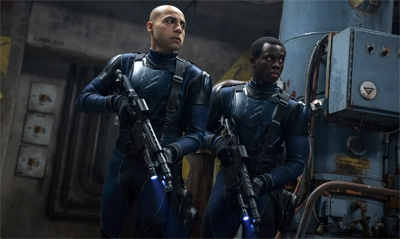
There are some forces not to be rifled with.
The Well reveals that the planet formerly known as “Midnight” has become a natural resource to be harvested and exploited. “This is a diamond mine,” Costallion tells the Doctor. “The entire surface of this planet was once made out of diamonds.” The idea seems to have been to return to what was once a place of abundance and harvest anything of value from it, and in doing so the miners awakened a monster.
Nostalgia is one of the big thematic preoccupations of the second Davies era. It is a tension at the heart of this version of Doctor Who. After all, Davies is himself a ghost from the show’s own past. He relaunched the show with the return of David Tennant and Catherine Tate. He did so with three stories, the first of which – The Star Beast – brought an old comic book into the show’s continuity and the third of which – The Giggle – resurrected a nearly-sixty-year-old villain from a long-lost serial.
At the same time, Davies has been somewhat ambivalent about nostalgia. The Legend of Ruby Sunday and Empire of Death brought back the classic monster Sutekh as “the god of death”, destroying everything that he touched as the Doctor scrambled to stay afloat inside “the Memory TARDIS.” In The Robot Revolution, the planet known as “Missbelindachandra One” was devastated by a war conjured into being by a young man obsessed with retro-futurist science-fiction. In Lux, Mister Ring-a-Ding controls Pye by allowing him to revisit old footage of his dead wife.
Doctor Who is haunted by its own past, which seems to stalk the show. The monster in The Well owes a lot to the creature that follows Ruby in 73 Yards. It is notable that the distance that the specter keeps from Ruby in 73 Yards, roughly 67 metres, corresponds to the initial designation of the planet in The Well, “Planet 6-7-6-7.” The revival has been running for two decades at this point, long enough to amass its own continuity that Davies has tried to shake off by rebranding the last series as “season one“, but there is no way to escape that weight and what it carries with it.
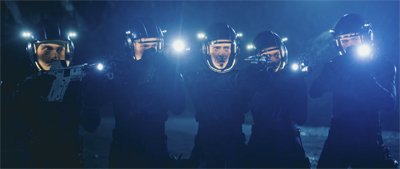
“Light ’em up…”
After all, nostalgia is a trap. So many modern major franchises – including Star Trek and Star Wars – have become beholden to nostalgia, lost in their own past and unable to find a way forward. To his credit, Davies seems to be actually and actively trying to push Doctor Who forward, to try new things. There is very little in the history of Doctor Who, for example, that compares to The Devil’s Chord or Lux.
There is also perhaps a more broader cultural critique in here. Nostalgia has become the defining politics for the United States and the United Kingdom. This sort of empty yearned for some imaginary past is a bottomless pit, one that can never be filled or satisfied, and which serves to justify reactionary politics and policies. Because nostalgia is the invocation of other signifiers from other contexts, nostalgia itself is invisible. However, it is also behind.
In this sense, The Well is recognisably of a piece with the larger second Davies era. This is a story which is, at its core, about the idea that turn one’s back on another is an act of violence that might even lead to death. It is an angry concept, but one that is very firmly rooted in the politics and the aesthetics of Davies’ second tenure as showrunner.
Davies has repeatedly stressed the importance of inclusion to his vision of Doctor Who, very specifically around transgender actors and characters. He has lauded the “increasing the visibility of queer characters on screen“, and publicly decried attempts to exclude transgender people from queer spaces contended that “to cut out the ‘T’ is to kill.” In essence, to turn one’s back on a vulnerable group is to make one’s self complicit in their suffering and death – a metaphor woven into the fabric of The Well.
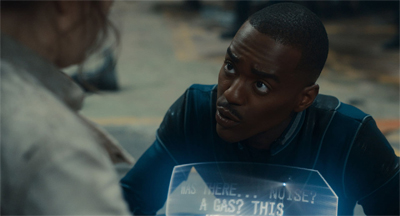
Making the subtext text.
This subtext is fairly heavily suggested in the text of the episode itself, most notably through the decision to present Aliss as a deaf character. Apparently this was not part of Davies’ original conception of the episode, but arose from his desire to cast Rose Ayling-Ellis in the role. Nevertheless, the episode draws attention to what it means to turn one’s back on a deaf person – it very literally makes it impossible for them to have any agency in the conversation, as they cannot read the lips, read the signs or even read the clever on-screen subtitles.
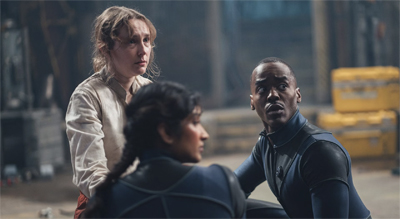
This moment is a clever piece of irony. Ostensible it is Aliss who is dangerous, with monster lurking behind her back. However, it is the soldiers who very literally turn their backs on her. “Don’t turn your back on me,” Aliss pleads with the troopers. “Please, don’t turn your back on me.” Costallion’s decision to turn her back on Aliss would be a literal death sentence.
This feels like an observation very directly targeted at Davies’ production partners at Disney, who have made a big deal of cutting transgender characters from their own media like Win or Lose and episodes featuring transgender characters from shows like Moon Girl and Devil Dinosaur. This erasure of a minority community, turning its back on some of the most vulnerable people in the world, just makes it easier for those groups to be targetted and further marginalised.
It is a really clever conceptual idea, and it is executed remarkably well. It is a clear thematic furtherance of ideas simmering through the larger Davies era about the importance of media like Doctor Who in the current political landscape. There might not be much that the Doctor can do when confronted with an ancient and unimaginary evil, but at the very least he can refuse to turn his back.
Filed under: Television | Tagged: alien, continuity, creature, disney, doctor who, hard sci-fi, hard science-fiction, memory, metaphor, Midnight, ncuti gatwa, nostalgia, russell t. davies, sequel, the doctor, the well, varada sethu |



 the m0vie blog
I only discovered your reviews after last week’s Doctor Who, and I love the depth of your analysis. Thank you!
Quoting a “Millennium” episode title in a photo caption is sheer genius.