












“And tell me, how did you enter this world?”
“I’m a two-dimensional character, you can’t expect backstory.”
There has been a lot of discussion about the reduction in the number of episodes of Doctor Who produced within a year. These discussions are often alarmist in nature, and framed in some sort of despairing lament about how the show is not what it once was. However, there is less discussion about how this compression of the show affects its format.
While Davies can be a chaotic writer within individual episodes, particular rushing towards a climactic resolution to a story or a season, he has always had a very vision of the structure of a given season of Doctor Who. Both of Davies’ successors, Steven Moffat and Chris Chibnall, experimented with different season structures.

Ring-a-Ding-Ding…
Moffat’s fifth season was structured identical to the previous four, and then his sixth season was structured as an inversion of that – opening with an epic two-parter, closing with a single run-around episode. His seventh season was all stand-alone episodes, while his ninth season was comprised primarily of two-parters, most of which adopted an interesting approach to the basic structure of a two-parter.
Chibnall’s first season was comprised entirely of standalone and disconnected episodes, with the Stenza serving as recurring antagonists. Chibnall’s second season was much more arc-focused, opening and closing with two big two-part adventures, with The Timeless Children rewriting the show’s lore. Chibnall’s third season was a single narrative spread across six episodes, Doctor Who: Flux.
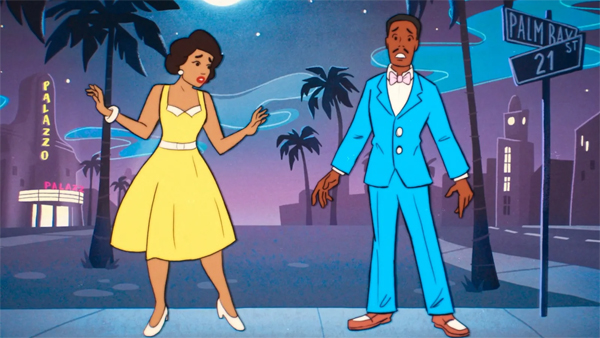
An animated discussion.
However, Davies had a structural formula and he largely stuck to it. Davies’ seasons often opened with triptych of present-past-future stories to orient new viewers in the world of Doctor Who, before leading into a toyetic monster two-parter. This would be followed later in the season by a more high-brow two-parter, and then a two-part season finale that had been seeded through the season to that point. Davies adhered rigidly to that structure.
That structure worked within the confines of thirteen-episode seasons, but obviously cannot be applied to an eight-episode season. After all, just counting through the “obligatory” episodes within that structure eats up nine of the season’s episodes. So Davies has had to come up with a new structure for the show’s seasons. Space Babies and The Robot Revolution effectively compress those opening three episodes into a single story, while The Devil’s Chord and Lux suggest an entirely new narrative archetype.
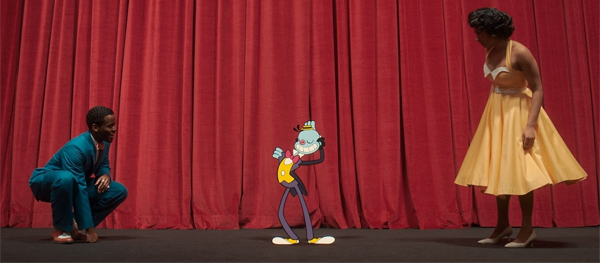
The next stage of the show…
There is some online debate about whether Davies is repeating himself, whether his approach to Doctor Who is meaningfully different now than it was twenty years ago. While it’s easy to focus on the places where Davies’ writing is similar – notably the premieres and the finales – it is also worth acknowledging where it is different. The Devil’s Chord and Lux are two episodes that are of a piece with one another, two episodes as similar to one another as Rise of the Cybermen and The Age of Steel are to The Sontaran Stratagem and The Poison Sky, fitting within Davies’ season structure.
However, they are also new and exciting. They are a type of episode that is fundamentally different from anything that Davies even attempted during his first tenure as showrunner. Indeed, they are fundamentally different from anything that Moffat and Chibnall attempted as well. They are big, bold and self-aware. They represent a clear evolution of what is possible on Doctor Who. If nothing else, they prove the show is still alive – that it is still animated.
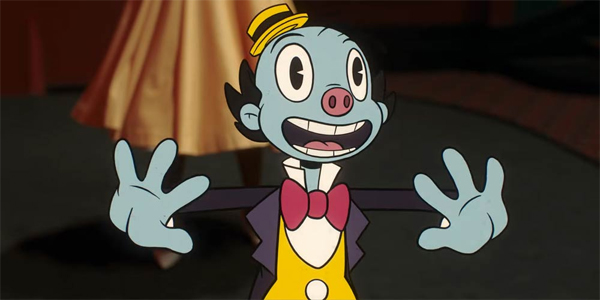
Rave about this episode until you are blue in the face…
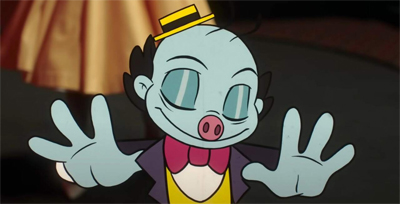
Much of the discussion of Lux is going to focus on the character of Mister Ring-a-Ding, a unique addition to the Doctor Who pantheon, in that he is a traditionally animated character who interacts with the Doctor within the confines of a live-action episode. It is a type of formal experimentation comparable to the decision to make a musical episode with The Devil’s Chord. There is a real sense with Lux that Davies is poking and prodding the audience, as if to goad them with the boast, “You have never seen Doctor Who like this before!”
He is correct, of course. Televised Doctor Who has never looked like this before. Indeed, for all that The Devil’s Chord didn’t work, feeling like the first draft of a good idea rather than a cohesive episode, there was something undeniably appealing about watching the show swing for the fences. It signalled the ambition that would come with more successful experiments later in the season like 73 Yards or Dot and Bubble. The Devil’s Chord was a failure, but a disappointing Doctor Who musical was a far more interesting failure than something like Praxeus or The Power of the Doctor.
There is a clear sense in which The Devil’s Chord and Lux are episodes that could only exist at this point in the show’s history, taking advantage of the additional money that Disney has pumped into the show. To put it simply, these are big and expensive episodes that never would have been possible when the show was scraping together pennies on the BBC budget. If nothing else, Davies is at least spending that Disney money well, using it in a way that remains distinctly and undeniably Doctor Who.
This is very different from how Star Trek or Star Wars spends its money. Indeed, it is very different than how Flux spent its money with its Sontaran, Daleks or Cybermen armies in Once, Upon Time. In contrast, The Devil’s Chord and Lux spend their budgets on more eccentric and unique choices. They are self-evidently more expensive than Doctor Who has been in the past, but they are also immediately recognisable as Doctor Who. Tellingly, Lux spends none of its budget making any concerted effort to convince its audience that Penarth Pier is actually Miami.

A Wales of a time.
Lux is a much better episode than The Devil’s Chord. It’s possible to imagine several reasons for this. Most obviously, The Devil’s Chord was Davies’ first attempt at an episode like this, and so Lux has the luxury of that experience shaping his approach to what is possible within the framework of the series. There’s also the sense that Davies is a bit less stretched on this season. Davies was credited as the solo writer on seven of Ncuti Gatwa’s first nine episodes. Davies was clearly spread rather thin. In contrast, he is only credited as solo writer of four of Gatwa’s subsequent nine episodes.
Of course, Davies is credited as co-writer on one more of this season’s episode and it seems likely that he has been involved in heavily rewriting the three other scripts in this batch that are not credited to either Davies or Moffat. However, it does seem like the pressure is off Davies on this season. This might explain why The Robot Revolution and Lux feel like a much more successful execution of the kinds of episodes that Davies was trying to write with Space Babies and The Devil’s Chord.
It helps that Lux is much more overtly about the themes that were bubbling through The Devil’s Chord. In pushing the format of Doctor Who, in challenging the reality of the show by playing with the show’s conventions, both The Devil’s Chord and Lux are stories about what Doctor Who is. The Doctor and his companion are confronted with an obviously fictional conceit, a concept that breaks the reality of the world as they understand it, whether the logic of a musical or the presence of a character from a different medium, and are forced to reframe their own understanding of reality.
There has been a fair amount of handwringing over the recurring emphasis on artifice within Davies’ second tenure as showrunner of Doctor Who. Some fans are concerned that Davies might “break” the “reality” of Doctor Who by drawing attention to the show’s fictional nature. Lux certainly does this, first of all by trapping the Doctor and Belinda within a cartoon and then by having them escape from that cartoon into a living room. The moment where the Doctor physically breaks the television screen, pushing the glass to the ground – is one of the most interesting beats in Doctor Who history.

“And she’s hooked to the silver screen.”
Lux wisely avoids playing this scene straight. It leaves a lot of ambiguity about the nature of the sequence in which the Doctor enters the viewers’ living room. On the one hand, the three fans believe themselves to be fictional, a trap within a trap set by Lux. The Doctor and Belinda believe them, so they don’t completely become aware of their nature as fictional constructs. At the same time, the audience is obviously meant to understand that these characters represent the actual audience. They laud Blink, they reference “#RIPDoctorWho”, they wear branded merchandise. They survive the closing credits.
It is tempting to write this sequence off as either a silly meaningless goof or postmodernism for the sake of postmodernism. After all, the sequence between the Doctor and these fans adds little in terms of plot. The characters signpost certain plot developments that have been previously set up within the narrative, but the Doctor routinely does that on his own. It is a “cute” joke, but there is a concern that it might be too cute for its own good, that it runs the risk of breaking the show for a goofy sequence.
However, this reaction ignores both the larger context for this playful self-awareness within Doctor Who and the specific thematic concerns of Davies’ second tenure as Doctor Who showrunner. To start with Doctor Who itself, the show has always had a decidedly porous fourth wall. The first time that the Doctor explains the “bigger on the inside” logic of the TARDIS in An Unearthly Child, he does so using television as the frame of reference, comparing the interior of the TARDIS to “showing an enormous building on your television screen.”
Throughout the show’s history, Doctor Who has often alluded to the audience’s understanding that this is a work of fiction. The Doctor broke the fourth wall to wish viewers at home a Merry Christmas in The Feast of Steven. The Doctor was implied to be a fugitive from the Land of Fiction in The Mind Robber. The two serials that opened the show’s tenth anniversary season, The Three Doctors and Carnival of Monsters, were largely about the experience of watching Doctor Who unfold on television screens. Remembrance of the Daleks has the Doctor narrowly miss the premiere of Doctor Who.
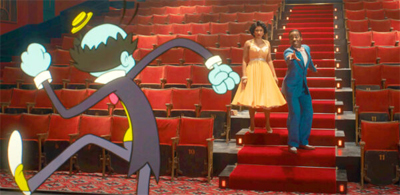
This is exactly what Martin Scorsese means when he talks about “cinema.”
This is without getting into the way in which the show has always been specifically interested in the mechanics and the logic of television. Vengeance on Varos features one of the best cliffhangers in television history, cutting to a control room where one of the characters orders the editor to cut the feed. The Idiot’s Lantern is a story about the arrival of television in the United Kingdom. Silence in the Library keeps cutting to a girl watching Doctor Who. Bad Wolf finds the Doctor and his companions bouncing around other contemporary shows like The Weakest Link and Big Brother.
Davies’ second tenure showrunning Doctor Who is even more engaged with the idea of Doctor Who as television. Rogue found the characters comparing a regency party to Bridgerton. The Legend of Ruby Sunday found the Doctor and Ruby stepping inside a reconstructed memory where the snow evoked the noise on a classic television signal. Davies has launched a spin-off Tales of the TARDIS, wherein the characters watch old Doctor Who episodes together.
Within this specific season, The Interstellar Song Contest is scheduled to broadcast on BBC One right before The Eurovision Song Contest, a move that Davies himself has described as “the sexiest f@!king risk”, given that it is also scheduled to broadcast after the FA Cup Final and could be preempted if the match ends up going into overtime and penalties. For all that Doctor Who has become a streaming show that premieres on the iPlayer and on Disney+ internationally, Davies is still engaged with what it means to be television.
More to the point, this season is built around the Doctor’s efforts to get Belinda home, which means arriving at 7:30m on Saturday 24th May 2025. That is the same day that the first half of the season finale, Wish World, is set to premiere. Theoretically, the Doctor is trying to get Belinda home right before the episode premieres on the iPlayer and Disney+, which lends the show a winking self-aware quality. Of course the characters have to get back to Earth in time for the season finale.

An extended theatrical run…
Even the most seemingly straight-down-the-middle periods of Doctor Who, such as the Chibnall era, meditate upon Doctor Who as a fictional show. In Ascension of the Cybermen, the Doctor keeps having flashes back to the life of a policeman named Brendan in 1920s Ireland, which feels almost like the era contrasting the language of a conventional Doctor Who serial with the more “cosy” Sunday viewing like Call the Midwife, Downton Abbey or Heartbeat.
This can be more broadly understood in the context of British television’s origins in theatre. While American television often aspired towards cinema, British television was more likely to embrace theatrical conventions and language. This trend arguably continues to this day. The single long takes in Adolescence, for example, were arguably only possible because the series could draw on a pool of actors with extensive theatrical experience.
As a science-fiction show produced within the formal and financial constraints of British television, Doctor Who leaned heavily on the language of theatre. The audience was never meant to look at an episode like The Web Planet and believe that they were watching documentary footage broadcast from an alien world. They were supposed to understand that these actors in costumes were instead representing something that would be impossible to create within the realities of sixties broadcasting.
As much as critics might have mocked Doctor Who for looking “cheap” and for failing to keep pace with later science-fiction franchises like Star Trek and Star Wars, the show was never aspiring to a gritty photorealism. It was instead in conversation with an audience who understood that they were watching a television show. At various points in its history, most notably during Andrew Cartmel serials like Time and the Rani, Paradise Towers or The Happiness Patrol, the series embraced a style very close to pantomime.

A Lux-urious screening room…
Davies was a child of the wilderness years that followed the cancellation of the show, and has always been heavily influenced by the Cartmel era. As a character, Belinda owes a sizable debt to the character of Ace introduced in Dragonfire, a young woman swept away from Earth to a different time and place. There is a sense in which Davies renewed emphasis on the “gods” feels indebted to stories like Ghost Light or Curse of Fenric.
In particular, there is a fair amount of The Greatest Show in the Galaxy in Lux, particularly in the way that the Doctor seems to position the “gods” who determine the fate of the show’s reality as equivalent to the viewing audience at home. “There are forces beyond this universe,” the Doctor warns Belinda. “And when these vast creatures deign to look down on us, our entire reality is in danger.” It’s an interesting way to discuss the seasonal antagonists in an episode that features the Doctor and Belinda debating the show with fans.
It is very revealing that the central premise of Lux is articulated during an opening sequence in which Mister Ring-a-Ding directly engages his audience. The character on screen speaks to the audience watching him. More than that, he demands an answer from them. “I asked you: what do you think?” Mister Ring-a-Ding presses the viewers in the cinema. It’s very similar to the Doctor and Belinda’s encounter with the fans. Davies seems to be suggesting that Doctor Who is a show that demands an active audience and a viewer who is actively engaged in conversation with it.
As such, the way that Lux leans on the fourth wall is recognisably of a piece with the larger history of Doctor Who. The series has never tried to convince the audience that it is “real.” It has never relied on the convention of “suspension of disbelief.” It has instead always been aware of the audience’s understanding of Doctor Who as a fictional construct. It has always been self-aware. As early as The Rescue, the show was able to play with audience expectations by revealing that the guy in the bad monster suit was really just a guy in a bad monster suit.
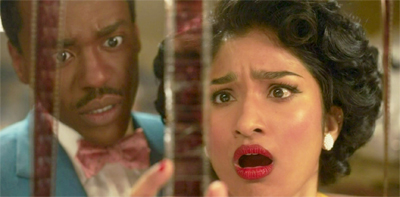
A strip-roaring success.
However, Lux also exists within the specific context of Davies’ second tenure showrunning Doctor Who, which has a slightly different set of thematic concerns than his first term. Most obviously, Davies is heavily influenced by the work of Steven Moffat. The Robot Revolution featured a joke at the expense of “timey wimey”, while the fans in Lux unanimously agree that Blink is the show’s best episode. One of the big recurring thematic preoccupations of Moffat’s Doctor Who was the question of what the show was “about”, what the point of the show was, why the character is unique.
Although the central gimmick tends to distract from this, Lux is technically a historical adventure. Trying to get Belinda home, the Doctor arrives in Miami in 1952. Although the bulk of the adventure unfolds inside a cinema, and a lot of that unfolds inside a constructed reality, there is an acknowledgement of what it means for the Doctor and Belinda to walk around Miami in the early fifties.
Investigating strange goings-on at the cinema, the Doctor and Belinda check out the local diner. They find a waiter and Misses Longsteen, whose son Tommy Lee disappeared in the theatre. “I’ll talk to anyone about that boy of mine,” Misses Longsteen tells the waiter. “If you’ll bend the rules.” The waiter shrugs it off, awkwardly. “I’ve got no problem,” he concedes. “This time of night, who’s looking.”
Belinda struggles to make sense of this exchange. “No Blacks,” the Doctor explains. “Which includes you.” The Doctor warns his companion, “We’re breaking the law just by being in here.” There are constant reminders of this reality. When the Doctor arrives in the theatre, he is very mindful of the racial dynamics at play as he talks to the projectionist, Reginald Pye. “Mister Pye, I know this is a segregated space,” the Doctor begins, cautiously and carefully. There is an acknowledgement that the Doctor and Belinda have entered a space inherently hostile to them, in a very real way.
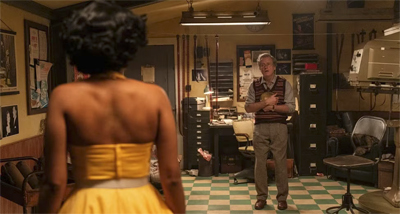
American Pye.
In this sense, Lux feels like a companion piece to The Robot Revolution. These are both stories engaged substantively with what it means for Doctor Who to finally have a TARDIS team that is comprised entirely of people of colour. It’s very telling that both of the first two episodes starring the Doctor and Belinda trap the pair in a recognisably fifties milieu. The Robot Revolution might have been a futuristic science-fiction adventure, but it was set in a world that could have been lifted from some trashy fifties paperback.
One of the central tensions of The Robot Revolution, although one largely implied rather than outright stated, was the sense that this older mode of science-fiction was not welcoming to characters like the Doctor and Belinda. It was a future built largely from the imagination of nostalgic white men, and the Doctor and Belinda are people who rarely get to be the lead characters in that sort of narrative. Lux goes a step further, throwing the Doctor and Belinda into the literal fifties rather than a future extrapolated from the pulp fiction of the era, and makes the hostility to them textual rather than implicit.
This pushes Doctor Who into an interesting – and challenging – space. It confronts the Doctor and Belinda with an existential question. After all, the Doctor travels the cosmos toppling corrupt regimes. He ventures across space and time changing the course of entire civilisations. With that in mind, how does one account for all of the terrible things that happened on Earth? Why did the Doctor allow the Holocaust to happen? Why didn’t he stop slavery? If the Doctor has a time machine, he could theoretically stop every injustice and every wrong.
This is the challenge of Chibnall era episodes like Rosa and Spyfall, Part II, which throw the Doctor into these sorts of thorny historical circumstances. It’s arguably also the case with the era’s one true masterpiece, Demons of the Punjab, which at least goes out of its way to explain the Doctor’s passivity by arguing that changing history might prevent Yaz from being born. In Rosa, the Doctor witnesses a key moment in the Civil Rights movement. In Spyfall, Part II, the Doctor meets a real-life historical figure destined to die in a concentration camp.
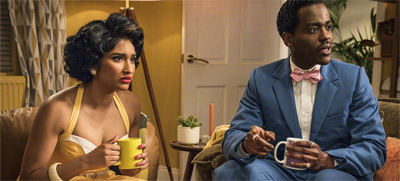
The show has come sofa, so fast.
In both cases, the Doctor does nothing. The Doctor just stands by and lets history happen. The Doctor is passively, and even actively, complicit in historical injustices. In Rosa, the Doctor makes Graham take a seat to force Rosa Park to take her stand. In Spyfall, Part II, the Doctor erases Noor Inayat Khan’s memory before sending her on her way to a horrific and certain death. Neither narrative makes a convincing argument for why, confronted with these injustices in the world of the show, the Doctor wouldn’t dismantle the United States or Nazi Germany.
Of course, the audience intuitively understands why the Doctor can’t do anything, and it has nothing to do with character or morality or “fixed points” or any narrative concerns. The Doctor cannot alter those events because they really happened and she is a fictional character. Having the Doctor topple the United States would break the narrative reality of the show, and undermine the real-life struggle of activists like Rosa Park. However, neither Rosa nor Spyfall, Part II can find a compelling way to frame this simple narrative reality.
There is a sense in which Lux exists in conversation with this idea. Whether intentionally or not, it is interesting that Davies should cast Alan Cumming as Mister Ring-a-Ding. Cumming is a recognisable celebrity, even affecting an American accent, and it has not been that long since his last prominent appearance in Doctor Who, playing King James in The Witchfinders. That is another of Chibnall’s historicals, and it ended with the Doctor leaving King James to to go on the spearhead a witchhunt that would lead to the wrongful death of thousands of women.
The Moffat era dealt with this idea very bluntly and very directly in Let’s Kill Hitler, an episode that sent the Doctor and his companions back to Nazi Germany. The episode initially frames itself as the classic time travel fantasy of murdering Hitler, but then has Rory shove Hitler into the closet so the actual plot of the episode can continue, in which the Doctor is confronted by the Teselecta, a very Star–Trek-coded counterpart to himself that travels through time punishing war criminals. The Doctor mocks this unimaginative use of time travel “to punish dead people.”
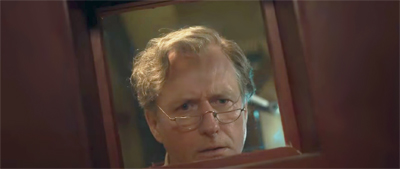
The best of booth worlds.
Core to Let’s Kill Hitler is the understanding that there are certain limits that exist upon Doctor Who by virtue of the show’s nature as a fictional television series about a time-travel alien. There is no reason within the show why the Doctor can’t kill Hitler, beyond the simple reality that Doctor Who is not that kind of show. It is a more honest answer to this question than any of the po-faced angst of Rosa or Spyfall, Part II. It is also built on the assumption that the audience understands the logic underpinning this, even if it cannot be directly articulated.
This was a recurring preoccupation within the Moffat era. Extremis only really makes sense as an episode about the limits of Doctor Who. It is a story about how the Doctor cannot literally save the world from any of the existential horrors facing it, but instead suggests that the audience watching an episode of Doctor Who might derive something of value from it that allows them to go forward in their own lives.
Much of Davies’ return to Doctor Who has felt in conversation with Moffat’s tenure. Even watching Lux, it feels like Davies is thinking a little bit about Let’s Kill Hitler. After all, the episode’s emphasis on the flammability of nitrate film feels like an allusion to Quentin Tarantino’s Inglourious Basterds, another fairly recent piece of art about the joys of killing Hitler in these sorts of fictional works, reaching a slightly different (and more provocative) conclusion than Let’s Kill Hitler.
Lux builds on Moffat’s argument about the fictional nature of Doctor Who, contrasting the reality of racial segregation in fifties Miami to the imaginary worlds within the cinema itself. When Belinda bristles at the racism of the era, the Doctor shuts her down quickly, “Save it for later, Belinda. Right now we are busy.” Belinda understandably counters, “How can you say that?” The Doctor replies, “I have toppled worlds. Sometimes I wait for people to topple the world. Until then, I live in it and I shine.”
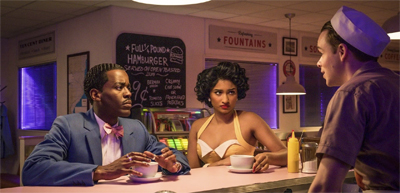
Guess who’s coming to diner?
The Doctor’s distinction between “worlds” and “the world” only makes sense if one understands the worlds of the show existing separate and distinct from the real world outside. The Doctor can deal with monsters and collapsing reality and robots, but the Doctor cannot singlehandedly solve racism or bigotry or political corruption. The Doctor cannot reverse the transphobic court ruling from the Scottish Supreme Court this week.
Even outside of the sequence in which the Doctor literally pushes down the television screen, Lux is built around the understanding that the Doctor is a fictional construct, but one who does exert some influence on reality. “But you are the most amazing creation, my Doctor, sir,” Mister Ring-a-Ding gasps. “You have light within you that builds a body.” The Doctor is not entirely dissimilar to Lux, but he is also more tangible, more tactile. As Tommy Lee watches the TARDIS fade away, he observes, “That was like a special effect. Like from the movie.”
Lux parallels the Doctor and Mister Ring-a-Ding. The Doctor travels in a blue box, Mister Ring-a-Ding has blue skin. The Doctor is a stranger who drops out of the sky, inserting himself into a given situation, just like “Mister Ring-a-Ding Goes to Town.” Just like the Doctor waves away any challenge to his authority, Mister Ring-a-Ding shrugs off any questions about himself with a dismissive, “Don’t make me laugh.” Indeed, Mister Ring-a-Ding even picks up a pretty young blonde woman on his travels, as the Doctor picked up Rose or Ruby. Both the Doctor and Mister Ring-a-Ding even wear bowties.
There is an interesting equivalence implied between the two fictional characters, these two figures who transcend the barrier of the screen. Of course, Mister Ring-a-Ding is the star of an animated cartoon short and the Doctor is a television character, but Lux suggests that the audience is to understand these creations as existing in conversation with one another.
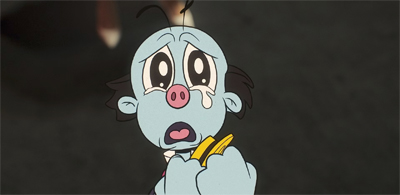
Your cartoon friend, your ani-mate.
This is one of the recurring preoccupations of Davies’ new era of Doctor Who. This era is built upon the understanding of Doctor Who as a television show, but also an understanding of the show’s power within that medium. The Giggle begins with the creation of television, and is built on the idea that the first television broadcast was encoded with a subconscious signal that would eventually drive humanity mad.
Davies has talked at length about the use of media – particularly in the United Kingdom – to push particular agendas and paranoia upon the population, to stoke hatred and division. He has railed against “newspapers of absolute hate, and venom, and destruction, and violence.” There is an understanding in the modern world that media holds great influence and power. Andrew Breitbart famously argued that “politics are downstream from culture“, and it feels notable that the United States elected a reality television star as its President.
This feels particularly notable in the context of the United Kingdom. British television has considerable social weight. Cathy Come Home was credited with sparking a national debate over homelessness and a new commitment to social housing. Up the Junction shifted public opinion on abortion. Even recently, Mr. Bates vs. the Post Office led to public outcry and attempted law reform. Even recently, Adolescence has opened a national debate involving the Prime Minister and the Houses of Parliament.
None of this is to suggest that Doctor Who has anything near that same cultural impact, but instead to acknowledge the context in which the show exists. Davies is clearly fascinated with the corrosive power of modern media, the way in which it can be weaponised and deployed against the audience. Even in Wild Blue Yonder, Donna wonders about the ethics of teaching kids to sing war songs in school before encountering an alien species driven insane by all the noise humanity has pumped into the void.
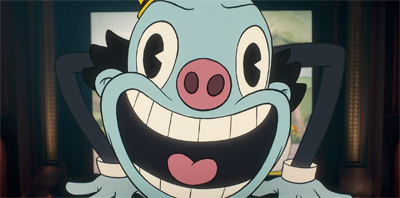
Screen saver.
Lux engages with this idea, with the fear that these images can be weapons. The episode opens with a newsreel reporting on the “latest atomic bomb test”, with the announcer wondering, “The world must ask: is the pinnacle of man’s creative genius?” The fact that this imagery and these ideas are just being pumped into the collective cultural psyche would explain how young minds became fertile ground for conspiracy theories, with the waiter at the diner speculating that the missing cinema audience had been abducted by sinister forces “recruiting for Batista.”
Even before the cinema screen devours its audience, Davies seems to be wondering about the power of the image to shape the minds of the audience. This doesn’t just apply in the context of the fifties. There is a fair question to be asked about whether the popularity of movies like JFK or shows like The X-Files during the nineties helped to sew the seeds for the complete disconnect from reality experienced by large portions of the population.
In this sense, despite its period setting, Lux is a decidedly timely episode. Like The Robot Revolution, it plays as a cautionary tale about the dangers of nostalgia. The Doctor and Belinda are shocked to discover that Mister Ring-a-Ding has convinced Pye to remain in the theatre, manning the projection booth. However, it’s quickly revealed that the animated figure holds considerable leverage over the projectionist.
Pye explains that he is bound to Mister Ring-a-Ding by his wife. Pye’s wife died in a car accident a few years earlier, but Mister Ring-a-Ding “brought her back” by using existing footage to conjure a three dimensional recreation. The episode cuts between Pye dancing with his wife and cradling the reel of footage that he has, drawing a clear parallel between his wife and the film on which her image exists. Pye is beholden to Mister Ring-a-Ding “because he showed [Pye] so much joy.”

Life through a lens.
There is a sense that Mister Ring-a-Ding has created an imaginary world in which Pye might lose himself, the nostalgic invocation of a life that is long gone. In some ways, it feels similar to what Alan does in The Robot Revolution, travelling to an alien world and recreating it in the image of the nostalgic science-fiction and video games that he would use to escape from reality. Once again, Davies is acknowledging the power that these imaginary worlds hold over people. When Mister Ring-a-Ding abducted the audience, he “trapped them on film” and “turned them into an image.”
In keeping with the sense that Davies’ second tenure is in conversation with Moffat’s vision of the show, Mister Ring-a-Ding exists in conversation with Moffat era monsters like the Silence and the Weeping Angels, which exist primarily within the language of visual storytelling – the Silence editing themselves out of the narrative and the Weeping Angels moving only in cuts. Indeed, the Weeping Angels are themselves defined as sentient ideas manifesting on reality, as “that which holds an image of an angel becomes itself an angel.” Mister Ring-a-Ding plays with similar ideas.
Once again, Davies seems to be actively interrogating the nostalgic impulse in contemporary pop culture, as he did in Empire of Death and The Robot Revolution. Davies understands the allure of these constructed nostalgic fantasies, but also the danger that they pose. So much of the current global resurgence of fascism is rooted in the fantasy of some nostalgic return to an imagined past, one that is hostile to people like the Doctor and Belinda.
Lux draws a very clear connection between the atomic bomb and the theatrical projector. Mister Ring-a-Ding hopes to escape from the cinema to harvest “the most savage light of all, the glow of the atom.” The power of the atom is often framed in terms of the sun, as if mankind is harnessing Promethean fire. In the opening newsreel, the announcer notes that the explosion was visible for miles “even in brilliant sunshine.” The light of the screen is framed in opposition to this, with Lux travelling by moonlight and Mister Ring-a-Ding “more interested in moonlight.”
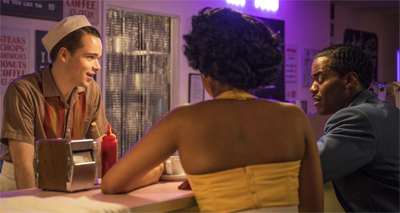
Counterpoint.
It’s possible to read the entirety of Lux as a response to that opening question from the newsreel narrator, positing the screen itself as “the pinnacle of man’s creative genius.” After all, Lux is not only the name of the entity puppeting Mister Ring-a-Ding, it is also Latin for “light.” The choice of Latin feels deliberate. It is a holy language, associated with church and mass. “Light without end”, indeed.
In some ways, the screen is presented as the antithesis of the atomic bomb. J. Robert Oppenheimer famously marked the first atomic bomb detonation by proclaiming, “Now I am become Death.” In contrast, Lux presents the screen as a source of life. Mistrer Ring-a-Ding is not a hologram or a projection. He is instead “life made of light.” (He boasts, “I’m beamin’ at ya.”) He is “Lux Imperator, the God of Light”, and it feels noteworthy that – as he points out – the Doctor is facing him so soon after vanquishing the God of Death.
In the context of Lux as a meditation on the nature and identity of Doctor Who, Belinda remains a compelling companion. She is a different sort of companion than the one that Davies usually writes. Most obviously, there remains a clear tension between Belinda and the larger show itself. When the characters discover a chained up cinema, Belinda’s first (perfectly rational) impulse is to leave it completely alone. “We can go now,” she tells the Doctor. “We need to get inside that TARDIS thing and leave, yeah?”
Belinda helps to deflate a lot of what might otherwise seem pompous and self-important. Introducing the Doctor as “just the Doctor”, Belinda cannot help but sigh, “ridiculous.” When Lux pulls the classic and cliché move of having the pair think they’ve escaped the film only to reveal that they are simply trapped within another layer of the film, Belinda complains, “I hate when they do that.”
This gets back to the question of how Davies is approaching Doctor Who differently on his second go-around. Belinda fits the familiar companion role of having to have the Doctor explain the logic of Doctor Who to her, but it is worth acknowledging that Belinda is a more skeptical audience than Rose, Martha, Ruby or even Donna. Belinda is not immediately impressed with the fact that she is in Doctor Who.
A colourful character.
This feels like a clever and earnest reflection of the show’s somewhat diminished stature within British popular consciousness. Davies understands that it is not enough for the Doctor to fall back on the familiar routines to wow the audience. It is not enough to simply be Doctor Who anymore. Modern audiences are familiar with the show’s tricks and have grown up in an era of big-budget science-fiction television where Doctor Who is no longer as unique as it once was.
As such, the Doctor’s seduction of Belinda is more contested and challenging. The Doctor really has to win Belinda over. He really has to prove to her that this lifestyle is exciting and interesting, that it is worth adventuring and being in Doctor Who. This is a fundamentally different energy than Davies’ first tenure as showrunner, and it is very conscious of the changed circumstances of the show.
Lux is a triumph for Doctor Who, proof that the show is as light on its feet as ever.
Filed under: Television | Tagged: alan cumming, animated, cartoon, doctor, doctor who, film, lux, media, mister ring-a-ding, ncuti gatwa, russell t. davies |



 the m0vie blog
I have watched Dr Who all my life. At school I was in the minority. No-one liked it but me. It’s had it’s ups and downs over the years (I didn’t enjoy Colin Baker or McCoy, loved McGann but hated the story he was in.) When it came back I was shocked at how good it was, and relished Eccleston, Tennant and Smith. Something went wrong (This is all for me personally I hasten to add, I’m aware other people cite Capaldi as their favourite) with Capaldi’s run. I was so happy with Jodie’s first episode and couldn’t understand the hate people had for it, but as her time progressed I began to fall out of love with the show. I didn’t even mind the timeless child idea, except that it never really went anywhere. But then the show left me for good. The 3 specials were not Dr Who to me. I cannot begin to understand how Tennant was on board with the version of the Dr he was asked to play. Again, unlike a lot of the naysayers I thought Ncuti was fantastic in his debut. Beyond that, I struggle to understand the thinking behind the Christmas specials and his first season. With the backlash it received (Often called out as racism or bigotry of various types which most opinions were not) and the terrible viewing figures, plus Davies talking of it ‘returning’ in the future when the youngsters who love it now become writers themselves, it seems fairly obvious this show is finished. I was ok with that. But last week I felt sad, because ‘Robot Revolution’ was good, not amazing, but an indication that the show could still engage me, still be fun. This week I’m even sadder, because Lux is hands down Ncuti’s best episode, and a prime example of how unique and special Dr Who is and how it can create stories that no other show can manage. Was it perfect? No. But it was fun and clever and expertly crafted. It is the saddest thing in the world that this show will end when it has the potential evidenced in this episode.