• Following Us

  • Categories

  • Check out the Archives


  • Awards & Nominations

Star Trek – Assignment: Eternity by Greg Cox (Review)

The first Star Trek pilot, The Cage, was produced in 1964. To celebrate its fiftieth anniversary, this December we are reviewing the second season of the original Star Trek show. You can check out our first season reviews here. Check back daily for the latest review.

Assignment: Eternity is pretty much exactly what you might expect from a sequel to Assignment: Earth written by Greg Cox. It is a functional story a number of nice clever continuity touches, but no real interest in playing with the big ideas suggested by the source material. Instead, it feels like an act of connecting various dots, stopping occasionally to wink at the audience, but never having anything particularly clever or insightful to say about its inspirations.

Like The Eugenics Wars or To Reign in Hell, the result is a competent piece of Star Trek continuity, albeit one that feels more than a little lifeless.

tos-assignmenteternity Continue reading

Star Trek: Enterprise – Fight or Flight (Review)

Next year, Star Trek is fifty years old. We have some special stuff planned for that, but – in the meantime – we’re reviewing all of Star Trek: Enterprise this year as something of a prequel to that anniversary. This January, we’re doing the first season. Check back daily for the latest review.

Fight or Flight is reasonably solid as second episodes go. It’s very clear that Rick Berman and Brannon Braga are making a conscious effort to avoid the mistakes of Star Trek: Voyager. There’s a sense that they are trying to give Star Trek: Enterprise its own unique mood and flavour. As such, Fight or Flight feels like a story that isn’t just tailor-made for Enterprise, but is tailor-made for early in the first season of the show. It isn’t a story that could be done by another spin-off, and it’s also not a story that could be done by Enterprise even a year later.

While Fight or Flight works on a conceptual level, the execution feels a little strange. While Broken Bow was a big and bombastic Star Trek pilot with its own feel and rhythm, Fight and Flight feels almost quaint. As a piece of television, it’s constructed in a very meticulous and very precise manner, one that seems suspiciously outdated for a show broadcast in late 2001.

Slugging it out...

Slugging it out…

Continue reading

Star Trek – The Omega Glory (Review)

The first Star Trek pilot, The Cage, was produced in 1964. To celebrate its fiftieth anniversary, this December we are reviewing the second season of the original Star Trek show. You can check out our first season reviews here. Check back daily for the latest review.

Gene Roddenberry is a controversial figure who casts a fairly large shadow. It is very hard to talk about Star Trek – particularly the classic Star Trek – without talking about Roddenberry’s influence and vision. Roddenberry was fond of myth-making when he was alive, of playing up his own contributions to Star Trek while marginalising or dismissing the other people who shaped or defined the franchise.

Roddenberry is a polarising figure among fans and critics, insiders and outsiders. To some, Roddenberry was the man who created Star Trek. While this doesn’t immunise him against criticism, it does provide a sense of context – whatever sins he may have committed and whatever faults he may have had must be offset against that. To others, Roddenberry was prone to exaggerate his accomplishments at the expense of people like David Gerrold or Gene L. Coon who shaped the franchise just as much as (if not more than) he did.

Flagging trouble ahead...

Flagging trouble ahead…

While those are two extremes, they are not the only possible views of Roddenberry. There are a broad range of opinions that might be offered, and not all of them are mutually exclusive. Ask a dozen people who know their Star Trek about Roddenberry, and are likely to come up with a dozen nuanced and defensible positions on the man and his legacy. Nobody seems entirely what to make of Roddenberry and his creative contributions to the franchise.

The Omega Glory is an interesting episode, one that invites as much debate as any of Roddenberry’s contributions to the franchise.

A strong constitution to make it through this one...

A strong constitution to make it through this one…

Continue reading

Star Trek: Enterprise – Broken Bow (Review)

Next year, Star Trek is fifty years old. We have some special stuff planned for that, but – in the meantime – we’re reviewing all of Star Trek: Enterprise this year as something of a prequel to that anniversary. This January, we’re doing the first season. Check back daily for the latest review.

Broken Bow is probably the strongest pilot in the Star Trek canon, with Emissary and The Cage vying for second place.

That’s not saying a lot. Broken Bow is still a troubled production with some rather sizeable issues marring what is otherwise an ambitious début for a new Star Trek show. Watching, Broken Bow – as with watching most of the first few years of Star Trek: Enterprise (or just Enterprise) – it feels like the show is at war with itself. It wants to be something new and fresh and exciting, but it also wants to be an important part of this larger tapestry. And the episode has difficulty reconciling that.

New (old) frontier...

New (old) frontier…

So we get new aliens like the Suliban, but a plot that revolves around the Klingons; we get an entirely new crew with a Vulcan science officer and Southern gentleman as the Captain’s best friend; we get a ship without most of the conveniences that we take for granted on Star Trek, but with substitutes and a resolution that relies on technological gimmickry; we get to explore an uncharted part of the Star Trek canon, but with the intrusion of the future to help make it feel a little more familiar.

From the first episode, Star Trek: Enterprise seems to exist as a show trapped between what it could have been and what it has to be. It’s a premise rich with potential, but which still feels a little too much like everything that came before.

Into the sunset...

Into the sunset…

Continue reading

Star Trek – The Ultimate Computer (Review)

The first Star Trek pilot, The Cage, was produced in 1964. To celebrate its fiftieth anniversary, this December we are reviewing the second season of the original Star Trek show. You can check out our first season reviews here. Check back daily for the latest review.

The Ultimate Computer is the second classic produced by John Meredyth Lucas, following on from The Immunity Syndrome. (Although it is credited to him, Journey to Babel was actually overseen by Gene L. Coon.) Like The Immunity Syndrome before it, The Ultimate Computer is a bottle show, filmed on the show’s standing set. It features a relatively small guest cast, even trimming the number of extras appearing on the Enterprise sets.

It seems that these sorts of constraints and pressures brought out the best in Lucas. Lucas steps behind the camera on The Ultimate Computer, and helps to bring the show to life. Although he is using familiar sets, he often figures out ways to shoot them that feel original and fresh – no mean accomplishment two years into the show’s run. The guest cast that Lucas has assembled is superb – with William Marshall turning in one of the best one-shot guest appearances in the history of Star Trek.
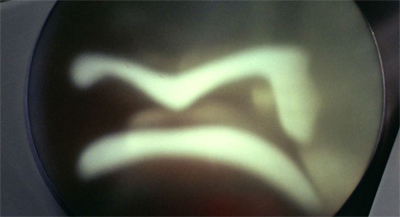
Does not compute...

Does not compute…

However, what is most notable about The Ultimate Computer is the funereal atmosphere that haunts the episode. There is a solemn and reflective tone to the episode, particularly during the early tests of the M-5 computer. The Enterprise is dark, abandoned, empty. Kirk is reflective. As with Bread and Circuses at the end of Gene L. Coon’ tenure, Spock offers McCoy an olive branch. In many respects, The Ultimate Computer seems to hark forward to the film series, with Kirk wondering how he might define himself if he is not a starship captain.

Appropriately enough for a series staring down the barrel at cancellation, The Ultimate Computer would have made for a pretty great finalé.
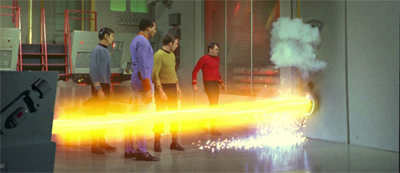
"Dammit, I told you we should have used a surge protector..."

“Dammit, I told you we should have used a surge protector…”

Continue reading