• Following Us

  • Categories

  • Check out the Archives


  • Awards & Nominations

Star Trek: The Next Generation – Q Who? (Review)

This January and February, we’ll be finishing up our look at the second season of Star Trek: The Next Generation and moving on to the third year of the show, both recently and lovingly remastered for high definition. Check back daily for the latest review.

Q Who? throws down the gauntlet for Star Trek: The Next Generation. It serves as a fitting reminder that Picard and his crew are still amateurs when it comes to space exploration. They don’t even win the day – they suffer “a bloody nose” before limping away from their strange new opponents to lick their wounds. For a crew that never seemed to sweat before, who never seemed like they were under pressure, this is a shocking development.

More interestingly, it’s something unknown in a universe that has become far too familiar. Three of the four episodes leading into Q Who? ended with the crew accepting that there were some things they’d never fully understand or comprehend, and – while it’s unlikely this was intentional – it seems like a nice bit of thematic foreshadowing rather than haphazard plotting. For the first season-and-a-half of the show, it seemed like the Enterprise was always dealing with the familiar, always in control of the situation.

With Q Who?, everything is put into perspective.

Borg to death...

Borg to death…

Continue reading

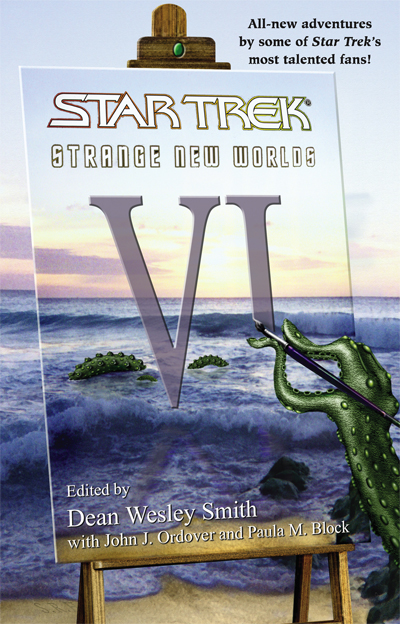
Star Trek: Strange New Worlds VI – The Beginning (Review)

This January and February, we’ll be finishing up our look at the second season of Star Trek: The Next Generation and moving on to the third year of the show, both recently and lovingly remastered for high definition. Check back daily for the latest review.

We’ll be supplementing our coverage of the episodes with some additional materials – mainly novels and comics and films. This is one such entry.

The Borg are, quite possibly, the most significant addition to the Star Trek mythos since the Klingons. They are one of the few modern pieces of Star Trek lore that will be instantly recognisable to a broader audience. They have featured, in some way, in all four of the Star Trek spin-off series. They are constantly rumoured and suggested as a viable antagonist for the rebooted film series. The Borg are a pretty big deal.

And yet, like so many pop culture villains, they seem less threatening the more we know about them. One of the more frequent complaints about the use of the Borg in Star Trek: Voyager was that it made the aliens more familiar, more understandable, more relatable. Continuing to build off the premise of the Borg Queen in Star Trek: First Contact, the Borg became an alien species that Janeway would reason and negotiate with, in stark contrast to Q’s characterisation of the collective in Q Who?

Although Star Trek: Enterprise did manage to turn the Borg’s fascination with mankind into a causal loop, televised Star Trek never managed to produce an origin story for those cybernetic monsters. Ever ready to fill in a perceived blank in the canon, the expanded Star Trek universe has actually proposed a number of origins for the Borg.

st-strangenewworlds6

Continue reading

Star Trek: The Next Generation – Pen Pals (Review)

This January and February, we’ll be finishing up our look at the second season of Star Trek: The Next Generation and moving on to the third year of the show, both recently and lovingly remastered for high definition. Check back daily for the latest review.

Pen Pals is a pretty mediocre episode of Star Trek: The Next Generation, one with a lot more potential than the episode actually delivers upon. Centring around Data’s unilateral decision to violate the Prime Directive and the consequences stemming from that decision, there’s a sense that Pen Pals might have been a lot more incisive in earlier version – a lot more willing to ask tough questions about the rules and regulations that our heroes uphold.

Sadly, Pen Pals instead ends with a massive cop out and an unwillingness to really commit to any big idea or to interrogate any of the show’s core concepts.

Everything burns...

Everything burns…

Continue reading

Star Trek: The Next Generation (DC) Annual #2 – Thin Ice (Review)

This January and February, we’ll be finishing up our look at the second season of Star Trek: The Next Generation and moving on to the third year of the show, both recently and lovingly remastered for high definition. Check back daily for the latest review.

We’ll be supplementing our coverage of the episodes with some additional materials – mainly novels and comics and films. This is one such entry.

Riker is a character caught between a rock and a hard place. According to the series bible, Riker was imagined as one of the “dual lead characters” for the show and clearly envisioned as an impulsive and brilliant Kirk to Picard’s more rational and stoic Spock. However, it didn’t quite work out that way, for a number of reasons. For one thing, the writing on the early years of Star Trek: The Next Generation tended to be a bit more sterile and bland, so Riker was never really allowed to step too far out of Picard’s shadow.

Instead, we got lots of characters talking about how ambitious Riker was, without seeing it for ourselves. It’s implied that Riker’s career led him to separate from Troi, something Peter David ran with in Imzadi. Everybody is constantly telling everybody else how Riker desperately wants to be a starship commander. And yet, when it come to the actual characterisation of Riker on the show, none of this shines through.

Due to the constraints imposed on the early years, interpersonal conflict was impossible in early Next Generation scripts, putting Riker in a paradoxical position as a character. We’re repeatedly told how ambitious and career-orientated he is, but none of that shines through.

Dead space...

Dead space…

Continue reading

Star Trek: The Next Generation – The Icarus Factor (Review)

This January and February, we’ll be finishing up our look at the second season of Star Trek: The Next Generation and moving on to the third year of the show, both recently and lovingly remastered for high definition. Check back daily for the latest review.

The Icarus Factor is a character-driven story. At least, it wants to be a character-driven story. The problem is that Star Trek: The Next Generation hasn’t reached the point where it can really do character-driven storytelling with a measure of consistence. (The fact that Picard confronting his future failures in Time Squared worked was more down to Patrick Stewart than the episode’s script.)

The Icarus Factor is a story focusing on Riker as a character, and it suffers from the fact that Riker hasn’t really been well-defined to date. We’re repeatedly told that he’s ambitious and career-driven, but most his on-screen characterisation has fluctuated between reckless, jerkish and horny. So The Icarus Factor tries to compensate by giving Riker the most generic back story possible for a lead male character on a television show.

This is the story of Riker’s daddy issues.

Somehow, this image just sums up Riker as a character...

Somehow, this image just sums up Riker as a character…

Continue reading

Star Trek: The Lost Era – Deny Thy Father by Jeff Mariotte (Review)

This January and February, we’ll be finishing up our look at the second season of Star Trek: The Next Generation and moving on to the third year of the show, both recently and lovingly remastered for high definition. Check back daily for the latest review.

We’ll be supplementing our coverage of the episodes with some additional materials – mainly novels and comics and films. This is one such entry.

In theory, you can probably tell a good story about just about anything. There’s a knack to constructing a narrative and in making particular characters fascinating or compelling. In the right hands, even the most tired and boring premise can generate some measure of excitement and over a glimpse of depth that we never thought was there. For example, I didn’t come out of Star Trek: Generations thinking that I’d ever read a classic story about John Harriman, and then I read the superb Serpents Among the Ruins.

However, some ideas strike you as a little less exciting than others. Some concepts seem a bit riskier to pull off, a bit more daunting in scope. Constructing a compelling narrative around the youth of Commander William T. Riker, probably one of the blandest members of the Star Trek: The Next Generation ensemble, seems like an uphill struggle.

Unfortunately, Jeff Mariote’s Deny Thy Father isn’t up to the task of making the boring father-son relationship glimpsed in The Icarus Factor seem any more exciting.

tng-denythyfather

Continue reading

Star Trek: The Next Generation – Time Squared (Review)

This January and February, we’ll be finishing up our look at the second season of Star Trek: The Next Generation and moving on to the third year of the show, both recently and lovingly remastered for high definition. Check back daily for the latest review.

Time Squared is an intriguing little episode, if not entirely satisfying. Like The Royale before it, it features the Enterprise stumbling across a phenomenon that it can’t explain. Also like The Royale, the episode presents an existential horror to the crew. Time Squared is significantly stronger as a character piece, forcing Picard to confront a potential future version of himself that he can’t reconcile with his own expectations and self-image. Unfortunately, the open-ended mystery of the episode lacks the bizarre charm of the unresolved questions dangling at the end of The Royale.

"I never noticed before, but the Captain has pretty spectacular bone structure..."

“I never noticed before, but the Captain has pretty spectacular bone structure…”

Continue reading

Non-Review Review: Last Vegas

Last Vegas is a curious blend. On a purely practical level, it’s a genre hybrid that was bound to happen. Audiences love the “boys behaving badly” narratives that have been revitalised by The Hangover; indeed, that unlikely hit was popular enough to spawn a trilogy. Recent years have also seen audiences flock to films involving older performers, the cynically-described “grey dollar” that turned The Best Exotic Marigold Hotel into such a runaway success, but has been bubbling away in the background with films like Red or The Bucket List.

So, from a studio’s perspective, combining these two successful genres was a bit of a no-brainer. However, the two genres are also somewhat opposed to one another. The Hangover and its string of imitators pride themselves on their immaturity and their irreverence. There’s nothing that is off limits or out-of-bounds to those reckless young turks, no sacred cows that can’t be slaughtered, no sense of good taste that can’t be ignored completely in pursuit of the next laugh.

In contrast, films banking on elderly stars to draw aging audiences are built around reverence. Isn’t it nice to have films that don’t marginalise and sideline elderly performers? Isn’t it great to give people like Morgan Freeman or Robert DeNiro their due? In a way, the genre is built around reverence.

That puts Last Vegas in a very weird place, where it’s constantly trying to go far enough that it can pass as an irreverent “boys on vacation” comedy, but also trying to remain courteous enough and respectful enough of its leads that it won’t alienate viewers who just want to hang out with Douglas, DeNiro, Freeman and Kline. The result is predictably unsatisfying.

Putting their cards on the table...

Putting their cards on the table…

Continue reading

Star Trek: The Next Generation – The Royale (Review)

This January and February, we’ll be finishing up our look at the second season of Star Trek: The Next Generation and moving on to the third year of the show, both recently and lovingly remastered for high definition. Check back daily for the latest review.

“None of it makes any sense, sir,” Riker succinctly states before the credits role on The Royale. The Royale is a decidedly nonsensical episode of Star Trek: The Next Generation, where an away team find themselves trapped inside an atrocious casino melodrama and have to figure out how to return to the ship. The episode is packed with interesting visuals and a bizarre situations, but it never quite comes together in the end.

And, yet, despite the obvious problems, The Royale is intriguing. Visually, it’s one of the most striking and memorable episodes of the show’s first two season. The rotating door to nowhere is a beautifully strange image, and the sight of the Enterprise away team wandering around a twentieth century casino is enough to prevent the episode from ever becoming boring. The Royale isn’t the best constructed episode of the show’s first two years, and it has more than its fair share of problems.

However, it’s also a wonderfully bizarre and adventurous piece of science-fiction, as if Riker has beamed into a cheap imitation of The Twilight Zone. That’s enough to make it well worth a watch.

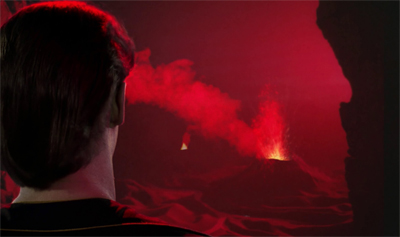
The whole plot revolves around absurdities...

The whole plot revolves around absurdities…

Continue reading

Star Trek: The Next Generation – The Sky’s The Limit: Meet with Triumph and Disaster & Trust Yourself When All Men Doubt You by Michael Schuster & Steve Mollmann (Review)

This January and February, we’ll be finishing up our look at the second season of Star Trek: The Next Generation and moving on to the third year of the show, both recently and lovingly remastered for high definition. Check back daily for the latest review.

We’ll be supplementing our coverage of the episodes with some additional materials – mainly novels and comics and films. This is one such entry. This is actually supplementary to the first season of the Next Generation, specifically the episode Encounter at Farpoint.

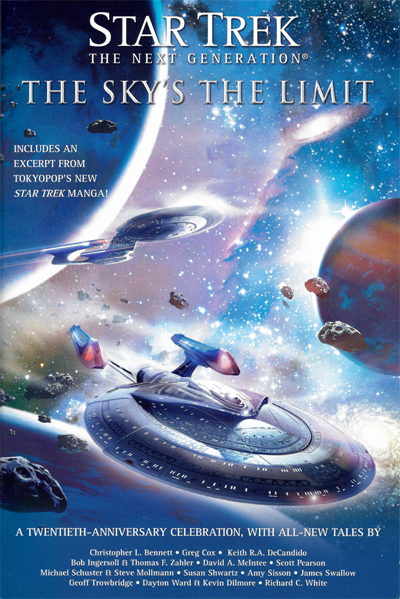
The Sky’s the Limit was an anthology released to celebrate the twentieth anniversary of Star Trek: The Next Generation in 2007. It was a bit of a no brainer, edited by the wonderful Marco Palmieri in the style of anthologies like The Lives of Dax or Prophecy and Change. The goal was to draw together a bunch of talented writers to fashion stories involving the crew and the ship at various stages in the life cycle of the Enterprise. There is a short story for every season of the show, save the fourth, and between each of the movies.

tng-theskysthelimit

Continue reading