












I feel a little bit heartless in confessing this, but Amélie (or Le fabuleux destin d’Amélie Poulain, to use its original title), never really connected with me. Don’t get me wrong, I can appreciate the film’s wonderful visual style, and those amazing opening scenes with a young Amélie growing up the way she did thanks to the strange and particular set of circumstances around her, but I couldn’t maintain that emotional connection through the film. Which is a shame, because the movie is a wonderful technical accomplishment, from its heavily saturated primary colours through to its distinctive score, and the manner at which it plays with the fourth wall.
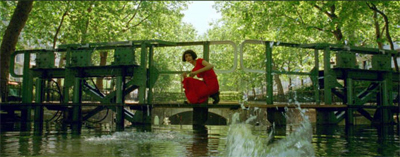
Making a splash...
I think part of my problem with the film is Amélie herself, or rather the meddling that she engages in. The movie goes to great lengths to point out that she is “introverted” and needs to find an outlet for all her genuine affection and compassion, but I’m not necessarily convinced that the movie’s idea of “sweet” is quite in line with my own. The movie sees its eponymous character interfering in the personal lives of those around her. She sets up a staff member and a regular at the café where she works, she kidnaps her father’s beloved garden gnome and takes pictures of him around the world, she uses a copied key to sneak into the house of an evil grocer and mess with his head. She spies on her neighbour, “the Glass Man”, a man with bones so brittle that he can’t go outside.
Here’s the thing. These aren’t healthy behaviours. These are the kind of things that have serious consequences. At one point, she sets up a plug to blow out on the evil grocer, a stunt one could easily see ending a manslaughter conviction. If she has issues with how her father is coping (in his own way) with the loss of his wife, sho owes it to them both to directly confront him, rather than simply quietly and sheepishly raise (and immediately drop) the topic. If he’s not listening, then you raise your voice, or ask genuinely for his attention. You don’t steal the crowning piece of his memorial to the woman he loves and arrange for photos of it to be taken around the world to goad him into travelling. Of course, all this is vindicated because the grocer stops being evil and her father does opt to travel.
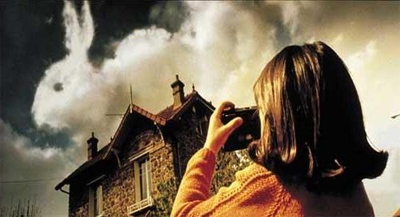
Head in the clouds, that one...
The only example of her direct interference which doesn’t end well is her misguided attempt to matchmake the café’s hypochondriac tobacconist and its psychotic regular. Even then, the movie doesn’t dwell on the broken hearts or the fact that Amélie’s subtle machinations have potentially caused all manner of personal problems in the café. Instead, we focus on the good things. Because, you know, good things happen, right – and that’s what’s really important?
The movie seems to celebrate the idea of voyeurism and living vicariously. It’s funny, the theme of characters watching other characters reminded me a bit of the superb Trois Couleurs: Rouge, which explored similar themes. Here, however, Amélie’s spying on other characters is presented as a good thing – it allows her to make connections with people who need connections, to punish those who need punishment. Characters seem to break into one anothers’ apartments like it’s going out of fashion. The only time it’s deemed inappropriate to spy on the neighbours is near the end of the film, as two characters prepare to resolve some sexual tension. Clearly the movie accepts the spying on people making love is inappropriate, but breaking into their apartments and watching them go about their business isn’t (at least not when you have the best of intentions)?
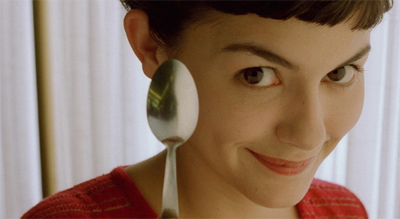
"That's not a knife...!"
Even the film’s male lead collects discarded photos from photo booths, rooting through trash and under the booths for those thrown away by unsatisfied patrons. It’s quirky, and apparently a hobby shared with a friend of the director, but I can’t help but think of it as just a little creepy, especially in this era of identity theft – where we’re told to shred anything that might identify us before discarding it, but shredding won’t stop this enthusiastic hobbyist, who takes great pride in putting the pictures back together. It can’t help but feel a little voyeuristic and unwholesome, despite the fact that the movie attempts to treat it as an endearing character trait. I wouldn’t want people I didn’t know putting my discarded picture in their scrapbook – let alone stalking me like he does one particular character.
Perhaps the film is attempting to mirror the collective sense of loss felt in the wake of the death of Princess Diana. The death and its aftermath form the backdrop of the film, with our lead so shocked on hearing the news she drops what she is holding and then superimposes her own image over Diana’s while half-asleep and watching the funeral. Perhaps Amélie’s subtle community-building involving those around her is meant to mirror the sense of collective “oneness” that many felt in the wake of the loss of “the People’s Princess”, but it still feels just little strange and a little more ambiguous than the movie suggests it is.
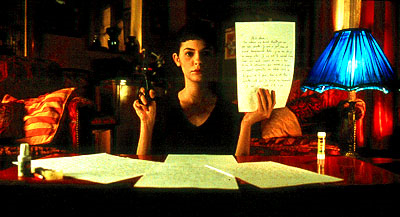
The film seems to letter do what she wants...
It’s a shame, because the movie has a genuine joie de vivre about it, with a charming cast, an energetic direction and a whimsical style. The design on the film, favourite bright colours like something out of an expressionist painting, is genuinely wonderful. Audrey Tautou is wonderful in the lead role, even if I can’t find myself especially caring for the character. The film’s opening sequence is genuinely heartfelt and wonderfully put together. Still, I could never really get into it.
Filed under: Non-Review Reviews | Tagged: Amélie, arts, Audrey Tautou, film, Filmmaking, french cinema, Jean-Pierre Jeunet, Le fabuleux destin d'Amélie Poulain, Movie, non-review review, paris, review |



 the m0vie blog
I always felt the inclusion of Diana’s death as a recurring motif to be a bit awkward, myself.
I think the unrelenting quirkiness of the characters here can make Amelie a bit difficult to find purchase in. For me, the inherent eccentricity of the film and its characters is the source of all of its charms, strangely inviting in that these people are so off-beat in such an organic way that I want to learn more about them. But that lovely oddness is a double-edged sword, I think, and I tend to find most people fall into either the “madly love it” category or “couldn’t connect to it” category with little in between.
Yep, I’m definitely in the latter. And I feel strangely bad about it.
I do, as a self confessed Francophile, absolutely love Amelie. I think it’s a beautifully executed little film with a wonderful script and it is perfectly portrayed by everyone in it but I do accept your criticism of it.
What I do find though is that the unashamedly creepy i.e. Nino’s odd habits, Amelie’s voyeurism and lies, the cruelty of the Glass Man’s existence, is glossed over and I like to think that this sugar coating of reality is intentional. I’m pretty willing to overlook the sinister elements of the film if Jeunet intended it that way
That being said, I found the footage sent to the Glass Man and that scene where he watches the loose horse running really heartbreaking and moving so I tend to forget that Amelie is pretty psychotic around that point.