• Following Us

  • Categories

  • Check out the Archives


  • Awards & Nominations

Star Trek: The Next Generation – Requiem by Michael Jan Friedman & Kevin Ryan (Review)

To celebrate the release of Star Trek: Into Darkness this month, we’ll be running through the first season of the classic Star Trek all this month. Check back daily to get ready to boldly go. It’s only logical.

We’ll be supplementing our coverage of the episodes with some additional materials – mainly novels and comics and films. This is one such entry.

At the risk of stating the obvious, Star Trek is a franchise spanning almost half-a-century with six leading actors and five different television shows. Due to its nature, one of the more enjoyably fanboy-ish pastimes is attempting to reimagine various confrontations and encounters, swapping out the characters involved. How would Kirk have responded to the Borg? Would Sisko have been ideally suited to dealing with the Xindi threat? What if Janeway faced the Doomsday Machine? Different characters have different defining moments, and those moments often play to their particular strengths. It might be fun to watch Khan spar with Picard, but it probably wouldn’t work as well as it did with Kirk. Q and Kirk would probably have difficulty striking it off.

Still, Kirk’s confrontation with the Gorn in Arena stands as one of the most iconic moments in the whole of the franchise, to the point where the weird toga-wearing god-like being at the end barely gets a look-in. Indeed, based on Sisko’s fanboy gushing in Trials and Tribble-ations, it seems to be one of Kirk’s defining moments within the shared Star Trek universe. So it might be fun to take Captain Jean-Luc Picard, and put him through that same sort of confrontation.

tng-requiem

Continue reading

Star Trek – Shore Leave (Review)

To celebrate the release of Star Trek: Into Darkness this month, we’ll be running through the first season of the classic Star Trek all this month. Check back daily to get ready to boldly go. It’s only logical.

When I talk about the surreal sixties energy that really holds quite a bit of Star Trek together, it’s quite possible that it sounds like a back-handed compliment, a cheap and easy gig at a cult television show. However, I mean that sincerely. When I argue that the illogical and somewhat scattershot dynamism of the last act of Court Martial can barely hold the patchwork script together, it’s quite possible that I sound like I’m being sarcastic. However, my affection for the mad-cap mayhem particular to the first iteration of Star Trek is entirely genuine. Although it makes no sense, the climax to Court Martial isn’t the problem. Everything leading up to it is.

I think Shore Leave is pretty much the perfect iteration of this concept. It is, from start to finish, absolutely insane nonsense that threatens to fall apart if one concentrates too hard on any particular detail. However, it’s executed with enough energy and drive that it becomes a compelling and surreal piece of television, and one of the best illustrations of the kind of weirdness that the classic Star Trek could pull off almost effortlessly.

No bunny business...

No bunny business…

Continue reading

Star Trek – Court Martial (Review)

To celebrate the release of Star Trek: Into Darkness this month, we’ll be running through the first season of the classic Star Trek all this month. Check back daily to get ready to boldly go. It’s only logical.

It’s hard not to be impressed by the sheer versatility of Star Trek as a format. For a show about exploring the universe, the creators have really managed to incorporate just about any and all genres of television story. Over the franchise’s 700-episode history, there’s been a wealth of quirky episodes that explore types of stories that one might consider quite surreal for a show about a ship travelling to the stars. A court room episode might not be the most radical of these shifts, but Court Martial is still fascinating as an evolution of Star Trek as a concept, broadening the kind of stories that could be told within a Star Trek framework. After all, the fact that there’s a whole subgenre of Star Trek involving court room drama is probably rooted in this first-season adventure.

While its influence is absolutely massive, Court Martial is still a problematic episode. Despite demonstrating what writers could really do within the context of the show, Court Martial suffers because it’s really not that good.

Running rings around the prosecution...

Running rings around the prosecution…

Continue reading

Non-Review Review: Star Trek – Into Darkness

Note: This is a spoiler-heavy review. If you want a spoiler-lite recommendation, click here. If not, continue at your own risk.

Towards the climax of Star Trek: Into Darkness, Kirk and the Enterprise flee an aggressor by entering warp. At that speed, several factors the speed of light itself, they surmise that they must be safe from their pursuer. Of course, they prove to be wrong – brutally so. Everything in Into Darkness moves fast, so fast that the Enterprise’s top speed seems more like a casual jog than a breakneck acceleration. The plot rockets along with incredible speed, from plot point to plot point, counting on the momentum to sustain the film and carry it across the line.

There is enough material here to produce a trilogy of films. Indeed, cynics might suggest that a lot of the movie’s iconography and plot points are indeed recycled from the central “trilogy” of the original Star Trek films, running from the homages to Star Trek II: The Wrath of Khan right down a climactic visual reference to Star Trek IV: The Voyage Home. Abrams and his team of writer continue their work from 2009’s breakout blockbuster Star Trek by putting the franchise’s most compelling images and cues into a high-speed blender.

Into Darkness just substantially increases the concentration.

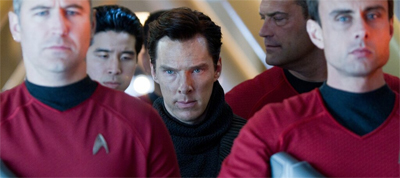
Seeing red...

Seeing red…

Continue reading

Non-Review Review: Star Trek – Into Darkness

Note: This is a spoiler-lite review. If you want a spoiler-heavy in-depth look at the film, click here.

Towards the climax of Star Trek: Into Darkness, Kirk and the Enterprise flee an aggressor by entering warp. At that speed, several factors the speed of light itself, they surmise that they must be safe from their pursuer. Of course, they prove to be wrong – brutally so. Everything in Into Darkness moves fast, so fast that the Enterprise’s top speed seems more like a casual jog than a breakneck acceleration. The plot rockets along with incredible speed, from plot point to plot point, counting on the momentum to sustain the film and carry it across the line.

There is enough material here to produce a trilogy of films. Indeed, cynics might suggest that a lot of the movie’s iconography and plot points are indeed recycled from the central “trilogy” of the original Star Trek films, running from the homages to Star Trek II: The Wrath of Khan right down a climactic visual reference to Star Trek IV: The Voyage Home. Abrams and his team of writer continue their work from 2009’s breakout blockbuster Star Trek by putting the franchise’s most compelling images and cues into a high-speed blender.

Into Darkness just substantially increases the concentration.

Seeing red...

Seeing red…

Continue reading

Star Trek – The Enemy Within (Review)

To celebrate the release of Star Trek: Into Darkness this month, we’ll be running through the first season of the classic Star Trek all this month. Check back daily to get ready to boldly go. It’s only logical.

One thing that I don’t think the original Star Trek gets nearly enough credit for is the quality of the writers that Gene Roddenberry recruited to contribute scripts. Television obviously operated under a different model at the time, but there’s an impressive selection of science-fiction literary giants who contributed scripts to the show. More than that, it’s impressive how many of those stories became truly iconic Star Trek stories.

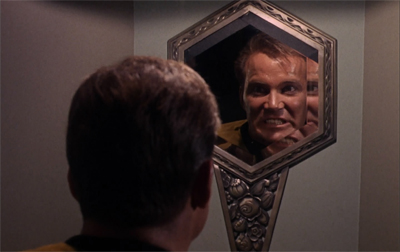
The Enemy Within is the work of author Richard Matheson, best known for stories like I Am Legend or What Dreams May Come. It’s very much a high-concept science-fiction story, but it’s also notable because it establishes two of what would become the show’s favourite tropes: transporter accidents and evil duplicates. Indeed, the two devices would be reunited in the following season’s Mirror, Mirror. These narrative elements even featured in the last season of Star Trek: Enterprise to air, in episodes like Daedalus and In a Mirror, Darkly.

Perhaps it’s a demonstration of how important these outside writers were to the development of Star Trek as a franchise that Matheson would effectively codify two stock narrative devices that would still be in use four decades later.

Mirror, mirror...

Mirror, mirror…

Continue reading

Star Trek – Where No Man Has Gone Before (Review)

To celebrate the release of Star Trek: Into Darkness this month, we’ll be running through the first season of the classic Star Trek all this month. Check back daily to get ready to boldly go. It’s only logical.

In a way, there’s a very clear divide between The Cage and Where No Man Has Gone Before. It’s clearer than the strange new actor sitting in the middle of the Bridge or the fact that Spock is suddenly a lot less casual. In a way, each is perfectly positioned in popular consciousness. The Cage was produced in late 1964, but wouldn’t be shown on television until 1988, after spending years touring the fan circuit. It remains a strange bit of Star Trek history, sitting simultaneously outside any of the five television shows, and simultaneously a completely inexorable part of the franchise’s evolution. It’s where it all began, but not where the first Star Trek began.

In contrast, Where No Man Has Gone Before feels more like the pilot episode of Star Trek. Sure, the fashion changes a bit in the episodes to come, the entire cast has yet to be assembled, but this is recognisably the same ship and the same show as The Corbomite Manoeuvre or The Man Trap. It’s more than the actors filling roles, the consistent characterisation of Spock or the fact that it actually aired on television in September 1966. This is what the next three years of Star Trek will be like. It’s an aesthetic or an approach to storytelling that is markedly different to the way that The Cage tackled many of the same themes and ideas.

While The Cage laid down many of the philosophical underpinnings of the broader Star Trek universe – including the classic show – it is also a lot less physical and visceral than the classic Star Trek. Indeed, The Cage featured the Captain of the Enterprise reasoning with an advanced bunch of god-like aliens, appealing to human virtues. The action sequences felt a bit extraneous. In contrast, Where No Man Has Gone Before sees the Captain of the Enterprise punching a god-like being repeatedly in the face while hitting on the same themes.

I think that’s perhaps the most dynamic difference between not only The Cage and Where No Man Has Gone Before, but between Star Trek and its spin-offs.

All the old familiar faces...

All the old familiar faces…

Continue reading

Star Trek: Early Voyages #1 – Flesh of my Flesh (Review)

To celebrate the release of Star Trek: Into Darkness this month, we’ll be running through the first season of the classic Star Trek all this month. Check back daily to get ready to boldly go. It’s only logical.

We’ll be supplementing our coverage of the episodes with some additional materials – mainly novels and comics and films. This is one such entry.

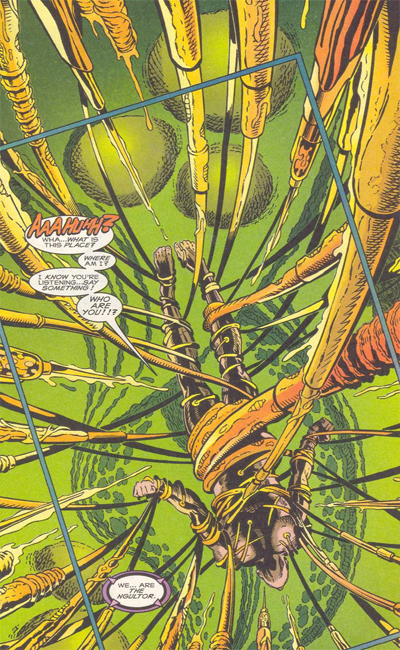
In the late nineties, Marvel were publishing Star Trek comic books. One of those books, perhaps the book garnering the most critical praise, was Star Trek: Early Voyages. Written by Dan Abnett and Ian Edginton, the series was intended to follow the mission of the USS Enterprise under the command of Captain Christopher Pike. Published monthly, the comic is perhaps the best indication of what a Star Trek show starring Christopher Pike might have actually looked like. Although the series was cancelled suddenly after only seventeen issues, ending on a cliffhanger, it is still a fascinating look at what might have been.

Looks like they've hooked a Pike...

Looks like they’ve hooked a Pike…

Continue reading

Star Trek – The Cage (Review)

To celebrate the release of Star Trek: Into Darkness this month, we’ll be running through the first season of the classic Star Trek all this month. Check back daily to get ready to boldly go. It’s only logical.

The Cage is fascinating. Looking at it now, it holds up phenomenally well a s apiece of sixties science-fiction. However, it feels like we’re watching a prototype of Star Trek. In many respects, The Cage feels like a rough sketch that captures some essentials, but is missing out on the finer details. Spock is there! But he smiles! The set design looks the same, but the characters are different. Some of the cast fill the same roles, but some are dramatically different. Watching The Cage, you can see a lot of the philosophy that Gene Roddenberry would bring to Star Trek, but it’s very difficult to imagine an on-going series spinning out of this adventure, let alone one that managed to become as iconic or influential as Star Trek would ever be.

Still, it’s pretty solid viewing. It’s entertaining on its own terms, but it’s also informative in the context of the series. It’s more like dry run or a test drive of the concept.

To boldly go... for some reworking...

To boldly go… for some reworking…

Continue reading

Star Trek – Vulcan’s Glory by D.C. Fontana (Review)

To celebrate the release of Star Trek: Into Darkness this month, we’ll be running through the first season of the classic Star Trek all this month. Check back daily to get ready to boldly go. It’s only logical.

We’ll be supplementing our coverage of the episodes with some additional materials – mainly novels and comics and films. This is one such entry.

I’ve never really felt too strongly one way or another about continuity. I never got too upset about Klingon forehead ridges, or the fact that Khan somehow remembered Chekov from an episode that took place before he joined the Enterprise. I’ve always found the use of the term “canon” to describe the shared continuity as more than a little indulgent or absurd. I consider some of the better tie-in novels I have read to be a worthy part of the Star Trek universe, regardless of the fact that they may not fit, or they may contradict what was depicted on-screen. I’ve never been too tightly tied to the notion that something is “important” or “in continuity” among this 700-episode franchise.

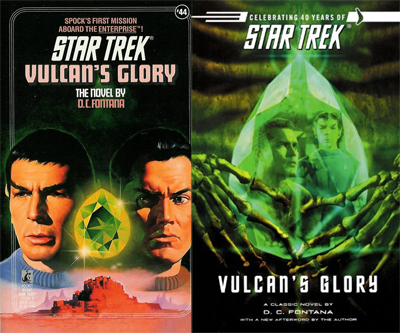
Still, I can’t help but feel like there’s something almost legitimate about Vulcan’s Glory. It is a novel from writer D.C. Fontana, who served as script editor and writer on the classic Star Trek show, and is regarded as one of the guiding lights of the franchise. She went on to write for both Star Trek: The Next Generation and Star Trek: Deep Space Nine. Given her importance to the show over its extended history, anything Fontana writes about it is worthy of note. Indeed, Vulcan’s Glory was originally published in 1989 and was reissued in 2006 for the franchise’s fortieth anniversary.

Even to somebody reluctant to consign “importance” or “worthy” to a tie-in based on outside factors, the story of Spock’s first mission on board the Enterprise, written by one of the strongest writers of the original Star Trek and a guiding influence on the franchise, still jumps out as a pretty important book.

vulcansglory

Continue reading