• Following Us

  • Categories

  • Check out the Archives


  • Awards & Nominations

Star Trek: The Next Generation (DC) Annual #3 – The Broken Moon (Review)

This January and February, we’ll be finishing up our look at the second season of Star Trek: The Next Generation and moving on to the third year of the show, both recently and lovingly remastered for high definition. Check back daily for the latest review.

We’ll be supplementing our coverage of the episodes with some additional materials – mainly novels and comics and films. This is one such entry. This is actually supplementary to the first season of the Next Generation, specifically the episode Conspiracy.

If you were to construct a list of the most niggling unresolved plot threads in the history of the Star Trek franchise, “what was up with those things from Conspiracy?” would likely rank up there alongside “so, did Bajor ever join the Federation?” Funnily enough, author S.D. Perry would tie those two dangling plot points up in her Deep Space Nine relaunch book, Unity.

However, several other writers have tried to figure out what exactly was going on with those mind-controlling parasites who appeared at the end of the first season of Star Trek: The Next Generation and were never heard from again. According to Ronald D. Moore on Inside the Writers’ Room on the third Next Generation blu ray box set, various writers for the show tried to revisit the idea, but Roddenberry hated that episode so much nothing was ever developed.

The Broken Moon, the third annual for DC’s Next Generation comic book series, offers its own take on the mind-controlling parasites. While writer Michael Jan Friedman wisely avoids revealing too much about these creatures, the story suffers because it never figures out anything interesting to do with them.

It always bugged me...

It always bugged me…

Continue reading

Star Trek: The Next Generation – Season 2 (Review)

This January and February, we’ll be finishing up our look at the second season of Star Trek: The Next Generation and moving on to the third year of the show, both recently and lovingly remastered for high definition. Check back daily for the latest review.

Although, as Rick Berman argues in the documentary Making It So, the first season of Star Trek: The Next Generation “was at least in syndicated ratings terms, extremely successful”, there was trouble brewing behind the scenes. The show lost two-thirds of its regular female cast members, and the season ended with a whimper rather than a bang as the 1988 Writers’ Strike cutting into the development of the final couple of scripts.

The second season was no less plagued by problems, even as the show proved a ratings and commercial success. The show’s writers’ room was in disarray, with conflicts erupting between Tracy Tormé and Maurice Hurley over scripting for the show – leading to the use of both of Tormé’s WGA-approved pseudonyms on consecutive scripts from the writer. Episodes were coming over budget and behind schedule, necessitating a clip show to round out the season.

tng-qwho17

Even on the set itself, new cast member Diana Muldaur had difficulty fitting in the cast, and did not wish to return after the second season. Katherine Pulaski would disappear from the show (and the franchise) with little fuss – her last appearance being in the rather disappointing Shades of Grey. While The Next Generation was successful by just about any objective external measure, it had yet to really find its own internal balance.

Still, the second season of The Next Generation did show hints of improvement. The show was finding its feet. While the average quality of the episodes was nothing like what it would become in the show’s third season, even the more middling instalments of the show’s second season (like Contagion or Where Silence Has Lease or Peak Performance) were leaps and bounds ahead of where the show had been in the first season. It was getting where it needed to go, but not nearly fast enough.

tng-timesquared19

Continue reading

Star Trek: The Next Generation – Peak Performance (Review)

This January and February, we’ll be finishing up our look at the second season of Star Trek: The Next Generation and moving on to the third year of the show, both recently and lovingly remastered for high definition. Check back daily for the latest review.

Peak Performance is a functional episode of Star Trek: The Next Generation. It doesn’t really stand out all that much, and it feels quite a bit average. Still, that’s not to dismiss Peak Performance. After all, this past season has seen The Next Generation advance considerably. During the first season, an episode like Home Soil or The Big Goodbye was a welcome relief. At this stage in the show, episodes like Peak Performance and Contagion are the average.

Of course, the third season would see the show’s quality improve even more dramatically, but we’re still just a little bit away from that. So we’re left with Peak Performance, a fairly standard piece of Star Trek that feels just a little bit too formulaic and a little bit too cliché. While it’s not among the strongest of the season, there are definitely worse sins.

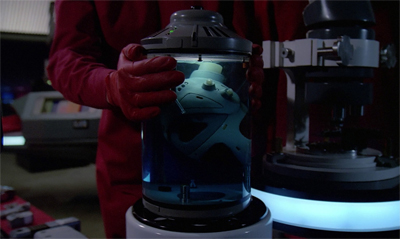
Game on...

Game on…

Continue reading

Star Trek: The Next Generation – Manhunt (Review)

This January and February, we’ll be finishing up our look at the second season of Star Trek: The Next Generation and moving on to the third year of the show, both recently and lovingly remastered for high definition. Check back daily for the latest review.

There’s a strange sense of fatigue as we come towards the end of the second season of Star Trek: The Next Generation, as if the effort of producing Q Who? has really just drained the show of any ambition or drive. To be fair, there are probably more banal motivations at play. The 1988 Writers’ Strike had taken the entire industry by surprise and has been credited with dropping television ratings by ten percent. It damaged the tail end of the first season, causing an improvised conclusion to We’ll Always Have Paris and is probably responsible for the mess that was The Neutral Zone.

The damage also bled into the second season. Even closing with a clip show, Shades of Grey, the second season wasn’t able to meet the average quota of twenty-six episodes per season. The season premiere, The Child, had to be hastily repurposed from an aborted script for Star Trek: Phase II. Even with the shortened orders, the second season of The Next Generation frequently saw episodes coming in behind schedule and above budget. This is one of the reasons that Rob Bowman, despite being responsible for two of the season’s strongest episodes (Elementary, Dear Data and Q Who?), did not become a regular director.

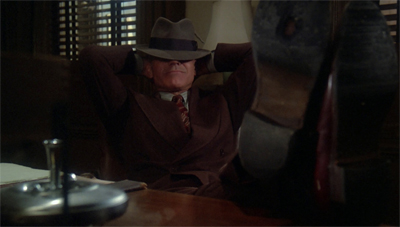
"It's a good time for nap time..."

“It’s a good time for nap time…”

Behind the scenes, the show seemed to be threatening to pull itself apart. Tracy Tormé and Maurice Hurley were frequently at loggerheads with one another over all manner of issues. Tormé was only allowed to register two pseudonyms with the Writers’ Guild of America, he used both on the second season of The Next Generation, protesting over modifications made to his script. It’s no wonder that the writers’ room pretty much exploded at the end of the season, with both Tormé and Hurley departing. When Michael Piller was put in charge on the third season, he had to pretty much start from scratch.

All of which explains why the tail end of the second season seems so lifeless and limp. The Emissary is really the only second season script with any life in it once the show gets past Q Who? Most of the rest of the season seems to trying to limp across the finish line. Still, even with all of that in mind, Manhunt feels a little mean-spirited. It’s an episode designed to mock at Lwaxana Troi, to reduce a middle-aged woman going through a process explicitly compared to menopause to the butt of some particularly harsh joke. It’s hard to find that all that amusing.

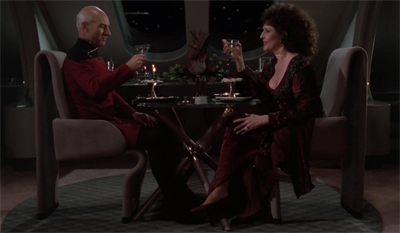
Starlit dinner...

Starlit dinner…

Continue reading

Star Trek: The Next Generation – Up the Long Ladder (Review)

This January and February, we’ll be finishing up our look at the second season of Star Trek: The Next Generation and moving on to the third year of the show, both recently and lovingly remastered for high definition. Check back daily for the latest review.

It’s been a while since Star Trek: The Next Generation has been openly offensive. So, just in case you’d forgotten that this was the same production staff that gave us “Riker beams down to a planet of beautiful women and screws their heads on straight” or “Troi’s womb is occupied by an alien intelligence, isn’t that cute?”, the writing staff have conspired to remind us that just because prejudice doesn’t exist in the 24th century (tell that to the Ferengi!) doesn’t mean that it can’t exist inside a late twentieth century writing room.

Begosh and begorrah! The space Oirish are coming!

"Wait, we're actually filming this?"

“Wait, we’re actually filming this?”

Continue reading

Star Trek: The Next Generation – Samaritan Snare (Review)

This January and February, we’ll be finishing up our look at the second season of Star Trek: The Next Generation and moving on to the third year of the show, both recently and lovingly remastered for high definition. Check back daily for the latest review.

To describe Samaritan Snare as a step down from Q Who? feels like an understatement. Q Who? was Star Trek: The Next Generation realising that it needed to improve its game if it ever wanted to measure up to its predecessor, interrogating some aspects of the series that had been taken for granted, calling the crew out on their arrogance and offering an opponent that could really push the Enterprise crew for all that they are worth.

It was really the logical culmination of themes running through the second season, themes that seem to faintly echo into Samaritan Snare, another story about the arrogance and ego of the Enterprise crew. Unfortunately, while it does seem to acknowledge many of the same weaknesses and flaws that Q Who? hit upon, it can’t help but seem a little disappointing. Here, the Enterprise are not thrown against an impossible-to-defeat adversary. Instead, their arrogance turns them into interstellar marks.

His heart just isn't in it...

His heart just isn’t in it…

Continue reading

Star Trek: The Next Generation – Pen Pals (Review)

This January and February, we’ll be finishing up our look at the second season of Star Trek: The Next Generation and moving on to the third year of the show, both recently and lovingly remastered for high definition. Check back daily for the latest review.

Pen Pals is a pretty mediocre episode of Star Trek: The Next Generation, one with a lot more potential than the episode actually delivers upon. Centring around Data’s unilateral decision to violate the Prime Directive and the consequences stemming from that decision, there’s a sense that Pen Pals might have been a lot more incisive in earlier version – a lot more willing to ask tough questions about the rules and regulations that our heroes uphold.

Sadly, Pen Pals instead ends with a massive cop out and an unwillingness to really commit to any big idea or to interrogate any of the show’s core concepts.

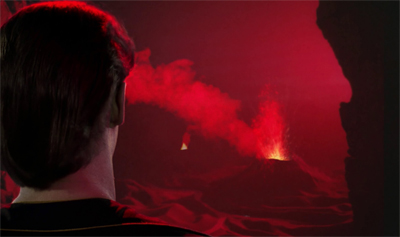
Everything burns...

Everything burns…

Continue reading

Star Trek: The Next Generation (DC) Annual #2 – Thin Ice (Review)

This January and February, we’ll be finishing up our look at the second season of Star Trek: The Next Generation and moving on to the third year of the show, both recently and lovingly remastered for high definition. Check back daily for the latest review.

We’ll be supplementing our coverage of the episodes with some additional materials – mainly novels and comics and films. This is one such entry.

Riker is a character caught between a rock and a hard place. According to the series bible, Riker was imagined as one of the “dual lead characters” for the show and clearly envisioned as an impulsive and brilliant Kirk to Picard’s more rational and stoic Spock. However, it didn’t quite work out that way, for a number of reasons. For one thing, the writing on the early years of Star Trek: The Next Generation tended to be a bit more sterile and bland, so Riker was never really allowed to step too far out of Picard’s shadow.

Instead, we got lots of characters talking about how ambitious Riker was, without seeing it for ourselves. It’s implied that Riker’s career led him to separate from Troi, something Peter David ran with in Imzadi. Everybody is constantly telling everybody else how Riker desperately wants to be a starship commander. And yet, when it come to the actual characterisation of Riker on the show, none of this shines through.

Due to the constraints imposed on the early years, interpersonal conflict was impossible in early Next Generation scripts, putting Riker in a paradoxical position as a character. We’re repeatedly told how ambitious and career-orientated he is, but none of that shines through.

Dead space...

Dead space…

Continue reading

Star Trek: The Next Generation – The Icarus Factor (Review)

This January and February, we’ll be finishing up our look at the second season of Star Trek: The Next Generation and moving on to the third year of the show, both recently and lovingly remastered for high definition. Check back daily for the latest review.

The Icarus Factor is a character-driven story. At least, it wants to be a character-driven story. The problem is that Star Trek: The Next Generation hasn’t reached the point where it can really do character-driven storytelling with a measure of consistence. (The fact that Picard confronting his future failures in Time Squared worked was more down to Patrick Stewart than the episode’s script.)

The Icarus Factor is a story focusing on Riker as a character, and it suffers from the fact that Riker hasn’t really been well-defined to date. We’re repeatedly told that he’s ambitious and career-driven, but most his on-screen characterisation has fluctuated between reckless, jerkish and horny. So The Icarus Factor tries to compensate by giving Riker the most generic back story possible for a lead male character on a television show.

This is the story of Riker’s daddy issues.

Somehow, this image just sums up Riker as a character...

Somehow, this image just sums up Riker as a character…

Continue reading

Star Trek: The Lost Era – Deny Thy Father by Jeff Mariotte (Review)

This January and February, we’ll be finishing up our look at the second season of Star Trek: The Next Generation and moving on to the third year of the show, both recently and lovingly remastered for high definition. Check back daily for the latest review.

We’ll be supplementing our coverage of the episodes with some additional materials – mainly novels and comics and films. This is one such entry.

In theory, you can probably tell a good story about just about anything. There’s a knack to constructing a narrative and in making particular characters fascinating or compelling. In the right hands, even the most tired and boring premise can generate some measure of excitement and over a glimpse of depth that we never thought was there. For example, I didn’t come out of Star Trek: Generations thinking that I’d ever read a classic story about John Harriman, and then I read the superb Serpents Among the Ruins.

However, some ideas strike you as a little less exciting than others. Some concepts seem a bit riskier to pull off, a bit more daunting in scope. Constructing a compelling narrative around the youth of Commander William T. Riker, probably one of the blandest members of the Star Trek: The Next Generation ensemble, seems like an uphill struggle.

Unfortunately, Jeff Mariote’s Deny Thy Father isn’t up to the task of making the boring father-son relationship glimpsed in The Icarus Factor seem any more exciting.

tng-denythyfather

Continue reading