• Following Us

  • Categories

  • Check out the Archives


  • Awards & Nominations

Star Trek: Voyager – Learning Curve (Review)

This September and October, we’re taking a look at the jam-packed 1994 to 1995 season of Star Trek, including Star Trek: Deep Space Nine and Star Trek: Voyager. Check back daily for the latest review.

So, Learning Curve is the last episode broadcast as part of Star Trek: Voyager‘s first season. It’s hard to get too excited about – or be too disappointed by – that.

Learning Curve is a bit of limp finalé to a mediocre season. Like a lot of the season before it, it’s a passable execution of what should have been a fantastic concept. (Boy, that really is Voyager in a nutshell, isn’t it?)

Is the show finally starting to gel?

Is the show finally starting to gel?

Learning Curve‘s position in the broadcast order was apparently a bit of blind luck. It was actually the fifth-last episode produced of the show’s first season. It just found itself broadcast in the “season finalé” slot when UPN decided to hold back the remaining four episodes of the season until the Fall, to broadcast leading into the second season.

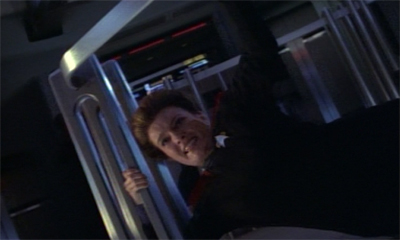
However, despite this, Learning Curve seems as good a choice as any to close out the first season – and certainly a better choice than Brannon Braga and Jeri Taylor’s preferred candidate, The 37’s. It returns to the conflict between Starfleet and the Maquis promised in Caretaker, but only fleetingly acknowledged in episodes like Parallax or State of Flux. Although the execution leaves a lot to be desired, it does create a sense that the show has come something of a full circle.

It's Chakotay or the high way...

It’s Chakotay or the high way…

Continue reading

Star Trek: Voyager – Jetrel (Review)

This September and October, we’re taking a look at the jam-packed 1994 to 1995 season of Star Trek, including Star Trek: Deep Space Nine and Star Trek: Voyager. Check back daily for the latest review.

Jetrel is an interesting episode for a number of reasons. It’s another example of how the first season of Star Trek: Voyager seems anchored in the aftermath of the Second World War. The episode exists primarily as a meditation on guilt over the use of atomic weapon, with the Metreon Cascade attack on Rinax standing in for the dropping of the atomic bomb on Hiroshima and Negaska in 1945. Jetrel aired three months shy of the fiftieth anniversary of the bombing, and amid a national period of reflection about the morality of Harry S. Truman’s actions.

Whatever the context of Jetrel in 1995, it serves as another example of how Voyager seems like a relic from a bygone age, a snapshot of atomic age science-fiction. Cathexis was the show doing Invasion of the Body Snatchers. Faces was an old-fashioned monster movie. Jetrel wasn’t even the first time that the first season had traded in atomic imagery. The aftermath of the polaric detonation in Time and Again was very clearly designed to evoke the aftermath of an atomic blast.

The devil in the pale moonlight...

The devil in the pale moonlight…

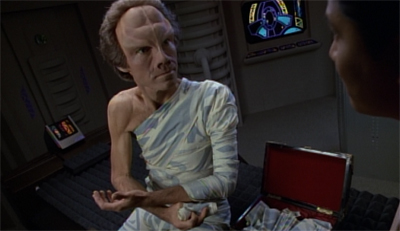
Even without all this baggage, Jetrel still feels like a mess of an episode. The heart of the story finds a member of the ensemble confronting a former war criminal while dealing with issues of war guilt and responsibility – a structure that evokes Duet the penultimate episode of the first season of Star Trek: Deep Space Nine. While that episode worked brilliantly, there’s a sense that Jetrel is burdened a little bit trying to offer a two-hander about guilt while tackling the issue of the atomic bomb.

The problem is compounded by a somewhat messy final act that eschews all the episode’s heavy character-based drama in favour of a contrived techno-babble climax that involves a lot of characters spouting nonsense while playing with light-emitting diodes. Jetrel begins as the strongest and boldest episode of the show’s first season, but ends as one of the prime examples of Voyager‘s preference for techno-babble over character work.

Burn with me...

Burn with me…

Continue reading

Star Trek: Voyager – Faces (Review)

This September and October, we’re taking a look at the jam-packed 1994 to 1995 season of Star Trek, including Star Trek: Deep Space Nine and Star Trek: Voyager. Check back daily for the latest review.

One of the more interesting aspects of the first season of Star Trek: Voyager is just how much of a throwback the show seems to be. In many ways, the show seems anchored in a very fifties mindset. While Star Trek: Deep Space Nine has embraced multiculturalism and the wake of the Cold War, the first season of Star Trek: Voyager seems to be dealing with anxieties carried over from the end of the Second World War.

Caretaker reconnected with the “Wild West in outer space” mentality of the classic Star Trek. Episodes like Time and Again and Jetrel are concerned with the splitting of the atom. Cathexis played out a decidedly Cold War paranoia thriller. Good old-fashioned technological espionage – like the leaking of nuclear secrets – was at the heart of State of Flux. There’s a sense that Voyager may have been a piece of fifties Americana that had the misfortune to arrive forty years too late.

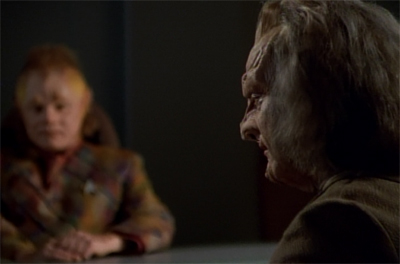
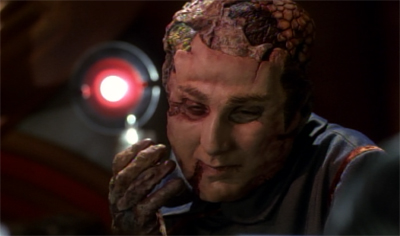
Faces is perhaps the most obvious example of this. Splitting a bi-racial character into two halves as part of a science experiment, evoking classic monster movies, and even the decision to define the Vidiians as stand-ins for the Nazis, all give the episode a delightfully pulpy feel. This is Voyager doing a cheesy fifties b-movie. And doing it quite well at that.

He has you now, his pretty!

He has you now, his pretty!

Continue reading

Star Trek: Voyager – Cathexis (Review)

This September and October, we’re taking a look at the jam-packed 1994 to 1995 season of Star Trek, including Star Trek: Deep Space Nine and Star Trek: Voyager. Check back daily for the latest review.

Cathexis has a vaguely interesting premise, but it gets a little bit too caught up in science-fiction high concepts and New Age mysticism.

Once again, there’s a sense that the wrong writer has been assigned the wrong brief. The New Age spirituality elements of Chakotay’s character were largely championed by Michael Piller; the “romantic period mystery” story for Janeway clearly comes from Jeri Taylor. The only part of Cathexis that clearly comes from credited writer Brannon Braga is the somewhat generic Invasion of the Body Snatchers plot line – and, as such, it seems to be the only thread in which Braga is particularly interested.

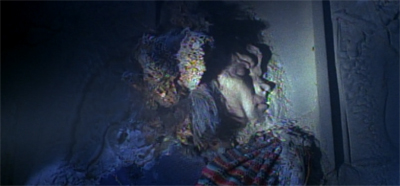
So we get a bunch of half-hearted New Age stuff unfolding, with Chakotay’s wandering spirit represented by a camera with a blurry filter swooping through familiar sets. Once again, Chakotay’s Native American heritage becomes a launching pad for some ill-advised mysticism and exoticism, which Cathexis never even bothers trying to explain.

Frankly, I'm surprised Tuvok put up with this for so long...

Frankly, I’m surprised Tuvok put up with this for so long…

Continue reading

Star Trek: Voyager – Heroes and Demons (Review)

This September and October, we’re taking a look at the jam-packed 1994 to 1995 season of Star Trek, including Star Trek: Deep Space Nine and Star Trek: Voyager. Check back daily for the latest review.

In many ways, Heroes and Demons is a watershed moment for Star Trek: Voyager. The two previous episodes, Prime Factors and State of Flux, may have been far from perfect, but they did at least hint at a direction for the show. They suggested that maybe Voyager might be interested in engaging in some of the big philosophical questions raised by the crew’s unique situation. Stranded seventy thousand light-years from home, the ship was cut off from the Federation. It was isolated and alone. That meant that tough choices at least had to be debated.

While neither Prime Factors nor State of Flux made for particularly exciting television, they were episodes that felt specific to Voyager in a way that a lot of the first season really doesn’t. Unfortunately, Heroes and Demons represents a step backwards. Far from telling a story specific to Star Trek: Voyager, this feels like a script that could easily have been recycled from Star Trek: The Next Generation or Star Trek: Deep Space Nine.

Can the Doctor hack it?

Can the Doctor hack it?

It’s written by veteran Next Generation writer Naren Shankar, who had also served on the staff of Deep Space Nine. He wrote Heroes and Demons as a freelancer, pitching the idea very early in the development cycle. Perhaps what is most remarkable is how little of Shankar’s script was adapted or edited from that first draft. In fact he described it to The Official Star Trek: Voyager Magazine as “the best experience I’ve ever had as a writer, in terms of writing something as a first draft and then seeing those exact words on screen.”

There’s a sense that Heroes and Demons is a fun story that could have really worked in any context, and doesn’t fit particularly well into the mould of Voyager‘s first season. This should be the year where Voyager is trying to find its own voice, rather than simply imitating that of its older siblings.

Only mostly armless...

Only mostly armless…

Continue reading

Star Trek: Voyager – State of Flux (Review)

This September and October, we’re taking a look at the jam-packed 1994 to 1995 season of Star Trek, including Star Trek: Deep Space Nine and Star Trek: Voyager. Check back daily for the latest review.

Prime Factors and State of Flux form something of a duology in the middle of the first season of Star Trek: Voyager. The two episodes might be far from perfect, but they seem to be the closest that the first season of Voyager comes to outlining its vision and ambitions. Taken together, they offer a demonstration that life in the Delta Quadrant might be significantly more complicated than life in the Alpha Quadrant – that everything might not be as it appears to be, that Voyager might not be the perfect Federation vessel.

While both episodes are flawed, they do demonstrate a willingness to take advantage of the basic premise of Voyager to tell stories that simply wouldn’t be possible on Star Trek: The Next Generation or Star Trek: Deep Space Nine. In that respect, they stand apart from surrounding stories like Ex Post Facto or Heroes and Demons, both of which feel like re-worked stories from an aborted eighth season of The Next Generation. These are adventurous and ambitious episodes. They lack the skill necessary to completely realise that vision; but that skill could come in time.

Unfortunately, these two episodes wind up feeling like exceptions – a flash of what might have been, rather than what would be.

Kazon development has hit a wall...

Kazon development has hit a wall…

Continue reading

Star Trek: Voyager – Prime Factors (Review)

This September and October, we’re taking a look at the jam-packed 1994 to 1995 season of Star Trek, including Star Trek: Deep Space Nine and Star Trek: Voyager. Check back daily for the latest review.

Prime Factors has some great ideas, but blunders awkwardly in the execution. In that respect, it genuinely feels like a first season episode of a new show in the same way that The Cloud did – there’s a sense that the series is trying to expand its own comfort zone in a way that offers potential for future storytelling opportunities. Prime Factors might make a few pretty serious missteps along the way, and often seems a little too timid to commit to its bolder ideas directly, but at least it feels more ambitious than Time and Again or Ex Post Facto.

Make way for Janeway...

Make way for Janeway…

Continue reading

Star Trek: Voyager – Emanations (Review)

This September and October, we’re taking a look at the jam-packed 1994 to 1995 season of Star Trek, including Star Trek: Deep Space Nine and Star Trek: Voyager. Check back daily for the latest review.

Emanations has a pretty effective set-up and solid premise. It is very clearly one of Star Trek: Voyager‘s “planet of the week” stories – like the show directly before it and the show directly following it – but it’s build around some vaguely interesting ideas. It’s very clearly an episode designed to function as social commentary in the grand Star Trek tradition, hitting on big ideas and bold concepts.

Unfortunately, it’s not the type of script that Brannon Braga is best suited to handle. It doesn’t feel so much an exploration of an important issue as a social treatise. It’s simplistic and heavy-handed while dealing with ideas that require a bit of nuance and sophistication. It feels under-developed, contrived and a little shallow. Despite an attempt at ambiguity in its closing scene, it feels like an episode driven primarily by an agenda rather than a strong story.

Emanations is a misfire, another example of the weird tendency in the first season of Voyager to assign the wrong writers to the wrong scripts.

Harry really got wrapped up in local culture...

Harry really got wrapped up in local culture…

Continue reading

Star Trek: Voyager – Eye of the Needle (Review)

This September and October, we’re taking a look at the jam-packed 1994 to 1995 season of Star Trek, including Star Trek: Deep Space Nine and Star Trek: Voyager. Check back daily for the latest review.

Eye of the Needle really should be a bigger deal than it is.

Looking at the basic premise of Star Trek: Voyager, a story like Eye of the Needle should be an “event.” It should, at the very least, be a mid-season finalé. Ideally, the episode would serve as the season finalé, bringing a sense of closure to year of adventuring by our crew, suggesting that there is some measure of hope for them. Perhaps home is not as far away as it might seem.

"Hm. You appear to have beamed me up in my pyjamas..."

“Hm. You appear to have beamed me up in my pyjamas…”

Voyager is a show about a ship stranded on the far side of the galaxy. The crew are isolated from friends and family. The return journey will take seventy years. It is quite possible that this will be a generational voyage. The Voyager crew will return home to a world that has changed without them. It’s heartbreaking even to think about.

So the ship’s first chance to get home should be something to get excited about. It should be cause for celebration; it should feel like a lifeline dangling just within the reach of our characters. There should be a sense that this sort of think might only happen once, and everybody best be prepared for it. Instead, it happens six episodes into the season, and the audience spends forty-five minutes waiting for the other shoe to drop.

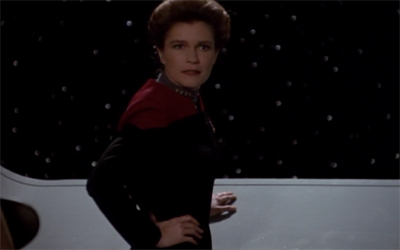
Thoughtful Janeway pose #452...

Thoughtful Janeway pose #452…

Continue reading

Star Trek: Voyager – The Cloud (Review)

This September and October, we’re taking a look at the jam-packed 1994 to 1995 season of Star Trek, including Star Trek: Deep Space Nine and Star Trek: Voyager. Check back daily for the latest review.

The Cloud feels more like a first season episode than Time and Again and Phage did. Star Trek: Voyager has ploughed fairly effectively into its first season, primarily by treating it as the eighth season of Star Trek: The Next Generation. However, the first season has been falling into a regular pattern so fast that pausing for forty-five minutes to do some awkward and ill-defined character work doesn’t feel like a bad idea.

The Cloud is an awkwardly constructed piece of television that feels like it’s interested in building up this ensemble. As such, the pacing suffers, and the episode makes a number of awkward mistakes along the way, but it still feels like it is at least trying to do something worthwhile.

Shaking things up around here...

Shaking things up around here…

Continue reading