• Following Us

  • Categories

  • Check out the Archives


  • Awards & Nominations

Doctor Who: Mawdryn Undead (Review)

To celebrate the fiftieth anniversary of the longest-running science-fiction show in the world, I’ll be taking weekly looks at some of my own personal favourite stories and arcs, from the old and new series, with a view to encapsulating the sublime, the clever and the fiendishly odd of the BBC’s Doctor Who.

Mawdryn Undead originally aired in 1983. It was the first instalment in the Black Guardian Trilogy.

Oh look, it’s all a long time ago, Doctor. I mean, surely what’s past is —

Very much in the present, Brigadier. You never did understand the interrelation of time.

– Brigadier and the Doctor have a bit of time travel trouble

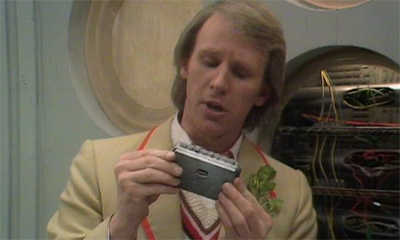
Mawdryn Undead is a bit of a strange beast. It’s written by director Peter Grimwade, who last wrote the script for the unbelievably bad Time-Flight, which is a serious contender for the worst Doctor Who adventure of the eighties – no small accomplishment in a decade that gave us The Twin Dilemma and Timelash. Still, Mawdryn Undead is an entertaining little romp with a clever central concept that is somewhat overshadowed by the fact that Grimwade seems to have been given a laundry-list of tasks to accomplish with his script. With the serial featuring the Brigadier, introducing Turlough and kick-starting The Black Guardian trilogy, you can understand why the rather nifty little time-travel story tends to get overshadowed a bit.

Faithful companion?

Continue reading

Doctor Who: Arc of Infinity (Review)

To celebrate the fiftieth anniversary of the longest-running science-fiction show in the world, I’ll be taking weekly looks at some of my own personal favourite stories and arcs, from the old and new series, with a view to encapsulating the sublime, the clever and the fiendishly odd of the BBC’s Doctor Who.

Arc of Infinity originally aired in 1983.

We know who you are.

That changes nothing.

– the Doctor and Omega set one thing straight

There really should be a bare minimum threshold of enjoyment for a Doctor Who story set on Gallifrey. I mean, these are beings who claim to control the whole of time and space. Their guards look like they modelled themselves on Adam Strange, replacing his jetpack with a cape, and there’s always an excuse for some good old-fashioned science-fiction ray-gun-related fun. How hard can it be to entertain an audience for four episodes in that particular setting?

Unfortunately, Arc of Infinity answers that question. Quite boring indeed, it seems.

Going around in circuits...

Going around in circuits…

Continue reading

Doctor Who: The Name of the Doctor (Review)

How do we get down there? Jump?

Don’t be silly. We fall.

– Clara and the Doctor set things straight

Like The Wedding of the River Song, The Name of the Doctor suggests that Moffat might be better served by reverting to the Davies-era model of two-part season finalés. The strongest season ender of the Moffat era (and probably the best season finalé of the revived show) was The Big Bang, because it felt like Moffat had enough space to allow his ideas to breathe. The Name of the Doctor is a lot sharper and a lot more deftly constructed than any of the closing episodes from Russell T. Davies’ seasons, but it feels a little too compact, a little too tight for its own good.

To be fair, Moffat is has very cleverly structured his season. The mystery of Clara was seeded as early as Asylum of the Daleks and hints have been scattered throughout the past year of Doctor Who. Even the build-up to the final line of the episode feels like an idea that Moffat has been toying with since The Beast Below. Despite all this, it still feels like The Name of the Doctor could do with a little more room to elaborate and develop the concepts at the core of the story.

Journey to the centre of the Doctor?

Journey to the centre of the Doctor?

Continue reading

Doctor Who: The Visitation (Review)

To celebrate the fiftieth anniversary of the longest-running science-fiction show in the world, I’ll be taking weekly looks at some of my own personal favourite stories and arcs, from the old and new series, with a view to encapsulating the sublime, the clever and the fiendishly odd of the BBC’s Doctor Who.

The Visitation originally aired in 1982.

It’s survival, Doctor. Just as these primitives kill lesser species to protect themselves, so I kill them.

That’s hardly an argument.

It’s not supposed to be an argument. It’s a statement!

– the Terileptil is in no mood for debate with the Doctor

As far as writing débuts go, The Visitation is not a bad first script. Writer Eric Saward had experience writing for radio, but The Visitation was his first live action script to be produced. It’s a pretty solid piece of Doctor Who, even if it’s not anything exceptional. Then again, Robert Holmes’ first script was the perfectly average The Krotons. So there’s room for improvement, and The Visitation is not a bad place to start from.

Of course, Holmes feels like the appropriate comparison here. Not only was Saward a massive fan of Robert Holmes, with the treatment of the ailing Holmes during The Trial of a Time Lord serving as one of the reasons for his departure from the show, but it also seems that The Visitation was very clear attempt to emulate Holmes’ approach to Doctor Who. In fact, it feels like an attempt to update Holmes’ Third Doctor story, The Time Warrior.

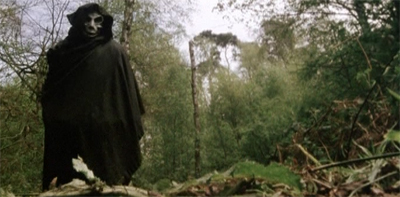
Death stalks the countryside...

Death stalks the countryside…

Continue reading

Doctor Who: Meglos (Review)

To celebrate the fiftieth anniversary of the longest-running science-fiction show in the world, I’ll be taking weekly looks at some of my own personal favourite stories and arcs, from the old and new series, with a view to encapsulating the sublime, the clever and the fiendishly odd of the BBC’s Doctor Who.

Meglos originally aired in 1980.

To control the output, it will be necessary to increase the violence of the emissions.

Then you’ll be in danger yourself.

Well, hardly. I’m a Time Lord. Having lived in the future I can hardly die in the present.

That can’t be true. That’s a philosophical paradox.

No, it’s merely beyond your comprehension.

– Meglos and Deedrix get their “parody” on

Meglos is one of those stories that has undergone something of an alternative interpretation among Doctor Who fans. Much like The Web Planet went from “a brave attempt to realise a truly alien world” to a “complete and utter embarrassment”, Meglos has gone from “that episode where a talking cactus tries to take over the universe” to “that parody where a talking cactus tries to take over the universe.” In fairness, looking at the serial, it is very hard not to see Meglos as an intentional and subversive parody of a bad Doctor Who story, but I have to concede that it doesn’t stop the adventure from being a bad Doctor Who story itself.

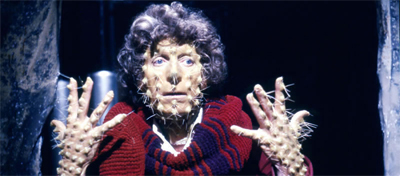
Okay, not every review this week is going to open with a close-up of Tom Baker in distress...

Continue reading

Doctor Who: The Armageddon Factor (Review)

To celebrate the fiftieth anniversary of the longest-running science-fiction show in the world, I’ll be taking weekly looks at some of my own personal favourite stories and arcs, from the old and new series, with a view to encapsulating the sublime, the clever and the fiendishly odd of the BBC’s Doctor Who.

The Armageddon Factor originally aired in 1979. It was the sixth and final part of The Key to Time saga.

The Key to Time was perhaps the first conscious attempt to tell a season-long story in Doctor Who. Sure, we’ve had elements of an arc before. The first season, for example, gave the Doctor himself a character arc where he evolved from cowardly curmudgeon into an unlikely heroic figure. Jon Pertwee’s second season was given the Master as a linking element. Tom Baker’s Doctor embarked in a pretty much unbroken series of adventures from Robot through to Terror of the Zygons, with the ending of one serial seemingly leading directly into the next. None of these were necessarily that ambitious and you could argue they evolved more by chance than by design.

So, The Key to Time represented a bit of a learning curve, an attempt to tie a season’s stories together using an over-arching concept. As I’ve discussed quite a bit in my reviews of the season, the result was a little clunky, with those concepts seemingly clumsily shoe-horned into a separate bunch of adventures. That leaves the finalé, The Armageddon Factor to do the heavy-lifting with regards to The Key to Time saga. Unfortunately, the pay-off feels a bit jumbled, over-wrought, disorganised and non-sensical, as it juggles a wealth of elements that never add up to more than the sum of their parts.

While a great many Doctor Who six-parters suffer from being too long, too padded, too stretched for their story and concepts, The Armageddon Game feels curiously over-stuffed, lacking a tight focus on the interesting elements and too many distractions clogging up the story.

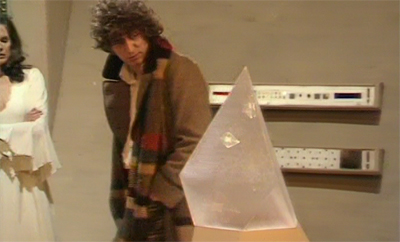
The problems are crystal clear...

The problems are crystal clear…

Continue reading

Doctor Who: The Ribos Operation (Review)

To celebrate the fiftieth anniversary of the longest-running science-fiction show in the world, I’ll be taking weekly looks at some of my own personal favourite stories and arcs, from the old and new series, with a view to encapsulating the sublime, the clever and the fiendishly odd of the BBC’s Doctor Who.

The Ribos Operation originally aired in 1978. It was the first part of The Key to Time saga.

Your name!

What about my name?

It’s too long… by the time I’ve called out “Look out Romanadv…” – what’s your name again?

Romanadvoratrelundar!

By the time I’ve called that out you could be dead! I’ll call you Romana.

I don’t like Romana!

It’s either Romana or Fred!

All right, call me Fred!

Good! Come along Romana!

The Key to Time was a rather ambitious project for the time – the idea being that an entire series of the show would centre around one core arc, suggested in the first story, developed through the rest of the season, and tied up at the end of the year. It helps, when you’re doing something like that, to have an experienced hand at the reins. While The Ribos Operation doesn’t stand as Robert Holmes’ finest contribution to the series, it’s a suitable introduction to the adventure.

Time Lord and Lady...

Continue reading

Doctor Who: The Last of the Time Lords (Review)

To celebrate the fiftieth anniversary of the longest-running science-fiction show in the world, I’ll be taking weekly looks at some of my own personal favourite stories and arcs, from the old and new series, with a view to encapsulating the sublime, the clever and the fiendishly odd of the BBC’s Doctor Who.

The Last of the Time Lords originally aired in 2007.

I just need you to listen.

No, it’s my turn. Revenge!

– the Doctor and the Master

I like quite a lot of The Last of the Time Lords. I think, for example, that Russell T. Davies does an exceptional job creating a version of the Master that manages to remain true to the character’s pantomime roots, while also seeming a credible threat and dark mirror to the Doctor. I also think that Martha’s character arc has a fairly logic and fluid conclusion. On the other hand, there’s a great deal about the resolution to The Last of the Time Lords that feels a bit rushed, a bit convenient, a bit tidy.

I’m quite fond of Davies’ writing style, but I’ll concede that he tends to favour theme and character over plot and structure. The Last of the Time Lords does an excellent job illustrating this, providing a bunch of fascinating thematic and character-based moments, but positioning them in a plot that doesn’t really work.

You know, for once I actually feel sorry for the Master...

You know, for once I actually feel sorry for the Master…

Continue reading

Doctor Who: Planet of the Daleks (Review)

To celebrate the fiftieth anniversary of the longest-running science-fiction show in the world, I’ll be taking weekly looks at some of my own personal favourite stories and arcs, from the old and new series, with a view to encapsulating the sublime, the clever and the fiendishly odd of the BBC’s Doctor Who.

Planet of the Daleks originally aired in 1973.

You know, for a man who abhors violence, I must say I took great satisfaction in doing that.

– The Doctor on demolishing a Dalek

The combined Frontier in Space and Planet of the Daleks serials were intended to mark the tenth anniversary of Doctor Who with a twelve-part epic that could be measured against the lost Daleks’ Master Plan. I’m quite fond of The Frontier in Space, and I’d argue that it stands as the best space-opera of the Pertwee era, but I’ll concede that the story is severely weakened by the links it shares with this little adventure, which is conclusive proof that Daleks were quite stale long before Davros was invented.

Not all Dalek stories are gold…

Continue reading

Doctor Who: The Deadly Assassin (Review)

To celebrate the fiftieth anniversary of the longest-running science-fiction show in the world, I’ll be taking weekly looks at some of my own personal favourite stories and arcs, from the old and new series, with a view to encapsulating the sublime, the clever and the fiendishly odd of the BBC’s Doctor Who.

The Deadly Assassin originally aired in 1976.

I deny this reality.

– the Doctor

The Deadly Assassin is a rather boldly experimental episode of Doctor Who. It’s the first story told without a companion character, and it also ventures quite forcefully into the realm of surrealism. It offers a rather bold deconstruction of the Time Lords, a rather cynical depiction of the aliens who had seemed all-powerful in stories like The War Games or The Three Doctors. More than that, though, The Deadly Assassin feels – appropriately enough – like a treatise on the inevitable death of Doctor Who.

Located in the middle of the fourteenth of twenty-six seasons, and broadcast thirteen years from both the start and the end of the show’s initial run, The Deadly Assassin seems to be positioned at the very heart of Doctor Who.

A rough outline of what's going on...

A rough outline of what’s going on…

Continue reading