• Following Us

  • Categories

  • Check out the Archives


  • Awards & Nominations

Star Trek: Deep Space Nine – The Collaborator (Review)

Star Trek: Deep Space Nine is twenty years old this year. To celebrate, I’m taking a look at the first and second seasons. Check back daily for the latest review or retrospective.

It’s surprising how long we’ve had since a solid Bajoran episode of Star Trek: Deep Space Nine. Barring the dark reflection of Bajor as a power-broker (and brief allusion to a colony in the Gamma Quadrant) in Crossover, the last episode to really explore the planet’s political and religious structure was probably Sanctuary, which aired more than half a season earlier. After a reasonably high concentration of Bajoran political adventures in the first season and the first half of the second, it seems that further explorations will be more broadly spaced.

Indeed, the first season ended (and the second season began) with a five-episode run that was heavily anchored in the show’s Bajoran surroundings. However, as of late, it feels we’ve been strangely disengaged from the show’s stated objective of welcoming Bajor to the Federation. With episodes like The Maquis, it seems like the show is making a conscious effort to disentangle Cardassian politics from those of Bajor.

In a way, this probably represents Deep Space Nine growing into the form that it will take for the rest of its run. The second season has really been about Deep Space Nine figuring out what it wants to be, and what it doesn’t want to be. With The Collaborator‘s focus on Bajoran politics feeling conspicuous by the lack of other Bajor-centric episodes in this half of the season, it seems like Deep Space Nine doesn’t want to be a show about Bajor.

Enough rope to hang himself...

Enough rope to hang himself…

Continue reading

Star Trek: The Next Generation – Dark Mirror by Diane Duane (Review)

Star Trek: Deep Space Nine is twenty years old this year. To celebrate, I’m taking a look at the first and second seasons. Check back daily for the latest review or retrospective.

We’ll be supplementing our coverage of the episodes with some additional materials – mainly novels and comics and films. This is one such entry.

Dark Mirror was released a few mere months before Crossover was broadcast – one of those moments of pop culture synergy where it turns out that two different individuals can have the same idea, but with infinitely different nuance or emphasis. Indeed, the timing syncs up so well that Crossover actually aired between the hardcover and soft cover printings of Dark Mirror, suggesting that a return to the mirror universe was something of an inevitability for Star Trek, in one form or another.

Duane’s approach to the mirror universe is markedly different to that of writers Michael Piller and Peter Allan Fields, with both Dark Mirror and Crossover taking the ending of Mirror, Mirror and running with it in opposite directions. Piller and Fields used the aftermath of Kirk’s meddling as a means to explore the consequences of interference in a culture that Kirk didn’t quite understand – a mechanism to explore the way that the original Star Trek didn’t seem to grasp moral relativity, and to explore political complexities outside Kirk’s value system.

In contrast, Dark Mirror is a more philosophical meditation on the nature of good and evil, a more metaphysical exploration of a fictional world built around the concept of selfishness and strength, and how such a universe would have to work on different physical laws than that of Star Trek: The Next Generation.

tng-darkmirror

Continue reading

Star Trek: Deep Space Nine – Crossover (Review)

Star Trek: Deep Space Nine is twenty years old this year. To celebrate, I’m taking a look at the first and second seasons. Check back daily for the latest review or retrospective.

At the time, Crossover must have seemed like a very odd choice for a late-second-season episode of Star Trek: Deep Space Nine. Of course, the mirror universe episodes would become a quasi-annual occurrence on the show, similar to the “O’Brien must suffer” adventures. However, in May 1994, it must have seemed like a really strange choice to do an entire episode as a sequel to a much-loved second-season installment of the original Star Trek.

Still, Crossover remains the strongest of Deep Space Nine‘s mirror universe episodes, most notably because it treats the rather absurd premise with a certain amount of weight and integrity, but also because it feels so delightfully weird.

Half the cast has been waiting two years to do that...

Half the cast has been waiting two years to do that…

Continue reading

Star Trek: Mirror, Mirror #1 – Fragile Glass (Review)

Star Trek: Deep Space Nine is twenty years old this year. To celebrate, I’m taking a look at the first and second season. Check back daily for the latest review or retrospective.

We’ll be supplementing our coverage of the episodes with some additional materials – mainly novels and comics and films. This is one such entry.

One of the benefits and the curses of tie-in material is the ability to connect the dots – to tie together two parts of continuity separated by time and space, filling in the blanks in some character or plot arc. Often, this feels extraneous at best. In order for the televised stories to work, there must be enough information conveyed effectively to the audience so they can make their own leaps. Trying to plug imaginary and unnecessary holes is seldom satisfying.

On the other hand, there are occasionally gaps that are worth exploring. These are gaps that have been explained on the show, but which are still large enough that creators can fit their own interesting stories between them. The divide between Mirror, Mirror and Crossover is one such gap, as we go from the original Star Trek‘s version of the mirror universe to the very different iteration seen on Star Trek: Deep Space Nine.

Tom DeFalco’s Fragile Glass attempts to sketch in some of the details around this gap. While it’s not entirely satisfying as either a missing link or a story in its own right, it does offer some nice pulpy fun and gets considerable mileage out of the “Spock vs. Kirk” premise.

I am not Spock...

I am not Spock…

Continue reading

Star Trek: Deep Space Nine – The Wire (Review)

Star Trek: Deep Space Nine is twenty years old this year. To celebrate, I’m taking a look at the first and second seasons. Check back daily for the latest review or retrospective.

The Wire might just be the best episode of the second season of Star Trek: Deep Space Nine. In fact, it ranks with Duet and In the Hands of the Prophets as one of the best episodes of the show so far. Written by Robert Hewitt Wolfe and showcasing the dramatic talents of both Siddig El Fadil and Andrew Robinson, The Wire is a powerhouse of dramatic writing – an intimate character study capable of provoking tensions and ambiguities on par with the season’s universe-altering installments.

Garak has only appeared a handful of times so far. Indeed, considering how important he would become to the series, it’s interesting how rare his early appearances are. However, The Wire is really the episode that pins Garak down and tells us everything that we could possibly need to know about Garak, without ever actually telling us everything we might want to know. It’s a careful distinction, and Wolfe’s script walks that line skilfully while Andrew Robinson’s performance is perfectly modulated.

Bashir's bedside manner...

Bashir’s bedside manner…

Continue reading

Star Trek: Deep Space Nine – A Stitch in Time by Andrew J. Robinson (Review)

Star Trek: Deep Space Nine is twenty years old this year. To celebrate, I’m taking a look at the first and second seasons. Check back daily for the latest review or retrospective.

We’ll be supplementing our coverage of the episodes with some additional materials – mainly novels and comics and films. This is one such entry.

A Stitch in Time remains a fascinating read. Sure, Star Trek actors had written novels before. William Shatner had turned his Captain Kirk novels into something of a cottage industry, even turning in a Starfleet Academy novel to cash-in in the success of JJ Abrams’ 2009 Star Trek reboot. However, Andrew J. Robinson’s A Stitch in Time is the first tie-in novel written by a cast member without a ghost writer or a collaborator. A Stitch in Time is entirely about Robinson’s relationship with Garak, the character he played for seven years on Star Trek: Deep Space Nine.

It’s a very thoughtful, eloquent and beautiful piece of work – providing the reader a great deal of insight into how Robinson sees Garak as a character, stripping away a lot of the mystery and intrigue that surrounded the character during his appearances. It feels like an attempt by Robinson to offer Garak some measure of closure, to put the character to rest.

ds9-astitchintime

Continue reading

Star Trek: Deep Space Nine – The Maquis, Part II (Review)

Star Trek: Deep Space Nine is twenty years old this year. To celebrate, I’m taking a look at the first and second seasons. Check back daily for the latest review or retrospective.

Oddly enough, for an episode designed to serve as a launching pad for Star Trek: Voyager, The Maquis, Part II really feels like the point where Star Trek: Deep Space Nine becomes Ira Steven Behr’s show. Deep Space Nine had been created by Michael Piller and Rick Berman. While Berman oversaw the franchise as a whole, Piller had been a guiding influence during the first two seasons of Deep Space Nine. However, his attention would wander to both Voyager and the pending films based on the Star Trek: The Next Generation film franchise.

As a result, producer Ira Steven Behr would be left in the driving seat of Deep Space Nine. Behr had some experience with the franchise. he was part of the wonderful writers’ room responsible for the massive upswing in the quality of The Next Generation, but left after a year on that show – describing it as “the Connecticut of Star Trek.” Years later, he was aggressively pursued by Piller to work on Deep Space Nine, where Piller felt his philosophy might be more at home.

The Maquis, Part II is far from Behr’s first writing credit on the show, and it’s certainly not the first time his influence has been felt. It is, however, the point at which it feels like Behr’s creative vision is firmly cemented the show’s outlook. Piller would move further away over the course of the next year, and Behr’s influence would grow even stronger, but this is the point where Behr’s vision of Deep Space Nine really takes hold.

Burning bridges...

Burning bridges…

Continue reading

Star Trek: Deep Space Nine – The Maquis: Soldier of Peace (Review)

Star Trek: Deep Space Nine is twenty years old this year. To celebrate, I’m taking a look at the first and second seasons. Check back daily for the latest review or retrospective.

We’ll be supplementing our coverage of the episodes with some additional materials – mainly novels and comics and films. This is one such entry.

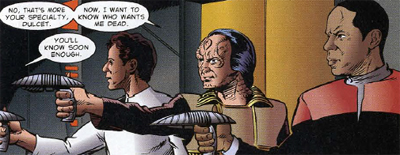
The Maquis: Soldier of Peace is a rather interesting little miniseries, produced while Malibu comics held the rights to Star Trek: Deep Space Nine spin-off comics in the early nineties. Malibu owned the rights to the earliest comics, publishing just over thirty issues of the main Deep Space Nine title between August 1993 and December 1995. Due to Paramount’s desire to exploit the license as much as possible, Malibu only had access to the Deep Space Nine rights, and not to Star Trek: The Next Generation or the original Star Trek.

Malibu would eventually be bought by Marvel, allowing the company to briefly publish Star Trek comics related to all on-going series. However, the company managed to generate an impressive amount of content in the time that it held the rights. Cynics would suggest that company was trying to cash in on the comics boom of the nineties, trying all manner of gimmicks, including one-shots and even a “celebrity” prestige series featuring stories written by Mark Lenard or Aron Eisenberg.

As such, these comics offer an interesting snapshot of where Deep Space Nine was at this point in its history.

The three amigos...

The three amigos…

Continue reading

Star Trek: Deep Space Nine – The Maquis, Part I (Review)

Star Trek: Deep Space Nine is twenty years old this year. To celebrate, I’m taking a look at the first season. Check back daily for the latest review or retrospective.

The Maquis is an interesting episode, because it really illustrates the weird place that Star Trek: Deep Space Nine holds in the pantheon. It’s the middle act of an arc designed to play out across the final season of Star Trek: The Next Generation, the second season of Deep Space Nine and into the first year of Star Trek: Voyager. This was all part of gigantic lead-up to Voyager, a way for the producers to generate friction between the regular cast of the show.

However, with The Next Generation ending and Voyager being set on the other side of the galaxy, Deep Space Nine wound up stuck with this plot thread. As Michael Piller concedes in The Deep Space Log Book: A Second Season Companion, “DS9 is the true inheritor of the Maquis since there is no long term benefit to Voyager.” And so – despite the fact the Maquis were never intended for the show – they wind up become a perfect vehicle to explore the show’s world view.

Picard's not the only one who can get a good face palm going on...

Picard’s not the only one who can get a good face palm going on…

Continue reading

Star Trek: Deep Space Nine – Blood Oath (Review)

Star Trek: Deep Space Nine is twenty years old this year. To celebrate, I’m taking a look at the first season. Check back daily for the latest review or retrospective.

Blood Oath is a pretty fantastic piece of Star Trek: Deep Space Nine, and kicks the second season back into gear after a few mediocre (although not embarrassing) episodes. While it’s hardly the best episode of the year, and comes with its share of problems and baggage, it’s a tight and well-constructed piece of space opera. It’s a pulpy Klingon adventure, with the show’s best exploration to date of the existential problems of being Dax and a relatively simple (but potent) moral dilemma. It’s also just great fun.

Here's Kor!

Here’s Kor!

Continue reading