• Following Us

  • Categories

  • Check out the Archives


  • Awards & Nominations

Non-Review Review: Star Trek – Into Darkness

Note: This is a spoiler-heavy review. If you want a spoiler-lite recommendation, click here. If not, continue at your own risk.

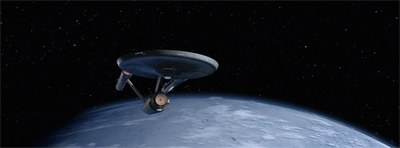
Towards the climax of Star Trek: Into Darkness, Kirk and the Enterprise flee an aggressor by entering warp. At that speed, several factors the speed of light itself, they surmise that they must be safe from their pursuer. Of course, they prove to be wrong – brutally so. Everything in Into Darkness moves fast, so fast that the Enterprise’s top speed seems more like a casual jog than a breakneck acceleration. The plot rockets along with incredible speed, from plot point to plot point, counting on the momentum to sustain the film and carry it across the line.

There is enough material here to produce a trilogy of films. Indeed, cynics might suggest that a lot of the movie’s iconography and plot points are indeed recycled from the central “trilogy” of the original Star Trek films, running from the homages to Star Trek II: The Wrath of Khan right down a climactic visual reference to Star Trek IV: The Voyage Home. Abrams and his team of writer continue their work from 2009’s breakout blockbuster Star Trek by putting the franchise’s most compelling images and cues into a high-speed blender.

Into Darkness just substantially increases the concentration.
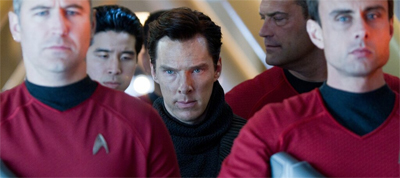
Seeing red...

Seeing red…

Continue reading

Star Trek – What Are Little Girls Made Of? (Review)

To celebrate the release of Star Trek: Into Darkness this month, we’ll be running through the first season of the classic Star Trek all this month. Check back daily to get ready to boldly go. It’s only logical.

What Are Little Girls Made Of? is the first episode from a script written by Robert Bloch, perhaps best known as the author of Psycho. Interestingly, it wasn’t the first script Bloch wrote for the show. Apparently Bloch contributed Catspaw first, when the show asked him for a Halloween special, even though it wouldn’t be produced until the series’ second year. And, to be fair, you can sense that What Are Little Girls Made Of? is a bit more comfortable with the Star Trek conventions than Bloch’s other two episodes. An uncredited re-write from Gene Roddenberry probably helped.

With Bloch’s third script, Wolf in the Fold, serving as a loose adaptation of (or spiritual successor to) his celebrated short story Yours Truly, Jack the RipperWhat Are Little Girls Made Of? stands out among Bloch’s contributions to the show. It’s an iconic episode, one that has undoubtedly influenced the way that we remember Star Trek, serving as the source for all manner of Star Trek memes like Kirk overwhelming a hot android with his sexual charisma, and defeating a less physically attractive robot with a logic puzzle. It features some of the most iconic costuming of the original Star Trek show, and also serves as the root of the whole “what constitutes life?” philosophical strand that would find itself embodied by Data on Star Trek: The Next Generation.

It helps that, like so much of this first season of Star Trek, it is just good pulpy fun.

A cold reception...

A cold reception…

Continue reading

Star Trek – Romulans: Pawns of War by John Byrne (Review)

To celebrate the release of Star Trek: Into Darkness this month, we’ll be running through the first season of the classic Star Trek all this month. Check back daily to get ready to boldly go. It’s only logical.

We’ll be supplementing our coverage of the episodes with some additional materials – mainly novels and comics and films. This is one such entry.

Where were the Klingons? That seems to be one of the most frequently asked questions when a modern writer re-visits the early part of the first season of Star Trek. It makes sense. The Klingons are the franchise’s flagship aliens, and their long-term relations with the Federation mark one of the show’s earliest examples of continuity. The Organian Peace Treaty from Errand of Mercy is mentioned once or twice, but it informs a lot of the appearances of the Klingons in the classic Star Trek, as the warriors are prevented from engaging in direct warfare with the Federation.

However, when first introduced in Errand of Mercy, towards the end of the first season, the Klingons have just declared war on the Federation. However, it seems like this has been expected for a long time. Kirk speaks of the Klingons like old enemies. Kor knows that captain of the Enterprise by name. There’s a sense of a pre-established history, which makes their appearance towards the tale-end of the season all the more perplexing. Apparently they have been there all along, even if we haven’t seen them before.

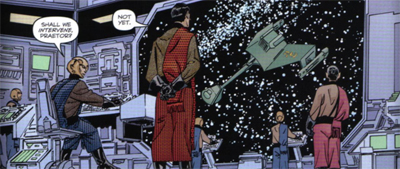
John Byrne’s Alien Spotlight issue might have been themed around the Romulans, and the collected edition might be Romulans: Pawns of War, but it seems more devoted to exploring what exactly the Klingons were up to behind the scenes between their appearances on Star Trek.

Cry havok, and let slip the dogs of war...!

Cry havok, and let slip the dogs of war…!

Continue reading

Star Trek – Balance of Terror (Review)

To celebrate the release of Star Trek: Into Darkness this month, we’ll be running through the first season of the classic Star Trek all this month. Check back daily to get ready to boldly go. It’s only logical.

I’ve talked about it about it quite a bit in my earlier reviews, so I won’t dwell on it too much here, but Star Trek got really good really quickly. Balance of Terror is only the ninth ever episode of Star Trek ever produced, but it stands as one of the finest entries in the original series, and perhaps even the franchise. It also represents the moment where the model of what Star Trek would be really sort of solidified. The first eight episodes had contained any number of classic Star Trek tropes.

The Cage and Charlie X gave us old and immeasurably powerful alien civilisations, while Where No Man Has Gone Before gave us a god-like being. The Man Trap gave us space monsters. Mudd’s Women gave us awkward gender politics. The Enemy Within created the whole “transporter malfunction” and “evil duplicate” subgenres. However, Balance of Terror is the first episode to suggest outer space might be more than the place where crazy stuff happens and our heroes bump into monsters or ancient civilisations. The universe might have its own politics, its own history, its own civilisations that will emerge, contrasted with mankind’s expansion into space.

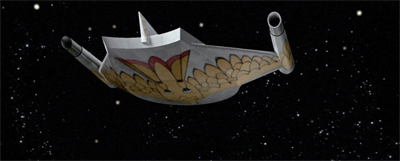
The Klingons are undoubtedly the most recognisable and iconic of the classic Star Trek races, but the Romulans are the first of the franchise mainstays to appear, and Balance of Terror is the first episode to devote considerable effort to world-building the Star Trek universe.

The not-so-great bird of the galaxy...

The not-so-great bird of the galaxy…

Continue reading

Star Trek – My Enemy, My Ally by Diane Duane (Review)

To celebrate the release of Star Trek: Into Darkness this month, we’ll be running through the first season of the classic Star Trek all this month. Check back daily to get ready to boldly go. It’s only logical.

We’ll be supplementing our coverage of the episodes with some additional materials – mainly novels and comics and films. This is one such entry.

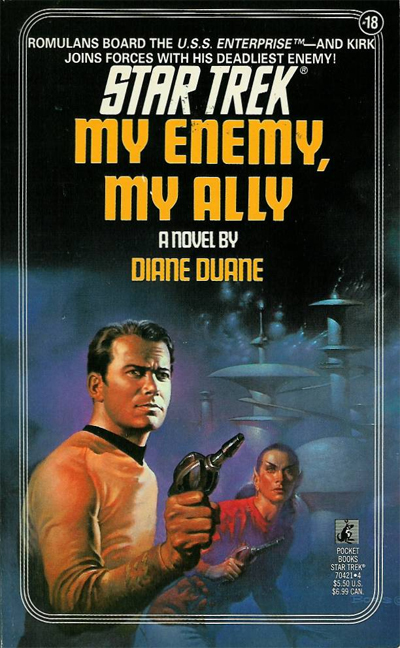
1984 was a hell of a year of Star Trek tie-in novels. John M. Ford’s The Final Reflection was published in May 1984. It was followed by a tie-in adaptation of Star Trek III: The Search for Spock, but the very next original novel would by My Enemy, My Ally by Diane Duane. Both novels feel like kindred spirits, really pushing the boundaries of what you could do with Star Trek tie-in novels.

In particular, both works devoted considerable time to developing some of the iconic and memorable aliens of Star Trek. Ford’s The Final Reflection extrapolated an entire Klingon culture, while Duane’s My Enemy, My Ally dared to imagine a complex Romulan Empire, so distinct and well-defined that it isn’t even known as Romulan (apparently the term outsiders use for the species), but Rihannsu.

myenemymyally

Continue reading

Star Trek – Charlie X (Review)

To celebrate the release of Star Trek: Into Darkness this month, we’ll be running through the first season of the classic Star Trek all this month. Check back daily to get ready to boldly go. It’s only logical.

It really is incredibly difficult to divorce Star Trek from the sixties. I know that this has become something of a (very obvious) theme in these daily reviews, but Charlie X is the kind of Star Trek episode that could only have been produced for television in the sixties. It isn’t necessarily the presence of a single factor, it’s more the package as a whole. While the general concept (“The Day Charlie Became God”, to quote Roddenberry’s succinct synopsis from his 1964 Star Trek Is… pitch) could easily be adapted for any of the spin-offs (and Hide & Q clearly plays on the same idea), the execution is so firmly anchored in the sixties that it’s very hard to separate and parse.

Part of it is the weird use of coloured lighting on the mostly grey Enterprise sets, something that Inside Star Trek suggests was down to the fact that NBC was owned at the time by RCA, a major manufacturer of colour television sets. Part of it is the somewhat confused sexuality that is a weird mix of liberated and outdated. Part of it is the fact that the show features an impromptu musical and dance number. The idea of Charlie X might be fairly simplistic, but the execution is very clearly and very distinctively Star Trek.

Screaming to the Evans...

Screaming to the Evans…

Continue reading

Star Trek 101: The Best of The Original Series

To celebrate the release of Star Trek: Into Darkness, we’re holding a month full of Star Trek  related fun. We’re reviewing every episode of the show’s first season, from The Cage through to Operation — Annihilate!, one-per-day for all of May. We’re also looking at some of the various spin-offs, tie-ins and pop culture intersections, so there’s always something going on to do with Star Trek. Anyway, with the release of the new film, we thought it might be interesting to make some recommendations for fans of the new films who wanted to “dip their toes in the water” so to speak, offering a quick taste of the best that the classic 1960s original Star Trek has to offer those wanting to boldly go with Kirk, Spock and McCoy.

tos-operationannihilate26

Continue reading

Non-Review Review: Star Trek – Into Darkness

Note: This is a spoiler-lite review. If you want a spoiler-heavy in-depth look at the film, click here.

Towards the climax of Star Trek: Into Darkness, Kirk and the Enterprise flee an aggressor by entering warp. At that speed, several factors the speed of light itself, they surmise that they must be safe from their pursuer. Of course, they prove to be wrong – brutally so. Everything in Into Darkness moves fast, so fast that the Enterprise’s top speed seems more like a casual jog than a breakneck acceleration. The plot rockets along with incredible speed, from plot point to plot point, counting on the momentum to sustain the film and carry it across the line.

There is enough material here to produce a trilogy of films. Indeed, cynics might suggest that a lot of the movie’s iconography and plot points are indeed recycled from the central “trilogy” of the original Star Trek films, running from the homages to Star Trek II: The Wrath of Khan right down a climactic visual reference to Star Trek IV: The Voyage Home. Abrams and his team of writer continue their work from 2009’s breakout blockbuster Star Trek by putting the franchise’s most compelling images and cues into a high-speed blender.

Into Darkness just substantially increases the concentration.

Seeing red...

Seeing red…

Continue reading

Star Trek – The Naked Time (Review)

To celebrate the release of Star Trek: Into Darkness this month, we’ll be running through the first season of the classic Star Trek all this month. Check back daily to get ready to boldly go. It’s only logical.

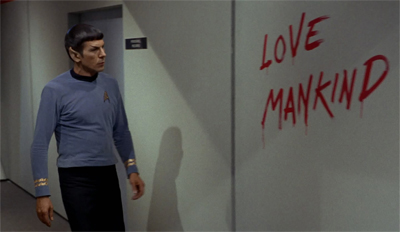
Star Trek is, by its nature, an inherently optimistic television show. I seem to keep mentioning that in these reviews, as the first season of the show subverts and plays with the notion of an idealised future. However, despite the suggestion that evil is necessary in The Enemy Within or the death of the last of a species in The Man Trap or the suggestion that man’s next evolutionary phase would be truly horrifying in Where No Man Has Gone Before, Star Trek is still a hopeful vision of a possible future. It’s a story about a world where mankind hasn’t wiped each other out and where we can go (relatively) peacefully among the stars. It’s a world without racism or classism. There is sexism in Star Trek, but I’ll give the producers the benefit of the doubt and assume it’s not intentional.

So The Naked Time feels a little weird, being – as it is – a story about the collapse of civilisation at the end of a world. Not our world, mind you, but there’s a very clear sense of social collapse mirrored in the literal collapse of planet Psi-2000.

How logical...

How logical…

Continue reading

Star Trek – The Enemy Within (Review)

To celebrate the release of Star Trek: Into Darkness this month, we’ll be running through the first season of the classic Star Trek all this month. Check back daily to get ready to boldly go. It’s only logical.

One thing that I don’t think the original Star Trek gets nearly enough credit for is the quality of the writers that Gene Roddenberry recruited to contribute scripts. Television obviously operated under a different model at the time, but there’s an impressive selection of science-fiction literary giants who contributed scripts to the show. More than that, it’s impressive how many of those stories became truly iconic Star Trek stories.

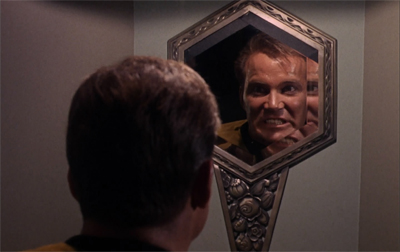
The Enemy Within is the work of author Richard Matheson, best known for stories like I Am Legend or What Dreams May Come. It’s very much a high-concept science-fiction story, but it’s also notable because it establishes two of what would become the show’s favourite tropes: transporter accidents and evil duplicates. Indeed, the two devices would be reunited in the following season’s Mirror, Mirror. These narrative elements even featured in the last season of Star Trek: Enterprise to air, in episodes like Daedalus and In a Mirror, Darkly.

Perhaps it’s a demonstration of how important these outside writers were to the development of Star Trek as a franchise that Matheson would effectively codify two stock narrative devices that would still be in use four decades later.

Mirror, mirror...

Mirror, mirror…

Continue reading