• Following Us

  • Categories

  • Check out the Archives


  • Awards & Nominations

Non-Review Review: Star Trek (2009)

This August, to celebrate the upcoming release of Star Trek: Into Darkness on DVD and blu ray, we’re taking a look at the Star Trek movies featuring the original cast. Movie reviews are every Tuesday and Thursday.

Star Trek was not in a healthy place at the end of the first decade of the twenty-first century. The last film, Star Trek: Nemesis, had been box office poison – partially due to the terrible script and direction, and partially due to the monumentally stupid decision of opening it during a winter season including The Lord of the Rings: The Two Towers, Harry Potter and the Chamber of Secrets and Die Another Day.

On television, things hadn’t been much brighter. Ratings had been in decline since Star Trek: Voyager hit the air, and Star Trek: Enterprise went through both a re-tool and a creative shift before becoming the first Star Trek television show since the eighties to be cancelled before running a full seven seasons. Even the most ardent Star Trek fan would have to concede that the franchise did not appear to have a bright future at that point in time.

And yet, against all odds and despite all the goodwill the franchise had lost, JJ Abrams and Paramount managed to reinject both an energy and a vitality into the film, producing one of the best blockbusters of the decade.
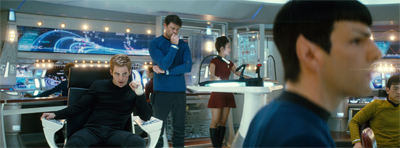
A commanding Enterprise....

A commanding Enterprise….

Continue reading

Non-Review Review: Star Trek II – The Wrath of Khan

This August, to celebrate the upcoming release of Star Trek: Into Darkness on DVD and blu ray, we’re taking a look at the Star Trek movies featuring the original cast. Movie reviews are every Tuesday and Thursday.

In many respects, Star Trek II: The Wrath of Khan represents the franchise’s first true “reboot.”

There have been various points in the history of the franchise when the show has undergone a reinvention of some description, a radical shift from what it was into what it would be. The third season of Star Trek: The Next Generation represented such a dramatic update, a shift turn-around from the show’s first troubled two seasons. The third and fifth seasons of Star Trek: Deep Space Nine did something similar. Star Trek: Enterprise tried to affect some radical shift, but only managed to accomplish it in the third season. JJ Abrams’ recent summer blockbuster represented its own dramatic alteration to what Star Trek was or could be.

However, The Wrath of Khan represents the show’s first massive shift, the first point at which the franchise effectively evolved into something markedly different from what it had been before.

You Khan do it!

You Khan do it!

Continue reading

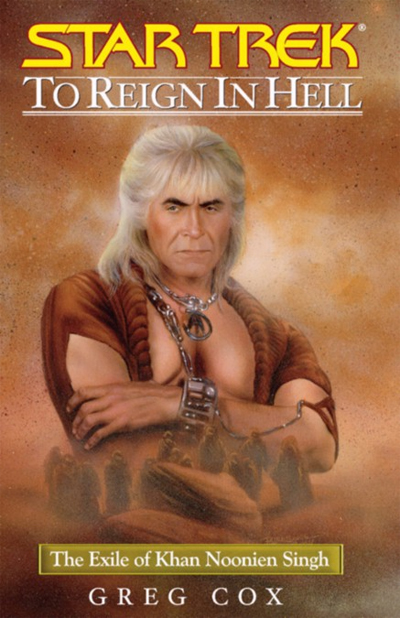
Star Trek: To Reign in Hell – The Exile of Khan Noonien Singh by Greg Cox

This August, to celebrate the upcoming release of Star Trek: Into Darkness on DVD and blu ray, we’re taking a look at the Star Trek movies featuring the original cast. Movie reviews are every Tuesday and Thursday.

We’ll be supplementing our coverage of the movies with tie-ins around (and related to) the films. We’ll be doing one of these every week day. This is one such article.

I feel like I’m in the minority because I didn’t much care for Greg Cox’s The Eugenics Wars: The Rise and Fall of Khan Noonien Singh, Vol. 1 & 2. The books had an absolutely great premise, and Cox had a very clever way of explaining how the Star Trek universe could have had a major conflict between genetically-engineered supermen in the 1990s, despite the fact that their version of the 1990s looked a lot like ours. However, Cox became bogged down in shout-outs and continuity references and character cameos. Despite the seemingly epic scope of the story, it seemed like 20th century Earth was inhabited by twenty people who all knew one another.

In contrast, To Reign in Hell has a much less ambitious and exciting premise, but the novel also reigns in some of Cox’s excesses. While the author’s taste for continuity sometimes overwhelms the narrative, he is somewhat restrained in how heavily he cane lean on what came before. While Cox’s prose is still a little prosiac, and his narration a little ham-fisted, he at least has a bit more room here to develop Khan as a character. Without the crutch of feeling the need to reference every 20th century character ever to appear in Star Trek, Cox can focus on his leading man.

Well, mostly.

st-toreigninhell

Continue reading

Star Trek – Ex Machina by Christopher L. Bennett (Review)

This August, to celebrate the upcoming release of Star Trek: Into Darkness on DVD and blu ray, we’re taking a look at the Star Trek movies featuring the original cast. Movie reviews are every Tuesday and Thursday.

We’ll be supplementing our coverage of the movies with tie-ins around (and related to) the films. We’ll be doing one of these every week day. This is one such article.

Ex Machina is really an astoundingly clever piece of work. On the surface, a lot of reads like a fan’s wishlist, a collection of “snags” made while watching the classic Star Trek films and making a conscious effort to fix them up a bit. There’s a lot of effort into explaining the changes between Star Trek: The Motion Picture and Star Trek II: The Wrath of Khan, with character-centric subplots focusing on Kirk’s ego or Chekov’s growing disenfranchisement.

Indeed, Bennett even provides an entirely unnecessary but quite-enjoyable-nonetheless set of annotations for Ex Machina, explaining where and how he’s tying his story into a rake of continuity. He describes Ex Machina as probing “an unexplored gap” in the franchise’s chronology. Ex Machina exists as both a sequel to a rather bland third-season episode of the show (For the World is Hollow and I Have Touched the Sky) and The Motion Picture. Neither is especially loved among fans.

However, what’s fascinating about Ex Machina is the way that none of this prevents Bennett from crafting a compelling and intriguing narrative. It’s clear that he’s enjoying attempts to fill in various gaps, but Ex Machina works incredibly well as a piece of Star Trek which stands on its own two feet.

st-exmachina

Continue reading

Star Trek (Gold Key) #56 – No Time Like the Past (Review)

To celebrate the release of Star Trek: Into Darkness this month, we’ll be running through the first season of the classic Star Trek all this month. Check back daily to get ready to boldly go. It’s only logical.

We’ll be supplementing our coverage of the episodes with some additional materials – mainly novels and comics and films. This is one such entry.

It’s remarkable to think that Star Trek was kept alive in the decade between the airing of The Turnabout Intruder and Star Trek: The Motion Picture. The most popular television show to air in the 1968 and 1969 season was Rowan and Martin’s Laugh-In, a show that was apparently lucky to receive two “best of” DVD collections in the early part of the last decade, collecting a grand total of eight of the 140 episodes. Given that Star Trek didn’t even rank among the twenty highest rated shows of that broadcast season, it’s incredible that the show endured for so long.

To be fair, there is a lot of material which fills the gap between the last episode of the live action television show and the first feature film. There was Star Trek: The Animated Series, perhaps the most high-profile release. There were a few novels, even if the tie-in line wouldn’t necessarily take off until the eighties. And there were the comic books, produced by Gold Key, notable as perhaps the largest publisher of non-superhero comics in the seventies.

These comics weren’t classics. It’s hard to argue that they are essential additions to the mythos, or that anybody would miss anything be ignoring them entirely. However, there’s a weird pulpy sci-fi charm to these stories that makes them interesting, even when you would wonder whether the artist or writer had actually watched any episodes of the show they were apparently adapting.

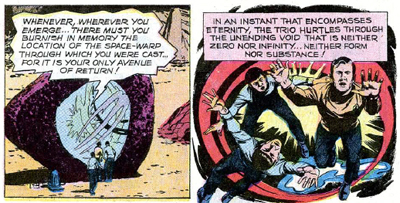
Trippy!

Trippy!

Continue reading

Star Trek – Operation — Annihilate!

To celebrate the release of Star Trek: Into Darkness this month, we’ll be running through the first season of the classic Star Trek all this month. Check back daily to get ready to boldly go. It’s only logical.

How do you follow The City on the Edge of Forever? The previous episode is one of the best-loved episodes of Star Trek ever produced, one of the great science-fiction television episodes of the sixties, and one of the best science-fiction romances ever written. It’s a gigantic and massively influential piece of television, one of the cornerstones of Star Trek and perhaps the best indicator of just how thoughtful and how genuine the franchise can be when it tries. So, what’s next? Where do we go from here? What is the next shot after that last scene of Kirk abandoning the Guardian of Forever on a desolate rock?

It’s always interesting to compare the first season of Star Trek to the first year of Star Trek: The Next Generation. The former can be counted among the very best of the show’s thirty televised seasons, while the latter can be counted among the worst. However, they do have something in common. They both probably should have ended an episode early, with The City on the Edge of Forever and Conspiracy serving as effective caps on each show’s first season, leaving the audience a chance to digest what they had seen.

Unfortunately, neither show ended on anything that could be measured among the strongest show of a given year. The Neutral Zone ended the first season of The Next Generation with a moralising whimper. While Operation — Annihilate! is quite entertaining on its own terms, it doesn’t rank among the best of the season. Still, it’s a solid pulpy science-fiction tale, which might not be the worst thing.

Man of action!

Man of action!

Continue reading

Star Trek – Tomorrow is Yesterday (Review)

To celebrate the release of Star Trek: Into Darkness this month, we’ll be running through the first season of the classic Star Trek all this month. Check back daily to get ready to boldly go. It’s only logical.

It’s interesting how easily you can trace a line back from the original Star Trek films to the television show which inspired them. Each of the first four films has a very clear predecessor, an episode broadcast during the show’s run which seems to serve as something of a thematic forerunner. Star Trek: The Motion Picture is so similar to The Changeling that Star Trek: The Original Series 365 dubs it “Where Nomad Has Gone Before.” The Wrath of Khan is obviously rooted in Space Seed. Kirk’s decision to hijack the Enterprise and go against regulations to save his first officer in The Search for Spock feels like a full circle from Spock’s efforts to help Pike in The Menagerie.

And Tomorrow is Yesterday feels like a bit of a dry run for Star Trek IV: The Voyage Home. The crew might not have to save any whales, but it’s a comedic time-travel adventure that finds the Enterprise crew visiting the twentieth century and trying to avoid altering the time-line too much. Tomorrow is Yesterday feels a little simplistic when compared to some of the franchise’s later interactions with time-travel, but it is a fun and entertaining little episode. It’s easy to see why The Voyage Home might be tempted to revisit the set-up.

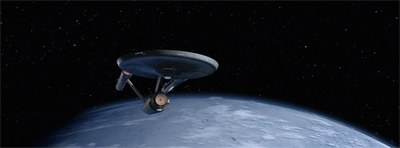
Flying the friendly skies...

Flying the friendly skies…

Continue reading

Star Trek – Shore Leave (Review)

To celebrate the release of Star Trek: Into Darkness this month, we’ll be running through the first season of the classic Star Trek all this month. Check back daily to get ready to boldly go. It’s only logical.

When I talk about the surreal sixties energy that really holds quite a bit of Star Trek together, it’s quite possible that it sounds like a back-handed compliment, a cheap and easy gig at a cult television show. However, I mean that sincerely. When I argue that the illogical and somewhat scattershot dynamism of the last act of Court Martial can barely hold the patchwork script together, it’s quite possible that I sound like I’m being sarcastic. However, my affection for the mad-cap mayhem particular to the first iteration of Star Trek is entirely genuine. Although it makes no sense, the climax to Court Martial isn’t the problem. Everything leading up to it is.

I think Shore Leave is pretty much the perfect iteration of this concept. It is, from start to finish, absolutely insane nonsense that threatens to fall apart if one concentrates too hard on any particular detail. However, it’s executed with enough energy and drive that it becomes a compelling and surreal piece of television, and one of the best illustrations of the kind of weirdness that the classic Star Trek could pull off almost effortlessly.

No bunny business...

No bunny business…

Continue reading

Star Trek – Errand of Vengeance: The Edge of the Sword by Kevin Ryan (Review)

To celebrate the release of Star Trek: Into Darkness this month, we’ll be running through the first season of the classic Star Trek all this month. Check back daily to get ready to boldly go. It’s only logical.

We’ll be supplementing our coverage of the episodes with some additional materials – mainly novels and comics and films. This is one such entry.

When you think about it, Star Trek finished its first season with its mythology reasonably well established. There were the Romulans, the Klingons and the Federation. (Oh, my!) We knew that Kirk had a brother on the colonies, who died in the season finalé. Vulcan was a hot desert planet. The Prime Directive existed, and we even got a taste of how Starfleet operated. However, these things all developed gradually over the course of the year, and early episodes couldn’t even seem to agree who exactly Kirk was working for.

The Federation was first mentioned in Arena and only fully named in A Taste of Armageddon. The Klingons were introduced in Errand of Mercy, with a cold war between the two galactic powers finally turning hot. Of course, it’s hard to write “finally” when they had only been introduced in this particular episode. So where were the Klingons during the show’s first year? How come we didn’t pick up any of the tension that must have been simmering?

Kevin Ryan’s Errand of Vengeance trilogy attempts to offer some context, suggesting that the Klingon threat had been brewing during the entire first season. It follows Jon Anderson, a new recruit to the ship’s security department, arriving just before the events of What Are Little Girls Made Of? Oh, and he’s a Klingon infiltrator.

tos-errandofvengeance1

Continue reading

Star Trek – What Are Little Girls Made Of? (Review)

To celebrate the release of Star Trek: Into Darkness this month, we’ll be running through the first season of the classic Star Trek all this month. Check back daily to get ready to boldly go. It’s only logical.

What Are Little Girls Made Of? is the first episode from a script written by Robert Bloch, perhaps best known as the author of Psycho. Interestingly, it wasn’t the first script Bloch wrote for the show. Apparently Bloch contributed Catspaw first, when the show asked him for a Halloween special, even though it wouldn’t be produced until the series’ second year. And, to be fair, you can sense that What Are Little Girls Made Of? is a bit more comfortable with the Star Trek conventions than Bloch’s other two episodes. An uncredited re-write from Gene Roddenberry probably helped.

With Bloch’s third script, Wolf in the Fold, serving as a loose adaptation of (or spiritual successor to) his celebrated short story Yours Truly, Jack the RipperWhat Are Little Girls Made Of? stands out among Bloch’s contributions to the show. It’s an iconic episode, one that has undoubtedly influenced the way that we remember Star Trek, serving as the source for all manner of Star Trek memes like Kirk overwhelming a hot android with his sexual charisma, and defeating a less physically attractive robot with a logic puzzle. It features some of the most iconic costuming of the original Star Trek show, and also serves as the root of the whole “what constitutes life?” philosophical strand that would find itself embodied by Data on Star Trek: The Next Generation.

It helps that, like so much of this first season of Star Trek, it is just good pulpy fun.

A cold reception...

A cold reception…

Continue reading