• Following Us

  • Categories

  • Check out the Archives


  • Awards & Nominations

Star Trek: Voyager – The Disease (Review)

One of the curses of Star Trek is the tendency to saddle the weakest and most ill-defined members of a given ensemble with a generic soul-destroyingly dull love story.

Deanna Troi has Haven, The Price and Man of the People. Geordi LaForge has Booby Trap and Galaxy’s Child. In the first few years of Star Trek: Deep Space Nine, both Bashir and Dax were subjected to such plots. Bashir had Melora, and Second Sight was originally developed with his character in mind. Dax got a similar story in Meridian. Chakotay has Unforgettable, and was shipped with both Janeway and Seven at various points in the run of Star Trek: Voyager. Even Mayweather’s subplot in Demons and Terra Prime was romantic in nature.

Kiss and Tal.

Of course, there are any number of compelling and interesting  romantic episodes built around characters over the history of the franchise. Kirk had The City on the Edge of Forever. Spock had All Our Yesterdays. Tuvok had Gravity. Even the more developed seventh season version of Bashir had Chrysalis. However, it frequently seems like the production team’s go-to plot for an underdeveloped regular character is a romance-of-the-week plotline, perhaps because it is a fairly standard story and because it can be applied to almost any type of character.

However, the problem with building these romantic storylines around undeveloped characters is that they lack any real hook. The audience implicitly understands that the romantic interest is unlikely to stick around, so the story has offer a compelling insight into the regular character. This is understandably difficult if the production team have chosen to tell this story with this character because they really cannot think of any other interesting story to tell. As a result, these episodes can feel like an exercise in boredom, in watching wheels turn.

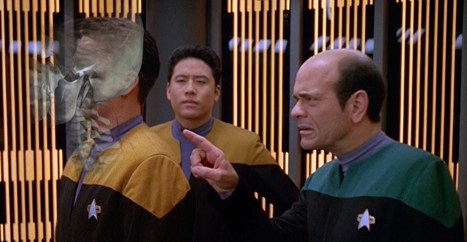
“Dammit, Harry. I thought we had this conversation after Favourite Son.”

This is particularly true in episodes built around weaker (or more disinterested) members of the ensemble. In a romantic installment of an episodic show, the audience needs to invest in the love story very quickly. This puts a lot of pressure on a performer to sell the romantic attraction. On a weekly schedule, with two performers who may not know one another particularly well, this can be very difficult to accomplish. Robert Beltran is a relatively serviceable performer with the right material, but he would never make a convincing romantic lead.

The Disease is a romantic episode built around Harry Kim. While the script has its own very severe problems, the biggest issue is that Garrett Wang simply cannot sell the intense attraction that is necessary for the episode to work.

Colony ship collapse disorder.

Continue reading

Star Trek: Voyager – Dark Frontier, Part II (Review)

Star Trek: Voyager has a morbid fascination with the Borg. Quite literally.

Time and time again, the series returns to the image of the Borg dead and dying. Blood Fever ends with the discovery of a Borg corpse. Unity features the extended autopsy of that corpse. In Scorpion, Part I, Kes is haunted by the image of a grotesque mound of Borg drones, torn apart and reassembled. In Unimatrix Zero, Part I, the Borg Queen tears the heads off her drones and mounts them on spikes. There is a very similar image in Dark Frontier, Part I, where Janeway wanders casually through the wreckage of a Borg ship.

Queen of minds.

Star Trek: The Next Generation worked hard to establish the Borg as a credible threat. If the Borg were associated with death, it was only because they delivered something akin to it. In The Neutral Zone, the Borg scooped an entire outpost off the surface of a planet. In Q Who?, Picard had to literally beg Q to save the Enterprise after the loss of eighteen crewmembers. In The Best of Both Worlds, Part I and The Best of Both Worlds, Part II, the Borg tore through the Federation like it was made of tissue paper. The trauma of that invasion informed Emissary.

In contrast, Voyager seems preoccupied with the destruction and desecration of the Borg Collective. This is an interesting creative choice on a number of levels. Most obviously, it severely undercuts the menace and threat posed by the Borg Collective. Janeway seems to travel through the Delta Quadrant leaving a trail of broken Borg bodies in her wake. It is hard to believe that the Borg are a big deal, when Janeway seems to decorate her ship with their remains. The Kazon, the Vidians and the Hirogen have all taken Voyager at some point. The Borg have never.

Green light for reassimilation.

Perhaps this fascination with Borg corpses and remains simply speaks to their visual aesthetic. With their pale skin and their lack of individual identity, the Borg have always evoked the walking dead; Star Trek: First Contact was essentially a zombie movie in deep space. However, perhaps this desecration of the Borg speaks to something buried deeper within the psyche of Voyager. The Borg are perhaps the most iconic aliens of the Berman era; they represent the moment that The Next Generation came into its own. Perhaps their decay mirrors that of the Berman era itself.

Dark Frontier, Part I and Dark Frontier, Part II represent something of a final frontier for the Borg Collective. While the Borg had been in decline for some time, Dark Frontier, Part I and Dark Frontier, Part II marked a point of no return. Regeneration is an underrated return to form for the iconic cyborgs, but it is too little and too late. Dark Frontier, Part I and Dark Frontier, Part II is effectively a funeral for the most iconic adversaries of the Berman era. However, they would remain shuffling lifeless for another two-and-a-half seasons.

Subject to change.

Continue reading

Star Trek: Voyager – Dark Frontier, Part I (Review)

The fifth season of Star Trek: Voyager arrives at a point when the Rick Berman era of the Star Trek franchise has hit its midlife crisis.

Star Trek: Deep Space Nine is coming to an end, bring down the curtain on a seven-year period where there were always two franchise series boldly going simultaneously. Star Trek: Insurrection had been released into cinemas as a snapshot of that midlife crisis, where Michael Piller’s last script for the franchise found the cast of Star Trek: The Next Generation desperately chasing their own youth and vitality on a planet with a fountain of youth.

Seven gets back in touch with her roots.

On the fifth season of Voyager, it seemed like the show turned inwards. The scripts for the fifth season are surprisingly retro and nostalgic in tone; Janeway’s reflections on the events of Caretaker in Night, the return of the Maquis and the Cardassians in Nothing Human, the indulgence of retro thirties sci-fi in Bride of Chaotica!, Tuvok’s childhood flashbacks in Gravity, the “telepathic pitcher plant” in Bliss, Seven’s trip back to the launch of Voyager in Relativity, Janeway’s investigation of her ancestor in 11:59.

However, there was a fundamental problem with all of this introspection. Voyager was a television series that had long struggled to define a unique identity, too often feeling like a half-hearted reheat of the leftovers from The Next Generation. It was very hard to turn the focus inwards when there wasn’t a lot unique or distinctive about Voyager. This is a show that was much closer to its end than to its beginning, and it still lacked any true sense of identity or self.

There’s coffee… I mean transwarp coils in that there Borg Sphere.

Dark Frontier, Part I and Dark Frontier, Part II serve as an example of this nostalgic indulgence, both in form and plot. It is a two-parter consciously designed to recapture the success of broadcasting The Killing Game, Part I and The Killing Game, Part II on the same night in the late fourth season. It is also a television movie that is very clearly patterned off the story for Star Trek: First Contact, borrowing key story beats and clear characters from that memorable Next Generation film.

However, Dark Frontier, Part I and Dark Frontier, Part II also demonstrate the shallowness of Voyager‘s own internal memory. This is a story built around an act of narrative archeology within the larger Star Trek universe, touching on the secret history of humanity’s true first encounter of the Borg. However, that history is ultimately illusory, built around what feels like a misremembrance of one of the franchise’s most iconic alien species. As Voyager turns its gaze backwards, it discovers that it has no real history.

Drone warfare.

Continue reading

Star Trek: Voyager – Gravity (Review)

Gravity is a powerful story, all the more effective for its relative simplicity.

Tuvok has been one of the most overlooked and ignored regular cast members on Star Trek: Voyager. The later seasons tend to neglect Harry Kim and Chakotay, but they had been given considerable focus in the earlier years of the show. Chakotay had been a major focus in The Cloud, State of Flux, Cathexis, Initiations, Tattoo, Manoeuvres and Basics, Part I. Kim had taken centre stage in Emanations, Prime Factors, Non Sequitur and The Thaw. In contrast, Tuvok remained relatively anonymous, more of a supporting player than a narrative focal point.

Vulcan on a ledge.

In hindsight, this appears a rather strange choice. Tuvok is the first full-blooded Vulcan character to appear as a regular on a Star Trek show. Spock is easily the most iconic character in the franchise, to the point that he would be the torchbearer for the JJ Abrams reboot and his family still haunts Star Trek: Discovery. As such, having a fully Vulcan character should have led to all manner of interesting stories. After all, Tuvok was introduced in Caretaker as a spy working undercover in the Maquis. There should have been a lot of material to mine in the set-up.

However, for most of the run of Voyager, Tuvok seemed cast in a supporting role. He was the investigator in episodes where the crew were falsely accused, as Paris was in Ex Post Facto or Torres was in Random Thoughts. He was a reliable sounding board for other characters, as with Kes in Cold Fire or Neelix in Rise or Seven of Nine in The Raven. He was even effectively employed as a mind-controlled monster in episodes like Cathexis and Repression. Tellingly, most of the handful of episodes focusing on Tuvok focus on events where he is not himself; Tuvix, Riddles.

Vulcan love slave.

This is a shame, as there is a lot of fertile ground to explore within Vulcan psychology. Logic is never as clean or simple as Spock made it sound. Existence is full of logical contradictions and inconsistencies. The two best Tuvok-centric episodes of Voyager tend to focus on these inconsistencies. Meld is an episode in which Tuvok asks questions for which there can be no answer, and in which his insistence that the universe is an ordered and logical structure pushes him to some very dark places. Gravity explores the long-standing myth that Vulcans are emotionless.

Gravity is a surprisingly influential episode of Voyager, an episode that explores the implications of an idea which the larger Star Trek franchise had taken for granted for more than thirty years. It is an episode that feels unique in the larger context of Voyager, one build as much around character as action. It is story about love and repression, one rooted very much in who Tuvok is. It might just be one of the best Vulcan-centric stories in the franchise.

Tuvok lightens up.

Continue reading

Star Trek: Voyager – Bride of Chaotica! (Review)

Bride of Chaotica! is an enjoyable mess.

As its title implies, Bride of Chaotica! is a celebration of nostalgic futurism. It is a culmination of a number of themes running through the series. Most obviously, this particular brand of retrofuturism has been a recurring gag since Night at the start of the fifth season, but it fits within a broader context. From the outset, Star Trek: Voyager has been engaged with a more nostalgic sci-fi aesthetic than Star Trek: The Next Generation or Star Trek: Deep Space Nine.

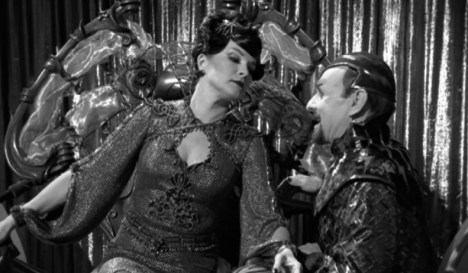
Bride of evil.

Voyager‘s retrofuturism has taken various forms; the old school “space western” tone established by Caretaker, the retro sci-fi trappings of episodes like Innocence or Rise, the monster mayhem of episodes like Phage or Macrocosm, the Cold War paranoia of Cathexis or In the Flesh, Tom Paris’ nostalgic holoprograms in Lifesigns or Vis á Vis, the abductees from the early twentieth century in The 37’s. However, perhaps the most basic is baked into the concept of the show. Voyager is literally a series about the desire to return to a safer and more familiar time.

In some ways, Bride of Chaotica! cements this nostalgia in the context of the larger Star Trek canon, embracing the anxiety that has become increasingly apparent in the years since the thirtieth anniversary. After all, the surrounding feature films all literalise the pull of the past. Star Trek: First Contact has Jean-Luc Picard literally journey back to twenty-first century Earth while revisiting his most iconic moment. Star Trek: Insurrection has the crew discover the fountain of youth. Star Trek: Nemesis confronts Picard with a younger clone of himself.

Radio Chaotica!

It is perhaps telling that Voyager was the moment at which the Star Trek franchise stopped pushing forward. During and after Voyager, the franchise would become increasingly backwards-looking. Star Trek: Enterprise would invite the audience to meet James T. Kirk’s childhood era, trying to recapture that old magic. JJ Abrams’ Star Trek reboot would focus on a young version of Kirk and Spock. Star Trek: Discovery will feature a central character who is something close to Spock’s sister. There is a conscious pull of nostalgia.

Perhaps the future was better yesterday.

Never too far afield.

Continue reading

Star Trek: Voyager – Latent Image (Review)

Latent Image is a powerful allegorical piece of Star Trek, a prime example of how Star Trek: Voyager could occasionally spin gold from its shift towards a more “archetypal Star Trek” template. It is a story that could easily have been told with Data on Star Trek: The Next Generation, for example.

At the same time, Latent Image is a story that touches on many of the core themes of Voyager, many of the show’s key recurring fixations and fascinations. It is an episode about the link between memory and identity, about the importance of preserving history rather than burying it; it touches upon both the metaphorical manipulation of history in stories like RememberDistant Origin and Living Witness and the literal manipulation of the past in stories like Future’s End, Part IFuture’s End, Part IIYear of Hell, Part I and Year of Hell, Part II.

Picture imperfect.

However, it filters that experience through Brannon Braga and Joe Menosky’s recurring fascination with themes of identity and self-definition. The writers have often used the artificial characters on Voyager to explore the malleability of self, how easily the sense of self might be eroded or decayed; the EMH grappled with this challenge in Projections and Darkling, while Seven wrestled with it in Infinite Regress. The artificial characters on Voyager frequently seemed on a verge of a nervous breakdown.

Latent Image is notable for wedding these two concepts together, for integrating these two concepts and exploring the manipulation of an individual’s history as the root of an identity crisis. What happens to the EMH in Latent Image is at once an extension of the dysfunction suggested in Projections and Darkling as well as a more intimate exploration of the cultural identity crises in episodes like RememberDistant Origin and Living Witness. Latent Image suggests that memory is the thread that ties identity together. Without that continuity of self, everything unravels.

A bone to pick with him.

As such, Latent Image exists in an interesting space. It is a story that works very well as a high-concept character study, focusing on the nature of the EMH has a computer programme. Although episodes like Pen Pals suggest that Starfleet has the power to remove memories from biological life forms, the plot of Latent Image could not work as well with a character like Kim or Paris. At the same time, it is a broader allegory about how important memories and experiences are in terms of defining who a person is, and how dealing with these memories defines a cultural identity.

Latent Image is a powerful and clever piece of television.

The camera never lies.

Continue reading

Star Trek: Voyager – Counterpoint (Review)

Counterpoint is a spectacular episode of Star Trek: Voyager, a highlight of the fifth season and of the seven season run in general.

Counterpoint is meticulously constructed, put together with a great deal of care and consideration. This is most obvious in the plotting and characterisation in the episode, in the way that the focus of the story remains constant while peeling back the layers on the characters involved. Too many Voyager episodes indulge in a contrived sequence of “… and then…” plotting, while Counterpoint is an episode that understands what it is about and is content to explore its ideas and its characters to their logical conclusions.

Playing it pitch perfect.

Counterpoint benefits from two superb central performances. Mark Harelik is one of the strongest one-shot guest stars to appear on Voyager, playing Kashyk as an endearingly ambiguous figure caught half way between a conventional romantic lead and a fascist thug. However, Counterpoint works best as a showcase for Kate Mulgrew as Kathryn Janeway. Mulgrew has always been one of the strongest members of Voyager‘s primary cast, but the production team always struggled to play to her strengths while building a consistent character.

Counterpoint is an episode that plays perfectly to the strengths of all involved, creating a symphony where all of the orchestra is playing both in key and in time with one another. At this point in the run, Voyager should be producing episodes like this with much greater consistency.

Near kiss.

Continue reading

Star Trek: Voyager – Thirty Days (Review)

Thirty Days is a fascinating misfire.

Thirty Days is build around a number of interesting ideas. In terms of character, there is the framing device that finds Tom Paris sentenced to spend one month in the brig after an act of crass insubordination, suggesting a relapse into the “bad boy” persona that was largely forgotten after Ex Post Facto, barring the occasional revival for episodes like Vis á Vis. It also hints at questions of discipline on the ship, something around which Star Trek: Voyager has skirted in the past in episodes like Prime Factors and Manoeuvres. There is a compelling story here, somewhere.

Watching Thirty Days can feel like…

In terms of science-fiction plot elements, Thirty Days features the first ocean planet in the history of the Star Trek franchise. That is interesting of itself. What wonders lurk within an ocean world? What would life look like had it never left the sea and set foot on land? There is something decidedly pulpy and magical about a planet that has no surface of which to speak, instead comprised of waves and tides. Even with the flimsiest of plots, this element alone should provide fodder for an exciting installment.

Unfortunately, Thirty Days fumbles both of these interesting elements, falling victim to a recurring issue with the plotting on Voyager. The pacing is awkward, the plot points are under-developed, the framing device is hackneyed. The script for Thirty Days seems far more concerned about hitting the forty-five minute mark than it does with using these elements to tell a compelling story. The result is a bit of a wash.

Water conservation.

Continue reading

Star Trek: Voyager – Nothing Human (Review)

Nothing Human is very much an example of Star Trek: Voyager doing archetypal Star Trek, those abstract morality plays with elaborate prosthetics that offer commentary on contemporary conundrums.

Nothing Human is essentially a story about scientific ethics, about the question of what to do with information that was gathered through amoral means. Is knowledge tainted by the mechanisms through which it was acquired? Is the use of that research an endorsement of the means through which it was conducted? At the very least, does employing such information erode the user’s moral high ground? Does the use of such data make them a hypocrite, demonstrating a willingness to reap the benefits of such monstrous work, but without getting their hands dirty?

Something inhuman.

These are tough questions, with obvious applications in the modern world. These are the sorts of abstract ethical queries that are well-suited to a Star Trek episode, and there is something very endearing in the way that Nothing Human often comes down to two characters debating scientific ethics in a room together. To be fair, Nothing Human is a little too cluttered and clumsy to be as effective as it might otherwise be, its conclusions a little too neat, its developments just a little bit too tidy.

However, Nothing Human is a great example of the way in which Voyager tried to offer a version of Star Trek reflecting the popular perception of it. Nothing Human is a little clumsy in places, but it is an episode that is very much in line with what casual viewers expect from Star Trek in the abstract.

A Cardie-carrying monster.

Continue reading

Star Trek: Voyager – Infinite Regress (Review)

As with One from late in the fourth season, Infinite Regress is an episode that uses Seven of Nine’s cybernetic mind as a vehicle for psychological horror.

Producer Brannon Braga has always been interested in constructing psychological thrillers within the science-fiction framework of Star Trek, using the franchise’s pseudo-science trappings as a way to explore themes of mental deterioration or disconnect. Frame of Mind is probably the first example, but there are many others. Braga is very interested in having his characters question the nature of their reality, of trapping them within their own minds, of undercutting their sense of self. That interest bled into the shows around him.

Self-image.

Star Trek: Voyager presented the writers with an artificial computer-generated character who could more readily combine the writer’s fascination with psychological thrillers and the franchise’s engagement with advanced technology. The EMH was a character whose mind was comprised entirely of computer protocols and software code. His mind could be unfurled on monitors, buffered in memory, fragmented on the hard drive. Episodes like Projections, The Swarm and Darkling suggested a character prone to psychosis, reinforced by Dejaren’s breakdown in Revulsion.

However, the addition of Seven of Nine to the cast in Scorpion, Part II seemed to provide the the Voyager writers (and Braga in particular) with character who could function as an even more effective vehicle for these sorts of stories. Seven is a fusion of human and machine, an organic brain augmented by technological components. She is a character whose mind is in many ways already divided, whose sense of self is understandably fragile. As such, Seven is ideally suited to stories like Infinite Regress.

Mind your step.

Continue reading