• Following Us

  • Categories

  • Check out the Archives


  • Awards & Nominations

Star Trek: Deep Space Nine – The Storyteller (Review)

Star Trek: Deep Space Nine is twenty years old this year. To celebrate, I’m taking a look at the first season. Check back daily for the latest review or retrospective.

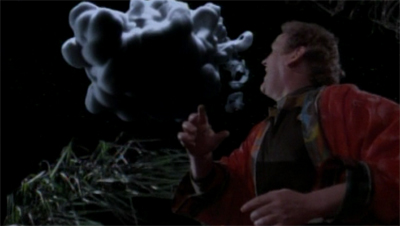
The Storyteller should not work half as well as it does. While some episodes this season (notably The Passenger and Battle Lines) feel like they were simply lifted directly from the “reject” pile within the writers’ room on Star Trek: The Next Generation, The Storyteller is actually a rejected pitch from that show’s first season. Written by Kurt Michael Bensmiller, the writer responsible for Time Squared, one of the stronger installments of the show’s first two years, it was also written late in 1992, about a month before Star Trek: Deep Space Nine would actually air.

And yet, despite that, The Storyteller really feels like a show that wouldn’t work on any of the other Star Trek spin-offs. A lot of that seems to be down to the work by Ira Steven Behr to polish up Bensmillers’ draft and to add a lot of character work and development to what is a decidedly high concept. As producer Michael Piller confessed in Captains’ Logs Supplemental – The Unauthorized Guide to the New Trek Voyages, “Ira did a lot of work on that script.”
O'Brien's mind is a bit clouded right now...

O’Brien’s mind is a bit clouded right now…

Continue reading

Star Trek: Deep Space Nine – Vortex (Review)

Star Trek: Deep Space Nine is twenty years old this year. To celebrate, I’m taking a look at the first season. Check back daily for the latest review or retrospective.

Something very interesting happens in the second half of Star Trek: Deep Space Nine‘s first season. It seems like the writers and producers are making a conscious effort to develop the show’s characters, themes and the world that these inhabit. Plot threads are hinted at, only to be left dangling. Ideas are broached, and tucked away for another day. Given that Star Trek: The Next Generation waited until the third season to broach serialisation in Sins of the Father, the approach taken here is quite striking.

These three episodes are more notable for what they set up rather than what they actually accomplish on their own terms. These adventures lay groundwork, or at least hint at laying groundwork, that will pay off throughout the show’s extended seven-year run. Okay, not exactly. There are some redundant elements here that never actually pay off, but Vortex, Battle Lines and The Storyteller all play into the show’s bigger story arc, even if it seems the writers aren’t entirely sure what those story arcs are.

It's murky out there...

It’s murky out there…

Continue reading

Star Trek: Deep Space Nine – The Nagus (Review)

Star Trek: Deep Space Nine is twenty years old this year. To celebrate, I’m taking a look at the first season. Check back daily for the latest review or retrospective.

The Nagus starts what turns out to be an annual tradition for Star Trek: Deep Space Nine. It introduces the concept of a “Ferengi” episode, where once (or twice) a year, the show would take time out from other on-going concerns to focus on the state of affairs in the Ferengi Alliance. In a way, it’s quite like what Star Trek: The Next Generation did for the Klingons, taking an episode every once in a while to delve into the alien culture and offer a bit of exploration of a species originally created as a two-dimensional cardboard stand-in for a philosophy the franchise found unappealing.

Starting with Heart of Glory, The Next Generation developed Klingons from “those bad guys with the ridges” into a fully functioning and multi-faceted culture, largely driven by writer Ronald D. Moore from the third season. Deep Space Nine did largely the same thing with the Ferengi, largely spearheaded by producer Ira Steven Behr. Although, given the fact that the episodes concerned amoral capitalists instead of imposing warriors, Deep Space Nine opted for comedy as the genre of choice when developing the Ferengi.

He's got the lobes for business...

He’s got the lobes for business…

Continue reading

Star Trek: Deep Space Nine – Move Along Home (Review)

Star Trek: Deep Space Nine is twenty years old this year. To celebrate, I’m taking a look at the first season. Check back daily for the latest review or retrospective.

And here we hit what is commonly agreed to be the nadir of Star Trek: Deep Space Nine‘s rocky first season. Even the production staff seemed to acknowledge the problems with Move Along Home. Director David Carson conceded that it was “disappointing”, while future writer Ronald D. Moore could help  “wondering if everyone had lost their minds.” And there’s no way of getting around it. Move Along Home is a stinker in virtually every way that counts. It’s messy, contrived, confused, but without the wit to pull off the surreality of the set-up. There are no stakes, and the only way the episode can generate suspense is by lying to the audience.

And yet, despite that, I am actually much fonder of Move Along Home than I am of The Passenger. Don’t get me wrong, I don’t like either very much, but I’m more forgiving of the problems with Move Along Home, which stem from the episode’s ambition. There’s a sense that at least the episode was trying to do something a bit novel, even it backfired spectacularly. If I have to choose between flawed ambition and bland mediocrity, I’ll choose flawed ambition every time. Move Along Home might be a pretty dodgy episode, but at least its less generic than The Passenger.

A piece of the action...

A piece of the action…

Continue reading

Star Trek: Deep Space Nine – The Passenger (Review)

Star Trek: Deep Space Nine is twenty years old this year. To celebrate, I’m taking a look at the first season. Check back daily for the latest review or retrospective.

And here we hit what amounts to the rock bottom of Star Trek: Deep Space Nine‘s first season. The Passenger and Move Along Home exist as the two weakest stories in this first season, and the point from which Deep Space Nine begins to map a path towards recovery, climaxing in the best final two episodes of any first season in the history of Star Trek. We’re a long way from that, and we seem furthest from it here.

While Move Along Home is a legitimately bad episode, one with flaws that probably should have been spotted in any of the episode’s troubled development history, The Passenger suffers because it is the most bland and generic of the first season Deep Space Nine episodes. It accomplishes nothing, but it feels worse because its ambitions were so low. It’s the kind of story that could easily have been told on any Star Trek show, or any science-fiction series, but with no sense of local colour to give it distinctive flavour.

The Passenger is just as bland as the title makes it sound.

The not-so-good Doctor...

The not-so-good Doctor…

Continue reading

Star Trek: Deep Space Nine – Dax (Review)

Star Trek: Deep Space Nine is twenty years old this year. To celebrate, I’m taking a look at the first season. Check back daily for the latest review or retrospective.

Dax is a very weird episode. It is the first episode centred around Jadzia Dax, but it also demonstrates the problems that will affect Dax-centric episodes throughout Terry Farrell’s time on the show. Due to the nature of the character, the stories about Dax tend to treat her as a plot point or a macguffin rather than a character in and of herself. Here, for example, Dax finds herself on trial for the actions of her direct predecessor, Curzon Dax. It’s a fascinating moral and philosophical dilemma (can you hold somebody accountable for their actions in a past life?), but it’s a story about Dax that isn’t about the character as she currently exists. It’s fascinating and frustrating in equal measure, but at least it’s a sign that Star Trek: Deep Space Nine is content to do more than merely imitate Star Trek: The Next Generation.

Touching...

Touching…

Continue reading

Star Trek: Deep Space Nine – Q-Less (Review)

Star Trek: Deep Space Nine is twenty years old this year. To celebrate, I’m taking a look at the first season. Check back daily for the latest review or retrospective.

And the first season of Deep Space Nine continues its trend towards mediocrity. I feel I should qualify that. The first season of Deep Space Nine is never truly terrible. Even the (very) dodgy Move Along Home is superior to any number of episodes from the first season of Star Trek: The Next Generation, like Code of Honour or Angel One. The first season of Deep Space Nine just winds up feeling like it’s treading water, as if it is trying too hard to emulate The Next Generation, instead of exploring the unique storytelling opportunities offered by the show’s setting.

Q-Less is arguably the most obvious example of these attempts at imitation. While episodes like Babel and The Passenger could have been reworked as episodes of The Next Generation with a minimum of fuss, Q-Less rather cynically takes two recurring guest stars from The Next Generation and allows them to steal focus from an ensemble that is still finding its feet. It feels not only a little ill-judged, but also a bit rude.

Guess Q...

Guess Q…

Continue reading

Star Trek: Deep Space Nine – Captive Pursuit (Review)

Star Trek: Deep Space Nine is twenty years old this year. To celebrate, I’m taking a look at the first season. Check back daily for the latest review or retrospective.

Much like Babel, it’s not too difficult to reimagine Captive Pursuit as an episode of Star Trek: The Next Generation. It’s notable for being one of the few episodes of Deep Space Nine to really feature the famous “Prime Directive”, something of a staple of the original Star Trek, The Next Generation and even Voyager. Like a lot of episodes from the middle of Deep Space Nine‘s first season, this seems almost like an attempt to port on episode concept directly over from The Next Generation. In particular, the notion of the crew dealing with a fugitive while wrestling with the Prime Directive feels like a retread of The Hunted.

That said, Captive Pursuit does work quite well, taking a familiar concept and putting a twist on it unique to the show. Despite the fact the episode’s premise feels like it has been carried over, the execution is careful enough to distinguish Deep Space Nine from its older sibling.

The hunted...

The hunted…

Continue reading

Star Trek: Terok Nor – Day of the Vipers by James Swallow (Review)

Star Trek: Deep Space Nine is twenty years old this year. To celebrate, I’m taking a look at the first season. Check back daily for the latest review or retrospective.

We’ll be supplementing our coverage of the episodes with some additional materials – mainly novels and comics and films. This is one such entry.

Star Trek: Deep Space Nine comes with back story. A lot of back story. In fact, the opening scene of Emissary establishes the show in the context of The Best of Both Worlds, Part II, introducing a lead character whose tragic origin is rooted in an encounter that we had only fleetingly glimpse in Star Trek: The Next Generation. Due to the setting and nature of the show, history and continuity were major parts of Deep Space Nine‘s identity, and a large part of what set the show apart from its predecessors. (And successors, for that matter.)

Although the Klingons would dominate the show’s fourth season and remain a presence throughout the show’s run, and the Romulans might occasionally be glimpsed lurking in the back ground, the series largely focused on two alien races that had been introduced in The Next Generation. The Cardassians had been introduced in the show’s fourth season, in The Wounded, and the Bajorans first appeared during the fifth season in Ensign Ro.

Officially part of The Lost Era series of novels designed to flesh out the history of the shared Star Trek universe, the Terok Nor trilogy exists as a bridge into Emissary, something of an extended history lesson that contextualises the events of Deep Space Nine by providing an account of the Occupation of Bajor, an atrocity that only ended shortly before Emissary actually began.

teroknordayofthevipers1

Continue reading

Star Trek – Dwellers in the Crucible by Margaret Wander Bonanno (Review)

This August, to celebrate the upcoming release of Star Trek: Into Darkness on DVD and blu ray, we’re taking a look at the Star Trek movies featuring the original cast. Movie reviews are every Tuesday and Thursday.

We’ll be supplementing our coverage of the movies with tie-ins around (and related to) the films. We’ll be doing one of these every week day. This is one such article.

The state of Star Trek tie-ins in 1985 was radically different than it is today. While the film series was at height of its popularity, generating a great deal of attention for the franchise, authors working on the associated tie-in novels were granted a great deal of freedom. Books from this era tend to be a great deal looser, adapting a sort of “devil may care” attitude towards the type of restrictions one might impose on a Star Trek story. Novels could be dedicated to new characters or to existing aliens, or offer radical twists on the show’s rich mythology. It was almost free-style Star Trek, with authors afforded the freedom to tell the stories that they wanted to tell, no matter how difficult it might be to fit that within the confines of “Star Trek.”

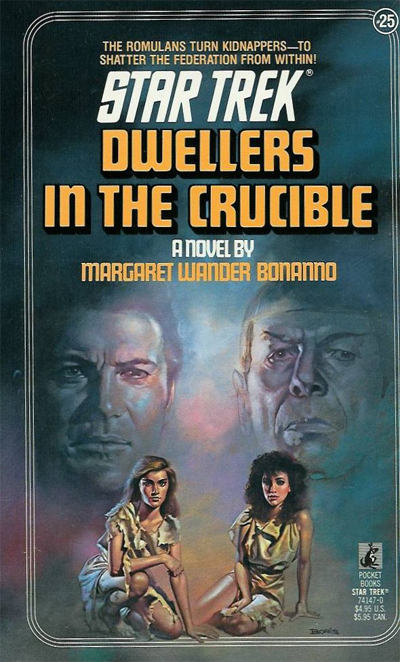
Dwellers in the Crucible captures a lot of the spirit of this era quite well. It’s Margaret Wander Bonanno’s first Star Trek tie-in book, but it’s also her strangest. It’s a rather high-concept piece of trashy “women in prison” fiction that dares to ask a question that nobody in their right mind had ever broached before: what if Kirk and Spock were lesbians?

st-dwellersinthecrucible

Continue reading