• Following Us

  • Categories

  • Check out the Archives


  • Awards & Nominations

Star Trek – Crucible: Spock – The Fire and the Rose by David R. George III (Review)

This August, to celebrate the upcoming release of Star Trek: Into Darkness on DVD and blu ray, we’re taking a look at the Star Trek movies featuring the original cast. Movie reviews are every Tuesday and Thursday.

We’ll be supplementing our coverage of the movies with tie-ins around (and related to) the films. We’ll be doing one of these every week day. This is one such article.

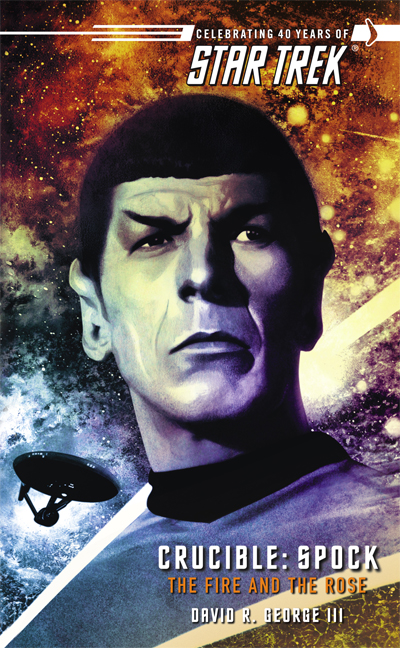
The second part of David R. George II’s epic Crucible trilogy, The Fire and the Rose, can’t quite measure up to the charm and warmth of the first instalment in the series, Provenance of Shadows. George’s Crucible trilogy is a breathtakingly ambitious piece of work. Celebrating the fortieth anniversary of Star Trek with a trilogy of novels, each grounded in The City on the Edge of Forever and each based around a different member of the show’s leading trinity. The Fire and the Rose is still a very smart and well-constructed read, but it stands in the shadow of the first of George’s three books.

I suspect that at least part of the reason The Fire and the Rose doesn’t work as well is down to the subject. Leonard McCoy is a vitally important Star Trek character, but he was also a relatively under-developed one. While he was one of the leading trio on the original show, he was never as popular as Kirk and Spock, and never garnered the same amount of attention. (Notwithstanding solid work done by writers like Diane a Duane.) So McCoy was a relatively blank canvas for George to develop.

In contrast, Spock is the face of Star Trek. He was part of the first episode of Star Trek ever produced. He appeared in the most recent film released. Although DeForest Kelley christened Star Trek: The Next Generation with a cameo in Encounter at Farpoint, Leonard Nimoy’s visit to the spin-off earned a full two-parter in Unification. As such, Spock is a character who has been developed and explored and expanded by countless writers over the franchise’s long history.

Quite frankly, it’s hard to imagine there’s too much left to say about him. George tries quite hard, and find a nuance or two, but The Fire and the Rose feels more like an attempt to consolidate what we already know of Spock.
cruciblespock

Continue reading

Non-Review Review: Star Trek – The Motion Picture

This August, to celebrate the upcoming release of Star Trek: Into Darkness on DVD and blu ray, we’re taking a look at the Star Trek movies featuring the original cast. Movie reviews are every Tuesday and Thursday.

Star Trek: The Motion Picture has a lot to recommend it. It’s big, thoughtful science-fiction, ripe with ideas and high-concepts tying directly into the root of the franchise. It gives both Kirk and Spock clear character arcs. It looks and sounds amazing, demonstrating just how far special effects had evolved in the decade since the show went off the air. However, it suffers from a pace that might best be described as “glacial”, and a sense that – for all the grand ideas – we aren’t really boldly going anywhere that new. Elements of the film can’t help but recall both the 1968 science-fiction classic 2001: A Space Odyssey and even the show’s own episode The Changeling.

While it’s easy to admire The Motion Picture, it’s a lot harder to enjoy it.

Strange new worlds...

Strange new worlds…

Continue reading

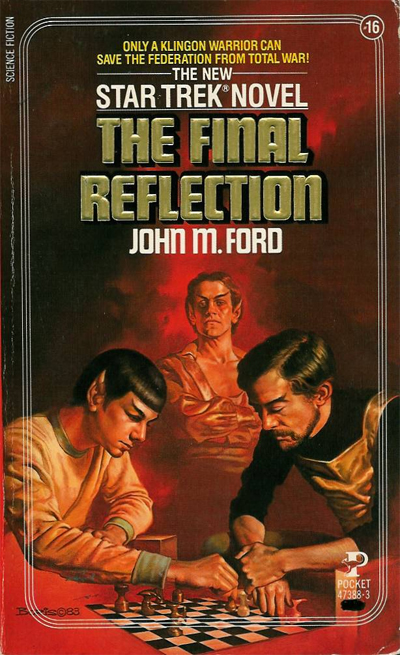
Star Trek – The Final Reflection by John M. Ford (Review)

To celebrate the release of Star Trek: Into Darkness this month, we’ll be running through the first season of the classic Star Trek all this month. Check back daily to get ready to boldly go. It’s only logical.

We’ll be supplementing our coverage of the episodes with some additional materials – mainly novels and comics and films. This is one such entry.

The Final Reflection was written in 1984. Development on Star Trek: The Next Generation would only be announced in 1986. Sure, there were a bunch of successful movies being produced, but these only amounted to a couple of hours of Star Trek once every few years. And, even then, the movies were aimed at a much broader audience, without the same development and continuity that a television show could offer. Not that Star Trek ever really had that tight a sense of continuity, of course, but it must have seemed unlikely that things could ever go back to the way they had been. Certainly, in 1984, nobody could have anticipated the eighteen-straight years of Star Trek running from Encounter at Farpoint to These Are the Voyages.

As a result, fans had to look to other avenues to expand and develop the rich Star Trek universe. The novels were one such avenue, although they developed slowly. Mission to Horatius had been published while the show was on the air, but it was very clearly aimed at a younger audience. Spock Must Die! would be published in 1970. However, the spin-off fiction developed relatively slowly. Star Trek had yet to become a massive franchise with tie-in multimedia commercial opportunities.

Perhaps because the Star Trek novels had not quite turned into a massive franchising opportunity, and they weren’t under the same level of publicity or scrutiny that they would be in the years to come, writer John M. Ford was able to do something quietly revolutionary with his first Star Trek novel, The Final Reflection. He was able to venture away from our core cast of iconic characters and instead develop the Klingon Empire.

More than that, though, he was able to paint the Klingons as the good guys.

tos-thefinalreflection5

Continue reading

Star Trek – Arena (Review)

To celebrate the release of Star Trek: Into Darkness this month, we’ll be running through the first season of the classic Star Trek all this month. Check back daily to get ready to boldly go. It’s only logical.

Arena is a fascinating piece of Star Trek, because it’s such an iconic and important piece of franchise history, despite the fact that it’s far from the best that the show has to offer. Indeed, the basic premise of the show is rather generic science-fiction B-movie stuff. Kirk is forced to compete against a lizard-like alien by some god-like beings to ensure the survival of his crew. The script, by producer Gene L. Coon, is credited to a story written by Fredric Brown. Despite its similarities to Brown’s short story of the same name, Arena also shares quite a few plot points with a 1964 episode of The Outer Limits, Fun & Games. None of this is to suggest that Coon was consciously channelling these sources when he wrote the teleplay, just to illustrate how generic the basic plot is.

However, despite (or perhaps because of) this rather straightforward and familiar set-up, Arena is a truly memorable episode of Star Trek. Like quite a few other episodes of the original Star Trek, the episode produced images and concepts that have resonated well outside Star Trek fandom, to the point where elements like the Gorn or Kirk’s highly dubious improvised weapon will be recognisable to people who have never actually seen the episode. However, the episode is also vitally important to the Star Trek franchise itself, as it offers a more thorough expansion and exploration of the back story that has been inconsistently hinted at throughout this first season. Arena is really the first episode to feature a fully-formed framework for the internal logic of the Star Trek universe, one that has informed half-a-century of the franchise.

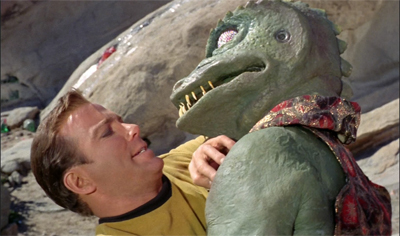
Plus, you know, Kirk wrestles a lizard man.

Don't pretend you aren't loving every minute of this, Shatner!

Don’t pretend you aren’t loving every minute of this, Shatner!

Continue reading

Star Trek 103: The Best of Deep Space Nine

To celebrate the release of Star Trek: Into Darkness, we’re holding a month full of Star Trek related fun. We’re reviewing every episode of the show’s first season, from The Cage through to Operation — Annihilate!, one-per-day for all of May. We’re also looking at some of the various spin-offs, tie-ins and pop culture intersections, so there’s always something going on to do with Star Trek. Anyway, with the release of the new film, we thought it might be interesting to make some recommendations for fans of the new films who wanted to “dip their toes in the water” so to speak. Today, we’re making recommendations from the second of the 24th century spin-offs, and the first to broadcast concurrently with another Star Trek project, Star Trek: Deep Space Nine.

ds9-emissary2

Continue reading

Star Trek 102: The Best of The Next Generation

To celebrate the release of Star Trek: Into Darkness, we’re holding a month full of Star Trek  related fun. We’re reviewing every episode of the show’s first season, from The Cage through to Operation — Annihilate!, one-per-day for all of May. We’re also looking at some of the various spin-offs, tie-ins and pop culture intersections, so there’s always something going on to do with Star Trek. Anyway, with the release of the new film, we thought it might be interesting to make some recommendations for fans of the new films who wanted to “dip their toes in the water” so to speak. Today, we’re making recommendations from the first of the 24th century spin-offs, Star Trek: The Next Generation.

tng-encounteratfarpoint1

Continue reading

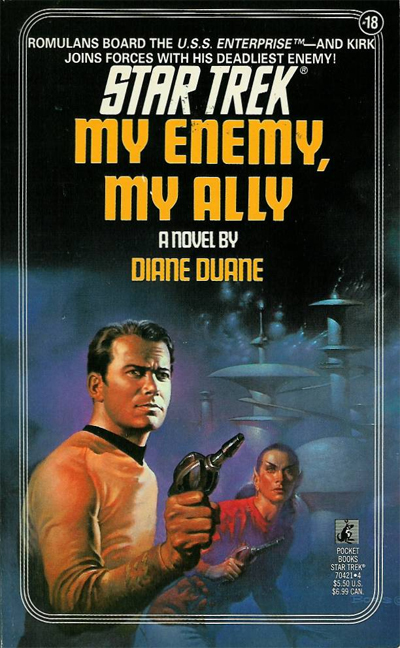
Star Trek – My Enemy, My Ally by Diane Duane (Review)

To celebrate the release of Star Trek: Into Darkness this month, we’ll be running through the first season of the classic Star Trek all this month. Check back daily to get ready to boldly go. It’s only logical.

We’ll be supplementing our coverage of the episodes with some additional materials – mainly novels and comics and films. This is one such entry.

1984 was a hell of a year of Star Trek tie-in novels. John M. Ford’s The Final Reflection was published in May 1984. It was followed by a tie-in adaptation of Star Trek III: The Search for Spock, but the very next original novel would by My Enemy, My Ally by Diane Duane. Both novels feel like kindred spirits, really pushing the boundaries of what you could do with Star Trek tie-in novels.

In particular, both works devoted considerable time to developing some of the iconic and memorable aliens of Star Trek. Ford’s The Final Reflection extrapolated an entire Klingon culture, while Duane’s My Enemy, My Ally dared to imagine a complex Romulan Empire, so distinct and well-defined that it isn’t even known as Romulan (apparently the term outsiders use for the species), but Rihannsu.

myenemymyally

Continue reading

Star Trek – Charlie X (Review)

To celebrate the release of Star Trek: Into Darkness this month, we’ll be running through the first season of the classic Star Trek all this month. Check back daily to get ready to boldly go. It’s only logical.

It really is incredibly difficult to divorce Star Trek from the sixties. I know that this has become something of a (very obvious) theme in these daily reviews, but Charlie X is the kind of Star Trek episode that could only have been produced for television in the sixties. It isn’t necessarily the presence of a single factor, it’s more the package as a whole. While the general concept (“The Day Charlie Became God”, to quote Roddenberry’s succinct synopsis from his 1964 Star Trek Is… pitch) could easily be adapted for any of the spin-offs (and Hide & Q clearly plays on the same idea), the execution is so firmly anchored in the sixties that it’s very hard to separate and parse.

Part of it is the weird use of coloured lighting on the mostly grey Enterprise sets, something that Inside Star Trek suggests was down to the fact that NBC was owned at the time by RCA, a major manufacturer of colour television sets. Part of it is the somewhat confused sexuality that is a weird mix of liberated and outdated. Part of it is the fact that the show features an impromptu musical and dance number. The idea of Charlie X might be fairly simplistic, but the execution is very clearly and very distinctively Star Trek.

Screaming to the Evans...

Screaming to the Evans…

Continue reading

Star Trek – The Naked Time (Review)

To celebrate the release of Star Trek: Into Darkness this month, we’ll be running through the first season of the classic Star Trek all this month. Check back daily to get ready to boldly go. It’s only logical.

Star Trek is, by its nature, an inherently optimistic television show. I seem to keep mentioning that in these reviews, as the first season of the show subverts and plays with the notion of an idealised future. However, despite the suggestion that evil is necessary in The Enemy Within or the death of the last of a species in The Man Trap or the suggestion that man’s next evolutionary phase would be truly horrifying in Where No Man Has Gone Before, Star Trek is still a hopeful vision of a possible future. It’s a story about a world where mankind hasn’t wiped each other out and where we can go (relatively) peacefully among the stars. It’s a world without racism or classism. There is sexism in Star Trek, but I’ll give the producers the benefit of the doubt and assume it’s not intentional.

So The Naked Time feels a little weird, being – as it is – a story about the collapse of civilisation at the end of a world. Not our world, mind you, but there’s a very clear sense of social collapse mirrored in the literal collapse of planet Psi-2000.

How logical...

How logical…

Continue reading

Star Trek – Mudd’s Women (Review)

To celebrate the release of Star Trek: Into Darkness this month, we’ll be running through the first season of the classic Star Trek all this month. Check back daily to get ready to boldly go. It’s only logical.

I think it’s fair to say that Star Trek had some gender issues. I say that as a fan of the show, and as a person with an immense fondness for the ensemble. It’s tempting to write off those sexist moments and decisions as attitudes that were socially acceptable at the time. After all, the sixties are almost half a lifetime away at this point. However, that doesn’t account for the fact that many of the same gender issues plagued Star Trek: The Next Generation in the late eighties, which lost two of its three female leads in its first season, and opened its second year by subjecting the remaining female lead to The Child.

Even disregarding that, though, there comes a point where even the time when a work was produced can’t excuse certain attitudes or approaches. Star Trek doesn’t feature too many strong female characters, relegating recurring female characters like Uhura and Janice Rand to the background. This is dodgy enough, but the show’s problems with gender become a lot more obvious when a show throws sexuality into focus. Mudd’s Women is such a show. It famously introduced one of the few recurring non-crewmember characters, and it plays into the “Star Trek as space western” theme, but it is also very sexist. Very, very sexist.

Mudd-ying the waters...

Mudd-ying the waters…

Continue reading