• Following Us

  • Categories

  • Check out the Archives


  • Awards & Nominations

Non-Review Review: Star Trek VI – The Undiscovered Country

This August, to celebrate the upcoming release of Star Trek: Into Darkness on DVD and blu ray, we’re taking a look at the Star Trek movies featuring the original cast. Movie reviews are every Tuesday and Thursday.

Whatever its faults, Star Trek VI: The Undiscovered Country is a fond farewell to the original cast of Star Trek, giving the ensemble one last epic adventure before heading off into legend. Chancellor Gorkon suggests that the “the undiscovered country” that lends the movie its title is “the future.” Most Shakespearean scholars would argue that it is “death.” Perhaps they need to – as Gorkon argues – “experience” it in “the original Klingon”, or perhaps there’s more to it than that.

Perhaps the undiscovered country can be both – the death waiting for all of us eventually, the “chimes at midnight” that Chang alludes to after a disastrous diplomatic dinner. Probably not. Still, The Undiscovered Country does represent a death. It’s the end of an era, the extinguishing of a torch that had already been passed. It’s the last adventure of Kirk’s starship Enterprise, and it feels appropriate that it serves to end the Cold War raging between the Klingons and the Federation.

It’s a beautiful farewell to the crew, to the extent that even the actors’ decision to “sign” the closing credits doesn’t feel over saccharine or manipulative. The movie has more than its fair share of narrative flaws, neither as tight as Star Trek II: The Wrath of Khan nor as energetic as Star Trek IV: The Voyage Home. However, it hangs together remarkably well, in no small part thanks to a solid premise, a strange honesty and a deep affection for the cast and crew.

We're having some old friends for dinner...

We’re having some old friends for dinner…

Continue reading

Non-Review Review: Star Trek IV – The Voyage Home

This August, to celebrate the upcoming release of Star Trek: Into Darkness on DVD and blu ray, we’re taking a look at the Star Trek movies featuring the original cast. Movie reviews are every Tuesday and Thursday.

Up until the release of JJ Abrams’ Star Trek in 2009, Star Trek IV: The Voyage Home was the most successful of the Star Trek films. Indeed, it ranks alongside Star Trek II: The Wrath of Khan as the film which has most deeply dug itself into the popular consciousness. “I’m from Iowa; I only work in outer space” might not be as iconic a quote as “KHAAAAAAN!!!”, but a lot of people casually remember “the one with the whales.”

The fourth film in the series closes off an inter-connected trilogy of Star Trek films, wrapping up character development for the leads and tying up loose ends, but it’s also – somewhat paradoxically – the most accessible of the movies. If you’re looking for an introduction to Star Trek, it’s hard to think of a more welcoming entry than The Voyage Home. However, what’s really strangely charming about The Voyage Home is that it’s also probably the film truest to the franchise’s humanist values.

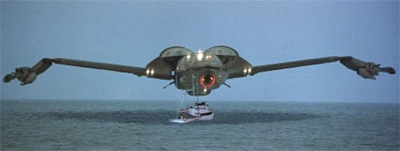
Ship off the starboard bow!

Ship off the starboard bow!

Continue reading

Star Trek (DC Comics, 1984) #28 – The Last Word (Review)

This August, to celebrate the upcoming release of Star Trek: Into Darkness on DVD and blu ray, we’re taking a look at the Star Trek movies featuring the original cast. Movie reviews are every Tuesday and Thursday.

We’ll be supplementing our coverage of the movies with tie-ins around (and related to) the films. We’ll be doing one of these every week day. This is one such article.

Star Trek II: The Wrath of Khan, Star Trek III: The Search for Spock and Star Trek IV: The Voyage Home form a trilogy that tells a single story, covering Spock’s death and resurrection, the loss of the Enterprise and the construction of its replacement and Kirk’s journey from washed-up old commander to saviour of the planet Earth. Although the three films weren’t planned as a single story, they worked out surprisingly well as a Star Trek epic told across three films and four years.

Four years is a remarkable turn-around for three franchise films, let alone three well-received franchise films. However, it’s worth conceding that the storyline had a fairly significant impact on the tie-in media. Books could be published set in the existing gaps in chronology, but DC’s plan for their first volume of Star Trek comics was to feature stories set in the contemporary film universe. Since that universe was in the middle of its own story, and the comic publishers had no idea how it would play out, the results are interesting.

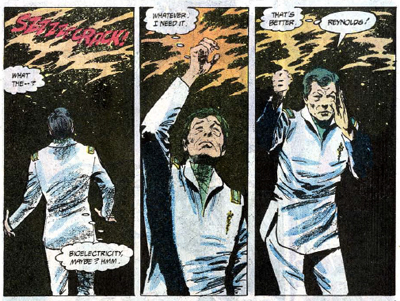
Lighten up...

Lighten up…

Continue reading

Star Trek: Myriad Universes – Echoes and Refractions: The Chimes at Midnight by Geoff Trowbridge (Review)

This August, to celebrate the upcoming release of Star Trek: Into Darkness on DVD and blu ray, we’re taking a look at the Star Trek movies featuring the original cast. Movie reviews are every Tuesday and Thursday.

We’ll be supplementing our coverage of the movies with tie-ins around (and related to) the films. We’ll be doing one of these every week day. This is one such article.

The death of Spock at the climax of Star Trek II: The Wrath of Khan is one of the definitive Star Trek moments. Pop culture has assimilated the moment, to the point where any half-decent nerd will identify “the needs of the many…” or “I have been and always shall be…” or maybe even “of all the souls I encountered…” It’s an absolutely massive moment for the franchise, where the film series dared to kill off the show’s most iconic and best-loved character.

It’s no wonder that the moment is such a strong focal point for those seeking to explore Star Trek. Star Trek: Into Darkness riffs mercilessly on that iconic scene, inverting it and counting on the iconography to generate enough emotional resonance for the film to get away with a fairly half-hearted homage. (The effects of The Wrath of Khan last until Star Trek III: The Search for Spock, while the consequences of the climax of Into Darkness don’t even last until the closing credits.)

So that famous sequence serves as an effective focal point of Geoff Trowbridge’s The Chimes at Midnight, which offers a parallel continuity of the Star Trek films in a universe where Spock died after the events of Yesteryear.

st-myriaduniverses

Continue reading

Non-Review Review: Star Trek III – The Search for Spock

This August, to celebrate the upcoming release of Star Trek: Into Darkness on DVD and blu ray, we’re taking a look at the Star Trek movies featuring the original cast. Movie reviews are every Tuesday and Thursday.

I have a soft spot for Star Trek III: The Search for Spock. It’s a weird thing to admit, but it was really my first encounter with the crew of the original Star Trek television show. I was only eight or nine at the time, and I’d grown up watching and loving Star Trek: The Next Generation. Of course, this was in an era before DVD and blu ray made it feasible (and affordable) to collect the whole thing. So I branched out by trying the movies.

Being a young child in the era before the internet, I didn’t know that the second through fourth films formed a loose thematic trilogy. I just picked the film with the title that jumped out at me. Since “Spock” was an iconic part of Star Trek, and I knew him from his guest appearance on The Next Generation, The Search for Spock seemed the logical choice.

And it retains a special place in my heart.

"I have been, and always shall be, your friend..."

“I have been, and always shall be, your friend…”

Continue reading

Non-Review Review: Star Trek – The Motion Picture

This August, to celebrate the upcoming release of Star Trek: Into Darkness on DVD and blu ray, we’re taking a look at the Star Trek movies featuring the original cast. Movie reviews are every Tuesday and Thursday.

Star Trek: The Motion Picture has a lot to recommend it. It’s big, thoughtful science-fiction, ripe with ideas and high-concepts tying directly into the root of the franchise. It gives both Kirk and Spock clear character arcs. It looks and sounds amazing, demonstrating just how far special effects had evolved in the decade since the show went off the air. However, it suffers from a pace that might best be described as “glacial”, and a sense that – for all the grand ideas – we aren’t really boldly going anywhere that new. Elements of the film can’t help but recall both the 1968 science-fiction classic 2001: A Space Odyssey and even the show’s own episode The Changeling.

While it’s easy to admire The Motion Picture, it’s a lot harder to enjoy it.

Strange new worlds...

Strange new worlds…

Continue reading

Non-Review Review: Star Trek – Into Darkness

Note: This is a spoiler-heavy review. If you want a spoiler-lite recommendation, click here. If not, continue at your own risk.

Towards the climax of Star Trek: Into Darkness, Kirk and the Enterprise flee an aggressor by entering warp. At that speed, several factors the speed of light itself, they surmise that they must be safe from their pursuer. Of course, they prove to be wrong – brutally so. Everything in Into Darkness moves fast, so fast that the Enterprise’s top speed seems more like a casual jog than a breakneck acceleration. The plot rockets along with incredible speed, from plot point to plot point, counting on the momentum to sustain the film and carry it across the line.

There is enough material here to produce a trilogy of films. Indeed, cynics might suggest that a lot of the movie’s iconography and plot points are indeed recycled from the central “trilogy” of the original Star Trek films, running from the homages to Star Trek II: The Wrath of Khan right down a climactic visual reference to Star Trek IV: The Voyage Home. Abrams and his team of writer continue their work from 2009’s breakout blockbuster Star Trek by putting the franchise’s most compelling images and cues into a high-speed blender.

Into Darkness just substantially increases the concentration.

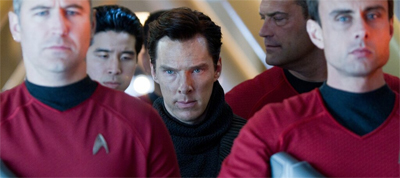
Seeing red...

Seeing red…

Continue reading

Non-Review Review: Star Trek – Into Darkness

Note: This is a spoiler-lite review. If you want a spoiler-heavy in-depth look at the film, click here.

Towards the climax of Star Trek: Into Darkness, Kirk and the Enterprise flee an aggressor by entering warp. At that speed, several factors the speed of light itself, they surmise that they must be safe from their pursuer. Of course, they prove to be wrong – brutally so. Everything in Into Darkness moves fast, so fast that the Enterprise’s top speed seems more like a casual jog than a breakneck acceleration. The plot rockets along with incredible speed, from plot point to plot point, counting on the momentum to sustain the film and carry it across the line.

There is enough material here to produce a trilogy of films. Indeed, cynics might suggest that a lot of the movie’s iconography and plot points are indeed recycled from the central “trilogy” of the original Star Trek films, running from the homages to Star Trek II: The Wrath of Khan right down a climactic visual reference to Star Trek IV: The Voyage Home. Abrams and his team of writer continue their work from 2009’s breakout blockbuster Star Trek by putting the franchise’s most compelling images and cues into a high-speed blender.

Into Darkness just substantially increases the concentration.

Seeing red...

Seeing red…

Continue reading