• Following Us

  • Categories

  • Check out the Archives


  • Awards & Nominations

Star Trek: Deep Space Nine – Move Along Home (Review)

Star Trek: Deep Space Nine is twenty years old this year. To celebrate, I’m taking a look at the first season. Check back daily for the latest review or retrospective.

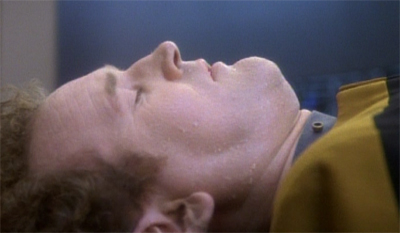
And here we hit what is commonly agreed to be the nadir of Star Trek: Deep Space Nine‘s rocky first season. Even the production staff seemed to acknowledge the problems with Move Along Home. Director David Carson conceded that it was “disappointing”, while future writer Ronald D. Moore could help  “wondering if everyone had lost their minds.” And there’s no way of getting around it. Move Along Home is a stinker in virtually every way that counts. It’s messy, contrived, confused, but without the wit to pull off the surreality of the set-up. There are no stakes, and the only way the episode can generate suspense is by lying to the audience.

And yet, despite that, I am actually much fonder of Move Along Home than I am of The Passenger. Don’t get me wrong, I don’t like either very much, but I’m more forgiving of the problems with Move Along Home, which stem from the episode’s ambition. There’s a sense that at least the episode was trying to do something a bit novel, even it backfired spectacularly. If I have to choose between flawed ambition and bland mediocrity, I’ll choose flawed ambition every time. Move Along Home might be a pretty dodgy episode, but at least its less generic than The Passenger.

A piece of the action...

A piece of the action…

Continue reading

Star Trek: Deep Space Nine – The Passenger (Review)

Star Trek: Deep Space Nine is twenty years old this year. To celebrate, I’m taking a look at the first season. Check back daily for the latest review or retrospective.

And here we hit what amounts to the rock bottom of Star Trek: Deep Space Nine‘s first season. The Passenger and Move Along Home exist as the two weakest stories in this first season, and the point from which Deep Space Nine begins to map a path towards recovery, climaxing in the best final two episodes of any first season in the history of Star Trek. We’re a long way from that, and we seem furthest from it here.

While Move Along Home is a legitimately bad episode, one with flaws that probably should have been spotted in any of the episode’s troubled development history, The Passenger suffers because it is the most bland and generic of the first season Deep Space Nine episodes. It accomplishes nothing, but it feels worse because its ambitions were so low. It’s the kind of story that could easily have been told on any Star Trek show, or any science-fiction series, but with no sense of local colour to give it distinctive flavour.

The Passenger is just as bland as the title makes it sound.

The not-so-good Doctor...

The not-so-good Doctor…

Continue reading

Star Trek: Deep Space Nine – Dax (Review)

Star Trek: Deep Space Nine is twenty years old this year. To celebrate, I’m taking a look at the first season. Check back daily for the latest review or retrospective.

Dax is a very weird episode. It is the first episode centred around Jadzia Dax, but it also demonstrates the problems that will affect Dax-centric episodes throughout Terry Farrell’s time on the show. Due to the nature of the character, the stories about Dax tend to treat her as a plot point or a macguffin rather than a character in and of herself. Here, for example, Dax finds herself on trial for the actions of her direct predecessor, Curzon Dax. It’s a fascinating moral and philosophical dilemma (can you hold somebody accountable for their actions in a past life?), but it’s a story about Dax that isn’t about the character as she currently exists. It’s fascinating and frustrating in equal measure, but at least it’s a sign that Star Trek: Deep Space Nine is content to do more than merely imitate Star Trek: The Next Generation.

Touching...

Touching…

Continue reading

Star Trek: Deep Space Nine – Q-Less (Review)

Star Trek: Deep Space Nine is twenty years old this year. To celebrate, I’m taking a look at the first season. Check back daily for the latest review or retrospective.

And the first season of Deep Space Nine continues its trend towards mediocrity. I feel I should qualify that. The first season of Deep Space Nine is never truly terrible. Even the (very) dodgy Move Along Home is superior to any number of episodes from the first season of Star Trek: The Next Generation, like Code of Honour or Angel One. The first season of Deep Space Nine just winds up feeling like it’s treading water, as if it is trying too hard to emulate The Next Generation, instead of exploring the unique storytelling opportunities offered by the show’s setting.

Q-Less is arguably the most obvious example of these attempts at imitation. While episodes like Babel and The Passenger could have been reworked as episodes of The Next Generation with a minimum of fuss, Q-Less rather cynically takes two recurring guest stars from The Next Generation and allows them to steal focus from an ensemble that is still finding its feet. It feels not only a little ill-judged, but also a bit rude.

Guess Q...

Guess Q…

Continue reading

Star Trek: Deep Space Nine – Captive Pursuit (Review)

Star Trek: Deep Space Nine is twenty years old this year. To celebrate, I’m taking a look at the first season. Check back daily for the latest review or retrospective.

Much like Babel, it’s not too difficult to reimagine Captive Pursuit as an episode of Star Trek: The Next Generation. It’s notable for being one of the few episodes of Deep Space Nine to really feature the famous “Prime Directive”, something of a staple of the original Star Trek, The Next Generation and even Voyager. Like a lot of episodes from the middle of Deep Space Nine‘s first season, this seems almost like an attempt to port on episode concept directly over from The Next Generation. In particular, the notion of the crew dealing with a fugitive while wrestling with the Prime Directive feels like a retread of The Hunted.

That said, Captive Pursuit does work quite well, taking a familiar concept and putting a twist on it unique to the show. Despite the fact the episode’s premise feels like it has been carried over, the execution is careful enough to distinguish Deep Space Nine from its older sibling.

The hunted...

The hunted…

Continue reading

Star Trek: Deep Space Nine – Babel (Review)

Star Trek: Deep Space Nine is twenty years old this year. To celebrate, I’m taking a look at the first season. Check back daily for the latest review or retrospective.

With Babel, we hit the most significant flaw in the first season of Star Trek: Deep Space Nine. Put frankly, Babel is the first story that could easily have worked as an episode of the original Star Trek or of Star Trek: The Next Generation. Indeed, Michael Piller concedes in Captains’ Logs Supplemental – The Unauthorized Guide to the New Trek Voyages that Babel had a history longer than that of Deep Space Nine itself:

We had this premise for over five years at Next Generation. It was written by the same person who wrote “Hollow Pursuits” for us, and we had always been attracted to the idea that you could suddenly lose the ability to use language and communicate, and how people are able to communicate with each other.

This isn’t necessarily a bad thing, but it’s worth noting that the first season of Deep Space Nine was airing concurrently with the sixth season of The Next Generation. If people wanted to see stories that could work on The Next Generation, it made more sense to see them executed on that show by a production team with experience in these sorts of plots.

While Babel isn’t a bad episode by any means, there’s a sense that it has been cobbled together from leftovers at another table, and the result isn’t nearly as satisfying as it should be.

Chief concerns...

Chief concerns…

Continue reading

Star Trek: Deep Space Nine – A Man Alone (Review)

Star Trek: Deep Space Nine is twenty years old this year. To celebrate, I’m taking a look at the first season. Check back daily for the latest review or retrospective.

To be fair to Star Trek: Deep Space Nine, it’s clear that the show’s heart is in the right place. After all, a Star Trek television show isn’t quite the gambit that it was in 1987. The producers expect that the series will be going for quite some time. After all, the regulars signed six-year contracts, one of the reasons that the show managed to make it to its penultimate season without losing a primary cast member.

As such, a lot of the early episodes of Deep Space Nine seem prudent – they effectively amount to good housekeeping. While Star Trek: The Next Generation got its cast together and couldn’t wait to start telling bold Star Trek stories, you can see that Deep Space Nine is laying a lot of groundwork. The ensemble doesn’t gel instantly. Episodes are devoted to little more than set-up for something that will pay off over the coming year. A vast supporting cast is systematically established.

This is world-building, and it’s world-building to a purpose, even if Deep Space Nine doesn’t seem to really know what that purpose is yet. So it’s quite hard to fault these early episodes, even if they feel more like set-up for delayed pay-off.

The writing's on the wall for Odo...

The writing’s on the wall for Odo…

Continue reading

Star Trek: Deep Space Nine – Prophecy & Change: Ha’Mara by Kevin G. Summers (Review)

Star Trek: Deep Space Nine is twenty years old this year. To celebrate, I’m taking a look at the first season. Check back daily for the latest review or retrospective.

We’ll be supplementing our coverage of the episodes with some additional materials – mainly novels and comics and films. This is one such entry.

Comparing and contrasting the anniversary short story anthologies for Star Trek: The Next Generation and Star Trek: Deep Space Nine can be highly informative. The Sky’s the Limit, released to celebrate the twentieth anniversary of The Next Generation, features fourteen stories. Most of these stories serve as prologues or epilogues to existing Next Generation episodes. Suicide Note provides closure to The Defector; Turncoats follows a character from Face of the Enemy after the camera stops rolling; Four Lights is an epilogue to Chain of Command.

In contrast, Prophecy and Change, released to celebrate the tenth anniversary of Deep Space Nine, tends to focus on short stories that fit gracefully between episodes – fleshing out connective tissue and explaining how one plot development or character decision led to another. That says quite a lot about the two shows and the way that their stories were told, with much of Prophecy and Change feeling ling deleted scenes or inserts loosely inserted between what was seen in television.

Ha’Mara is the first short story of the collection, following the introduction and the mysterious Revisited – a book-ending wrap-around written by an author who has yet to be publicly identified. Written by Kevin G. Summers, who provided Isolation Ward 4 to Strange New Worlds IV, the short story is set in the immediate aftermath of Emissary, attempting to smooth over the rough edges transitioning from the pilot to the rest of the show.

ds9-prophecyandchange

Continue reading

Star Trek: Deep Space Nine – Past Prologue (Review)

Star Trek: Deep Space Nine is twenty years old this year. To celebrate, I’m taking a look at the first season. Check back daily for the latest review or retrospective.

Past Prologue is a pretty decent second episode of Star Trek: Deep Space Nine. It does what it needs to do, serving primarily to build the world of Deep Space Nine just a little bit. After all, a story like this was inevitable with a character like Kira in the main cast, so it’s probably for the best that the show deals with it so early. It’s not a classic episode by any means, feeling as if the show was obligated to tell this particular story. Then again, I suppose that’s what the first season of any television show is for. Set up and development.

Past Prologue continues to hint at the strengths of Deep Space Nine, investing considerable effort in crafting a tangible setting for the series. However, there’s also a hint of the weaknesses of the first season to be found here. Like just about any of the Star Trek spin-offs, Deep Space Nine is going to spend its first year searching for its identity. While Past Prologue indicates the series is looking the right direction, it hasn’t quite found its footing.

Los cannon...

Los cannon…

Continue reading

Star Trek: Deep Space Nine – Emissary (Review)

Star Trek: Deep Space Nine is twenty years old this year. To celebrate, I’m taking a look at the first season. Check back daily for the latest review or retrospective.

Star Trek: Deep Space Nine is a phenomenal piece of television. It’s often a bit overlooked because of its unique setting. After all, the words Star Trek evoke space ships and new worlds – “new life forms and new civilisations.” As such, a Star Trek series about a space station feels counter-intuitive. “To boldly sit” is the hardly the most dynamic premise. And yet, despite that, there’s a very serious argument to be made that Deep Space Nine is the crowning accomplishment of television Star Trek. It’s certainly the last great attempt to boldly push the franchise forward, with Star Trek: Voyager and Star Trek: Enterprise feeling just a tad regressive and conservative in comparison.

Indeed, Deep Space Nine represents a massive narrative leap forward from the success of Star Trek: The Next Generation, which remains one of the greatest science-fiction shows ever produced. For better or worse, Emissary makes it quite clear that Deep Space Nine is not an attempt to copy its direct predecessor, even if some of the other episodes in the first season might back-pedal a bit. In fact, it’s surprising just how well the pilot for this strangest of Star Trek shows holds up, suggesting a firmer grasp of its own identity than a few of the subsequent episodes could claim.

A Commanding presence...

A Commanding presence…

Continue reading