• Following Us

  • Categories

  • Check out the Archives


  • Awards & Nominations

Star Trek: The Next Generation – Unnatural Selection (Review)

This January and February, we’ll be finishing up our look at the second season of Star Trek: The Next Generation and moving on to the third year of the show, both recently and lovingly remastered for high definition. Check back daily for the latest review.

It’s really strange that this is our first Pulaski-centred episode. It’s even stranger that it’s the shows only Pulaski-centred episode, given she’s a new character being inserted into an established ensemble. It’s even stranger-er that the episode doesn’t really seem to have much to say about Pulaski apart from the fact that she is the show’s new doctor – and she’s a bit of an idiot. Which is not necessarily what you want when you’re trying to endear a new character to the audience.

Then again, Unnatural Selection is a pretty good indicator of where Star Trek: The Next Generation is right now. The show hasn’t quite figured out that it’s a good idea to anchor character-centric stories in the character upon which that intended to centre. It’s one of the most successful aspects of Michael Piller’s approach, and part of what really revitalised the writing in the show’s third season. As it stands, Unnatural Selection seems to be a story about medical stuff, so it gets to focus on Pulaski. Who is really just sort of there.

I can see this getting old fast...

I can see this getting old fast…

Continue reading

Star Trek: The Next Generation – The Schizoid Man (Review)

This January and February, we’ll be finishing up our look at the second season of Star Trek: The Next Generation and moving on to the third year of the show, both recently and lovingly remastered for high definition. Check back daily for the latest review.

I should probably hate The Schizoid Man. It is certainly a very, very flawed piece of television. It would be a lot more forgivable had it aired during the first season of Star Trek: The Next Generation, when the show was still trying to find its feet – including it early in the second season feels like the show is pushing it a little. In many respects, The Schizoid Man embodies a lot of the (legitimate) complaints about the weaknesses of The Next Generation as a television show: the performances from the peripheral members of the main cast are a bit ropey, there’s an incredibly false sense of urgency generated by techno-babble and the dialogue is just terrible.

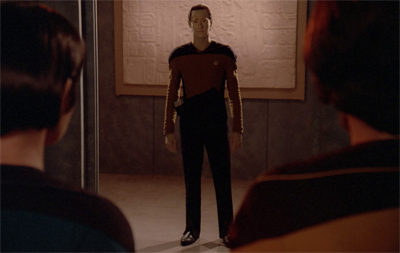
And yet, despite that, there’s quite a lot here to like. Stripping away the terrible dialogue and the unnecessary convolutions, The Schizoid Man is a very basic morality play, one touching on themes the show will handle a lot better a few episodes down the line. Brent Spiner is surprisingly creepy as Graves-as-Data, and W. Morgan Sheppard is pretty great in an admittedly thankless part as the misogynistic and creepy Ira Graves.

23rd century Schizoid Man...

23rd century Schizoid Man…

Continue reading

Agents of S.H.I.E.L.D – F.Z.Z.T. (Review)

F.Z.Z.T. is a reminder that Agents of S.H.I.E.L.D. is a genre show still in its first season. That might not sound like a good thing, and F.Z.Z.T. isn’t the strongest of the mediocre crop of episodes so far, but it does indicate that there is still potential. The Girl in the Flower Dress teased the possibility that Agents of S.H.I.E.L.D. might have settled into its own incredibly unambitious niche, and any evidence to the contrary should be welcomed.

F.Z.Z.T. is boring and generic, but at least it’s boring and generic in a way that is different from most of the boring and generic episodes so far. So that’s something.

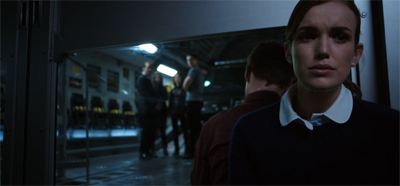
A Gemma of an idea...?

A Gemma of an idea…?

Continue reading

Star Trek: Deep Space Nine – Season 2 (Review)

Star Trek: Deep Space Nine is twenty years old this year. To celebrate, I’m taking a look at the first and second seasons. Check back daily for the latest review or retrospective.

Well, that’s more like it. The second season of Star Trek: Deep Space Nine might not rank with the very best of the franchise, but it doesn’t have to. Deep Space Nine is still a young show, and Star Trek spin-offs have a long history of taking their time to find their feet. The second season of Deep Space Nine contains its fair share of classic or memorable episodes, but it’s defined by a sense that the producers are still trying to figure out what works and what doesn’t.

While the first season occasionally felt like the series was stumbling back towards safety, trying to become a lighter version of Star Trek: The Next Generation as faith in its premise wavered, the second season is a lot more confident in itself. It’s willing to play around a bit to figure out how to be the show that it wants to be. And there’s a sense, as the season winds to a close, that we’re almost there.

By the time we hit the second half of the season, it seems the show has learned to churn out inoffensive episodes that feel unique and distinctively Deep Space Nine – episodes like Playing God or Shadowplay. However, it’s in the final third that the show seems to figure out how make truly great episodes of Deep Space Nine.

ds9-playinggod22

Continue reading

Star Trek: Deep Space Nine – The Jem’Hadar (Review)

Star Trek: Deep Space Nine is twenty years old this year. To celebrate, I’m taking a look at the first and second seasons. Check back daily for the latest review or retrospective.

In terms of sheer quality of execution, The Jem’Hadar is probably the weakest of Star Trek: Deep Space Nine‘s season finalés. It lacks the gut punch of A Call to Arms, the shock twist of Broken Link, the atmosphere of The Adversary or even the timeliness of In the Hands of the Prophets. It is, at its most basic level, a story about a disastrous first contact that occurs during a father-son bonding trip that goes horribly wrong, ending with precious little actually advanced.

However, in terms of conceptual ideas, The Jem’Hadar is a game-changer. It is the cornerstone upon which Deep Space Nine would construct its most iconic narrative arc. It caps off two years of trying to develop the Ferengi as more than one-note jokes. It’s a bold statement about the freedom that Deep Space Nine would enjoy with Star Trek: The Next Generation retiring from the airwaves. It cemented the notion that Deep Space Nine never really dealt in two-part episodes to bridge seasons.

For Deep Space Nine, season finalés did not exist simply as pieces of Lego designed to snugly fit those other pieces at the start of the following season, crafting some illusion of continuity flow between two different seasons of television. Instead, cliffhangers on Deep Space Nine changed the rules, shook up the status quo, and teased the changing face of things to come.

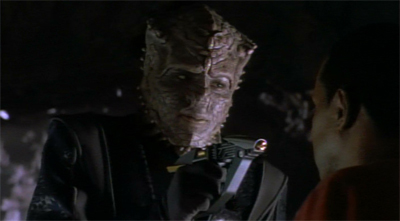
A Jem?

A Jem?

Continue reading

Star Trek: Deep Space Nine – Tribunal (Review)

Star Trek: Deep Space Nine is twenty years old this year. To celebrate, I’m taking a look at the first and second seasons. Check back daily for the latest review or retrospective.

Tribunal is probably the weakest episode of Star Trek: Deep Space Nine in quite some time, hampered by the fact that it never seems too ambitious and the fact that the episode ends because we’re three minutes away from the closing credits rather than because it feels like the story has been told. Tribunal is hardly the deepest or most sophisticated episode of the show’s second season, spending most of its time riffing on Kafka and Orwell, but it’s still solidly entertaining – a rare example of black comedy on Star Trek that works surprisingly well.

I suspect the biggest problem with Tribunal is where it’s placed. The second season of Deep Space Nine has been hitting it out of the park since around Blood Oath, giving us the strongest run of episodes we’d see until the start of the fourth season. Indeed, had the show found its groove a little bit earlier, the second season of Deep Space Nine could have been on par with the third season of Star Trek: The Next Generation as “that season the show found its groove.”

However, it remains an impressive run of episodes, a rallying of the show in the last third of the season, showing just what Deep Space Nine was capable of. Most of the episodes in that run felt very different from anything done on The Next Generation and most offered some major insight into how the world of Deep Space Nine works as distinct from the rest of the franchise.

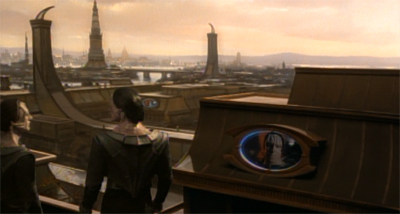
A broad cast of characters...

A broad cast of characters…

Continue reading

Star Trek: Deep Space Nine – The Collaborator (Review)

Star Trek: Deep Space Nine is twenty years old this year. To celebrate, I’m taking a look at the first and second seasons. Check back daily for the latest review or retrospective.

It’s surprising how long we’ve had since a solid Bajoran episode of Star Trek: Deep Space Nine. Barring the dark reflection of Bajor as a power-broker (and brief allusion to a colony in the Gamma Quadrant) in Crossover, the last episode to really explore the planet’s political and religious structure was probably Sanctuary, which aired more than half a season earlier. After a reasonably high concentration of Bajoran political adventures in the first season and the first half of the second, it seems that further explorations will be more broadly spaced.

Indeed, the first season ended (and the second season began) with a five-episode run that was heavily anchored in the show’s Bajoran surroundings. However, as of late, it feels we’ve been strangely disengaged from the show’s stated objective of welcoming Bajor to the Federation. With episodes like The Maquis, it seems like the show is making a conscious effort to disentangle Cardassian politics from those of Bajor.

In a way, this probably represents Deep Space Nine growing into the form that it will take for the rest of its run. The second season has really been about Deep Space Nine figuring out what it wants to be, and what it doesn’t want to be. With The Collaborator‘s focus on Bajoran politics feeling conspicuous by the lack of other Bajor-centric episodes in this half of the season, it seems like Deep Space Nine doesn’t want to be a show about Bajor.

Enough rope to hang himself...

Enough rope to hang himself…

Continue reading

Star Trek: The Next Generation – Dark Mirror by Diane Duane (Review)

Star Trek: Deep Space Nine is twenty years old this year. To celebrate, I’m taking a look at the first and second seasons. Check back daily for the latest review or retrospective.

We’ll be supplementing our coverage of the episodes with some additional materials – mainly novels and comics and films. This is one such entry.

Dark Mirror was released a few mere months before Crossover was broadcast – one of those moments of pop culture synergy where it turns out that two different individuals can have the same idea, but with infinitely different nuance or emphasis. Indeed, the timing syncs up so well that Crossover actually aired between the hardcover and soft cover printings of Dark Mirror, suggesting that a return to the mirror universe was something of an inevitability for Star Trek, in one form or another.

Duane’s approach to the mirror universe is markedly different to that of writers Michael Piller and Peter Allan Fields, with both Dark Mirror and Crossover taking the ending of Mirror, Mirror and running with it in opposite directions. Piller and Fields used the aftermath of Kirk’s meddling as a means to explore the consequences of interference in a culture that Kirk didn’t quite understand – a mechanism to explore the way that the original Star Trek didn’t seem to grasp moral relativity, and to explore political complexities outside Kirk’s value system.

In contrast, Dark Mirror is a more philosophical meditation on the nature of good and evil, a more metaphysical exploration of a fictional world built around the concept of selfishness and strength, and how such a universe would have to work on different physical laws than that of Star Trek: The Next Generation.

tng-darkmirror

Continue reading

Star Trek: Mirror, Mirror #1 – Fragile Glass (Review)

Star Trek: Deep Space Nine is twenty years old this year. To celebrate, I’m taking a look at the first and second season. Check back daily for the latest review or retrospective.

We’ll be supplementing our coverage of the episodes with some additional materials – mainly novels and comics and films. This is one such entry.

One of the benefits and the curses of tie-in material is the ability to connect the dots – to tie together two parts of continuity separated by time and space, filling in the blanks in some character or plot arc. Often, this feels extraneous at best. In order for the televised stories to work, there must be enough information conveyed effectively to the audience so they can make their own leaps. Trying to plug imaginary and unnecessary holes is seldom satisfying.

On the other hand, there are occasionally gaps that are worth exploring. These are gaps that have been explained on the show, but which are still large enough that creators can fit their own interesting stories between them. The divide between Mirror, Mirror and Crossover is one such gap, as we go from the original Star Trek‘s version of the mirror universe to the very different iteration seen on Star Trek: Deep Space Nine.

Tom DeFalco’s Fragile Glass attempts to sketch in some of the details around this gap. While it’s not entirely satisfying as either a missing link or a story in its own right, it does offer some nice pulpy fun and gets considerable mileage out of the “Spock vs. Kirk” premise.

I am not Spock...

I am not Spock…

Continue reading

Star Trek: Deep Space Nine – The Wire (Review)

Star Trek: Deep Space Nine is twenty years old this year. To celebrate, I’m taking a look at the first and second seasons. Check back daily for the latest review or retrospective.

The Wire might just be the best episode of the second season of Star Trek: Deep Space Nine. In fact, it ranks with Duet and In the Hands of the Prophets as one of the best episodes of the show so far. Written by Robert Hewitt Wolfe and showcasing the dramatic talents of both Siddig El Fadil and Andrew Robinson, The Wire is a powerhouse of dramatic writing – an intimate character study capable of provoking tensions and ambiguities on par with the season’s universe-altering installments.

Garak has only appeared a handful of times so far. Indeed, considering how important he would become to the series, it’s interesting how rare his early appearances are. However, The Wire is really the episode that pins Garak down and tells us everything that we could possibly need to know about Garak, without ever actually telling us everything we might want to know. It’s a careful distinction, and Wolfe’s script walks that line skilfully while Andrew Robinson’s performance is perfectly modulated.

Bashir's bedside manner...

Bashir’s bedside manner…

Continue reading